Improving Performance of Data Routing Protocol in Flying Ad-Hoc Networks
Shiyar Karbooz1 , Yaser Fawaz2 , Bader Al-Din Kassab31Postgraduate Student (M.S), Systems and Computer Networks Department, University of Aleppo, Syria
2 PhD, Systems and Computer Networks Department, University of Aleppo, Syria
3 PhD, Systems and Computer Networks Department, University of Aleppo, Syria
***
Abstract - Flying Ad-Hoc Networks (FANETs) have become very popular nowadays and have been widely used in various applications. However, due to the high mobility of Unmanned Aerial Vehicles (UAVs) and frequent topological changes, there are many challenges in FANETs such as routing path failure, packet loss, and frequent interruption of the link between UAVs. The unique characteristics of FANETs make designing routing protocols a difficult task. In this paper, we propose a routing protocol named Intelligence-OLSR (INT-OLSR) for FANETs. This protocol improves the routing performance of the Optimized Link State Routing protocol (OLSR) based on the Ant Colony Optimization algorithm (ACO) for efficient communication and obtain the most stable routes and the selfadaptation of the network in case of any topological changes. Our simulation was performed using NS2 simulator. The evaluation results show that the proposed protocol (INTOLSR) performs better than the OLSR protocol in terms of packet delivery ratio, average time delay and throughput.
KeyWords: FlyingAd-HocNetworks(FANETs),Optimized Link State Routing protocol (OLSR), Ant Colony Optimization Algorithm (ACO),Optimal Routing, UnmannedAerialVehicles(UAVs)
1.INTRODUCTION
Recently,FlyingAd-HocNetworks(FANETs)havebecome widespread as they have been used in a wide range of applications by organizing a group of Unmanned Aerial Vehicles (UAVs) to cooperate with each other in order to accomplishmanycomplextaskswithhighefficiency[4][1]. FANETisadistributedwirelessnetworkthatallowsUAVsto communicatewitheachotherwithoutafixedinfrastructure. Itisanextensionof MobileAd-HocNetworks(MANETs)and VehicleAd-HocNetworks(VANETs)[2].
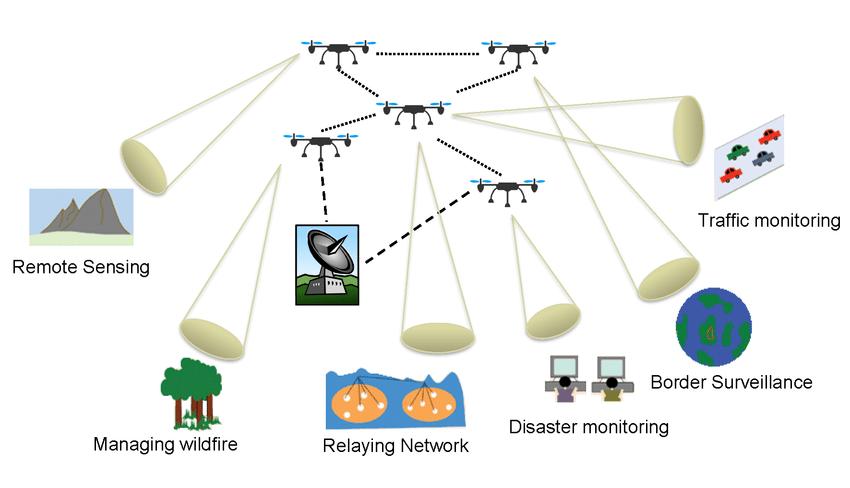
Duetotheirversatilityandflexibility,UAVshavebeenused in many military and civil applications, such as remote sensing operations, border control, fire management, disaster,andsearchoperations[3].However,therearealot of peculiarities in the behavior of UAVs, such as unpredictablemovement,highspeed,irregulardistribution across the network, and frequent changes in the network topology,thus,makesthedesignofFANETroutingprotocols averycomplextask[4].
2. FANET ROUTING PROTOCOLS

Thereareseveraltopology-basedroutingprotocolsthathave beendevelopedtosuittheuniquecharacteristicsofFANET networks.
These protocols are based on information about links between nodes which rely on IP addresses for packet exchangebetweenconnectednodes.Topology-basedrouting protocols in FANET can be classified into three main categories[4]:
2.1 Proactive Routing Protocols
These protocols are also known as table-driven routing protocols, because they pre-select routes before they are usedevenwhenthereisnodataflowoverthoseroutes,and maintain routing tables for the entire network by routing privateinformationinthenetworkfromnodetonode.The most widely used proactive routing protocols are as follows[5]:
OptimizedLinkStateRoutingProtocol(OLSR). DestinationSequenceDistanceVectorProtocol(DSDV).
2.2 Reactive Routing Protocols
Thisclassofprotocolcreatesroutesonlyondemandand does not maintain the entire network structure. Thus a
routingpathiscreatedwhenanynodewithinthenetwork wantstosenddatatoanothernode. The most widely used reactive routing protocols are as follows[5]:
DynamicSourceRoutingProtocol(DSR).
Ad-Hoc On-Demand Distance Vector Routing Protocol (AODV).
2.3 Hybrid Routing Protocols
Hybrid routing protocols have the advantages and characteristicsofreactiveandproactiveroutingprotocols. Themostcommonlyusedhybridroutingprotocolsis[5]: ZoneRoutingProtocol(ZRP).
3. OPTIMIZED LINK STATE ROUTING PROTOCOL
OptimizedLinkStateRoutingProtocolisaproactiverouting protocolforad-hocnetworksbecausethepathsarealways availablewhenanodewantstotransmitonit.Thisisbecause information about the network topology is regularly exchanged between nodes. Where each node within the network is responsible for sending control packets to all othernodes.Thismethodcangenerateanoverheadonthe networkduetothecontinuoustransmissionofpackets[6]. OLSRprotocolismainlybasedonMultiPointRelay(MPR) whichimprovescommunicationbetweennodesbyproviding the shortest path. MPR works by selecting a number of neighboringnodesthatwillthenretransmitcontrolpackets to all nodes within the network, reducing the amount of informationexchangedonthenetwork.OLSRprovidestwo main functions: neighbor discovery and topology propagation.Throughthem,eachnodecalculatesthepathsto alldestinations.Therearetwotypesofimportantmessages in the OLSR protocol which are HELLO and TC (Topology Control)messages:
1.HELLOmessage:EachnodeperiodicallybroadcastsHELLO messagestoallneighboringnodes,tosupportlinksensing, neighbordiscoveryandMPRgroupselection.
2. TC messages: With the information obtained from the HELLO messages, topology control (TC) messages are generatedandtransmittedthroughoutthenetworkbyeach MPRnode[5].
protocols have a significant impact on improving the communicationperformanceofUAVsnetworks.
In [7], a routing protocol called Predictive-OLSR (P-OLSR) wasproposed,inP-OLSRtheauthorspresentedanextension toOLSR,whichprovidesreliablecommunicationevenincase ofverydynamicUAVnetworks.Thebasicideaistomakeuse ofGPSinformation.Theyweighttheexpectedtransmission count (ETX) metric by a factor that takes into account the relativespeedbetweenthenodes.In[8],aroutingprotocol called Mobility and Load aware OLSR (ML- OLSR) was proposed,inML-OLSRtheauthorspresentedmobility-aware algorithmandload-awarealgorithmtothetraditionalOLSR protocol.MPRselectionmechanism,topologydiscoveryand routingareconductedwithcorrespondingimprovements.
In [9],a routing protocol called Unmanned Aerial Vehicles OLSR(UAV-OLSR)wasproposed,inUAV-OLSRtheauthors presentedthelifetimeofcommunicationlinkbetweentwo UAVs, then propose a measure metric called link live time (LLT) for the lifetime of the communication link, where a UAVsnodewiththemaximumLLTisselectedastheMPR.
In [10], a routing protocol called OLSR Expected TransmissionCount(OLSR-ETX)wasproposed,inOLSR-ETX theauthorspresentedanewformofOLSRprotocol,which takes into account the improved metric ETX using GPS informationandresidualenergyofnodes.In[11],arouting protocolcalledAirborne-OLSR(AOLSR)wasproposed,the proposed protocol AOLSR provides more optimization of Multi-point Relay (MPR) selection criteria used in OLSR protocol.Thiswillreducetheloadonthenetworkbysetting theMPRsettoeithertheleftsideofthesourcenodeorthe rightsidewhichdependsonthelocationofthenodetowhich thedatawillbesent.
Routingisoneofthemostessentialaspectswhileconducting wireless communications between nodes in FANETs. It is verychallengingduetothefrequentmovingandhighspeed oftheUAVswhichleadstochangesinthenetworktopology permanently.
Manyroutingprotocolsthatspecifyhowtoroutedataacross thenetworkhavebeendevelopedtoreducetheimpactofthe hightraffic andunbalancedloadofFANETs.Theserouting
In[12],aroutingprotocolcalledTrajectory-OLSR(T-OLSR) was proposed, in T-OLSR the authors presented a novel multi-hopprotocolbasedonOLSRtohandletheshortlink lifetime caused by the UAV’s high-speed movement This protocol is based on the UAV's trajectory information and adopts Q-learning deep learning tool to improve its performance. In [13], a routing protocol called Whale OptimizationAlgorithmOLSR(WOA-OLSR)wasproposed,in which WOA-OLSR is applied to multi objective function combining the several parameters such as neighbor- hood benefaction,energy,stabilitytimeandkeyutilizationof UAVs to provide optimal routing for energy efficient and secure FANET.
Inthispaper,wewillproposetoimprovetheolsrprotocol basedontheantcolonyoptimizationalgorithm,becauseitis suitablefordynamicoptimizationapplicationsandrouting problems, adapts greatly to changes in the environment, works in a distributed manner, and provides multi-path routingwithloadbalancing[14].
5. MOTIVATION
Routing in a Flying Ad-Hoc Networks (FANETs) is a challenging problem Due to the high speed mobility, frequent topologicalchanges,uncertainmovementdirection, and complicated communication environment of the UAV. TheOLSRprotocolwillencounterloss ofcontrol messages, unstablerouting,andthecommunicationlinkbetweentwo UAVsmaybreaksuddenlywhenappliedintheFlyingAd-Hoc NetworksbecausetheOLSRprotocol basedonthehopcount metricinrouteselectionanddoesnotconsidertheimpactof UAVspeedandcommunicationdistanceoncommunication whencalculatingroutes[15].SoweproposetheIntelligenceOLSR(INT-OLSR)protocolbyimprovingtheperformanceof data routing using the ant colony algorithm by adding parameters of node speed and the distance between the nodes.
6. PROPOSED PROTOCOL
RoutingisoneofthemostimportantissuesinFANETs.Inthis paper we present an improvement in the routing performanceoftheOLSRprotocolforFANETs.Theproposed protocolgoesthroughseveralstages:
6.1 Neighbor sensing stage

EachnodeinthenetworksendsHelloPacketstoallonehop nodes in order to detect the neighbor nodes. The proposed protocol works by sending these packets periodically,aftermakingmodificationstothembyadding speedinformationandlocationinformationofthenodeto them.Figure(2)showstheHellopacketaftermodifyingit byaddingthethree-dimensionallocationinformationfields to it, which are latitude, longitude, and altitude. The informationaboutthespeedofthenodehasalsobeenadded inthefield(speed).
At this stage, the ants algorithm will be relied upon to detectpathsandchoosetheoptimalpath,aftermodifyingits probability rule, which depends on distance only, and therefore we will add the node speed factor to the probabilityruleaswell.
The algorithm initializes the parameters (number of ants, numberofiterations)andstartswithanewiteration.Anant isselectedinordertofindapathfromthesourcenodetothe destinationnode.

The ant moves on the nodes until it reaches the destinationnodeaccordingtothemodifiedprobabilityrule, dependingonthedistanceofthenodeandthespeedofthe node.
Theequationforthedistancebetweentwonodes(i,j)is giveninthefollowingform:
Where( )arethelocationcoordinatesofnode(i). where( )arethelocationcoordinatesofnode(j).


Theequationfortherelativevelocityofnode(j)tonode(i)is givenbythefollowingequation:

Thus,theprobabilisticruleforcalculatingthepathcostfrom node(i)tonode(j)becomesasfollows:


where:
istheamountofpheromone on thepathbetween the twonodes(i,j).
istheinverseofthedistancebetweenthetwonodes(i,j).

istheinverseoftherelativevelocitybetweenthetwo nodes(i,j).
ω,β,αareconstants.
Thepheromonevalueisupdatedonthepaththatwasfound accordingtothefollowingequation:
Fig
Messagestructure
6.2 Path detection and selection stage
OLSR protocol mainlydependsonthenumber ofhops onlyinfindingthepathtothedestinationnodeanddoesnot takethedistanceofthenodenorthespeedofthenodeinto consideration.
where:
ρistheevaporationconstant.
misthenumberofants.
istheamountofpheromoneplacedonpath(i,j)byant
Kandcanbecalculatedasfollows:
where:
Qisaconstantnumber. isthepathlengthofantK.

6.3 Data passing stage
Each routing decision is made using a probability formula that gives preference to the next hops associated with higher pheromone values and better in terms of distanceandspeed.Withthisinformation,adecisioncanbe madeanddatapacketscanbesentonthebestpathobtained fromthesourcenodetothedestinationnode. probability routing sends data with automatic load balancing. When the path becomes non-optimal it will be avoidedandtheloadonitwillbereduced.
Figure3showstheflowchartoftheproposedprotocol(INTOLSR):

7. PERFORMANCE EVALUATION
In this section, we compare the performance of the proposedroutingprotocolINT-OLSR,withthatoftheOLSR routingprotocol.
7.1 Simulation Settings
The simulationwasperformedusingtheNS2network simulator.Thissimulatorisspeciallydesignedforsimulating protocolsandnetworkresearchandisthemostpopularand widelyusedsimulatorforresearchwork.Allowssimulation ofprotocolsforwiredandwirelessnetworks
The simulation process was conducted within a threedimensional network of 1500m x 1500m x 1500m with different number of nodes (10,20,30,40,50) nodes. These nodesmoveataspeedrangingfrom10to50m/s,thesizeof thepacketis512bytes,Thetransmissionrangeofeachnode is200m.Table(1)showstheparametersthatwereusedin thesimulation
7.3 Simulation Results
7.3.1 Packet Delivery Ratio:

Figure (4) shows the effect of node density on the data deliveryrate,wherewenotethatthedatadeliveryratein theproposedprotocolisbetterthantheOLSRprotocolwith theincreaseinthenumberofnodes,duetotheselectionof morestablepathsandthedecreaseinthenumberofbroken linksandtheavoidanceofchoosinghigh-speednodesinthe proposedprotocol.UnliketheOLSRprotocolwhichrelieson thenumberofhopsinselectingthenode'sMPRgroup.
7.3.2 End-to-End Delay:
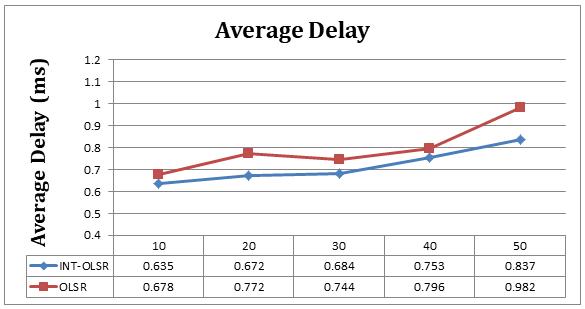
Figure(5)showstheeffectofnodedensityonthedelay. We note that the delay increases with the increase in the number of nodes in both protocols. This is due to the increaseinnetworktraffic,butthedelayremainshigherin the OLSR protocol due to unstable routing and deviation fromtheshortestpath.
7.2 Performance Metric
Thereareseveralperformanceevaluationcriteriaused toevaluatetheperformanceoftheproposedprotocoland compare it to the OLSR protocol. Each of these criteria is describedasfollows:
1- Packet delivery ratio: It is the ratio of the number of packetsreceivedatthedestinationnodetothetotalnumber ofpacketssentbythesourcenode.
2-End-to-enddelay:Itisthetimeittakesforapackettopass throughthenetworkfromthesourcenodetothedestination node.
3- Throughput: It is the amount of data that has been successfully received by the destination node during one unitoftime.
7.3.3 Throughput:
Figure(6)showstheeffectofnodedensityonthroughput. Wenoticethatthethroughputdecreaseswiththeincreasein the number of nodes in both protocols. This is due to the decrease in network performance in general with the increaseinthenumberofnodes,butthethroughputremains higherintheproposedprotocolduetotheincreaseinthe datadeliveryratecomparedtotheOLSRprotocol.
[4] OMAR SAMI OUBBATI, MOHAMMED ATIQUZZAMAN, PASCALLORENZ,MD.SHOHRABHOSSAIN,“Routingin Flying Ad Hoc Networks: Survey, Constraints, and FutureChallengePerspectives,”IEEEAccess,pp.8105781105,2019
[5] ArunKumarTadkal,SujataM,“ASURVEYONREACTIVE, PROACTIVE AND HYBRID ROUTING PROTOCOL FOR FANETS,” JOURNAL OF CRITICAL REVIEWS, pp.37393742,2020
[6] Artur Carvalho Zucchi, Regina Melo Silveira, “PerformanceAnalysisofRoutingProtocolforAdHoc UAV Network,” IFIP Latin American Networking Conference,pp.73-80,2018.
[7] StefanoRosati,Karol Kru˙zelecki,LouisTraynard,and Bixio Rimoldi, “Speed-Aware Routing for UAV Ad-Hoc Networks,”IEEE,pp.1367-1373,2013
[8] YiZheng,YuwenWang,ZhenzhenLi,LiDong,YuJiang, Hong Zhang, “A MOBILITY AND LOAD AWARE OLSR ROUTING PROTOCOL FOR UAV MOBILE AD-HOC NETWORKS,”pp.1-7,2014
[9] YanJiao,WenyuLi,andInwheeJoe,“OLSRImprovement with Link Live Time for FANETs,” Springer Nature Singapore,pp.521-527,2017
8. CONCLUSIONS
Inthispaper,wehaveproposedanINT-OLSRprotocolthat improvesroutingperformanceinFlyingAd-HocNetworks based on the ant colony optimization algorithm. The INTOLSRprotocolselectsthemoststablepathsandavoidshighspeednodesbytakingintoaccountthespeedanddistanceof thenodewhilediscoveringthepathtothedestinationnode.
The simulation and performance evaluation process was carriedoutusingtheNS2networksimulator.Thesimulation results show that the proposed protocol achieves better performancecomparedtotheOLSRprotocolintermsofdata deliveryratioandthroughput.Whiletheend-to-enddelay wassimilartotheOLSRprotocol.

REFERENCES
[1] Yirui Huang, Ruiming Xie, Bowen Gao, Jian Wang, “Dynamic Routing in Flying Ad-hoc Networks using Link Duration Based MPR Selection,” IEEE 92nd VehicularTechnologyConference,pp.1-5,2020.
[2] Dr.IlkerBekmezci,IsmailSen,ErcanErkalkan,“Flying AdHocNetworks(FANET)TestBedImplementation,” IEEE,pp.1-4,2015.
[3] Ilker Bekmezci, Ozgur Koray Sahingoz, Samil Temel, “FlyingAd-HocNetworks(FANETs):Asurvey,”Journal Elsevier,pp.1254-1270,2013
[10] Pengcheng Xie, “An Enhanced OLSR Routing Protocol based on Node Link Expiration Time and Residual Energy in Ocean FANETS,’ Asia-Pacific Conference on Communications(APCC),pp.598-603,2018
[11] Pardeep Kumar, Seema Verma, “Implementation of modified OLSR protocol in AANETs for UDP and TCP environment,” Journal of King Saud UniversityComputerandInformationSciences,pp.1-7,2019.
[12] Chen Hou, Zhexin Xu, Wen-Kang Jia, Jianyong Cai and Hui Li, “Improving aerial image transmission quality usingtrajectory-aidedOLSRinflyingadhocnetworks,” EURASIP Journal on Wireless Communications and Networking,pp.1-21,2020
[13] Mayank Namdev, Sachin Goyal, Ratish Agarwal, “An OptimizedCommunicationSchemeforEnergyEfficient andSecureFlyingAd hocNetwork(FANET),”Springer, pp.1-22,2021.
[14] Zhongshan Zhang, Keping Long, Jianping Wang, Falko Dressler, “On Swarm Intelligence Inspired SelfOrganized Networking: Its Bionic Mechanisms, Designing Principles and Optimization Approaches,” IEEE,pp.1-25,2013
[15] Qizheng Zhu, Zhou Zhou, Jie Yang, Zeliang Fu, “An Optimized Routing OLSR Protocol with Low Control
OverheadforUAVAdHocNetworks,’AmericanJournal ofNetworksandCommunications,pp.6-12,2021.
BIOGRAPHIES
Mr.YaserFawaz, PhD, Computer Networks Department, FacultyofInformaticsEngineering UniversityofAleppo.

Mr.ShiyarKarbooz, PostgraduateStudent, Computer Networks Department, FacultyofInformaticsEngineering UniversityofAleppo.
