Understanding the effect of Financing Variability Using ChanceConstrained Approach in Time-Cost Tradeoff
Shantanu Tiwari1 , Manoj Kumar Trivedi2Abstract - The issue of balancing trade-offs between project duration and associated costs can be effectively addressed through the implementation of the linear optimization methodology. It’s important to consider that this particular approach solely focuses on the monetary aspects. During our study, we decided to analyze the influence of financing variability within the scheduling process. To achieve this, we used chance-constrained programming (CCP) allowing us to estimate the coefficient of variation for financing feasibility at a desired confidence level. Evaluatinguncertainty involves calculatingCV within aspecifiedconfidencelevel. Inordertounderstanditseffect, an objective function along with a set of constraints is used. An effective way to find direct costs. The utilization of Excel Solver helps in successfully completing the study. To better comprehend how financing variability impacts our study, two scenarios were taken during our analysis.
Key Words: Financing feasibility, Linear optimization, Chance constrained programming (CCP), Coefficients of financing variability (CVAF), Time-Cost Tradeoff (TCT)
1. INTRODUCTION
Intheearlystagesofconstructionprojects,itisimportant to formulate a plan and estimate the time required for completionaswellastheprojectedexpenses.Thisprocess, commonlyreferredtoas"timeandcostestimationofthe project," is crucial in order to achieve efficiency from beginningtoend.Byaccuratelyestimatingthesefactors,it becomes possible to implement effective planning strategiesandmaintainconcisecontrolovercosts.
Accomplishingaconstructionprojectsuccessfullyistrulya challengingendeavor.Asitrequirescarefulplanningand preciseexecution.Regrettably,unforeseencircumstances frequentlyleadtomodificationsintimeandcostestimates evenwhenplansarecarefullyformulated.
As deviations emerge in the project, obtaining adequate financing presents a critical task, resulting in the suspensionofoperationsuntilsecuringnecessaryfundsthuscausingdelaysandhinderingmomentum.Assuch,it often proves impractical to limit potential divergences entirely;instead,ensuringreadyaccesstosupplementary
funding becomes imperative for effectively handling unanticipatedexpenses.
Chance-constrainedprogramming(CCP)isanoptimization techniquethatcanprovidevaluableinsightsintohowto handle the variability of financing. By incorporating the probabilityofeventsintotheoptimizationequationCCP enablesamorepreciseestimationofpotentialoutcomes. Thisprogrammingapproachservesasapowerfultoolfor evaluatingtherisksbasedonthedesiredconfidencelevel. [1]
According to our model. The optimal solution is determinedtohavearisklevelof15%.Basedonstatistics thereisan85%probabilityoffulfillingtheconstraintsand onlya15%chanceofbreachingthem.Asaresult.Itcanbe assumedthatthesolutionspresentedinthisstudyhavea commendablesuccessrateofcomplyingwithconstraints approximately85%ofthetime.
Thisstudyaimstodevelopacomprehensivemathematical model that considers various network Precedence relationshipsaswellasthefinancingvariabilitywithina project.
2. LITERATURE REVIEW

Intherealmofconstructionprojectmanagementstriking an effective equilibrium between time and cost holds significant importance. To tackle conventional time cost problems associated with these projects. Various mathematicalmodelsexistalongsidediverseapproaches likeheuristicsandmetaheuristics.Modernadvancements in machine learning and artificial intelligence have also opened up avenues for addressing these challenges effectively.
Twobroadgroupsofmathematicalprogrammingmodels are used to address the time-cost tradeoff problem in variousways.Onegrouputilizeslinearprogramming(LP) models,asseeninstudiesconductedbyresearcherssuch as Meyer and Shaffer [2] . Another approach involves integer programming (IP), demonstrated by Liuet al.'s combinedLP/IPhybridmethodthatestablishesbothlower bounds and exact solutions for project time-cost relationships through LP and IP techniques respectively [3]. Butcher's dynamic programming-based approach is
another perspective worth mentioning here[3]. Furthermore, Reda and Carr [4]presentamixedinteger programmingsolutionintheirstudy. Senouci and Adeli [5] take a holistic approach by integrating resourceconstrainedscheduling,resourceleveling,andprojecttotal cost minimization in their mathematical model. Conversely, Yang [1]'schance-constrainedprogramming methodincorporatesfundingvariabilityintoLPtechniques withoutconsideringuncertaintiesofprojectactivitiesor duration.Additionally, Khalaf et al. [6]introduceacosteffective strategy focusing on stretching non-critical activities within the available maximum budget by crashing all relevant activities simultaneously in the projectnetwork.Tomaximizesavingsfromthisapproach, they leverage Linear Programming (LP) technique and fullyutilizeslackinvariousnon-criticalpathswithinthe network.ThecostsavingsachievedthroughtheLPmodel are then subtracted from the initial cost of crashing all activitiestocalculatethefinalprojectcost.
Various computational optimization techniques using artificialintelligencehavebeenpresentedtoaddresstime cost tradeoff problems. For instance, genetic algorithms havebeenemployedby Senouci and Eldin [7]todevelop amodelforresourceschedulingthatconsidersprecedence relationships,resourceleveling,andresource-constrained scheduling.Similarly. Zheng et al.[8]proposedagenetic algorithm-basedmulti-objectiveapproachtooptimizeboth totaltimeandtotalcostsimultaneously.
In addition to genetic algorithms, Elbeltagi et al [9] utilizedfiveevolutionary-basedoptimizationalgorithms, namely Genetic Algorithm, Memetic Algorithm, Particle Swarm,AntColony,andShuffledFrogLeaping.Similarly. Abbasnia et al. [10]appliedtheFuzzylogictheoryalong with a genetic algorithm as an optimizer for time cost tradeoff.
Previous studies in this domain primarily aimed at minimizing cost (direct or total project cost) while consideringprecedenceconstraintsbetweenactivitiesand other factors such as resource leveling and constrained resource scheduling [11] [5] [7]. However, Yang [1] identified funding variability as another important constraintinthiscontext.
Toaddressthesevariousconstraintscomprehensivelyin the context of time cost optimization (TCO) this paper introducesanewmathematicalmodelthatincorporatesall precedence relationships, and financing variability of projectduration
Thispaperisbasedonpaper Yang [1],authorusedCCPfor quantifyingeffectofcostuncertaintywithsomeprobability infundingvariability
3. RESEARCH GAPS
Even though project delays, cost overruns, and other challenges are central to all types of projects. There is a noticeable gap in evaluating these issues. Despite numerous studies on construction project management. There has been limited investigation into the impact of fundingfluctuationsontimecosttrade-offs.Considering thatexternalfinancingoftenhasasignificantinfluenceon budgets and timelines. It is crucial to have a thorough understandingofthesedynamics.
4. RESEARCH METHODOLOGY
Chance constrained Programming (CCP) was originally uncoveredbyCharnes,Cooper,andSymmondsduringthe 1950s as a means of optimizing financial planning [12] [13]. In this study, the CCP approach is used to address time-cost trade-off problems. When confronted with decision-makinginuncertainscenarios.Theutilizationof ChanceconstrainedProgramming(CCP)canofferahighly efficientsolution.
CCPmathematicalformulationrequirestheintroductionof randomvariablesandalinearprograminordertoachieve this goal. An objective function is developed with constraintsthataimtooptimizewithinspecifiedmaximum andminimumbounds.
Thisequationforlinearoptimizationistakenfrom:[14]
Equation 1
Maximize j
Subjectto:
Equation 2
Pr(
Where,decisionvariable,i=constraint,cij=coefficientforjth variable in ith constraint, aij= left hand coefficient for jth variableintheith constraint,bi=righthandcoefficientfor the ith constraint, αi =prescribed confidence level (probability level) The level of certainty to fulfill the constraintshouldbebeyondorequaltothespecifiedαi,in somechoiceofxj.
Thepreviousequationcanberewrittenasfollows:
Equation 3
Pr(
Estimatingthemeanandstandarddeviationforbi: Equation 4
Themeanofbi andstandarddeviationofbi =mbi andσbi respectively.Itwasassumedthattheright-handsideofthe equationandbibothfollowastandardnormaldistribution.
Assumebi isdistributednormally,theright-handsideof inequalitymustfollowstandardnormaldistribution.For

standard normal distribution Mean=0, standard deviation=1.
Equation 5
(bi-mbi)/σbi =Zαi
= inverse of the cumulative standardized normal distribution.
Thus,fromEq.5th andEq.4th ,thisequationisobtained: Equation 6
resulting distribution will be approximately normal, regardlessof whethertheindividual distributionsof the contributing variables are normally distributed or not." Thisprincipleholdstrueforbothcontinuousanddiscrete random variables, as well as for distributions that are skewedorsymmetric.[12]
Thus,thefinancingconstraintcanbestatedasfollows: )
After convertingtheoriginal stochasticconstrainttothe deterministic equivalent, the following equation is obtained:[14].







Equation 7
Where1-αiinverseofthecumulativestandardizednormal distributionisevaluatedatprobability1-αi.[14]
Equation 8
5. MODEL FORMATION
This is the objective function that will be used for minimizingthedirectcostoftheproject:

Rather than using the standard deviation, utilize the coefficient of variation (CVAF), the equation will be as follows:Where and are the mean and standard deviationofavailablefinancingforaproject,respectively:-
ItwasassumedthatattheConfidencelevel(α=85%)the financialconstraintmustbesatisfied.

It was carefully observed by the project planner that variabilityinfinancingwillbe10%soheassignedCVAF to be10%:-
Constraints:
In order to restrict the possible solution range, chance constraints impose requirements on both outcome probabilities and acceptable limits for variables. This involvesestablishingminimumandmaximumvaluesfor each relevant variable, thereby reducing computation times while ensuring that solutions fall within predeterminednumericalranges.
Thefinancingconstraintisexpressedintermsoffinancing variability. Consider the available financing in a deterministicform.
Thepresenceofinstabilityorunpredictabilityinfinancing indicates that there may be a direct correlation with reduced output on the right-hand side of the mentioned Equation. Consequently, it is highly likely that project timelines may become longer, and there could be an overallincreaseinmeasuresaimedatminimizingexposure topotentialeconomichazards.
Similarlyfor15%CVAF(15%financingvariability)
Availablefinancingreferstothetotalamountoffinancing thatcanbeobtainedfromdifferentsources.Thisassertion issupportedbythecentrallimittheorem,whichstatesthat "when multiple random variables are combined, the
Solver constraints:
To achieve cost reduction when there is variability in financing or time, or both, it is essential to optimize the cost towards the desired point within a specific time duration.
Crashedduration(weekscrashed)<=maximumcrashing allowed The activity cannot be exceeded beyond its crashinglimit,therebypreventinganyfurthercrashing.In ordertomanagethedurationoftheproject,anadditional constraint has been imposed. As a result, the crashed durationcannowbecontrolledbymanuallyinputtingthe desiredprojectduration.
Duedate<=projectduration
Theduedateisthedurationtilltheprojecttobecrashed.
Start and finish relationship:
EarlyStart=Earlyfinishvaluefromlastpredecessor,Early Finish=Earlystart+Activityduration
LS=LF–Activityduration,LF=minimumvalueofLSfrom immediatesuccessor

Slack/float=Itcanbedefinedas thedifferencebetween theearliestandlatest,startorfinishtime.

Slack/float=EF–ESorLF–LS
6. Solving Procedure:
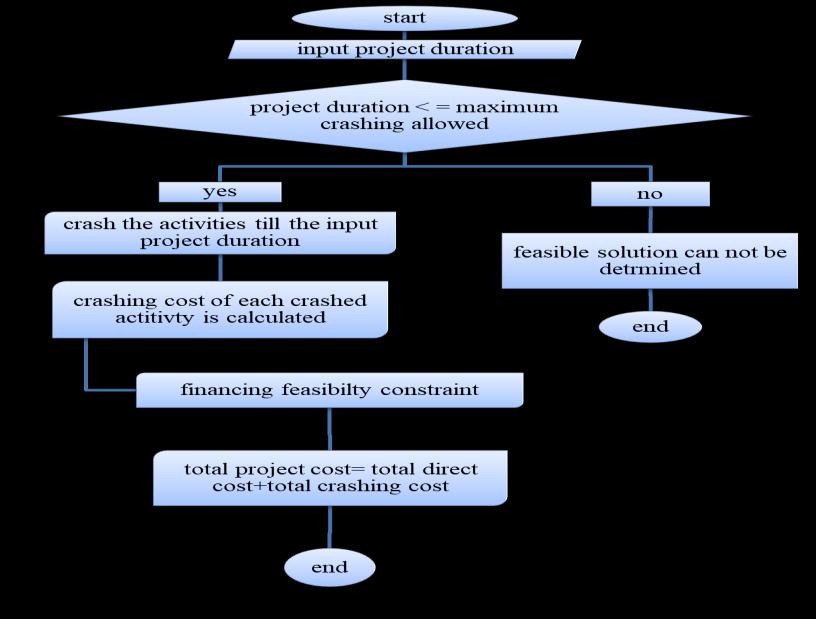
The optimization is done by means of Excel solver; four scenariosareadopted:-
Traditionaltime-costtrade-off
Traditionaltime-costtradeoffwith10%and15% Financingvariability
8. Solving Scenario
Twoscenarioshavebeeninvestigatedwiththeobjective offullycomprehendingtheimpactsoffinancialfluctuation:
A. Inthefirstscenario,theappliedtraditionaltimecost trade-offmethodresultedinadirectcostofINR93000 foradurationof20weeks.
B. Inthesecondscenariotwoalternativeswerepursued. The initial one (2a) involved a 10% variability in financing (CVAF) generating a direct cost of INR108645. Alternative (2b) introduced a higher degreeofuncertaintyat15%variabilityinfinancing (CVAF)resultinginadirectcostofINR118623forboth scenarioswithdurationbeingmaintainedat20weeks.
9. Analysis of Result
Table 1: Direct cost of considered scenarios
7. Numerical Example
Anumericalexampleistakentoanalyzetheworkingand performanceofthismodel.Thecasestudyconsistsofeight activities, three-time estimates under normal and crash conditions,andthemostlikelytimeestimateswhichare givenforthedirectcostoftheactivity.Anindirectcostof INR2000perweekisconsideredinthisexample [12].
Forcomparing scenario2a and2b,whichcorrespond to 10%and15%financingvariabilityrespectively,let'stake anexamplecostofINR132010.Thiscostisassociatedwith scenario 2a, and it takes 18 weeks of time to complete. Whenthesamecostisconsideredforscenario2b,whichis
15%financingvariability,ittakes18.95weeksoftimeto complete.Ithasbeenobservedthatalterationsinfunding canimpactthedurationoffinishingaprojectdespitefixed expenditures.Takescenario2a;forexample:withatime limit of 16 weeks and costs standing at INR164720. Conversely,inscenario2bwithanidenticaldeadlineof16 weeks; expenses total up to INR179846.It can be stated thatevenaslightescalationoffinancingvariability(byas little as 5%) can create significant results such as a lengthier duration (a rise of approximately 5.27%) for completingtheprojectandanincreasedoverallexpense (about9%)ifkeptonschedule.
Nowfixtheprojectdeadlineat17weeksthenecessary direct cost will be INR 127000, INR148364, and INR161989,forscenario1,scenario2a,andscenario 2b,respectively.Theoverallpercentageincreasefrom traditional time-cost scenarios amounts to 16.82%, 27.55%,

AtdirectcostINR177000,theprojectcanbecompleted in14weeks,15.42weeks,16.15weeks,forscenario1, scenario2a,and2b,theoverallamountofpercentages thatindicateanincreaseinrelationtothe1stscenario are10.14%,15.35%.
Forexample,thetotalexpenseofINR205000isestimated from the traditional time cost scenario, if financing variabilityof10%occursintheproject,thentheestimated completiontimewillbe15.56weeksinsteadof14weeks. Similarlyevaluatingallscenarios,itcanbeconcludedthat there are various timelines for completing of project availablewithinanallocatedbudget.
10. Conclusion
The scope of this research involves constructing a timecost trade-off model that takes into consideration the fluctuations in financing. By presenting this simplified model,decision-makerscangainvaluable.
Inordertograsptheinterrelationbetweencostandtime effectively, it is imperative to investigate the time cost curve for each scenario. A prime example would be that raising the coefficient of variation for funding by approximately 10 to 15% results in a corresponding incrementindirectcostsbyroughlyabout9%.
Subsequently drawing diverse conclusions becomes possiblethroughthisanalysis.
Total project calculations:
Table 2: Cost after including Indirect Cost
This model suggests that if the cost remains fixed, there willbeanincreaseintime.Similarly,iftimeisfixed,there willbeanincreaseincost.
Now, this model gives choice to the client for the completionoftheprojectwithrespecttotimeandfinance.
Thisparticularmodelofferstheoptiontoaddressdifferent confidencelevels,suchas99%,95%,90%,80%,and75%. Italsoallowsforarangeofvariations,including2.5%,5%, 10%, 15%, and 20%. These variations are significant in understandingandevaluatingtheimpactonbothdelays andexpenses.
11. REFERENCES
[1] T. Yang, "Chance-constrained time–cost tradeoff analysis considering funding variability," Journal of Construction Engineering and Management, vol.131, no.9,2005.
[2] L. S. W.L. Meyer, "Extensions of the Critical Path Method through the Application of Integer Programming," Civil Engineering Construction ResearchSeriesNo.2,Urbana-Champaign,1963.
[3] S. B. C. F. L. Liu, "Construction time–cost tradeoff analysis using LP/IP hybrid method," Journal of Construction Engineering and Management, vol.121, no.4,pp.446-454,1995.
[4] R.C.R.M.Reda,"Time
costtradeoffsamongrelated activities," Journal of Construction Engineering and Management, vol.115,no.3,pp.475-486,1989.
[5] H.A.A.B.Senouci,"Resourceschedulingusingneural dynamics model of Adeli and Park," Journal of Construction Engineering and Management, vol.127, no.1,p.28
34,2001.
[6] L.J.M.A.B.L.S.W.S.Khalaf,"Alinearprogramming approach to maximize savings by stretching non critical activities," Australian Journal of Basic and Applied Science, vol.4,no.11,p.5649–5657,2010.
[7] N. E. A.B. Senouci, "Use of genetic algorithm in resourceschedulingofconstructionprojects," Journal of Construction Engineering and Management, vol. 130,no.6,p.869–877,2004.
[8] T. N. M. K. D.X.M. Zheng, "Applying a genetic algorithm-based multiobjective approach for time–cost optimization," Journal of Construction Engineering and Management, vol.130,no.2,p.168–176,2004.
[9] T. H. D. G. E. Elbeltagi, "Comparison among five evolutionarybasedoptimizationalgorithm,"vol.19, p.43–53,2005.
[10] A.A.E.E.R.Abbasnia,"Time–costtrade-offproblem inconstructionprojectmanagementbasedonFuzzy," Journal of Applied Sciences, vol. 8, no. 22, p. 4159–4165,2008.
[11] A.C.C.Y.S.S.Leu,"AGA-basedFuzzyoptimalmodel for construction time–cost tradeoff," International Journal of Project Management, vol.19,no.1,pp.4758,2001.
[12] K.D.Duft, PERT Time/Cost: An Aid to Agribusiness Management, Washington: Collage of Agriculture & Home Economics,Washington State of University, 1967.
[13] G Dantzig,"Linearprogrammingunderuncertainty," Management Science, vol 1,p.197–206,1955.
[14] A. M. El-kholy, "Time–cost tradeoff analysis consideringfundingvariabilityandtimeuncertainty," Alexandria Engineering Journal, vol 52,pp 113-121, 2013.
[15] W.Prager,"Astructuredmethodofcomputingproject costpolygons," Management Science, vol.9,no.3,p. 394–404,1963.
[16] T.Hegazy, "Optimization of construction time–cost tradeoffanalysisusinggeneticalgorithms," Canadian Journal ofCivil Engineering, vol 26,no.6,p.685–697, 1999.
[17] J L T.B.M.J Quarda, "Chance-constrained optimal controlformultireservoirsystemoptimizationand riskanalysis," StochasticEnvironmentalResearchand Risk Assessment, vol 4,p.185–204,2001.
[18] C Y S.S Leu,"GA-basedmulti-criteriaoptimalmodel forconstructionscheduling," Journal of Construction Engineering and Management, vol 125,no.6,p.420–427,1999.
[19] O.Moselhi, "Schedule compression using the direct stiffness method," Canadian Journal of Civil Engineering, vol.20,p.65–72,1993.
[20] N.Siemens, "A simple CPM time–cost tradeoff algorithm," ManagementScience, vol 17,no 6,p 354
363,1971
[21] J.W.Fondahl, "A Non-Computer Approach to the CriticalPathMethodfortheConstructionIndustry," StanfordUniversity,Stanford,California,1961.
[22] C. C. P. J.R. Benjamine, Probability, Statistics, and DecisionforCivilEngineers,NewYork:McGraw-Hill, 1970.
[23] R C J Z J.H.Ellis,"Stochasticprogramsforidentifying critical structural collapse mechanisms," Applied Mathematical Modelling 15 (1991) 367
373, vol 15, pp 367-373,1991.
[24] J.E.Kelly, "Critical path planning and scheduling: mathematical basis," Operation Research, vol 9, p. 296–320,1961.
[25] P. L. H. Li, "Using improved genetic algorithms to facilitate time–cost optimization," Journal of Construction Engineering and Management, vol.123, no.3,p.233–237,1997.
[26] J C P L H. Li, "Using machine learning and GA to solve time
cost trade-off problems," Journal of Construction Engineering and Management, vol 121, no.4,p.446
454,1995.
[27] T.N D.X.M Zheng,"Stochastictime–costoptimization model Incorporating Fuzzy sets theory and nonreplaceablefront," JournalofConstructionEngineering and Management, vol 131,no.2,p.2005,176–186.
[28] D.R.Fullkerson, "A network flow computation for projectcostcurves,7(1961)127–178.," Management Science, vol 7,pp 127-178,1961.
[29] L.L.S.B.C.W.Feng,"Usinggeneticalgorithmstosolve constructiontime–costtrade-offproblems," Journalof Computation in Civil Engineering, vol 11, no. 3, pp. 184-189,1997.
[30] T. A C Henderickson, Project Management for Construction,EnglewoodCliffs,newjersey:PrenticeHall,Inc,1989.
[31] W.Butcher,"Dynamicprogrammingforprojectcost–timecurve," Journal of Construction Division, vol.1,p. 59–73,1967.
[32] A.Pagnoni,"ProjectEngineering:ComputerOriented Planningand Operational Decision Making," Berlin, Springer,1990.
[33] W C A Charnes,"Chance-constrainedprogramming," Management Science, vol 6,pp 73-79,1959
BIOGRAPHIES
Mr.ShantanuTiwari
M.E.(construction technology & management),MITSGwalior
B.tech (civil engineering) AKGEC, Ghaziabad
ContactShantanutiwari443sgmail.com
Dr.ManojKumarTrivedi

Head of civil engineering department,MITSGwalior
Ph.D. - hydraulics (IIT Roorkee,2001)

MTech-water resources engineering(IITKharagpur,1990)
B.Sc.-civil engineering ,(RIT, Jamshedpur)