Mixed Convection Flow and Heat Transfer in a Two Sided Lid Driven Cavity Using SIMPLE Algorithm
Arti KaushikDepartment of Mathematics, Maharaja Agrasen Institute of Technology, Delhi. India

***
Abstract - In this paper mixed convection flow and heat transfer in steady 2-D incompressible flow through a two sided lid driven cavity is studied. The upper and lower walls of cavity are moving with uniform velocity. The upper wall is at higher temperature and the lower wall is kept at lower temperature. SIMPLE algorithm is employed for solution of governing equations of the model A staggered grid system is employed for numerical computations for velocity, pressure and temperature. Various values of under relaxation factors for velocity, pressure and temperature are used to obtain the stability of the numerical solutions. Bernoulli equation has been taken up to check the accuracy of the computed solutions. The significant findings from this study have been given under conclusion.
Keywords - Incompressible flow, two sided lid driven cavity, SIMPLE algorithm, staggered grid system, mixed convectionflow
1. INTRODUCTION
The phenomenon of motion of viscous fluid in a twodimensional rectangular cavity was first studied by Kawaguti [1]. Since then, numerous researches have been donetostudythemotionoffluidinliddrivencavityunder differentconditions[2],[3],[4].
Numerical investigation of steady state two-dimensional mixed convection problem in a vertical two-sided liddriven differentially heated square cavity was done by Öztop and Dağtekin [5]. They considered three cases depending on the direction of moving walls. They found that both Richardson number and direction of moving walls affect the fluid flow and heat transfer in the cavity.
Muthtamilselvan et al studied the effect of magnetic field onmixedconvectioninatwo-sidedlid-drivencavityfilled withafluidsaturatedporousmediumkeepingthetopand bottom horizontal walls at constant but different temperatures[6].Auniform magneticfield wasapplied in the vertical direction normal to the moving wall. They found that Hartmann number, Richardson number, Darcy number and direction of the moving walls have strong influence on the fluid flow and heat transfer in the
enclosure. Numerical investigation to analyze the steady state two-dimensional mixed convection in two sided liddrivenporouscavityunderthecombinedbuoyancyeffects ofthermal and massdiffusion, when the wallsare moving in opposite direction was done by Benmalekb and Souidi [7]. Their results illustrate that heat transfer and mass transfer characteristics inside the cavity are enhanced for lowvaluesoftheRichardsonnumberduetothedominant mechanical effect induced by the moving lids. They also observed that heat and mass transfer are decreased for low values of the Darcy number. Numerical investigation of mixed convection fluid flow and heat transfer in an inclined two-sided lid-driven cavity subjected to Al2O3−water nanofluid was done by Esfe et al [8]. The effects of inclination angle, Richardson number, nanoparticle volume fraction, temperature, and nanoparticle diameter based on variable property formulations were recorded. Their results indicated that the addition of Al2O3nanoparticles has produced a remarkable enhancement on heat transfer with respect to that of the pure fluid. Esfe et al investigated mixed convection flows through a SiO2−water nanofluid in a square double lid-driven cavity with various inclination angles and sinusoidal heating on the left wall [9]. They studied the effects of variations of Richardson and Reynolds number, angle of inclination, and solid volume fraction of nanoparticles on the hydrodynamic and thermalcharacteristics.Theyfoundthattheincreasesheat transferratewiththesolidvolumefractionforaparticular Re. Sivasankaran et al numerically investigated magnetohydrodynamic mixed convection flow and heat transfer of Cu–waternanofluidinasquarecavityfilledwithaDarcian porous medium with a partial slip[10]. They performed a parametric study and presented a set of graphical results to demonstrate interesting features of the solution. An investigation of the heat transfer performance of a twosided lid-driven cavity filled with Cu-water nanofluid saturatedporousmediawasdonebyMukherjeeetal[11]. They introduced A concept of speed ratio to analyze the effectofdifferentmovingvelocityoftopandbottomwalls. They found that the heat transfer rate increases with the increase of speed ratio and for all the values of the speed ratio,averageNusseltnumberincreases
Using Finite Difference Method Hussain analyzed numerically the thermal behaviour and parameters effect onheattransferinsidethe2Ddoubleliddrivencavity[12]. He analyzed the velocity and temperature profiles for a vast range of dimensionless parameters namely Reynolds number (Re), Richardson number (Ri)and Prandtl number(Pr)and presented graphically and found that these flow parameters have significant effects in controllingtheflowbehaviorinsidethecavity.Manchanda and Gangawane presented numerical results for 2D, steady, laminar and incompressible flow in a square, twosided, lid-driven cavity with a decentered heated triangularblockfornon-Newtonianpower-lawfluids[13]. It was found that mixed convectionparameter have a negligibleimpactonfluidandthermalstructureinsidethe cavity. Saha et al analyzed the flow and heat transfer characteristics inside a double lid-driven cavity underneath buoyancy consequences of thermal diffusion [14]. Their results revealed that the influence of the development of the velocity profiles in the chamber decreases with the augmentation of Re Karabay numerically investigated fluid flow and heat transfer characteristicsofAl2O3–waternanofluidinatwo-sidedliddriven cavity with wavy walls [15]. The results showed thatbothflowandtemperaturedistributionsaresensitive to the geometric parameters. It is also found that introducing nanoparticles to the base fluid enhances heat transfer considerably for all Richardson numbers considered in this study. Benmalek et al analyzed mixed convection in a square cavity filled with Non-Newtonian fluidofBingham model withtwo movingvertical wallsby finite volume method [16]. Their results showed that increase in yield stress drops the heat transfer and the flowbecome flatter, while increasing Reynolds number augments it. The mixed convection and surface radiationeffectinatwo-sidedlid-drivensquarecavitywas studied by Dahani et al [17]. Their results showed significant effects of the Richardsonnumber and surface radiation on the overall structure of the flow and heat transfer characteristics. Zaydan et al numerically investigatedsteady,laminarmixedconvectioninsidealiddriven square cavity filled with nanofluid [18]. They focused on the heat transfer enhancement when different nano-particles are incorporated separately in different base fluids. They found that the choice of the efficient binary mixture for an optimal heat transfer depends not only on the thermophysical properties of the nanofluids but also on the range of the Richardson number. Mixed convection heat transfer of Cu-water nanofluid in an arc cavity with non-uniform heating was numerically studied byAljabairetal[19].Theirresultsfoundagoodagreement
with the others works. Kumar et al studied the mixed convectionphenomenoninsideatwo-dimensional,tallliddrivencavitywithtopandbottomlidsmovinginopposite directions, when the cavity contains a uniformly heated equilateraltriangularobstacleatitsgeometriccenter[20]. They showed that with a rise in the aspect ratio of the cavity, the flow-pattern becomes more dispersed inside the cavity. Tang et al investigated the hydrodynamics and thermal characteristics due to mixed convection in a vertical two-sided lid-driven differentially square cavity containing four hot cylinders in a diamond array [21]. They discussed the influence of different flow governing parameters, including the direction of the moving walls, the distance between neighboring cylindersand the Richardson numberon the fluid flow and heat transfer withdifferentvaluesofReynoldsnumber,Grashofnumber and Prandtl number. Chowdhury and Alim carried out numerical investigation to analyze the impacts of internal heat source size, solid concentration of nanoparticles, magnetic field, and Richardson number on flow characteristics in an oppositely directed lid-driven wavyshaped enclosure [22]. They showed that the overall heat transferratedeclineswiththeincreasinglengthofinternal heatsource.Theyalsoprovedthatthepresenceandrising values of solid concentration of nanoparticles cause the augmentation of heat transfer whereas the magnetic field hasanegativeinfluenceandtheRichardsonnumberhasa positiveinfluenceonheattransfer.
SIMPLEalgorithmproposedbyPatankarandSpalding has been extensively used by researchers for the study of motion in lid driven cavity [23]-[27]. But SIMPLE algorithm has not been applied to the problem of mixed convectiveheattransferinatwosidedliddrivencavity. In theviewofabovediscussionweaimtoexaminethemixed convection and heat transfer in a two sided lid-driven cavity using SIMPLE algorithm. The results obtained are shown through quiver plot and contour plots for various considereddimensionlessparameters.
2. METHODOLOGY
We consider a two dimensional, incompressible, steady and laminar flow through a square cavity of height and length L. The side walls of the cavity have no-slip condition. The upper and lower walls are moving in their own plane. The cavity upper wall is moving with velocity UUandiskeptatahightemperatureTh. Thebottomwallis moving with higher velocity UL and is kept at a low temperatureTc Followingassumptionsarebeingmade
1.Theleftandrightwallsareadiabatic.
2. All thermo-physical properties of the fluid are constant exceptthedensityvariationofthebuoyancyterm.
3. The density vary linearly with temperature as
where ρ is the fluid density, g is the acceleration due to gravity and β is the coefficient of thermalexpansion.
4.ThefluidisconsideredasNewtonian.
5.Viscousdissipationisneglected. Under these assumptions, the governing conservations equationsaregivenby:
where Re, Pr and Gr are non- dimensionalised Reynolds number,PrandtlnumberandGrashofnumberrespectively andaredefinedas
The initial and boundary conditions in the non dimensionalisedform are
where u and v are the fluid velocity components in the xand y directions, p the pressure, T the temperature, g is acceleration due to gravity ,β the volumetric coefficient of thermalexpansion, iskinematicviscosity,ρthedensity ofthefluidandαthethermaldiffusivity.
Introducingthenon-dimensionalquantities
SIMPLE algorithm is applied to solve the governing equations along with the boundary conditions. The algorithm is a guess and correct procedure for the calculation of pressure and velocities. The computational domain is discretised employing the staggered grid arrangement. Employing finite volume method, the nonlinear governing partial differential equations are converted into a system of discretised equations. These discretised equations along with pressure correction equation are solved to obtain the velocities, pressure and temperatureatallnodepointsofthegrid.
3. RESULTS AND DISCUSSION
Thegoverningequationsofmotionaresolvednumerically to obtain unknown variables u, v, p and T for various values of α, β, ρ and μ. The SIMPLE algorithm has been implementedinMATLABprogramminglanguage.Different valuesofunderrelaxationfactorsforuvelocity,vvelocity andpressureweretestedforallcases.
wecanwriteEqn.(1)-(4)innon-dimensionalformas
The effect of thermal diffusivity α on u velocity is negligible.ThiscanbeseeninFigure1aand1b.
The effect of thermal diffusivity on v velocity is shown in Figure2aand2b.Itcanbeseenthatincreaseinvalueofα results in lower v- velocity. We can see a sudden increase in the v velocity near midpoints of east boundary for all valuesofα.
InFigure3aand3b,thevariationinpressurewithchange in α can be seen. As α decrease, low pressure region near northeastcorner,decreasesinsize.Alsothelowpressure region along west wall decreases as α decrease No significantchangeintemperaturecanbeseenwithchange inα.
In Figure 4a and 4b we can see the change in velocity profileasαdecreases.
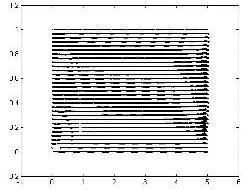
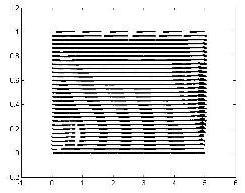
The effect of coefficient of thermal expansion β on the u velocity is shown in Figure 5a, 5b and 5c and the effect of coefficient of thermal expansion β on the v velocity is shown in Figure 6a, 6b and 6c It is seen that increase in valueofβresultsinhigheru–velocityandv-velocityatall pointsofthecavity.Itisnoticedthatuvelocityhashighest values near south boundary which decreases towards northboundary.
The values of v are highest at west boundary and reduce towardscentreofeastboundary.
InFigure7a,7band7cthepressurecontoursfordifferent values of β can be seen. The pressure is highest near the south boundary of the cavity and then decreases toward
north boundary for all point in cavity. Note that as β increases,thepressureinthecavityalsoincreases.
In Fig 8a and 8b we can see that no significant change is there with increase in value of β. In Fig 9a and 9b, remarkablechangecanbeseenwithincreaseinvalueofβ.
Itcanbeseenthatdecreaseinvalueofρresultsinincrease in u - velocity. The u – velocity has higher values near south boundary which reduces towards north boundary. Te pattern remains same for all values of ρ. The vvelocities are higher near midpoints along east boundary, whichreducesasthevalueofρdecreases.
In Figure 12a and 12b we can see, as expected, that the pressure in the cavity decreases with decreasing density. InFig13aand13b,variationoftemperaturewithpressure atallnodepointsofthecavitycanbeseen.
Theeffectofviscosityofthefluidonuvelocitycanbeseen inFigure15a,15band15c. Itcanbeseenthatthepattern of decrease of u velocity from south towards north boundary remains same, but varies as the viscosity changes.
Figure
14b shows the effect of density of fluid on the direction field of the flow. As the density of the fluid decreases, the direction field of the flow changes drastically
Theeffectofviscosityofthefluidonvvelocitycanbeseen in Figure 16a, 16b and 16c. It is seen that v velocity increasessignificantlywithincreaseinviscosity.
The variation of pressure inside the cavity with varying viscositycanbeseeninFigure17a,17band17c. Itcanbe clearly seen that the pressure decreases with increasing viscosity of the fluid. The change in temperature with changeinviscosityisminimal.
Thevelocityprofilealsochangeswithincreaseinviscosity ascanbeseeninFigure18aand18b.
Theeffectofvelocityofthebottomboundaryonu-velocity can be seen in Figure 19a and 19b As the velocity of bottom boundary increases, u- velocity increases, especially near the south boundary. For higher velocity of bottom boundary,thev velocitydecreasesthroughout the cavity.
Thehighestvvelocitycanbeseenalongtheeastboundary. ThisisshowninFigure20aand20b.
In Figure 21a and 21b, we can see the change in pressure in the cavity with increase in the velocity of bottom boundary. The lower pressure regions near north east corner and south west corners increase in size with increaseinvelocityofbottomwall.
InFigure 22a and22b, wecanseethe change in direction fieldoftheflowwithincreasingvelocityoftopboundary.
4. CONCLUSION
A numerical study of mixed convection flow and heat transfer in steady 2-D incompressible flow through a two sided lid driven cavity is presented in this paper. The governing equations of motion are solved for u velocity, v velocity, pressure and temperature using SIMPLE algorithm. The numerical computations were conducted usingstaggeredgridsystem.Itwasnotedthatthesolution converges for only few values of under relaxation factor for pressure. Following results were obtained from the study-
1. It was seen that v velocity decreases with increase in valueofα,butuvelocityshowsnoremarkablechangewith changeinthermaldiffusivity.
2. As α decrease, low pressure region near north east corner,decreasesinsize.
3. Both u–velocity and v-velocity increases at all points of thecavitywithincreaseinvalueofβ.
4.Pressureinthecavityincreaseswithincreaseinvalueof β.
5.Decreaseinvalueofρ resultsinincreaseinu – velocity and decrease in v-velocity. The pressure in the cavity decreaseswithdecreasingdensityρ.
6. Temperature changes along north boundary with decreaseinρ.
7.Increaseinμsignificantlyincreasev-velocitybutresults indecreasesinpressure.
8. The velocity profile changes drastically with change in valuesofα,βandρ.
REFERENCES
[1]M.Kawaguti,“Numerical solutionoftheNavier–Stokes equationsfortheflowinatwo-dimensionalcavity”,J.Phys. Soc.Jap.,Vol.16,1961,pp2307
2315.
https://ui.adsabs.harvard.edu/link_gateway/1961JPSJ...16 .2307K/doi:10.1143/JPSJ.16.2307
[2] R.D. Mills, “On the closed motion of a fluid in a square cavity”, The Aeronautical Journal, Vol. 69, 1965, pp116 –120.
DOI:10.1017/S0001924000060371.
[3] Ajay K. Prasad & Jeffrey R. Koseff,” Reynolds number andend‐walleffectsonalid‐drivencavityflow”,Physicsof FluidsA:FluidDynamics,1989,Vol.1,pp208–218.
https://doi.org/10.1063/1.857491
[4]A.K.Prasad&J.R.Koseff,“Combinedforcedandnatural convection heat transfer in a deep lid-driven cavity flow”, International Journal of Heat and Fluid Flow Vol.17, 1996, pp460–467.
DOI:10.1016/0142-727X(96)00054-9
[5] Hakan Fehmi Öztop & İhsan Dağtekin,” Mixed convection in two-sided lid-driven differentially heated square cavity”, International Journal of Heat and Mass TransferVol.47(8-9),2004, pp1761-1769.
DOI:10.1016/j.ijheatmasstransfer.2003.10.016
[6]M.Muthtamilselvan,PremKumarKandaswamy&Jinho Lee, ”Hydromagnetic Mixed Convection in a Two-Sided Lid-Driven Porous Enclosure”, International Journal of Fluid Mechanics Research, Vol. 37, Issue 5, 2010, pp 406423.
DOI:10.1615/InterJFluidMechRes.v37.i5.20
[7]ToufikBenmalekb&FerhatSouidi,”Combinedheatand masstransferintwosidedlid-drivenporouscavity”,AFM, 2013
https://core.ac.uk/works/7182263
[8] Mohammad Hemmat Esfe , Mohammad Akbari , Davood Semiromi Toghraie , Arash Karimipour , Masoud afrand,”Effect of nanofluid variable properties on mixed convectionflowandheattransferinaninclinedtwo-sided lid-driven cavity with sinusoidal heating on sidewalls” HeatTransferResearch,2014,Vol45,Issue5,pp.409-432.
DOI:10.1615/HeatTransRes.2013007127
[9] Mohammad Hemmat Esfe, Seyed Sadegh Mirtalebi Esforjani, Mohammad Akbari & Mohammad Hadi Hajmohammad, “Numerical simulation of mixed convection in a sio2/water nanofluid in a two−sided liddriven square enclosure with sinusoidal boundary conditions on the wall” Heat Transfer Research, 2014, Volume45,Issue7,pp.677-700.
DOI:10.1615/HeatTransRes.2014007311
[10] S. Sivasankaran, M. A. Mansour, A. M. Rashad &M. Bhuvaneswari,” MHD mixed convection of Cu–water nanofluid in a two-sided lid-driven porous cavity with a partialslip”NumericalHeatTransfer,PartA:Applications, 2016,Vol.70,Issue12,pp1356-1370.
https://doi.org/10.1080/10407782.2016.1243957
[11] Soumyodeep Mukherjee, Nirmalendu Biswas & Nirmal Kumar Manna,”Mixed convection in a two-sided lid-driven porous cavity saturated with nanofluid”, Proceedings of the 24th National and 2nd International ISHMT-ASTFE Heat and Mass Transfer Conference (IHMTC-2017) December, 27-30, 2017, BITS Pilani, pp 1665-1672.
DOI:10.1615/IHMTC-2017.2310
[12] Hussain, S.,”Effects of Inclination Angle on Mixed Convective Nanofluid Flow in a Double Lid-Driven Cavity with Discrete Heat Sources”. International Journal of Heat and Mass Transfer,2017, Vol.106, pp 847-860.
https://doi.org/10.1016/j.ijheatmasstransfer.2016.10.016
[13]ManviManchanda&KrunalGangawane,”Mixed convection in a two-sided lid-driven cavity containing heated triangular block for non-Newtonian power-law fluids”,InternationalJournalofMechanicalSciences,2018, Vol.144,pp235-248
https://doi.org/10.1016/j.ijmecsci.2018.06.005
[14] Kajal Chandra Saha, Goutam Saha& Doli Rani Pal,” Double Lid Driven Cavity with Different Moving Wall Directions for Low Reynolds Number Flow”, International Journal of Applied Mathematics and Theoretical Physics, Vol4,Issue3,2018,pp67-72.
doi:10.11648/j.ijamtp.20180403.11
[15]HasanKarabay,”Mixedconvectionflowofal2o3–water nanofluid in a two-sided lid-driven cavity with wavy walls”, Heat Transfer Research, 2018,Vol. 49, Issue 2,pp 91-102
DOI:10.1615/HeatTransRes.2017014257
[16]ToufikBenmalek ,FerhatSouidi ,MouradModerres , Bilal Yassad and Said Abboudi,” Mixed Convection of Bingham Fluid in a Two Sided Lid-DrivenCavity Heated From Below” Fluid Dynamics & Materials Processing,2019,Vol.15,no.2,pp.107-123.
https://doi.org/10.32604/fdmp.2019.04496
[17] Y. Dahani, M. Hasnaoui, A. Amahmid, I. Filahi, A. Mansour & S. Hasnaoui,”Lattice Boltzmann Simulations of Coupled Mixed Convection and Radiation Effect in a TwoSided Lid-Driven Enclosure” .Journal of Atomic, Molecular, Condensed Matter and Nano Physics,2020, Vol. 7(3), pp 175–188
https://doi.org/10.26713/jamcnp.v7i3.1543
[18] Mostafa Zaydan, Mehdi Riahi, Fateh MebarekOudina& Rachid Sehaqui,” Mixed Convection in a TwoSidedLid-DrivenSquareCavityFilledwithDifferentTypes of Nanoparticles: A Comparative Study Assuming Nanoparticles with Different Shapes” Fluid Dynamics & MaterialsProcessing,2021,Vol17,No.4,pp789-819.
https://doi.org/10.32604/fdmp.2021.015422
[19] Sattar Aljabair,Ali L. Ekaid,Sahira Hasan Ibrahim, &Israa Alesbe,” Mixed convection in sinusoidal lid driven cavity with non-uniform temperature distribution on the wall utilizing nanofluid”, Heliyon.2021 May;Vol. 7(5): e06907.
doi:10.1016/j.heliyon.2021.e06907
[20] Sudhanshu Kumar,Krunal M. Gangawane &Hakan F. Oztop,” A numerical study of mixed convection in a twosided lid-driven tall cavity containing a heated triangular block for non-Newtonian power-law fluids, Heat Transfer, 2021,Vol.50,Issue5,pp4806-4829
DOI:https://doi.org/10.1002/htj.22103
[21] Guyue Tang Qin Lou &Ling Li,” Numerical simulation of mixed convection in a two-sided lid-driven square cavity with four inner cylinders based on diamond arrays”, International Journal of Modern Physics C, 2021, Vol.32,No.01, 2150009
https://doi.org/10.1142/S0129183121500091
[22] Kakali Chowdhury &Md. Abdul Alim,” Mixed Convection in a Double Lid-Driven Wavy Shaped Cavity Filled with Nanofluid Subject to Magnetic Field and InternalHeatSource”,JournalofAppliedMathematics,Vol 2023,ArticleID7117186
https://doi.org/10.1155/2023/7117186
[23] V. Sivakumar, S. Sivasankaran,P. Prakash, and J. Lee, “Effect of heating location and size on mixed convection in lid-driven cavities” , Computers & MathematicswithApplications,Vol59(9),2010,pp 30533065.https://doi.org/10.1016/j.camwa.2010.02.025
[24] Z. Li and R. Wood,“Accuracy analysis of an adaptive mesh refinement method using benchmarks of 2-D steady incompressible lid-driven cavity flows and coarser meshes”, Journal of Computational and Applied Mathematics, Vol275, 2015, pp 262-271
https://doi.org/10.1016/j.cam.2014.07.025
[25] R.C. Mohapatra, (2016). “Study on laminar twodimensionallid-drivencavityflowwithinclinedsidewall” , Open Access Library Journal, Vol 3 (3), Article ID:e2430, http://creativecommons.org/licenses/by/4.0/
[26]L.C.Earn,W.Y.TeyandT.L.Ken,“Theinvestigationon SIMPLEandSIMPLERalgorithmthroughliddrivencavity” , Journal of Advanced Research in Fluid Mechanics and ThermalSciences, Vol29(1),2020,pp10–22.
https://akademiabaru.com/submit/index.php/arfmts/arti cle/view/2088
[27]I.R.Ali,A.I.Alsabery,N.A.BakarandR.Roslan,“Mixed convection in a double lid-driven cavity filled with hybrid nanofluid by using finite volume method” , Symmetry, Vol 12,2020,pp1-1977.
https://doi.org/10.3390/sym12121977