Optimization of Organic Rankine Cycle’s thermal efficiency based on Grey relational analysis with Taguchi method
Jayesh Choudhary 1, Purushottam Sahu2, Ghanshyam Dhanera 31 Research Scholar, BM College of Technology, Indore

2Professor and HEAD, BM College of Technology, Indore
3 Assistant Professor, BM College of Technology, Indore, MP ***
Abstract - For the statistical analysis in this study, the following 9 basic process parameters were chosen: working fluid type, heat exchanger efficiency, pinch point temperature differential in the evaporator and condenser, superheating temperature, evaporation temperature, and condensation temperature. The methodology employed was based on the Organic Rankine Cycle (ORC), where 9 tests were conducted using Taguchi's normal l9 orthogonal array. Subsequently, multi-response optimization was performed using principal component and grey relational analyses.
Acomprehensivestatisticalanalysiswasconductedtoassess theimpactoftheseparametersontheefficienciesoftheORC system. To validate the results, confirmation tests were carried out, demonstrating good agreement between the predicted and experimental values of the response variables attheoptimumcombinationofinputparameters.
The optimum operating conditions for the ORC system were identified as A1B1C3D3E3F3G1H3I3, while the worst operating conditions were A3B3C1D1E1F1G3H1I1, both within the range of the analyzed operating conditions. The first law efficiencies of the system were determined to be 17.3%forthebestcaseand9.6%fortheworstcase.
This study provides a ranking of the ORC process parameters based on their statistical impact weight, highlighting which parameters are effective and ineffective inrelationtothesystem'sefficiencies.
Regenerateresponse
Key Words: Grey relation analysis, Organic Rankine Cycle;ThermalEfficiency;Taguchi Method;ANOVA
1. INTRODUCTION
The Organic Rankine Cycle (ORC) is a thermodynamic process that converts low-temperature heat sources into electricity by using an organic working fluid. An ORC system's thermal efficiency is influenced by a number of factors. The Taguchi method and grey relational analysis
can be used to examine the impact of various factors on theORCsystem'sthermalefficiency.
Grey relational analysis is a technique for examining the connection between several variables and their effects on aspecificresult.TheTaguchitechnique,ontheotherhand, is a statistical strategy that enhances a system's performance by pinpointing the important variables that causevariability.
ToanalysetherelevantfactorsaffectingtheORC'sthermal efficiency using the Taguchi method and Grey relational analysis,youwouldtypically
The Taguchi method is a statistical approach that allows fortheevaluationofthesignificanceofdifferentfactorsin relation to the objective function. This method can be applied in experiments, theoretical analysis, and numerical simulations to examine the effects of various parameters on the exergy and thermal efficiency of the OrganicRankineCycle(ORC).
Consideringthegrowingurgencyofclimate-relatedissues, there is a need for further research on the ORC system's environmental performance, its role in emission reduction, and its integration within low-carbon energy scenarios. When designing optimization objectives, it is recommended that researchers consider thermodynamic, economic,andenvironmentalperformanceinconjunction. Additionally, working fluids can also be evaluated based onsafetyindicators,besidesothercriteria.
In recent years, the development of Organic Rankine Cycles (ORCs) has played a significant role in the expansion of commercial geothermal power utilization. This technology, particularly in the context of lowtemperature geothermal energy, has opened new possibilitiesforitsapplication.
To determine the optimal working fluid pairs for ORC systems, a multi-objective optimization approach was employed, considering 26 working fluid options. For simple ORC systems, a multi-objective optimization was conducted using exergy efficiency and levelized energy cost as the objective functions, with the aim of obtaining themostfavorableresults.
The increasing importance of energy utilization and environmental regulations has led to a greater emphasis on the analysis of thermodynamic cycles. Accurate and advancedthermodynamicanalysisisessentialforefficient energyutilizationinthermalsystems.Thefirstandsecond lawsofthermodynamicsprovidevaluableinsightsintothe behavior of thermodynamic systems, detailing the movement of heat and work. The first law expresses the conservation of energy, while the second law determines the direction of this conservation. The combined analysis ofthefirstandsecondlawsofthermodynamicsisthemost effective approach for evaluating the performance of thermal systems. Figure 4.1 illustrates the components of abasicOrganicRankineCycle(ORC)usedtoconvertwaste heatintousefulelectricalpower.ThebasicORCconsistsof fourdistinctprocesses:Method1-2(pumping),Method23 (constant-pressure heat addition), Process 3-4 (expansion), and Process 4-1 (constant-pressure heat rejection).
c. Process 3-4 (Turbine): Vaporized fluid from Point 3 expands through the turbine to generate mechanical energy before being directed to the condenser at Point 4. Thepoweroutputoftheturbinecanbedeterminedbased on a constant volume surrounding the turbine and the turbine's isentropic efficiency. The equation for turbine power includes the particular entropies of the working fluid at the condenser's inlet (s1) and exit (s4), as well as thetemperatureofthelowtemperaturereservoir(TL).In thiscase,TLisconsideredequaltoLLT=T1-ΔTL.

2. LITERATURE REVIEW
This study offers valuable insights into the effective and ineffective process parameters in the Organic Rankine Cycle (ORC), accompanied by a statistical ranking of their impact weights. The working conditions have been optimized to maximize both the first and second law efficiencies.Therefore,this optimizationstudyserves asa valuableresourceforresearchers,enablingthemtodesign more efficient ORC systems while considering various factorssuchasthermodynamics,economics,environment, and safety indicators (Bademlioglu, Canbolat, and Kaynakli,2020).
The first and second laws of thermodynamics are applied to each individual component to determine work output, heat added or rejected, and component and system irreversibility.Theenergybalanceequationisasfollows:
The literature review conducted in this study focuses on identifying papers that primarily emphasize the ORC. The majority of the papers analyzed were published after 2015, indicating a growing interest in multi-objective optimization (MOO) in system design. The work is organizedintosixchapters,coveringoptimalcontrolgoals based on thermodynamic, economic, environmental, and safety indicators. The advantages and disadvantages of various optimization techniques are also discussed in the thirdsection.
Where EiandEoare the energy rate in and out, Q&is the heattransferrate,and W&isthe
Power.(Somayaji2008)
a. Process 1-2 (Pump): The liquid is transferred from the condenser to the evaporator at Point 1 through a pump. Thepowerrequiredbythepumpcanbedeterminedusing Equation(4.1),assumingadiabaticpumpefficiency.

b. Process 2-3 (Evaporator): In this stage, the working fluidpassesthroughtheevaporator,whereitabsorbsheat and undergoes vaporization as it moves from the pump outlet to the turbine inlet. The rate of heat transfer from the energy source to the working fluid can be calculated usingacontrolvolumethatencompassestheevaporator.
The study's main contributions are twofold: firstly, it provides a comprehensive summary of the major advancements in ongoing multi-objective research, and secondly, it offers detailed recommendations for selecting optimizationtargetsandtechniquesforORCoptimization. Additionally, the study proposes a four-level design approach that considers aspects related to "device" such as ORC architecture, component structure, and working fluid molecules simultaneously. This approach is anticipated to further enhance overall performance and warrants further discussion in future studies (Orc et al., 2021).
3. METHODOLOGY
Figure1journaldatesfrom2010to2021.(Orcetal.2021)

Mathematical Model 3.1 Thermodynamic Analysis of ORC This study utilizes a thermodynamic analysis of the Organic Rankine Cycle (ORC) with a heat exchanger. The schematicdiagramoftheORCsystem,whichservesasthe basis for the thermodynamic analysis, is presented in Figure 1(a). Furthermore, the corresponding T-s (temperature-entropy)diagramisdepictedinFigure1(b).

Table 3.1 lists the variables and their values required in analyses.
3.2 Taguchi Method: The proper orthogonal array selection is crucial in Taguchi approach. The total level of freedom (DOF), which may be determined by adding the individual DOF of each element, determines selection. Each factor's DOF is equal to the number of factorial designs minus zero. Table 2 shows that there are nine components (from A to I) and three levels (from 1 to 3), whichresultsinatotalDOFnumberof26.Fundamentally, theDOFofthechosenorthogonalarrayisgreaterthanthe entire DOF. Consequently, L27 is chosen as the Taguchi orthogonalarrayinthisinvestigation(39).TheResultsand Discussion section includes a presentation of the chosen Taguchiorthogonalarray.

Table3.3liststheS/Nratiosandthermalefficiencyforthe L27orthogonalarray.(Bademliogluetal.2018)

3.7 Analysis of factors:
Table 3.3 shows the configuration for various input and outputparametersusingtheL15orthogonalarray.TheSN ratio should be calculated for each factor to assess the effect of each factor on the responses. The effect on deviations from mean responses was used to determine
the effect on average response and noise, revealing the sensitivity of the experimental output to sound effects. In this analysis, the SN ratio was chosen as the criterion of larger is better' to optimize responses.In this study, it is also a crucial tool to investigate how unconditional elements affect a response. By determining the design parametersthatcanminimizevariation,ofvariationinthe responsesthroughAnova In thisstudy“largerthe best”is used as the optimization criteria for specific performance .Variance of the corresponding parameter are compared with residual variance and estimated as mean square of theparametertothemeansquareofvariancetoderivethe fvalueforftestfvalueisusuallytakenwhenit isgreater orequaltounity.Fishertestftestwith95%ofconfidence level less than 0.05 is used to assess the significance of individual parameter on specific performance thermal efficiency.
4. DESIGN OF EXPERIMENT
Design of experiment is technique developed to understandthebehaviourofthemechanicalsystem. Data are collecting from the sets of the variable, and it can qualitatively explain the undergoing phenomenon. Hence it is well known that aim of any research is design the experimentwithminimumnumberoftheexperimentand with this experiment collects maximum information as much as possible. Every experiment focuses on the major number of the factor which can directly affect the results of the experiment. And such types of factor can be detectedby quantitieswhichhavemaximum effectonthe experiments outcomes. Important concepts for identified suchfactoristolookaftertheexperimentperformedlater orbytheories.
It is the combination of DOE with optimization of process forrequiredresults.Itfocusesontheeffectofvariationon the performance characteristics of process. According to Taguchi, proper parameter design should be done during the offline phase. Taguchi performs the following steps: determine the objectives, determine the performance characteristics with measurement tools, determine the factors affecting performance characteristics with their levels and interactions if any, determine the orthogonal arrayandgivethefactorsattheirlevels,conductthetests, analyse the experimental data using the SN ratio, factor effects, and analysis of variance to locate the significant factors with their optimum levels. The mean to standard deviation ratio is known as the S/N ratio. The lower the number, the better, the higher the number, and the nominal the better are the three subdivisions. ANOVA is used to determine which parameter has a substantial impact.Thebestmixoffactorscanbediscoveredusingthe S/N ratio and ANOVA analysis..(Sharma, Aggarwal, and Singh2020)

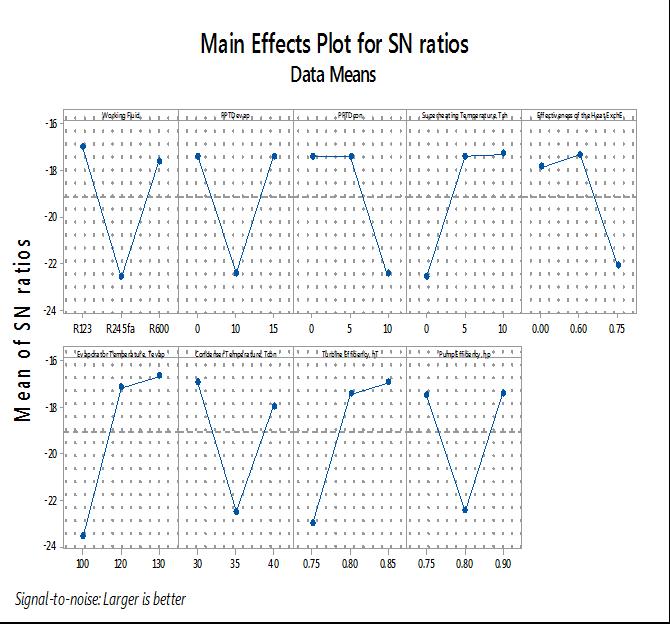
Furthermore, the optimum level of design parameters is thelevelwiththemaximumS/Nratio.Therefore,working fluid = R123 (A1), PPTDevap = 0°C (B1), PPTDcon = 0°C (C1), Tsh=10°C(D3),ɛexc=0.75(E3), Tevap =130°C(F3), Tcon= 30°C (G1), ηT= 85% (H3) and ηp= 90% (I3) are determined as design parameter optimum values for maximum ORC thermal efficiency. When the optimum condition (A1B1C1D3E3F3G1H3I3) is chosen for ORC thermodynamic analysis, thermal efficiency is calculated as 17.3%, which is the maximum value that can be obtainedundertheseworkingconditions
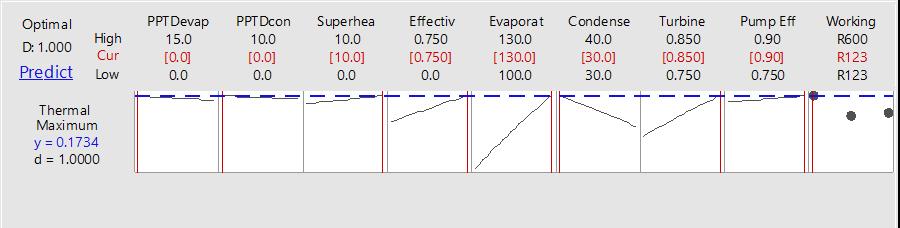
Table4.1TaguchiAnalysis:ThermalEfficiencyversus working...pEfficiency,ηpResponseTableforSignalto NoiseRatios
Table4.2TaguchiAnalysis:ThermalEfficiencyversus working...pEfficiency,ηpResponseTableforResponse TableforMeans

Although thiscase(A1B1C1D3E2F3G1H3I3) is notamong the 27 cases located in Table 4, the highest thermal efficiencyisstatisticallyobtainedforthiscase.Asseen,the Taguchi method allows determination of the cycle’s optimum working condition without calculating each possibility. On the other hand, despite PPTD=0°C is ideal conditionforevaporatorandcondenser;itdoesnotreflect actual operating conditions for the heat exchangers. Since thisisaparametricstudy,theoperatingrangeswerekept as wide as possible. For this reason, the PPTD values are initialized at 0°C. Although the condition of PPTD=0°C is practically impossible, it theoretically gives the best
working condition. In addition to the optimum condition, the worst working condition has been determined as A3B3C3D1E1F1G3H1I1.
4.2
An L15orthogonal array is used in the current analysis. Multi-attribute decisions can be obtained using the grey relationalanalysistechnique.Theexperimentalresultsfor thermal efficiencyand machining force in GRA are normalisedtoanumberbetween0and1.Theinformation forthermalefficiencyisexpressedasmaximumvaluesfor all objective functions. The higher is better. Thermal efficiency is maximum and stated as if the response is to bemaximum,thenhigherthebetterqualitiesismeantfor normalisationtoscaleitintoanacceptablerangeusingthe followingformulavariation.


Where ) (k yi indicatesthenormalizationvalueofgrey relationalgeneration,max ) (k xi andmin ) (k xi express themaximumandminimumvalueof ) (k xi ,respectively. Lastly, ) (k xi representstheoptimumvalue.
Additionally, Grey relation analysis method is implementedasanoptimizationtechniqueformaximizing the first law efficiencies simultaneously. Evaporator temperature, turbine efficiency, heat exchanger effectiveness, and condenser temperature are derived as the primary process parameters from the Grey relation analysis, and the impact ratios of these parameters are estimated as 48.90.37%, 17.43%, 10.80%, and 12.32%, respectively.Theoptimumandworstoperatingconditions for ORC are identified as A1B1C3D3E3F3G1H3I3 and A3B3C1D1E1F1G3H1I1, respectively, after taking into account several performance characteristics. The optimal conditionpresentsthehighestfirstlawefficiencies.Within the range of analysed operating conditions, the system's first law efficiencies are found to be 17.3% for the best case. The first are found to be 9.6% for the worst condition.
CONCLUSION
1. The investigation of grey relationmethod is implemented as an optimization technique for maximizing the first law efficiencies simultaneously. Evaporator temperature, turbine efficiency, heat exchanger effectiveness, and condenser temperature are derived as the primary process parameters from the Grey relation analysis, and the impact ratios of these parameters are estimated as 48.90.37%, 17.43%, 10.80%,and12.32%,respectively.
2. The optimum and worst operating conditions for ORCareidentifiedasA1B1C3D3E3F3G1H3I3and A3B3C1D1E1F1G3H1I1, respectively, within the range of analysed operating conditions, the system's first law efficiencies determined to be 17.3% for the best case. The first observed to be 9.6% for the worst condition. This study lists the
ORC process parameters that are effective and ineffective as well as their statistical impact weightrankings.
3. the optimum level of design parameters is the level with the maximum S/N ratio. Therefore, working fluid = R123 (A1), PPTDevap = 0°C (B1), PPTDcon = 0°C (C1), Tsh= 10°C (D3), ɛexc= 0.75 (E3), Tevap = 130°C (F3), Tcon= 30°C (G1), ηT= 85% (H3) and ηp= 90% (I3) are determined as design parameter optimum values for maximum ORC thermal efficiency. When the optimum condition (A1B1C1D3E3F3G1H3I3) is chosen for ORC thermodynamic analysis, thermal efficiency is calculated as 17.3%, which is the maximum value that can be obtained under these working conditions
4. The value for the R –sq is 91.51% which is good agreement between the input and the output relationship. It shows that there is strong relationship between the input and the output variables. Now the value of the R-Sq (adj) = 92.04%hence the data are well fitted for the new setsofthevariables
5. Statistically, F-test decides whether the parameters are significantly different. A larger F valueshowsthegreaterimpactontheEvaporator Temperature, Tevap performance characteristics [15].LargerFvaluesareobservedfor Evaporator Temperature(P=0.00)(51.67%)
Reference:
1. Abdellah, Youcef et al. 2021. “Towards Improvementof Waste Heat Recovery Systems:A Multi-Objective Optimization of Different Organic Rankine Cycle Configurations.” International Journal of Thermofluids: 100100. https://doi.org/10.1016/j.ijft.2021.100100.

2. Annuar, Arbainah Shamsul et al. 2021. “Jo Ur l P Re.” Carbohydrate Polymers: 118159. https://doi.org/10.1016/j.carbpol.2021.118159.
3. Authors, For. 2017. “Grey Systems : Theory and ApplicationArticleInformation :”
4. Bademlioglu, A H, A S Canbolat, and O Kaynakli. 2020. “Multi-Objective Optimization of Parameters Affecting Organic Rankine Cycle Performance Characteristics with Taguchi-Grey Relational Analysis.” Renewable and Sustainable Energy Reviews 117(March 2019): 109483. https://doi.org/10.1016/j.rser.2019.109483.
5. Bademlioglu, A H, A S Canbolat, N Yamankaradeniz, and O Kaynakli. 2018. “Investigation of Parameters Affecting Organic Rankine Cycle Efficiency by Using Taguchi and ANOVA Methods.” Applied Thermal Engineering https://doi.org/10.1016/j.applthermaleng.2018.0 9.032.
6. Ehyaei, E Ghasemian M A. 2017. “Evaluation and Optimization of Organic Rankine Cycle ( ORC ) withAlgorithmsNSGA-II,MOPSO,andMOEAfor Eight Coolant Fluids.” International Journal of EnergyandEnvironmentalEngineering.
7. Gimelli, A, A Luongo, and M Muccillo. 2016. “EFFICIENCY AND COST OPTIMIZATION OF A REGENERATIVE ORGANIC RANKINE CYCLE POWER PLANT THROUGH THE MULTIOBJECTIVE APPROACH.” Applied Thermal Engineering
http://dx.doi.org/10.1016/j.applthermaleng.2016 .12.009.
8. Goyal, Ashwni, Ahmad Faizan Sherwani, and Deepak Tiwari. 2019. “Environmental Effects OptimizationofCyclicParametersforORCSystem Using Response Surface Methodology ( RSM ).” Energy Sources, Part A: Recovery, Utilization, and Environmental Effects 0(00): 1–14. https://doi.org/10.1080/15567036.2019.163344
3.
9. Heberle, Florian, and Dieter Brüggemann. 2010. “Exergy Based Fl Uid Selection for a Geothermal Organic Rankine Cycle for Combined Heat and PowerGeneration.”30:1326–32.
10. Le, Van Long, Abdelhamid Kheiri, Michel Feidt, and Sandrine Pelloux-prayer. 2014. “Thermodynamic and Economic Optimizations of a Waste Heat to Power Plant Driven by a Subcritical ORC ( Organic Rankine Cycle ) Using Pure or Zeotropic Working Fl Uid.” Energy http://dx.doi.org/10.1016/j.energy.2014.10.051.