Smart Solar Energy System: Application for Traffic in Saudi Arabia
Idris H. Smaili,1* Ghazi Ben Hmida,11Electrical Engineering Department, College of Engineering, Jazan University, P.O. Box114, Jazan 45142, Saudi Arabia ***

Abstract - The purpose of this study is to encourage the usage of solar Energy in Saudi's remote, off-grid rural areas to power traffic light installations. It takes a photovoltaic system to continually consume this energy. In the study, the components, methodology, design investigations, and findings are presented. The primary power source for the system's operation is provided by solar cells, which absorb light and produce electricity. To provide electricity to the system when there is no sunlight, lead-acid batteries are adopted as the PV system's electric energy storage. To charge the storage battery, a charger circuit was constructed.
Key Words: solar energy, power source, photovoltaic system, sunlight, traffic light
1. INTRODUCTION
As the world continues to face the challenges of climate changeandenergyscarcity,thereisanincreasedneedfor sustainable and renewable energy sources. One such source is solar power, which has been gaining popularity in recent years due to its numerous benefits. Smart solar energy systems have been developed for use in various applications,includingtrafficmanagement.Solar-powered traffic systems have several advantages over traditional grid-powered systems. First and foremost, they are environmentally friendly since they do not emit harmful gases into the atmosphere. Additionally, they are costeffective since they rely on a free source of energy –sunlight – that requires minimal maintenance costs. Another benefit of smart solar-powered traffic systems is their reliability [1]. They can function during power outages or when there is a disruption in the power grid, ensuring uninterrupted traffic flow. Furthermore, these systems can be designed to include sensors that detect changes in weather conditions or traffic density, allowing them to adjust their operations accordingly. Smart solar energy systems for transportation have several advantages over typical grid-powered systems. These include environmental friendliness, cost-effectiveness, reliability, and adaptability. As such, it is important to continue exploring ways in which solar power can be harnessed for various applications as we strive toward a moresustainablefuture[2,3].
Solar-powered traffic systems have become increasingly popularinrecentyearsduetotheirnumerousadvantages. One of the most significant benefits of these systems is
that they rely on a clean and renewable source of energy, which reduces carbon emissions and helps to mitigate climate change. In addition, solar power is much cheaper than traditional electricity sources, which makes it an economically viable option for cities and municipalities looking to reduce their energy costs. The use of solar power also ensures that traffic lights and other infrastructure remain operational even during power outages or other emergencies, which can improve safety on the roads. Another advantage of solar-powered traffic systemsisthattheyarehighlyefficientandreliable.Unlike traditional electrical grid systems, which can experience frequent interruptions or failures due to weather events or equipment malfunctions, solar-powered systems are designed to be self-sufficient and require minimal maintenance. This means that traffic signals can operate continuouslywithoutinterruption,ensuringsmoothtraffic flow and reducing the risk of accidents caused by malfunctioning lights [4]. Moreover, solar-powered traffic systemsoffergreaterflexibilityintermsofplacementand installation compared to traditional electrical grid systems. Because they do not require a connection to the electrical grid, these systems can be installed in remote locations where access to electricity may be limited or non-existent. This makes them an ideal solution for rural areas or developing countries where access to reliable electricity is often scarce. In addition, solar-powered traffic systems are much safer than traditional electrical grid systems since there is no risk of electrocution from exposed wiresorfaultyequipment.Furthermore,because solarpanelsareusuallymountedhighabovegroundlevel on poles or other structures, they are less susceptible to damage from vehicle collisions or vandalism than traditionalstreetlights.Solar-poweredtrafficsystemshelp reduce reliance on fossil fuels by providing a sustainable alternative source of energy that does not contribute to greenhouse gas emissions [5] This helps promote environmental sustainability while also reducing dependence on foreign oil supplies. The advantages offered by smart solar energy systems for traffic are numerous and significant. From reducing carbon emissions and improving safety to increasing efficiency andreliability,solar-poweredtrafficsystemsofferarange of benefits that make them an attractive option for cities and municipalities around the world. As we continue to work towards a more sustainable future, it is clear that solar power will play an increasingly important role in poweringourtransportationinfrastructure[6,7].
Smart solar energy systems for traffic are the future of sustainable transportation. Solar-powered traffic systems come with numerous advantagesthat makethem a viable alternative to traditional electricity-powered systems. Firstly, they are cost-effective, as they do not require any additional costs in terms of energy bills or maintenance costs.Thismakesthemanidealsolutionforcountriesand cities struggling with limited budgets. Secondly, solar-powered traffic systems are environmentally friendly and contribute to reduced carbonemissions.Thisiscriticalinthefightagainstglobal warming and climate change. Additionally, these systems can function effectively even during power outages or natural disasters when traditional electrical grids may be down. Another advantage of smart solar energy systems fortrafficistheir reliability anddurability.Thesesystems can withstand harsh weather conditions such as extreme temperatures, rain, hailstorms, and snowfall without affectingtheirperformance.Furthermore,theuseofsolarpowered traffic lights can reduce accidents on roads by providing adequate visibility at all times. This helps to ensure that drivers follow road safety rules and regulations. Overall, the benefits of smart solar energy systemsfortrafficcannot beoverstated.These innovative solutionsoffera moresustainableandreliablealternative to traditional electricity-powered systems while also contributing to environmental conservation efforts globally[8,9].
In Saudi Arabia's isolated, off-grid rural areas, this study promotes the adoption of solar energy to power traffic light installations. This energy must be continuously consumed, which requires a photovoltaic system. The studypresentstheresultsofthecomponent,methodology, and design studies. Solar cells, which absorb light and generate energy, are the main source of power for the system'soperation.LeadacidbatteriesareusedasthePV system'selectricenergystoragetoutilizeelectricitywhen there is no sunlight. The construction of a charger circuit was built to charge the storage battery. Infrared (IR) sensors have been employed primarily to control the traffic signal sequence based on the crowd of traffic. In other words, the smart energy system uses sensors to detecttheflowoftrafficandadjustthetimingofthetraffic lights accordingly. This system also incorporates a renewableenergysource,whichisasolarpanel,topower the traffic lights. By using renewable energy sources, this system reduces carbon emissions and helps to mitigate climate change. The smart energy system can be integrated with other transportation systems, such as public transport networks, to optimize traffic flow and reduce congestion. The development of a smart energy system for traffic lights is a significant step towards creating sustainable transportation systems that are environmentally friendly while ensuring safety on our roads.
2. METHODOLOGY AND DISCUSSION
Arduino is an open-source electronics platform that has revolutionized the world of technology. It is a microcontroller-based kit, as shown in FIG. 1, that allows users to create a wide range of electronic projects, from simple LED blinkers to complex robots [10,11]. One such project that can be created using Arduino is a traffic light system with smart energy management. Traffic lights are animportantpartofourdailylivesandplayanimportant role in road safety. However, traditional traffic lights consume a lot of energy and are not very efficient. With the help of Arduino, we can create a smart traffic light system that uses renewable energy sources and reduces energyconsumption.

The Arduino-based traffic light system consists of two LEDs (red and green) connected to the microcontroller board. The system also includes sensors that detect the presence of vehicles and pedestrians at the intersection. The sensors send signals to the microcontroller board, whichthencontrolstheLEDsaccordingly.
2.1 Smart Traffic Control System
Oneofthekeyfeaturesofthesmarttrafficcontrolsystem isitsabilitytoadapttochangingtraffic conditionsinrealtime. For example, if there is an accident or road closure on a particular route, the system can quickly reroute traffic to alternative routes to minimize delays and congestion.Anotheradvantageofthistechnologyisthatit canbeintegratedwithothertransportationsystems,such as public transit. By coordinating traffic schedules with traffic signals, the smart traffic control system can help reduce wait times for commuters and improve overall travel times. The mechanism of action of the system includes three different stages, as illustrated in FIG. 2. Thesestagesare:
Sense traffic: Smart traffic control systems must incorporate sense traffic technology if they are to truly revolutionize urban transportation. Sense traffic is a vital component of any smart traffic control system. Its absence limits the potential benefits of such systems and hinders efforts to improve urban mobility. Therefore, city planners must prioritize the implementation of sense traffic technology when designing smart transportation solutions.
The sense traffic stage involves using IR sensors to detect the number of vehicles on the road, their speed,andtheirdirectionoftravel.Thisinformation is then used to adjust traffic signals and optimize trafficflow.
Control traffic: Onekeyfeatureofthesystemisthe abilitytocontrol trafficstages,whichinvolves using real-time data to modify the timing of traffic lights. There are several benefits to controlling traffic stagesinasmarttrafficcontrolsystem.Firstly,itcan help to reduce congestion by ensuring that vehicles aremovingsmoothlythroughintersections.Thiscan also lead to a reduction in emissions from idling vehicles, contributing to improved air quality. In addition, controlling traffic stages can improve road safety by reducing the likelihood of accidents at intersections.Byadjustingthetimingoflightsbased on factors such as pedestrian crossings and turning vehicles, the risk of collisions can be significantly reduced.

Traffic signals: One of the key benefits of incorporating traffic signals into a smart traffic control system is that they can be programmed to respond dynamically to changing traffic conditions. This means that they can adjust their timing based on real-time data about traffic volume, congestion, and accidents. In the system, LEDs are interfaced with the Arduino Uno. Red and green signals have beenadoptedforeachlane.
2.2 Programming Logic and Arduino Port Manipulation
Arduino programming logic and port manipulation are two essential concepts that every Arduino programmer mustunderstand.TheArduinoboardisamicrocontroller-
based platform that uses a simplified version of the C++ programming language. The programming logic in Arduino involves using conditional statements, loops, and functionstocontrolthebehaviorofthemicrocontroller.
Port manipulation is another critical concept in Arduino programming,whichinvolvescontrollingtheinput/output (I/O) pins on the microcontroller. These pins can be used to connect sensors, actuators, and other electronic components to the Arduino board. Port manipulation allows programmers to control these pins directly by settingtheirvaluestohighorlow.
Bycombiningthesetwoconcepts,complexprojects,which involve multiple sensors and actuators, can be created. Overall, understanding Arduino programming logic and port manipulation is crucial for anyone looking to create innovative projects using this powerful microcontroller platform. The programming logic of the system can be summarizedasfollows:
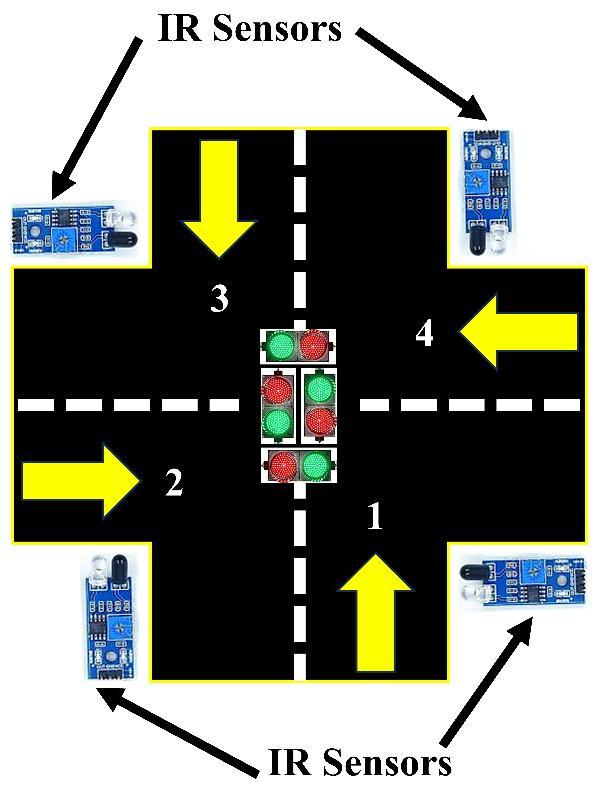
AsshowninFigure3,therearefourdistinctroads labeled1,2,3,and4.
Generally, the system will start clearing traffic fromroads1,2,3,and4intheend.
Traffic preference is given to the busiest lane. In other words, the green LED will be high, and the red LED will be low in the busiest lane. Green LEDs of other traffic lines will be low, and red LEDswillbehigh.
Controlling traffic lights, sensors, and other componentsofatrafficsystemwithprecisionand accuracyisfeasiblebycontrollingtheportsonan Arduinoboard.Portmanipulationofthesystemis adoptedasfollows:

Digitalpins0to7representportDinArduino
Multiple pins can be controlled at the same time byusingregisters
Values of the pins are stored in ports by starting initialization from right to left, i.e., pin7, pin6, pin5,pin4,pin3,pin2,pin1,pin0.
ThedirectionregisterforportDisrepresentedby DDRD.
DDRD is written in the void setup () part of the Arduinocode.
Setting pins to HIGH or Low values is accomplished by using the command PORTD, which stands for register for the state of the outputs.
PORTDiswrittenvoidloop()partoftheArduino code.
Thefinaltrafficcodeisasfollows: intsensor1; intsensor2; intsensor3; intsensor4; voidsetup()
DDRD=B11111111; PORTD=B00000000; voidloop()
sensor1=digitalRead(8); sensor2=digitalRead(9); sensor3=digitalRead(10); sensor4=digitalRead(11); if(sensor1==1)
PORTD=B11100001; delay(2000); elseif(sensor2==1)
PORTD=B11010010; delay(2000); elseif(sensor3==1)
PORTD=B10110100; delay(2000); elseif(sensor4==1)
PORTD=B01111000; delay(2000); else
PORTD=B11100001; delay(1000);
PORTD=B11010010;
delay(1000); PORTD=B10110100; delay(1000); PORTD=B01111000; delay(1000);
3. PROTOTYPE OF THE SMART SOLAR ENERGY SYSTEM
This system uses solar energy to power traffic lights and other road signs, reducing our reliance on nonrenewable energy sources and aiding in climate change mitigation. Some may argue that implementing this system would be prohibitively expensive or impractical. While the initial costs of installing the necessary infrastructure may be high, the long-term benefits of reduced energy consumption and improved traffic flow make it a worthwhileinvestment.
3.1 Battery charger with voltage regulator
Solar battery chargers have revolutionized the world of portable electronic devices. With the increasing reliance onsmartphones,tablets,andothergadgets,theneedfora dependable and long-lasting power source is more importantthanever.Solarbatterychargers,whichusethe powerofthesuntochargeourdevices,provideapractical solutiontothisproblem.
One of the primary benefits of solar battery chargers is thatthey are environmentallyfriendly. Solarchargers use clean and renewable energy, as opposed to traditional chargersthatuseelectricityderivedfromfossilfuels. This not only reduces our carbon footprint but also aids in the fightagainstclimatechange.
Furthermore, solar battery chargers are portable and convenient.Theyareperfectforoutdooractivitiesbecause they are lightweight and compact. Therefore, a solar
battery charger has been modified to charge the system's mainbattery,asseeninFig.4.ASolarpanel,diodes,LEDs, a transistor, resistances, and an LM317 voltage regulator areamongthecomponentsused.
TheLM317isa voltageregulatorwiththreeterminalsfor voltage regulation. It regulates the positive voltage from 1.25 to 37 volts depending on the output requirements. Two exterior resistances are required for output voltage adjustment.Itprovidedlineregulationof0.01percentand loadregulationof0.1percent.Ithasvariousfeaturessuch asoverloadcurrentlimitingandsavingoperatingfunction requirements.
Thiscircuitworksonthepremisethatacharger-regulated circuit will generate a constant voltage. The charging current is routed to the voltage regulator via the first diode in this configuration. The regulator's regulation pinout controls the output voltage and current the regulated current used by the battery. The circuit presentedinFig.4showsa12-voltsolarpanelpoweringa 9-volt battery. The LM317 acts as a regulator, and the transistor acts as a switch to control the operation and charging of the battery. When assessing the viability and effectiveness of renewableenergysources,theefficiencyofsolarpanelsis critical. Temperature is a critical factor that has a significant impact on solar panel efficiency. The relationship between temperature and solar panel efficiency has long been a source of contention among scientists and experts. As shown in Fig. 5, the maximum outputvoltageofthesolarpanelwasabout9volts.
usedinsolar cells,this phenomenon occurs.Becausehigh temperatures increase electron mobility, there are more recombination losses and lower energy conversion rates. Furthermore, high temperatures can cause thermal stress on the materials used in solar panels, resulting in degradation over time. This can lead to a shorter lifespan andhighermaintenancecostsforsolarinstallations.
3.2 Prototype of the system
Using Arduino to combine IR sensors with a battery charger and voltage regulator is a game-changing innovation with numerous advantages. For starters, the incorporation of infrared sensors allows for the efficient and accurate detection of objects or obstacles in the vicinity,therebyimprovingsafetymeasures.Furthermore, the inclusion of a battery charger ensures that the device receivesacontinuouspowersupply.Thisreducestheneed for frequent battery replacements while also reducing environmental waste. Furthermore, by incorporating a voltage regulator, voltage fluctuations are regulated, preventing damage to sensitive components. The Arduino platform provides an open-source programming and customization environment, making it accessible to both professionals and hobbyists. Additionally, this combination offers affordable solutions because it does not require additional devices. Fig. 6 depicts the smart solarenergysystem'sfinalprototype.
Fig -5:Measurementsofthesolarpanel
High temperatures are widely acknowledged to decrease theperformanceofsolarpanels.Asthetemperaturerises, so does the electrical output, resulting in lower overall efficiency. Because of the nature of the semiconductors
4. CONCLUSIONS
This study promotes the use of solar energy to power traffic light installations in Saudi Arabia's remote, off-grid rural areas. A photovoltaic system is required to continuously consume this energy. The components, methodology, design investigations, and findings are presentedinthestudy.Solarcells,whichabsorblightand produce electricity, are the primary power source for the system'soperation.LeadacidbatteriesareusedasthePV


system's electric energy storage to use electricity when there is no sunlight. A charger circuit was built to charge the storage battery. LED stoplights are energy efficient, have a long life span, and require little maintenance. The manipulated stop light used in this project was useful because the microcontroller could be programmed at any timeifaphasechangewasneeded.
REFERENCES
[1] A. Olabi, "Energy quadrilemma and the future of renewableenergy,"2016.
[2] B. V. Mathiesen, H. Lund, D. Connolly, H. Wenzel, P. A. Østergaard, B. Möller, S. Nielsen, I. Ridjan, P. Karnøe, K. Sperling, et al., "Smart energy systems for coherent 100% renewable energy and transport solutions," Applied Energy,vol.145,pp.139–154,2015.
[3] H. Lund, P. A. Østergaard, D. Connolly, and B. V. Mathiesen, "Smart energy and smart energy systems," Energy,vol.137,pp.556–565,2017.
[4]R.Bogue,"Solar-poweredsensors:areviewofproducts andapplications," Sensor Review,2012.
[5]P.Manikandan,S.Karthick,S.Saravanan,andT.Divya, "Role of solar powered automatic traffic light controller forenergyconservation," International Research Journal of Engineering and Technology (IRJET), vol. 5, no. 12, pp. 989–992,2018.
[6] K. Reddy, S. Aravindhan, and T. K. Mallick, "Technoeconomic investigation of solar powered electric autorickshaw for a sustainable transport system," Energies,vol.10,no.6,p.754,2017.
[7]L.P.R.NadimuthuandK.Victor,"Performanceanalysis and optimization of solar-powered e-rickshaw for environmental sustainability in rural transportation," Environmental Science and Pollution Research, vol. 28, pp. 34278–34289,2021.
[8] S. Xie, Z. Hu, J. Wang, and Y. Chen, "The optimal planning of smart multi-energy systems incorporating transportation, natural gas and active distribution networks," AppliedEnergy,vol.269,p.115006,2020.
[9]A.Razmjoo,S.Mirjalili,M.Aliehyaei,P.A.Østergaard,A. Ahmadi,andM.M.Nezhad,"Developmentofsmartenergy systems for communities: Technologies, policies and applications," Energy,vol.248,p.123540,2022.
[10] Y. A. Badamasi, "The working principle of an Arduino," in 2014 11th international conference on electronics, computer and computation (ICECCO), pp. 1–4, IEEE,2014.
[11]S.A.Arduino,"Arduino," Arduino LLC,vol.372,2015.