PERFORMANCE BASED ANALYSIS OF RC STRUCTURE WITH AND WITHOUT CONSIDERING SOIL STRUCTURE INTERACTION
Dr. M Keshava Murthy1 , Harini R21Professor, Dept of Civil Engineering, University Visvesvaraya College of Engineering, Bengaluru, India
2M.techstudent, Dept of Civil Engineering, University Visvesvaraya College of Engineering, Bengaluru, India

***
Abstract - There are considerable exchanges amongst structural engineers about structural modelling but not important about the modelling of foundation. While modelling any structure, the foundation is modelledinatruly simplistic manner. It's assumed as fixed, roller support. Still, in reality, analogous idealized foundations are truly rare. Ultimate of the foundations are footings, mat, piles, or other bedded structures. In fact, foundations are constantly huge structures by themselves. It may not always be goodtosimply convert them into single point and also assume them to be fixed or roller. The effect of soil structure interaction (SSI) on the Reinforced Concrete framed structures is directly told by the soil properties of the site. Pushover analysis which is also stated as Non linear static analysis is considerably accustomed procedures for the seismic assessment or evaluation of the structures. In the present work, the pushover model is used to measure thenewstructuresseismic demand or for current structures. Pushover review is carried out by considering G+8 multi- storeyed structure in Zone II, III, IV, and V using ETABSv20 software in all soil types i.e., Hard, Medium and Soft soil.
Key Words: Soil structure interaction, Modal analysis, Equivalent static analysis, Response spectrum analysis, Performance point.
1. INTRODUCTION
The failure of land compels masterminds to construct structures at site with lower favourable Geotechnical conditions in seismically active regions. Earthquake produces strong ground movements the impact on a structureduringanearthquakereliesupontheproperties of the ground soil, intensity of earthquake and structural system.Duringanearthquakeseismicwavesaretransmits throughsoilfromtheoriginofdisturbancetothestructure thewavemotionofthesoilexcitesthestructure,whichin turnmodifiestheinputmotionbyitsmovementrelativeto theground.Themovementsofsoilunder foundationwill interactwiththedistortionsofthestructureitself.Thus,a performance- grounded design is needed, which is incompletelysatisfiedthroughpushoveranalysis.Generally forseismicanalysis,structuresareassumedtobe strictly restrained at the foundation position, and thereby neglectingtheeffectofSSI.Butinreality,whenastructure isincontactwithanearthquakeexcitationitinteractswith
thesoil,andtherefore,thiscommerceaffectsthestructural response.Thus,duetotheconsiderationofinteractionof soil and the structure remains a very crucial issue in earthquakedesign.Present studyaimstounderstandthe effectofsoilinflexibilityonvariousresponseparametersof erecting frames with and without considering the soil structureinteraction.
1.1 Soil Structure Interaction
Soilstructureinteractionisdefinedasaprocesswherethe seismicexcitationthatoccursintheundergroundsoilnot onlycausesthemovementofsoilbutalsoaffectsresponse of the structure above the soil in turn this change in the structure causes changes in the soil movement. Although theeffectofSSIontherigidsoil,structuresthatarelowrise is negligible it's a very important aspect under considerationforsoftsoil,highrisestructures,roadways, heavy structures nuclear power plants, hydraulic structures. This conservative simplification is valid for certain class of structures and soil conditions, similar as light structures in fairly stiff soil. Unfortunately, the supposition doesn't always hold true. In fact, the soil structureinteractioncanhaveamischievouseffectonthe structuralresponse,andneglectingSSIintheanalysismay leadtounsafedesignforboththesuperstructureandthe foundation.
1.2 Approaches for Soil-Structure Interaction analysis
1.Methodsbasedonthehalf-spacetheory
a) Directapproach
b) Indirectapproach
2.Analyticalmethods
a) Winklerapproach
b) P-ymethod
c) Elasticcontinuumapproach
3.NumericalMethods
a) Finiteelementmethod
b) Finitedifferencemethod
c) Boundaryelementmethod
1.3 Modelling of soil by Winkler model
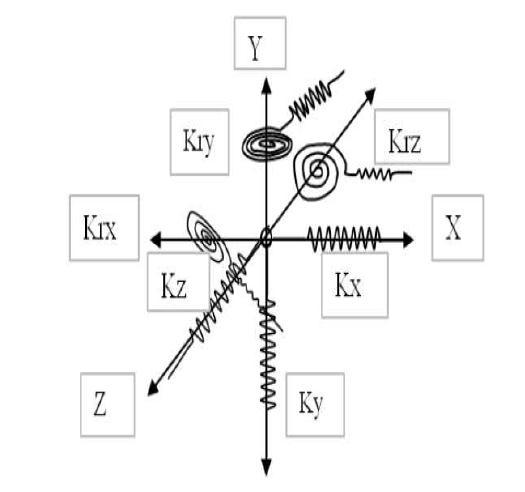
Theflexibilityofsoilisgenerallymodelledbyfittingsprings betweenthefoundation memberandsoilmedium. While modelling, the number of degree of freedom should be named precisely considering the ideal of the analysis. Duringearthquakearigidbasemaybeunderdisplacement insixdegreesoffreedom,andthusresistanceofsoilcanbe expressedbythesixcorrespondingresultantforcefactors Hencetomaketheanalysismostgeneral restatementsof foundation in two mutually perpendicular principle horizontal directions and vertical direction as well as rotation of the same about these three directions are consideredinthisstudy.
Where,G=dynamicshearmodulusofsoilandiscalculated byG=E/2(1+µ)
µ=Poisson’sratioofthesoil
K=equivalentspringstiffnessofthesoil
3. Present study uses both Response spectrum analysis and Push over analysis with and without the considerationofSoilstructureinteractionandalsothe Performancelevels,behaviourofthecomponentsand failuremechanisminabuilding.
4. AnalysisbyusingETABSv20andgeneratingtheresults.
4. SPECIFICATION OF THE MODEL
4.1 Plan Details
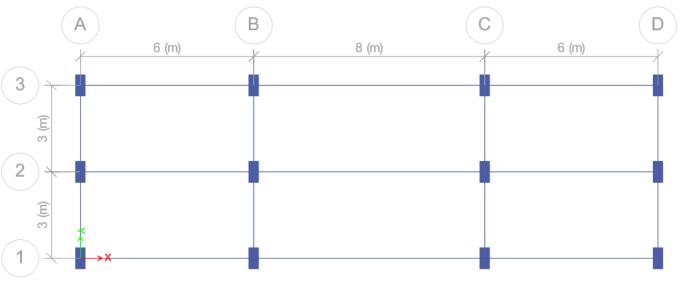
Thestudyframeis3bayx2bayRCstructurewithstorey heightof3mconsistingoftotally8stories.Thefirstandthe thirdbaylengthalongXdirectionis6mandthecentralbay lengthis8m.Theplanofthestructureisrectangle.AlongY directionboththebaysare3m.Theframeisassumedtobe specialmomentresistingframe.
Figure:1springsystematthefoundation
2. OBJECTIVE
Tostudythebehaviourofstructurewithandwithoutthe Soil structureinteractionwithRaftfoundation resting on differenttypeofsoilusingWinklermodel.Thereinforced concrete frame structures is analysed by linear i.e., Responsespectrumanalysisandnonlinearstaticanalysis i.e.,pushoveranalysisusingETABSv20Software.Itshows theperformancelevels,behaviourofthecomponentsand failuremediuminastructure.
3. METHODOLOGY
1. InthisstudysimpleRCframewithRaftfoundation,Slab istakenandisconsideredfor8storeybuilding.
2. Three type of soil i.e., Hard, Medium and Soft soil is consideredasperIScode1893:2016for ZoneII,Zone III, Zone IV and Zone V with soil springs proposed by Winkler.
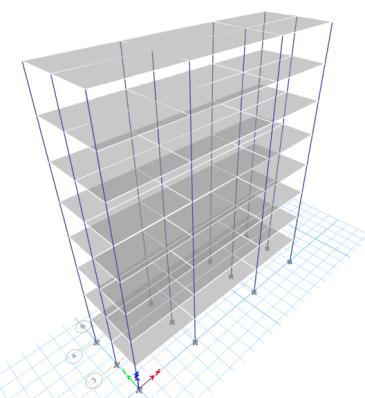
Conventional analysesof structuresare generallycarried outbyassumingthebaseofstructuretobefixed.Fixedbase modelisdonetocomparewiththat ofSSImodel.3Dview of8storeystructurewithfixedbaseisgivenbelow.
The various loads such as DL, LL, Wall load and FF was consideredasperIScodeprovisions.DLconsistsofweight of floor slab, roof slab, beams and columns. The LL is 3 kN/m²atfloorslaband1.5kN/m²atroofslab.TheFFload onallthefloorsis1.5kN/m².Thewallloadof8.8kN/m²is appliedonfloorbeamsand2kN/m²onroof.Thestructure isassumedtobesituatedin seismic ZoneII,III,IVandV, withanIfactorof1.5andresponsereductionfactorRof5. The slab thickness is 100mm. In order to account for seismicactions,IS:18932016ResponseSpectrumanalysis wasusedtoarriveattheStructuraldetailsadheringtothe code guidelines. The live load is applied directly on slabs andwhilecomputingthemasssource,25%ofliveloadis considered as per IS code provisions. The grade of the concreteisM25andSteelisFe500.
4.2 Loads
1. Dead load (Table2asperIS875(part1):1987)
2. Live load (Table1asperIS875(part2):1987)


3. Seismic load
Importancefactor,I=1.5


Responsereductionfactor,R=5
Zone factor, Z = 0.1, 0.16, 0.24, 0.36 for Zone II, Zone III, ZoneIVandZoneVrespectively.

DesignresponsespectraconstructedasperIS1893:2016 forallthefourzonesandthreetypesofsoil.
4.3 Load Combinations
1. 1.5(DL+LL)
2. 1.2(DL+LL+EQX)
3. 1.2(DL+LL-EQX)
4. 1.2(DL+LL+EQY)
5. 1.2(DL+LL-EQY)
6. 1.5(DL+EQX)
7. 1.5(DL-EQX)
8. 1.5(DL+EQY)
9. 1.5(DL-EQY)
10. 0.9(DL)+1.5(EQX)
11. 0.9(DL)-1.5(EQX)
12. 0.9(DL)+1.5(EQY)
13. 0.9(DL)-1.5(EQY)
14. 1.0(DL+LL)
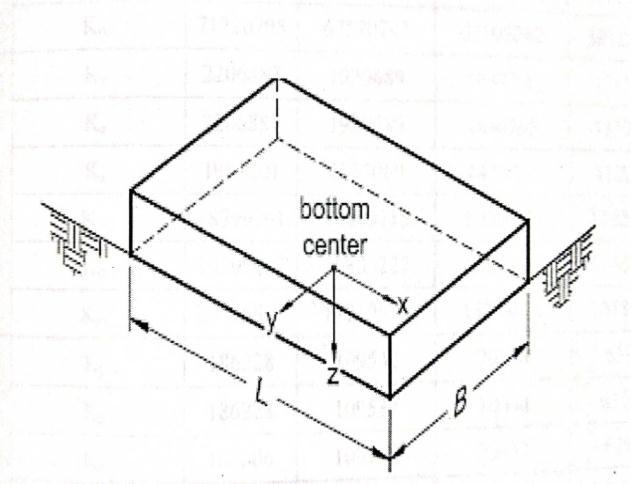
L=Lengthofthefoundation
B=widthofthefoundation
Thewholeareaismeshedwithquadshellelementsandsoil springsareapplied.
Table-5: CalculatedsoilspringvaluesasperRichartand Lysmer
5. RESULTS AND DISCUSSION
Medium
rz=6.84
rx=6.84
røx=5.257
røy=5.257
røz=7.862
rz=6.84
rx=6.84
røx=5.257
røy=5.257
Kz=977140
Kx=Ky=832690
Køx=13836000
Køy=13836000
Køz=64790000
Kz=570000
Kx=Ky=432000
Køx=8070000
Køy=8070000
Thecomparisonresultsofsystematicparameterssuchas ModalTimeperiod,Baseshear,Roofdisplacement,Storey drift and Performance of building has been studied and compared for 8 storey structures with and without soil structureinteraction.

røz=7.862
rz=6.84
rx=6.84
røx=5.257
røy=5.257
røz=7.862
Kz=244280
Kx=Ky=185140
Køz=32390000 Soft
Køx=34450000
Køy=34450000
Køz=13880000
Modal timeperiodforframeswithflexible baseishigher thanframeswithfixedbasei.e.,thesoilhavinglessstiffness have longer time period. The time period of soft soil is greater than that of other soils. The study shows that averagetimeperiodincreases1.7%withsoilflexibilityby theinclusionofSSIwhencomparedtofixedbasemodel.

5.1 RESPONSE SPECTRUM ANALYSIS RESULTS
Base shear
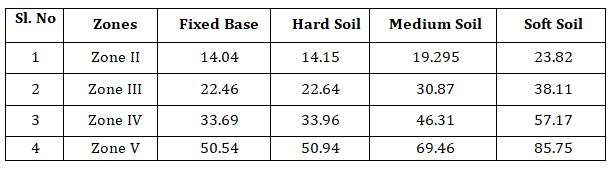
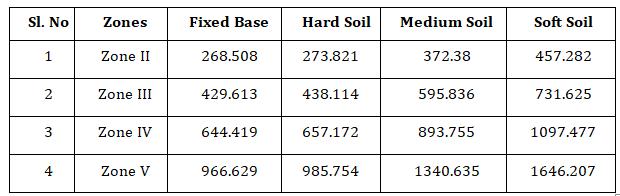
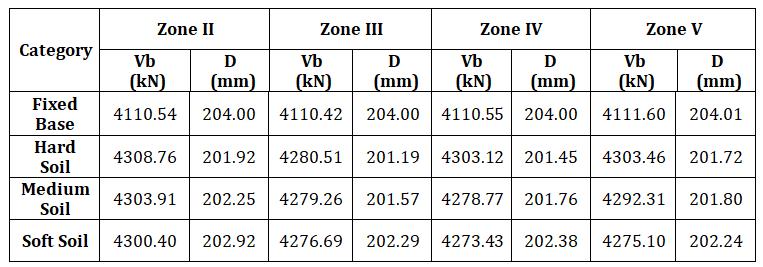
Table-7: Baseshear(Vb)inKN
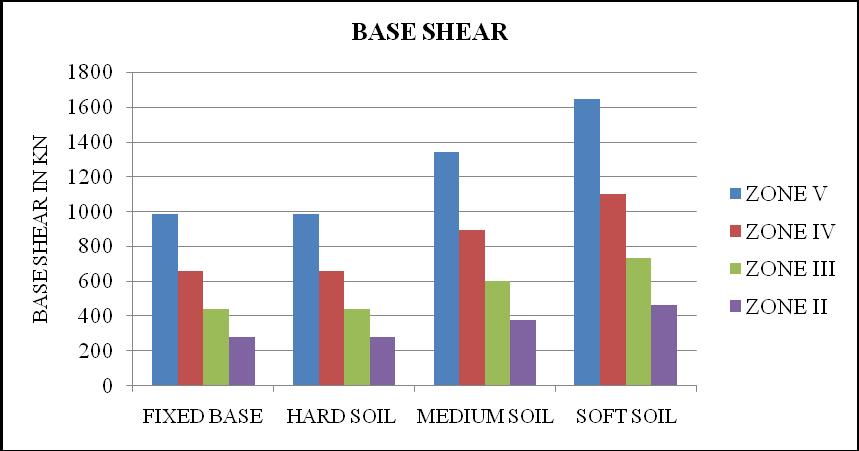
ThegraphshowsthatthebaseshearinSSIareincreasedfor building on soft ground conditions, and for firm ground conditions i.e., hard soil, they are decreased and can be neglectedwhencomparedtofixedcondition.Thereforethis study shows the soil flexibility at the rate of 2%, 38.5%, 70%withrespectto the fixedtoconsidering SSI in Hard, Medium,andSoftsoilmodelsrespectively.
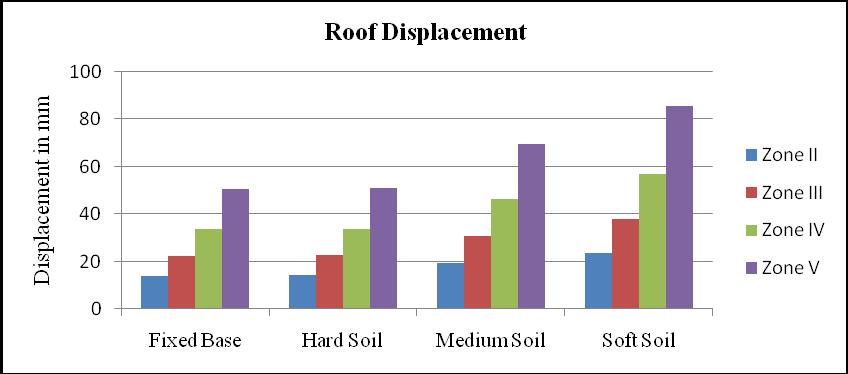
Roof displacement
Table-8: Roofdisplacement(mm)
Storey drift

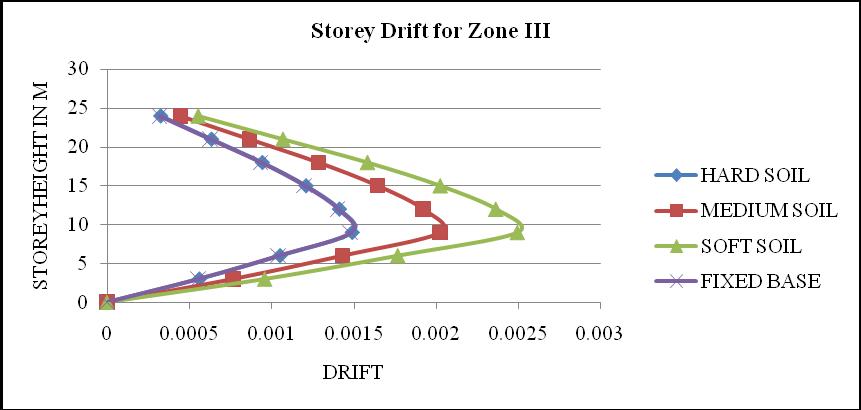

The storey drifts in case of hard soil, it is less when compared to the other two types of soil. Drift slightly increasesinSSImodelwhencomparedtofixedbase,and maximum in case of soft soil condition. The storey Drift increasesinthelowerstoreywhichfurtherincreasesina largerextentatthemiddlestoreylevelsanditisdecreased inthehigherstoreysinallthesoiltypes.Itreachescritical limitvalueswhenthenumberofstoryincreaseswhereas thesoilrigiditydecreasesbecauseoftheflexibilityofsoil especiallyinframesystems.
5.2 PUSHOVER ANALYSIS
Table-9
Abovetableshowsthatthereisanaverageincreaseinbase shear by 4.6 % in spring base condition while compared with fixed base condition. And also there is decrease in deflectionby1%whilecomparedwithfixedbasecondition. Thebaseshearattheperformancepointofthestructureis affected by different soil conditions for different support conditions.Theperformancepointforframeswithflexible base is lower than corresponding values for frames with fixedbase.Thebaseshearobtainedbypushoveranalysisis muchhigher than base shearobtained by linearanalysis. This shows that the value of base shear increases in the consideration of spring base system. Therefore there is morechanceforthebuildingtoactmorevigorouslywhen SSIisconsidered.

6. CONCLUSIONS
Thetimeperiodofsoftsoilisgreaterthanthatofother soils. The study shows that average time period
increases1.7%withsoilflexibilitybytheinclusionofSSI whencomparedtofixedbasemodel.
ThedisplacementishigherincaseofSSIsystemforall thethreetypesofsoilcomparedtofixedconditionandit increases as the flexibility of the soil increases. The storeydisplacementishighforsoftsoilforSSIsystem.It is also seen that as the storey height increases the displacementalsogoesonincreasing.
Roofdisplacementisobservedtobeincreasingdueto SSIforsoftsoilinWinklerapproach(springmodel).The averageincreaseintopdisplacementisabout53%along thezonesfromlowertohigherlevelofseismicity.
Thestoreydriftinthehardsoilislesserwhencompared totheothertwomediumofsoils,andishighforsoftsoil in the both cases such as with SSI and without SSI systemanditismaximumforSSIsystem.
Thebaseshearinthehardsoilislesserwhencompared totheothertwomediumofsoilandishighestforsoft soil under SSI effect. Base shear was increased at the rate of 2%, 38.5%, 70% with respect to the fixed to considering SSI in Hard, Medium, Soft soil models respectively.
Thesoftsoilconditionisconsideredtobemorecritical andunsafewiththeconsiderationofSSI.Thereforeitis necessary to consider SSI effects while designing a structure. The buildings designed without the considerationofSSIeffectswillbelesssafeduringthe timeofearthquakes.
Fromtheresultsofthestudyitwasdiscoveredthatthe hingesareestablishedbetweenImmediateOccupancy and Life Safety suggesting that the building is secure. Thestructuralmodelanalysedinthisstateissafe.
Obtainedresultsclearlyshowthatinteractionbetweensoil andthestructureaffectsbothcalculationofdisplacement capacitiesanddemandsindifferenttypesofsoilsinvarious zones. This situation implies that seismic performance of these buildings should be also examined since the performanceisdeterminedbycomparingbothcapacityand demand.
7. SCOPE FOR FURTHER STUDY
IrregularityinelevationandplanofRCbuildings.
The earthquake resisting elements such as core wall, shearwallandbracingscanbeincorporated.
Dynamic SSI analysis can be continued with different foundationmodelsanddifferentlayersofsoil.
Thisstudycanbeextendedtoanon-lineartimehistory analysisofthebuilding.
Thisstudycanalsoextendforundergroundstructures openstoreystructures,watertanksetc.
EffectofGroundwatertableonSSIcanbeanalyzed.
8. REFERENCES
1. AkshayV.Raut,Prof.RVRKPrasad,“pushoveranalysisof G+3Reinforcedconcretebuildingwithsoftstorey” IOSR Journal of Mechanical and Civil Engineering(IOSR-JMCE), Volume 11, Issue 4 Ver.I, PP25-29,Jul-Aug.2014.
2. BowlesJE.,“FoundationAnalysisandDesign”,McGrawHill,Inc.,1982.
3. BrajaMDas,“PrinciplesofFoundationEngineering”6th edition,2007.
4. DeepashreeR,SKavitha,MamathaPGandVishalBV “Evaluationoftheeffectsofsoilstructureinteractionon amultistoreyrcbuilding”FirstInternationalConference on Advances in Physical Sciences and Materials, 2020.
5. G. Dok, ve O. Kırtel “Soil-Structure Interaction in Nonlinear Pushover Analysis of Frame RC Structures: NonhomogeneousSoilCondition”,UluslararasıDeprem Mühendisliğive Sismoloji Konferansı (UDMSK) 11-13 Ekim2017.
6. Gazetas G, “Formulas and charts for impedances of surface and embedded foundations,” Journal of GeotechnicalEngineering,117(9):1363-138,1990.
7. JoyP.V,BennetKuriakoseandMiniMathew,“Pushover Analysis of Buildings Considering Soil-structure Interaction” Applied Mechanics and Materials, ISSN: 1662-7482,Vol.857,pp189-194.Nov2016..
8. Liu Liping, Xia Kui and Cao Xuan, “The Research of AppliedPushoverMethodintheEarthquakeResistance Analysis of Soil Structure System” The 14th World conferenceonearthquakeengineering,October12-17, 2008.
9. Nasala Dongol, Prachand Man Pradhan, Suman Manandhar“StudyofpushoveranalysisonRCFramed structurewithundergroundstructureconsideringthe effects of soil structure interaction” JSCE, Vol. 8, Sept 2020.
10. Pankaj agarwal and Manish Shrikhande, “Earthquake Resistant Design of Structures” PHI Learning Limited, NewDelhi,13thedition,2014.
11. Prashant Amragol, Dr. Tejas. D. Doshi “Non-Linear Analysis of RC Building Considering Soil Structure Interaction”, International Journal of Engineering Research&Technology(IJERT),ISSN:2278-0181,Vol.9 Issue08,August-2020.
12. PurvaM.Kulkarni,Dr.Y.M.Ghugal“DynamicAnalysisof RCC Building Considering Soil Structure Interaction”, International Research Journal of Engineering and Technology(IRJET)ISSN:2395-0056,Volume:06Issue: 08,Aug2019.
13. S. L. Kramer, "Geotechnical earthquake engineering” Prentice-Hall,Inc.,1996.
14. Sayali.S Takale, Dr. V. D. Gundakalle and Hemant Sonawadekar,“PerformanceEvaluationofOpenGround Storey Building with Soil-Structure Interaction by Pushover Analysis” International Journal of Trend in ResearchandDevelopment, Volume5(1),ISSN:23949333,Feb2018.
15. Taha A. Ansari, Sagar Jamle “Performance Based Analysis of RC Buildings with Underground Storey Considering Soil”, Structure Interaction International JournalofAdvancedEngineeringResearchandScience (IJAERS),Vol-6,Issue-6,June2019.
CODES / STANDARDS
ATC 40, “Seismic Evaluation and Retrofit of concrete buildings”,AppliedTechnicalCouncil,California.
FEMA 356, “Pre-Standard and Commentary for the SeismicRehabilitationofbuildings”,ASCE,Washington, D.C.
IndianStandardIS1893-2016,“CriteriaforEarthquake ResistantDesignofStructures”.
IS456-2000,“IndianStandardcodeofpracticeforPlain andReinforcedconcrete”.
IS: 875 (Part-1 DEAD LOADS) 1987 “Indian Standard Code of Practice for Design Loads for buildings and structures”,BureauofIndianStandards,NewDelhi.
IS: 875 (Part-2 LIVE LOADS) 1987 “Indian Standard Code of Practice for Design Loads for buildings and structures”,BureauofIndianStandards,NewDelhi.