Predictions And Analytics In Healthcare: Advancements In Machine Learning
Vangala Surya Teja Reddy1 , Gatla Akanksh2 , Satyam3, Kalpana Kumari4, Bhanu Talwar51234Undergraduate student, Lovely Professional University, Jalandhar, Punjab

5Professor, Lovely Professional University, Jalandhar, Punjab ***
Abstract - As everyone in this world knows how technology is advancing every day and the drastic changes are occurring in every sector these days and so does in the healthcare sector. Many revolutions are coming our way from this sector because the integrated technology in this sector is helping the scientists, researchers, doctors, etc. to reach their target goals with the help of computers. They can get the exact match or near to that with the help of technology and in the same way the user can also be informed and be filled with the knowledge with the help of these technological advancements. Like, in today’s world, we are seeing a lot of websites or apps that are helping users know their diseases by getting some input from them and they are also getting proper medication based on that result. In this review, there is information about predictive analytics that is framing the healthcare sector and making it more comfortable for the end-user to diagnose their diseases and take charge of them in minimal time. This paper is going to talk about various advancements that can lead to, what we say as, informed user experience, which will keep them informed and also, they will be able to cure themselves at an appropriate time.
Key Words: Healthcare sector, technological advancements,diseases,predictiveanalytics,diagnose, userexperience.
INTRODUCTION
Itisveryessentialforthediagnosisofchronicdiseasesinthe medicalfieldasthesediseasespersistforalongtime.Some of the most common chronic diseases include diabetes, strokes,heartdisease,arthritis,cancer,hepatitisC.Ifwecan detect the disease in an early phase, it will help in taking preventiveactionsandeffectivetreatmentataninitialstage whichisalwaysfoundhelpfulforpatients[1]incuringtheir diseases.
There has been lots and lots of data that can help the healthcaresectortoimproveonmanyweakpointsandalso to do different advancements through the use of modern technologiessuchasmachinelearning,artificialintelligence, data mining techniques, and many more. These latest technologies combined can open many new doors for the peopleinthisworldandcanhelpscientistsanddoctorsto reachaparticularmilestoneinaveryshortperiod.Thereisa lotofpotentialthatneedstobeunlockedbecausethethings whichweretobedoneinyearsarenowpossiblewithina
fraction ofsecondsifall the thingsareplacedinorder. So basically,itcanimprovetheefficiencyofthehumanbrain andalsobeapartofatremendouschangeoferawiththeuse oftechnology.Inthisresearchpaper,aproblemthatneeds tobesolvedispresentedsothatfurtherdevelopmentinthis area can be made, and also with the help of existing technologies, something can be improved by using a tremendousamountofdatathatisavailabletous.Thereis alwaysaquestioninpeople’smindsabouthowaparticular disease occursand how to be able tocure thatinthe first place.So,byappropriatelyusingsometechnology,wegotto knowthatnowpeoplecanassuretheirwell-beingbysitting attheirhomes,andalsoiftheygottoknowsomethingbad aboutthem,thentheycancureitassoonastheyknowabout it.Wearegoingtopredictsomeofthediseasesforthemto let them know whether they are having any chances of catchingthatdisease.Moreover,users’datawillbeanalyzed aboutvariousimplicationsorfactorsrelatedtogettingsome diseasesataparticulartime,age,etc.
LITERATURE SURVEY
Aswethinkitiseasytopredictoranalyzedata,butitisnot, itiscertainlynotsoeasytoanalyzebig-datadata[4]withinit andtherearetoomanychallengestopredictsomethingto theenduserintherightway.
The difficulty of analyzing big data comes from its three dimensions,namely,variability,speed,andvolume.‘Variety’ suggests that large amounts of data are made up of many typesofdata, both formal andinformal,e.g.,doctor notes. Healthcare data is presented in a variety of formats and presentationsfromavarietyofsourcesincluding(1)Clinical data on Electronic Health Records, medical imaging, machine-sensorydata,andgenomics,(2)clinicalandR&D data e.g., from clinical trials. and journal articles, (3) job claims and cost data from health care providers and insurance companies, and (4) patient behavior and emotionaldatafromwearabledevicesandcommunication posts, including Twitter feeds, blogs, Facebook status updates, healthcare communities, and web pages. ‘Speed’ referstolargedatathatistransmittedandobtainedinrealtime,e.g.,criticalsignals,andusuallyarrivesatanexplosive ratherthancontinuouslevel.‘Volume’meanslargedata,in the name itself, is extremely large. For example, 3D CAT scanningusuallytakes1GBwhileonehumangenometakes about3GBofdata[2].Theroleofprofessionalsinthefieldof
healthcareshouldmaintainabalancebetweenbusinessand technology,whichpavesthewayforBigDatainhealthcare information systems. Using Big Data in a health care environmenthasledtochangesinthestorageandhandling ofcomplex,randomizeddatasets[3].
Severalresearchershavebeencommittedinrecentyearsto evaluating the classification precision of various classificationalgorithmsusedintheClevelandheartdisease database[9],whichisfreelyavailablethroughtheUniversity of California's online data mining repository. Many researchers have used this database since its inception to investigate various classification challenges using various classification algorithms. Detrano [10] deployed a logistic regressionapproachandachievedaclassificationaccuracy of77%.
Theauthorof[11]researchedontheClevelanddatasetwith the goal of analyzing global computational intelligence techniques and found that applying a new approach improvedpredictionperformance.Theperformanceofhis proposedtechnique,ontheotherhand,isdependentonthe qualitieschosenbythealgorithm.
P.Saranya'spaper[7]hasmentionedadifferentalgorithm whichisusedforpredictingaccurateresultsafterdiagnosis. Machine decision diagnosis auxiliary algorithm is used to diagnosecancerwithlargedatasets,thisalgorithmhas77% accuracy in predicting the disease. An online contextual learning algorithm is used because it minimizes the false positiverateinbreastcancerscreeningdiagnosisdecisions. Also,MultipleStreamsof2Dconvolutionnetworksareused for detecting false positives in the scan. When 3D ConvolutionalNeuralNetworkisuseditperformsbetterasit hasasensitivityof85%to90%indetectingfalsepositives. Gamification,ConvolutionalNeuralNetworkalgorithm,and Onlinecontextuallearningalgorithmisusedforpredicting outputsasaccuratelyaspossible.
Dhiraj Dahiwade, Gajanan Patle, and Ektaa Meshram proposedagenericdiseasepredictionsystem[8]basedon thepatient'ssymptoms.Fordiseaseprediction,researchers used the K-Nearest Neighbor (KNN) and Convolutional Neural Network (CNN) machine learning algorithms. The CNN algorithm has an accuracy of 84.5 percent in general diseaseprediction,whichishigherthantheKNNapproach. Inaddition,KNNhasahighertimeandmemoryneedthan CNN. After predicting general disease, their system can calculatetheriskofgeneraldisease,indicatingwhetherthe riskislowerorhigher.
MinChen,YixueHao,KaiHwang,LuWang,LinWang,Inthis proposed paper[12], They streamline techniques for effective chronic disease outbreak prediction in diseasepronecommunities.Theymodifiedpredictionmodelsusing real-worldhospitaldatafromcentralChinabetween2013 and 2015. They employed a latent component model to recreate the missing data to overcome the challenge of
incomplete data. And experimented on a regional chronic disease of cerebral infarction. Using structured and unstructured data from hospitals, they suggested a new convolutional neural network (CNN)-based multimodal disease risk prediction algorithm. When compared to variouscommonpredictionalgorithms,theirnewapproach hasapredictionaccuracyof94.8%andaconvergencespeed that is faster than the CNN-based unimodal disease risk predictionalgorithm.
TECHNOLOGY USED
VarioustechnologieslikeAWS,ECinstance;tableau,Flask, Pandas, Numpy, and Scikit Learn have been used to implementthisprojectandtoanalyzeandpredictthevalues of the users, the data is converted into meaningful information to let users experience the advancements in technology.
In this implementation to predict and analyze the data, different libraries of python(like pandas, NumPy, Scikit Learn)arebeingusedfordataprocessing,datavisualization, andmodelbuilding.
Numpy and Pandas have libraries that are used for any scientific computation, here we used this due to their intuitive syntax and high-performance computation capabilities.
Numpy: It is used to provide support for large multidimensional array objects like shape manipulation, logicalandmathematicaloperation,sorting,selecting,Basic algebra&statisticaloperations,andmuchmore.InNumpy wecanperformelement-wiseoperationsonyourdataset.It provides us with an enormous range of fast and efficient ways of manipulating data inside them. Numpy uses less memory to store data and work on arrays, which is very convenienttouse.DuringDataprocessingweuseNumpy's functionlikesort()forSortingelements,toaddelementswe useconcatenate()function.Wecandoindexingandslicingof thedataaccordingtoourrequirements.
Pandas: Itisanopen-sourcepythonpackagethatismostly usedfordataanalysisandmachinelearningtasks.Pandas allowustodotime-consumingandrepetitiveworkinavery simpleway.ThisworkincludesDatacleaning,datafill,Data normalization, data visualization, statistical analysis, Data inspection,loading&savingdata,andmanymore.Pandas areusedasoneofthemostimportantdatamanipulationand analysis tools. Pandas allow importing from different file formats such as comma-separated-values, JSON, SQL databasetables,andMicrosoftExcel.
Scikit-learn: It is the most useful and robust library of pythonusedformachinelearning.Scikit-learnallowsusto defineMLalgorithmsandevaluatemanyotheralgorithms against one another. It also includes tools to help us preprocessourdatasets.Thispackageprovidesaselectionof
efficienttoolsformachinelearningandstatisticalmodeling includingclassification,regression,clustering,etc.Thereal power of Scikit-Learn lies in its model evaluation and selection framework, where we can cross-validate the parametersofourmodels.Withthehelpofthislibrary,we can create a machine learning model that will predict the positiveornegativeoutputmodel.Thislibraryisfocusedon modelingdatawiththehelpofEnsemblemethods,Feature extraction,featureselection&Supervisedmodels.
Flask: FlaskisawebframeworkofPythonmodulesthatlet usdevelopwebapplicationseasily.Ithasasmallandeasyto-extendcore.Flaskcomesunderamicro-framework,ithas littletonodependenciesonexternallibraries.
AWS: Amazon Web Services (AWS) provides you with trustworthy, scalable, and cost-effective computational resourcesforanyapplications.AWSoffersamassiveglobal cloudinfrastructurethatenablesustoquicklycreate,test, and iterate. Rather than waiting weeks or months for hardware, users can rapidly deploy new apps, scale up as their workload expands,andreduce resourcesasdemand decreases.That'swhyAWSispreferableforwebhosting.
METHODOLOGY
A single algorithm may not be able to make the perfect prediction for any given dataset. As a result of their limitations, machine learning algorithms are not able to produceaccuratemodels.

Accuracycountsallofthetruepredictedvalues,howevernot specificforeachlabelthatexists.Tocompletelyremovethis, weusevariousalgorithms.
If we build and combine multiple models, the overall accuracy can be increased. The combination can be implemented by aggregating the outputs from different modelswithtwoobjectives:reducingthemodelerrorand maintainingitsgeneralization.


Some techniques can be used to implement such aggregation.
may use different strategies to map the features with differentdecisionlimits.
Bagging:Usingbagging,trainingdataismadeavailablefor an iterative learning process. Eachmodel learns the error that is produced by the previous model using a slightly differentsubsetofthetrainingdatasets.Bagginghelpsusto reducethevarianceandoverfitting.
Fig1:Multiplemodelcombination
Theensemble[5]modelconstructiondidnotfocussolelyon thevarianceofthealgorithmused.Inthiscase,eachmodel learnsaspecificpatternspecializedinpredictingoneaspect, whichisknownasaweaklearner,andthoseweaklearners
2:Baggingmethodology
Boosting:AdaptiveBoostingisanensembleofalgorithms, wherewebuildmodelsonthetopofseveralweaklearners. As a result of such adaptability, sequential decision trees adjusttheirweightsbasedonpriorknowledgeofaccuracy. Hence, we perform the training in such a technique in a sequentialratherthanparallelprocess.Inthistechnique,the processoftrainingandmeasuringtheerrorinestimatescan be repeated for a given number of iterations or when the errorrateisnotchangingsignificantly.
3:Boostingmethodology
Gradient Boosting: With high predictive performance, gradientboostingalgorithmsaregreattechniques.
Stacking: Stacking is analogous to boosting models; they producemorerobustpredictors.Stackinginvolvesbuildinga stronger model from all weak predictions made by weak learners.
Decisiontree:Adecisiontree(DT)isoneoftheearliestand most prominent machine learning algorithms. A decision treemodelsthedecisionlogic,i.e.,howtoclassifydataitems intoatree-likestructurebasedontheresultsoftests.The nodesofaDecisiontreenormallyhavemultiplelevelswhere the first or top-most node is known as a root node. All internal nodes represent tests on input variables or attributes.Accordingtotheresultsofthetest,thebranches oftheseparationalgorithmpointtothecorrectlocationof the child where the process of testing and integrating reaches the leaf position again. Terminal nodes are the outcomesofthedecisionprocess.Acommoncomponentof medicaldiagnosticprotocols,DTsareeasytointerpretand simpletolearn.
Random forest: A random forest (RF) is an ensemble classifier[6] consisting of many DTs similar to the way a forestisacollectionofmanytrees.Randomsubsetsarebuilt fromtheoriginaldataset.Toidentifytheappropriatesplit, each node in the decision tree considers a random set of features.Adecisiontreemodelisfittedtoeachsubset. All decisiontreesareaveragedtogethertodeterminethefinal prediction.
DTsthataregrownverydeepoftencauseoverfittingofthe trainingdata,resultingfromahighvariationinclassification outcomeforasmallchangeintheinputdata.Theirtraining dataisquitesensitive,whichcausesthemtomakeerrorson thetestdataset.Trainingdatasetsusedifferentpartstotrain thedifferentDTsofanRF.Theinputvectorofanewsample is used to classify it. For a sample to be classified, it must pass down to each DT in a forest. Each DT then The classificationisbasedonadifferentpartoftheinputvector. Theforestthenselectstheclassificationbasedonthemost votes(fordiscreteclassificationoutcomes)ortheaverageof alltreesintheforest(fornumericclassificationoutcomes). InadditiontoconsideringtheresultsofmanydifferentDTs, theRFalgorithmcanreducetheresultsofasingleDTofthe samedataset.
RESULT
Wearejustbeginningtounderstandwhatcanbedonewith BigDatainthehealthcareindustrytoday.BigDatawillbe able to generate innovative and novel solutions to the problemsofhealthcareasaresultoftheintersectionofdata frommultiplesources,tools,andtechnologies.Therearea lotofimplementationsthatcanbeachievedusingamassive amount of data that every part of healthcare is collecting dailyfromitscustomers,typesofdiseases,andmanymore.
Likewise, there are a lot of advancements going on in the healthcare industry but there are lots and lots of advancementsthatneedtobeintroducedinittoletpeople getinterestedintheirhealthandtheirlovedones.Andfor the same purpose, it has been developed to let people understand themselves better with the help of Machine Learning and Artificial Intelligence which is going to revolutionizethis.Itissolvingmanymoreproblemssoeasily inafractionofasecondwithitsimplementations.
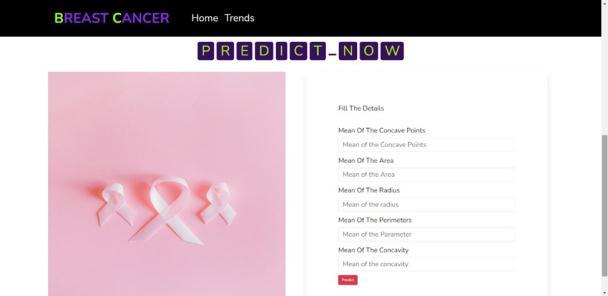
In this, predictions have been made on some diseases for peoplebytakingsomevaluesfromtheuserandgivingthem a proper result based on their inputs. Through this, it is goingtogetastepclosertopredictingdiseasesfortheuser. Herearesomesamplesofhowithastakeninputsandhow youaregoingtogetoutputbasedontheinformationthatis providedinthecolumns.


In the above image, as you can see, user can predict their chancesofgettingbreastcancerbyprovidingcertainvalues liketheMeanoftheconcavepoints,theMeanofthearea,the Meanoftheradius,etc.Bycalculatingthesevaluestheyare going to get output telling them their chances of having breastcancerasseeninthebelowimage.
If someone wants to predict their chances of having lung cancer then, as shown in the above image, they can also predict it by adding certain values asked like Albumin, AlbuminandGlobulinRatio,TotalProteins,etc.whichwill allowthemto predicttheir diseaseinanearlyphase.And alsotheuserwill gettheoutputbasedontheinformation providedasyoucanseeinthebelowimage.
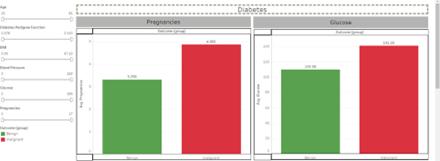
After predicting some of the diseases, we have taken the samediseasestoanalyzethedataofthatdisease.Wehave usedTableauandPythontoanalyzethedatawhichisbeing fetchedfromKaggleitself.Analysisofthedatacanalsobe modified by making someadjustments for which wehave includedsometogglebuttonsandsliderswhichwillallow the user to adjust the ranges according to which they can knowaboutthedatathattheywant.Fortheirconvenience, somelabelshavebeenincludedtoguidethemtounderstand thegraphsandtheywillbehavingcertainvaluesbasedon therangesanddataavailableatthemoment.Forexample, how many pregnant ladies can have the risk of catching diabetesonanaveragewhetheritisBenignorMalignantata particularage?Thereisalotmoreinformationthatcanbe consumed from the graphs and people can educate themselvesbytakingalookatthosegraphs.Herearesome samples of these graphs which a person can see after selectingaparticulardiseaseonthewebpage.

9:HeartdiseaseanalyticsUI
Intheaboveimage,thegraphsarebeingshownforhaving heartdisease.Therearevariousfactorswhichareaffecting forthetypeofchestpainthatapersoncanhavewhilehaving heartdiseaseintheabovegraphitishavingThalachrange between71-202,Cprangeof0-3,Trestbpsrangeof94-200, Fbsbetween0-1andmanymorerangesarebeingusedto analyzethisdata.Itisalsoshowninthegraphaboutwhoall aresafeandwhocanbeaffectedbygivingaccuratenumbers onanaverageusingdifferentrangesandinputs.
CONCLUSIONS
In today’s world, a lot more diseases can affect people in manywaysbutthereareverylesstechnologiesthatcanbe accessedandusedbytheuseritselftoself-educateortoget someinformationonthisserioustopic.Manytechnological geeksareworkinginthedirectionofeducatingpeopleabout thehealthofthemselvesandtheirfamilymembers.Ifauser is educated and has access to the information which is appropriate and precise then it is easy to diagnose the diseasesandalsopeoplecangetalertnessorconsciousness inthemselveswhichcanhelpthemgettreatedbeforeitgets worse.
Fig8:DiabetesanalyticsUI
Intheaboveimage,itisshownthat,betweentheageof2181,withaglucoselevelof0-199,bloodpressurebetween0122,and basedonmany more factors,how manyaverage pregnanciescancatchdiabetes,whichcanbebenign(Green bar) or malignant(Red bar) and it is also shown for the glucoselevelsofdiabeticpatientsatthatpoint.
So,throughthisproject,whichisbackedbyproperresearch, we want to get ahead with the help of technology in predictingpeople’shealthbyusingMachineLearningandAI andalsoanalyzingsomedataforthemsothattheycangain some knowledge through this website. The sole motive of this project is to give people the freedom to live and take careoftheirhealthandwewhoareherehavealittlebitof interestintechnologyandwantpeopletoknowaboutwhat ArtificialIntelligencecandoforthemandhowitwouldbe framedforourfutureselves.Inthisproject,wehaveused somelatesttechnologiestobuildawebapplicationthatcan show your chances of catching some diseases by getting somevaluesfromtheusers.Itisapredictionmodelwhich canshowinformationaboutyourdiseasebyaskingyoufor someinformation.Andinthesecondpart,wehaveanalyzed somedatasetswhichwillbehavingdynamicvaluesbywhich one can know about a particular disease, e.g., at what age there are more chances of getting breast cancer or which typesofthingswillletyoucatchaheartdisease.Therewill begraphstoshowthisinformationtotheuser.

In this, we have leveraged the amount of data that is available out there which can be made of use if someone knowshowtouse it properly.We have triedtomake this informationmeaningfulsothatthesenewtechnologiescan beintroducedtothepeopleandcanbeofuseinanyway.
REFERENCES
[1] H. Alharthi, “Healthcare predictive analytics: An overview with a focus on Saudi Arabia,” Journal of Infection and Public Health, pp. 749–756, Feb. 2018. https://doi.org/10.1016/j.jiph.2018.02.005
[2] Divya Jain, Vijendra Singh, “ Feature selection and classificationsystemsforchronicdiseaseprediction:A review”,EgyptianInformaticsJournal,pp.179-189,Mar. 2018.https://doi.org/10.1016/j.eij.2018.03.002
[3] Atreyi Kankanhalli, Jungpil Hahn, Sharon Ta, Gordon Gao,“Bigdataandanalyticsinhealthcare:Introduction tothespecial section”,BusinessmediaNewyork,Mar. 2016. https://link.springer.com/content/pdf/10.10 07/s10796-016-9641-2.pdf
[4] A.RishikaReddy,P.SureshKumar.“PredictiveBigdata analytics in healthcare”, Second International Conference on Computational Intelligence Communicational Technology (CICT), Feb. 2016. https://sci-hub.hkvisa.net/10.1109/CICT.2016.129
[5] Mohammed Alhamid, “A guide to learning Ensemble technique”, Toward Data Science, Mar. 2021. https://towardsdatascience.com/ensemble models5a62d4f4cb0c
[6] An introduction to Random forest Classifier. https://scikit-learn.org/stable/modules/gen erated/sklearn.ensemble.RandomForestClassifier.html
[7] P.Saranya,Dr.P.Asha,“SurveyonBigDataAnalyticsin HealthCare”,2019InternationalConferenceonSmart System and Inventive Technology(ICSSIT), Feb. 2020. https://ieeexplore.ieee.org/document/8987882
[8] Dhiraj Dahiwade, Gajanan Patle, Ektaa Meshram, "Designing Disease Prediction Model Using Machine LearningApproach",20193rdInternationalConference on Computing Methodologies and Communication (ICCMC), Aug. 2019. https://ieeexplore.ieee.org/document/8819782
[9] “ClevelandHeartDiseaseDataset,”accessedon03-022017.
[10] R. Detrano, A. Janosi, W. Steinbrunn, M. Pfisterer, J.-J. Schmid,S.Sandhu,K.H.Guppy,S.Lee,andV.Froelicher, “International application of a new probability algorithmforthediagnosisofcoronaryarterydisease,” TheAmericanjournalofcardiology,pp.304–310,1989.
https://www.ajconline.org/article/0002-914 9(89)90524-9/pdf
[11] B. Edmonds, “Using Localised ‘gossip’ to structure distributed learning”, Jan. 2005. https://www.researchgate.net/publication/ 28764359_Using_Localised_'Gossip'_to_Str ucture_Distributed_Learning
[12] MinChen,Yixue Hao,KaiHwang,LuWang,Lin Wang, “DiseasePredictionbyMachineLearningOverBigData FromHealthcareCommunities”,pp8869-8879,April 2017. https://ieeexplore.ieee.org/abstract/docum ent/7912315