Parametric Study of Elevated Water Tank with Metallic and Friction Damper
Swaty Arun1 , Deepa H Raval2
1PG student, Applied Mechanics Department, L.D. College of Engineering, Gujarat, India

2Assistant Professor, Applied Mechanics Department, L.D. College of Engineering, Gujarat, India ***
Abstract – Presentresearchattemptstofindtheresponseof RC elevated water tank with metallic dampers. Analytical investigation of metallic damper and friction damper in reducing seismic response of an Elevated Water Tank is done using different time history. Seismic response parameters suchas base shear, base moment, time period, top staging displacement and sloshing displacements are evaluated and compared.
Key Words: Timehistory,Seismicresponse,Elevatedwater tank,Metallicdamper,Frictiondamper
1. INTRODUCTION
Manystructuressuchasbridgesbuildings etc.damagedin previousearthquakes. Importantstructuressuchaswater tankshospitalsetc.shouldremainfunctionalevenafteran earthquake. Failure of water tanks makes evacuation and rehabilitation during earthquakes worse. All structures irrespectiveofitsimportanceshouldbedesignedforlateral forces induced during ground motions. Performance of elevatedwatertanksduringBhujearthquakewasstudiedby DurgeshCRai[11].
Generally,watertanksaredesignedfordeadloads,liveloads, andforcesduetowindandearthquakes.Selectionoftypeof watertank isa crucialstepindesignof watertanks.Intze type tanks are very economical as it reduces the size of bottomringbeam.
1.1 SEISMIC CONTROL DEVICES
Conventional seismic design method, overall safety, and safety of structures against earthquake, are designed and constructedtohavesufficientstrength.Thetraditionaldesign methodologyisquiteexpensive.Theuseofpassivecontrol devicesresultsinreductionofseismicdesignforcesonthe building[14].Thismethodusesanexternalsourceofenergy toresistlateralforcesduetoearthquake.Vibrationsinduced by wind or earthquake forces can be diminished without increasing the strength of the structure by addition of structuralcontroldevices.
Generallyseismiccontroldevicesareclassifiedintoactive, passive,andsemi-active.Activecontroldevicesrequirean
external source of energy for activation. Passive control devicesdonotrequireanyexternalenergyandonlyrequire earthquake forces to act. Semi active devices require some external energy to activate. These are modification of passive controldevices.Sincepassivecontrol devicesdonotrequire external source to operate it can be a viable solution for seismicretrofitaswellasrehabilitationofstructures.Passive control devices convert lateral forces induced by earthquake into other forms of energy such as heat energy [4]. Supplemental energy dissipation system and seismic isolation system comes under passive energy dissipation devices.Devicessuchasdamperscomesundersupplemental control system whereas base isolation and multi-story isolationscomeunderseismicisolationsystem.Optimization of dampers can result in economic design and is done in various literatures. Optimal design of metallic and friction dampers is proposed by Moreschi et al [9]. On installation of isolationdevices time periodof thestructureincreases and whereasthereisadecreaseintimeperiodonapplicationof dampers.
1.2 X - PLATE METALLIC DAMPER (XPD)
Generally metallic dampers are made of steel, aluminum, copper,lead,andshapememoryalloys.Mildsteelisthemost commonlyusedmaterialasametallicdamper.Steelmaterial can be simplified as a bilinear or trilinear elastoplastic model. Hence these dampers are also called elastoplastic dampers.Thesedampersarealsocalledhystereticdampers. Thesedampersarealsoyieldingdampersasdissipationof energyoccursbyyieldingofmetals.
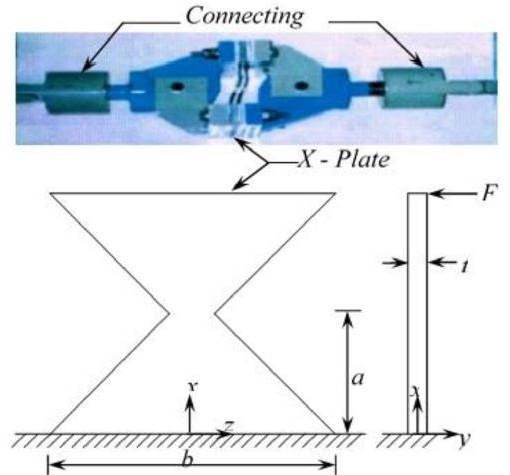
XPDisatypeof metallicdamperwhichconsists ofaseriesof X shaped plates arranged parallelly. These can be connected diagonally or on top of chevron bracing etc. This type of damperswasintroducedbyKellyet.al[15].XPD’smadeof steelundergoesmanycyclesuntilitreachestheyieldlimit [1]. These dampers showed good response reduction in pipingsystems[10].ThepropertiesofanXPDcanbederived using beam theory which is done after a series of tests. InitiallyXPDisassumedtobemadeoftwotriangularplates andpropertiessuchasstiffnessandyieldstrengthisfound out.Fig1showsa typical diagramofanXPDwithholding devices.
Fy and Kd denotes the yield strength and stiffness of the damper.σy,Eandnrepresentstheyieldstressmodulusof elasticityandnumberofplatesofthedamper. Theheight, widthandthicknessofthedamperisrepresentedbya,band trespectivelyXPDcanbemodelledasalinkelementwhichis availableinSAP2000.


1.3 FRICTION DAMPER
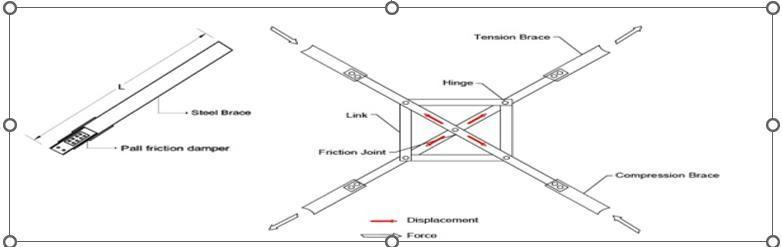
Thesedissipatesenergythroughsolidfrictionbetweentwo slidingbodies[3].Atypicalfrictiondampercontainsaseries ofsteelplateswhichareclampedtogether.Whensubjectedto ground motions these plates slip and dissipates energy throughheat.Thesedamperscanbeconnecteddiagonally, withchevronbracingscrossbracingsandsoon.Pallfriction damperisoneofthebestfrictiondampersavailable.Friction dampersarenotdesignedforwindandminorearthquakes. They require heavy lateral forces to operate [3]. During earthquakes they slip at a load known as slip load. These dampers also have very good hysteretic behavior. Like metallicdamperstheyalsoundergolargecycleofloading. Oneofthedisadvantageoffrictiondampersisthatitisnot reliable in a long run. Also, these can undergo permanent deformation if restoring force is not provided. Nonlinear
analysisisrequiredtounderstandthebehavioroffriction dampersystem.
Numerous structural analysis software’s are available to model engineeringstructures. Eulerianapproach,Lagrangian approach and added mass approach are some of the methods adopted to model fluid structure interaction using finite element software. Provisions to use Westerguard’s added mass approach and Alegreane’s water mass approach to model fluid structure interaction are available in SAP2000. Water tanks are modelled as a typical spring mass model. Initiallywatertankwasmodelledasonemassmodel.Butthis method is not reliable for tanks of larger capacity. Hence more suitable method of spring mass model called two mass idealization (Housner et.al) was introduced. IITK GSDMA guidelinesIS1893-2014part2alsofollowstwomassmodel of watertank. The liquid in the upper part of water tank is called convective mass and undergoes sloshing effect. The water mass attached to the walls of the container is called impulsive mass. Generally, these idealizations are used for cylindrical andrectangularwatertanks. Forelevated water tanks of different shape of container, the spring mass parameters are obtained by assuming an equivalent circular containerofsamediameter.

IITK GSDMA guidelines and IS 1893-2014 part 2 suggests equationsforspringmassmodelofwatertanks.Thespring massparameters canalso be obtainedfromgraphs provided incodalprovisions.
Westerguard’saddedmassapproachisusedfortheanalysis. Inthisapproachimpulsivemassisaddedtothewallsofthe container.
Theequationforfindingtheimpulsivemassisgivenby
mαi=Ai[mαi=Ai[7/8ρ√(h(h-yi))]

h=heightofwaterlevel
yi=heighttocenterofeachpanelfromtankbottom
Ai=Areaofeachpanel.
Initiallythecontainerwallsaredividedintovariouspanels and the impulsive mass calculated from the equations are addedtothesepanels.
2. PROBLEM DISCRIPTION

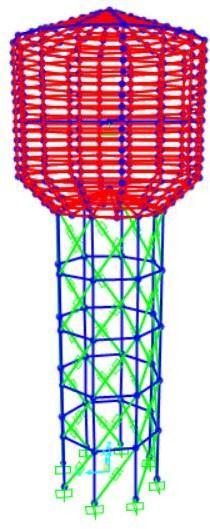
Areinforcedconcreteelevatedintzetankwithacapacityof 1000m3 and 20m staging height is adopted. Columns and beamsaremodelledasframeelementwhereascontaineris modelledasareasectionwiththinshells.M30gradeconcrete andFe415gradesteelisusedtomodelwatertank.Densityof concreteistakenas25kN/m3.StiffnessofXPDandfriction damper is taken as 956812.5kN/m and 321654kN/m respectivelyandyieldstrengthofXPDistakenas190.35kN andsliploadoffrictiondamperisassumedas190.35kN.

Volume: 10 Issue: 07 | Jul 2023 www.irjet.net
International Research Journal of Engineering and Technology (IRJET) e-ISSN: 2395-0056 p-ISSN: 2395-0072
Table -2:TimeHistorydata
3.RESULTS
The results obtained from the analysis of intze tank are providedwithsuitabletablesandcharts.
Table -3: TimePeriod(s)for1000m3 capacityintzetank
Volume: 10 Issue: 07 | Jul 2023 www.irjet.net
International Research Journal of Engineering and Technology (IRJET) e-ISSN: 2395-0056 p-ISSN: 2395-0072
4.CONCLUSION
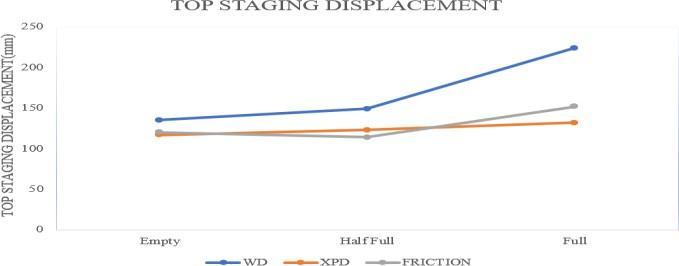
Xplatemetallicdamperisgoodinreducingsloshing andtopstagingdisplacementofEWT.
Both friction and metallic dampers shows good reductioninsloshingdisplacementandtopstaging displacement.
Maximum reduction of 40% and 37%in topstaging displacement and sloshing displacement was observedwithmetallicdamper

Metallic damper showed higher reduction in top stagingdisplacement.
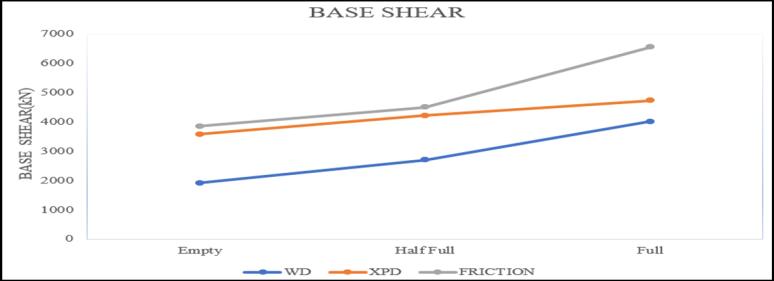
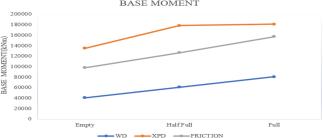
Reduction in base shear base moment and acceleration is slightly less for EWT with friction dampers
5.REFERENCES
[1] Sakshi. A. Manchalwar et al, “Seismic response reduction of RC water tank,” Advances in Civil EngineeringandInfrastructuraldevelopment.
[2] A. Manchalwar et al “Performance of RC structures equipped with steel and aluminum X-plate dampers”, JournalofTheInstitutionofEngineers(INDIA)
[3] Muhammed Zain Kangda et al “Seismic performance upgrade of elevated water tanks utilizing friction dampers”,PracticePeriodicalonstructuralDesignand Construction
[4] DeepshikhaChaudhuryetal“Performancebaseddesign of RC frame buildings with metallic and friction dampers” Journal of The Institution of Engineers (INDIA)
[5] IITK GSDMA guidelines for seismic design of liquid storagetanks
Table -7: Sloshingdisplacement(mm)for1000m3capacity intzetank Chart -1: Variationofbaseshear(kN)forKobeearthquake Chart -2: Variationofbasemoment(kNm)forKobe earthquake Chart -3: VariationofSloshingdisplacement(mm)for Kobeearthquake[6] IS 1893 (Part 2): 2014 Criteria for earthquake resistant design of structures part 2, Liquid retainingTanks
[7] IS 3370 (part 4) Code of practice for concrete structuresforstorageofliquids.
[8] AhadJavanmardietal,“State of the ArtReviewof Metallic Dampers: Testing, Development and Implementation”
[9] L.M Moreschi et.al, “Design of yielding metallic and friction dampers for optimal seismic performance”, EarthquakeEngineeringandStructuralDynamics.
[10]S.V. Bakre et al, “Optimum X-plate dampers for seismic response control of piping systems,” InternationalJournalof Pressure Vessels and Piping System
[11]Durgesh C Rai, “Performance of elevated tanks in Mw 7.7BhujearthquakeofJanuary26th,2001”IndianAcad Sci(EarthPlanetSci)
[12]ChiragN.Patel etal,“Seismic responseofRCelevated water tank considering site specific and acceleration timehistory,”LectureNotesinMechanicalEngineering
[13]M.C. Constantinou et al, “Passive energy dissipation systemsforstructuraldesignandretrofit”
[14]Kelly JM et al, “Mechanisms of energy absorption in special devices for use in earthquake resistant structures.” Bulletin of New Zealand Society for EarthquakeEngineering.