Counterfeit of Immobilized Enzymes in Packed Bed Reactor
Megala S1 , Priyadarsan S2, Shreeprada A M3, Swarupa Dhar4, Rohith51Assistant professor, Dept of Chemical Engineering, MVJ College of Engineering, Bengaluru, Karnataka, India

***
Abstract - Textile industrial effluents,containhigh dye concentrations. Withouteffectivetreatment,thedischarge of textile effluent to the environment affects aquatic life and makes water unfit for any kind of usage. Thus, the aim of this work is to develop an effectivetreatmentmethodforindustrial dye effluent. Adsorption is one of the most efficient techniques for decontaminating industrial dye effluent, and its performance is dependent on the adsorbent's characteristics. The development of immobilised laccase enzymes as adsorbents in a packed bed reactor is more economical, effective, and environmentally friendly
In the present study, laccase enzyme extracted from fungi was immobilized by entrapment method in sodiumalginate gel and cross-linked with copper sulphate pentahydrous. By determining the optimum operating conditions for reusability, flow rate,bedheight,concentration, and pH, a batch decolorization of dye solution was performed in a packed-bed reactor.
The method led to very effective laccase immobilization and also imparted significant stability to the enzyme. Then immobilizedlaccaseenzymewerecharacterized by BET and SEM, and the results showed that laccase could be well immobilized on sodium alginate and revealed that, the immobilized laccase enzyme beads exhibited noticeable levels of porosity. In a batch decolorization,73-100% decolorization was achieved for the prepared dye solution. Crystal violet dye was found to be highly decolorized up to 100% followed by Methylene Blue (99.40%), Congo Red (98.18%), Rhodamine B (97.7% ) and Methyl orange (92.73%).
Key Words: Adsorption, Decolorization, Dye effluent, Immobilized Laccase Enzyme, Packed Bed Reactor
1.INTRODUCTION
Textile processing is one of the oldest and most complex industry and its production has been improved due to continuous developmentandautomation,causinga major pollution problem around the world. The rheology of wastewaterdischargedbytextilemillsishighlycomplexin nature, sometimes difficult for a specialist to grasp and understand it. Out of 70% total water phase across the world,onlyanegligiblepartofitisinpureform[1] Themain damagecausedbythetextileindustryisduetoimproperly treated waste discharged into water bodies, which are responsible for 80% of the total emissions caused by the
industry.Dyeisthesubstancethatisusedtoimpartcolorto a substrate. Different types of dyes are used in the textile industry such as acid dyes, reactive dyes, basic dyes, and azoicdyes.Oneofitspropertiesistheabilitytoimpartcolor to a given substrate because of the presence of chromophoric groups in its molecular structures. Decolorization of dyes from textile effluents depend on enzymeorigin,presenceofothercompoundsinsolutionand alsoaprocesscondition.Enzymesarebiodegradable,donot produce toxic by-products, and exhibit high specificity towards target dyes, allowing for selective and efficient decolorization. Enzymes such as laccases, peroxidases, azoreductases,andlipasesarecommonlyusedtodecolorize dyes Additionally, enzymes can improve the overall performance of dye decolorization processes, resulting in higher colorremoval efficiencyandimproved wastewater quality.Comparedtofreeenzymesinsolution,immobilized enzymes are more robust and more resistant to environmentalchanges.Enzymeimmobilizationreferstothe processofattachingorconfiningenzymestoasolidsupport matrix, thereby enhancing their stability, activity, and reusability. Immobilized enzymes have numerous applicationsinvariousfields,includingbiocatalysts,biofuel production, pharmaceuticals, food processing, and environmentalremediation.Inrecentyears,awiderangeof interest and high attention has been directed toward exploringthepotentialofimmobilizedenzymes.Theenzyme immobilizationmethodscanbeclassifiedaccordingtothe interaction between the enzyme and the support matrix, such as adsorption, entrapment, encapsulation, covalent bondingetc.
1.1 Packed Bed Reactor
Theoperationofa packedbedreactor involvespassing the wastewater through the packed bed, where the solid particles serve as an adsorbent for the decolorization process.Thedesignandoperationofapacked-bedreactor fordyedecolorizationdependonvariousfactors,suchasthe typeandconcentrationofdyes,particlesizeandshape,flow rate,andcontacttime.Theseparametersplayamajorrolein reactorefficiency.Optimalconditionsneedtobedetermined throughexperimentalstudiesandprocessoptimization.
2. MATERIALS AND METHODS
2.1 Materials
A fungi-based laccase enzyme was purchased from the vendor.Textiledyes,Sodiumalginate,andallotherchemical reagents were obtained from the Chemical Engineering DepartmentatMVJCollegeofEngineering,Bengaluru
2.2 Selection of Enzyme
Basedontheobservationtable1,laccaseexhibitsthehighest Vmax among all the other enzymes. Vmax is inversely proportionaltoMichaelisMentenConstant(Km),andlaccase also demonstrates a low Km value. This indicates that laccasetightlybindstothesubstrate'sactivesitecompared to the other enzymes. Laccase also displays superior temperaturestability,withamaximumtemperatureof65°C at which it remains highly active. However, its activity decreasesbeyondthistemperature,anditbecomesunstable afterreaching80°C.
With a molecular weight of 50-140 kDa, laccase ensures stabilityandefficiency.Theflowraterequiredisalsolow, and it works efficiently within a pH range of 5.5-7.5, indicatingitssuitabilityforneutralconditions.Inconclusion, laccaseemergesasthemostefficientandeffectiveenzyme for immobilization in our project due to its highest Vmax, low Km value, and high temperature stability. Immobilization can further enhance its activity at higher temperatures[2,3,4,5]
2.2 Immobilization of Laccase Enzyme by Entrapment Method
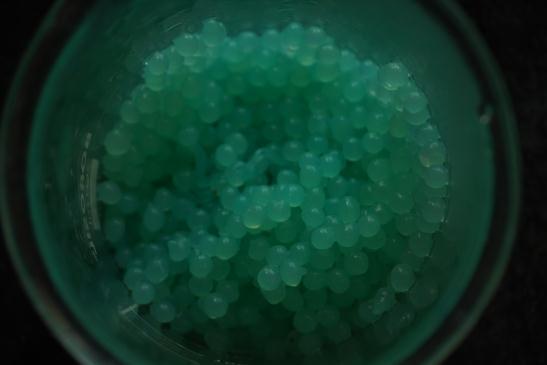
TheEntrapmentoflaccaseinalginategelwasperformedby adding1grammeoflaccaseenzymetoa3%sodiumalginate solutionundercontinuousstirringatroomtemperaturefor one hour, where the formation of the alginate-laccase enzymemixturetakesplace.Thesodiumalginatesolution waspreparedbyadding3grammesofalginatepowder to 100 ml of distilled water. The higher the concentration of sodium alginate, the smaller the pore size of the beads, leading to lower immobilization efficiency. The formed alginate-laccaseenzymemixturewastakeninasyringeand thenaddeddropwiseintochilled0.2MCaCl2andCuSO4.5H2O solutions,respectively.Theprocessiscalledcross-linking, andtheresultingbeadswerelefttohardenovernightat4to 10°C.Thebeadswerewashedseveraltimeswithdeionized water to remove any unencapsulated enzyme and then storedatacoldtemperature[6]
2.3 Preparation of Stock Solution
A500mlstocksolutionofknownconcentration(50ppm) was prepared by dissolving 25 mg of dye in 500 ml of distilledwater.Then,a30-ppmdyesolutionwasprepared byadding60mlofthestocksolutiontoa100mlstandard flaskanddilutingituptothemark.
2.4 Characterization of Immobilized Laccase Enzyme
To investigate the optimal conditions for the treatment of dyesolutionusingimmobilizedlaccaseenzymeinapacked bed reactor,a studywasconducted.Thestudyfocused on various parameters and their efficiency in dye decolorization.Specifically,theirrecyclability,morphological characteristics, surface area analysis, and the effects of concentration,pH,bedheight,andflowratewereanalyzed
2.4.1 Effect of Flow Rate
The adsorption performance was investigated for preplanned flow rates of 3, 6, 9, 12, and 15 ml/min, using a centrifugalpumpwithavariableflowresistor.Theobjective was to observe the effect of these flow rates on the adsorption process. Throughout the experiment, the bed height was maintained at approximately 10 cm, while the inletconcentrationremainedconstantat30ppm

2.4.1 Effect of Bed Height
Inordertoassesstheimpactontheadsorptionperformance, thestudyinvestigatedfordifferentbedheightsof5.0,7.5, and10.0cm.Theaimwastoobservehowthesevaryingbed heights affected the adsorption process. During the experiment,theflowratewasmaintainedatapproximately3 ml/min,whiletheinletconcentrationremainedconstantat 30ppm.
2.4.3 Effect of Inlet Concentrations
To analyze the sway on the adsorption performance, the studyexploredvariousinletconcentrationsof5,10,15,20, 25,30,40,50ppm.Theobjectivewastoobservehowthese different inlet concentrations affected the adsorption process. Throughout the experiment, the bed height was maintained at approximately 10 cm, while the flow rate remainedconstantat3ml/min
2.4.4 Effect of pH
In order to assess the impact of pH on the adsorption performance ofimmobilized laccaseenzyme,theresearch examinedthepHofthedyesolutionbyemployingvarious buffer tablets to adjust it towards both the alkaline and acidicendsofthespectrum.Duringtheexperiment,theflow rate was maintained at approximately 3 ml/min and a constantbedheightof10cm,whiletheinletconcentration remainedconstantat30ppm.
2.4.5 Reusability Test
The reusability of immobilized enzyme was measured by usingthesameimmobilizedenzymeforninecyclesof100 ml each. Throughout the experiment, the flow rate was maintainedatapproximately3ml/minandaconstantbed height of 10cm, while the inlet concentration remained constantat30ppm.Theimmobilizedenzymewasremoved andwashedwithbuffertabletsofpH(phosphateandacetic buffer),andthentheimmobilizedenzymewastransferredto afresh0.2Mcoppersulphatepentahydratesolution.
2.5 Batch Decolorization of Dye solution in Packed Bed Reactor by an Immobilized Laccase Enzyme
Abatchdecolorizationofadyesolutionwasperformedina packed-bedreactorwiththeaidof adroppingfunnelwitha height of 13 cm and an internal diameter of 2.4 cm. The adsorbent(immobilizedlaccaseenzyme)waspackedinthe reactorwithglasswoolatvariousstagestopreventtheloss of adsorbent during the process. The adsorbent and glass woolwerearrangedalternatively(Glasswool-beads-Glass Wool-Beads-Glass wool). During the experiment, the bed heightwasconsistentlymaintainedatapproximately10cm The initial absorbance of the dye was measured at its respective wavelength and recorded for each dye using a bio-photometer. The dye solution was pumped into the reactorusinga centrifugal pump,withtheflowrateset at approximately 3 ml/min. A constant bed height of 10 centimeterswasmaintained.Theinletconcentrationofthe dyewaskeptconstantat30 ppminanalkalinecondition. After treatment, the decolorized water was filtered using Whatman filter paper, and the final absorbance was determined.Thepercentageofremovalefficiencyforthedye was calculated based on the difference in absorbance at λ max,accordingto[7].
3. RESULTS AND DISCUSSION
3.1 SEM Analysis
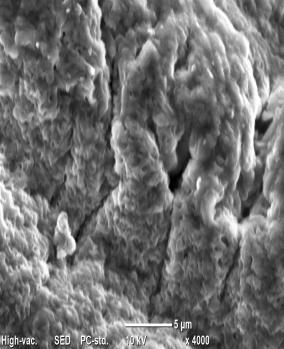
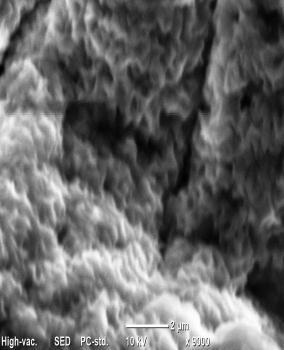
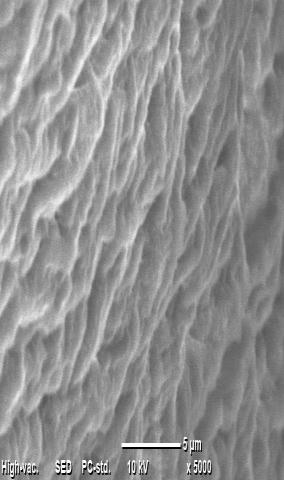
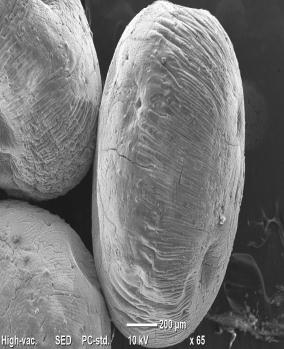
The immobilized laccase enzyme beads were morphologically analyzed using SEM, with an image scale bar ranging from 1millimeter to 2 micrometers and a magnification range of 27 to 9000. The morphological analysisrevealedthattheimmobilizedlaccaseenzymebeads exhibitedasphericalshapeandexhibitednoticeablelevelsof porosityandbindingsitesontheirsurfaces.
3.2 BET Analysis
Thesurfaceareasoftheimmobilizedlaccaseenzymebeads weremeasuredat77.3KusingaNovaStationBinstrument. ThesurfaceareawascalculatedbasedontheBETnitrogen adsorption isotherm. The BET analysis shows that the immobilized laccase enzyme beads have a surface area of 5.661 m2/g,a pore volume of 0.007 cc/g, and a pore diameterof2.571nm.
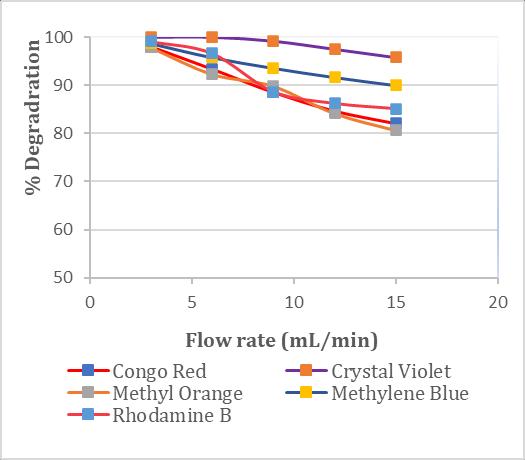
Blueexhibitedadecolorizationefficiencyof98.76%,Congo Reddemonstratedadecolorizationefficiencyof98.06%,and Methyl Orange achieved a decolorization efficiency of 97.91%.Thepercentageofdecolorizationdecreasedasthe flowrateincreasesto6,9,12,and15ml/min.Theresults indicate that reducing the flow rate in the packed-bed reactorincreasesthecontacttimebetweentheimmobilized laccaseenzymeandthedye.Thisextendedcontacttimeat lower flow rates enhances the efficiency of the enzymatic degradation process, leading to improved decolorization outcomes.
3.4 Effect of Bed Height
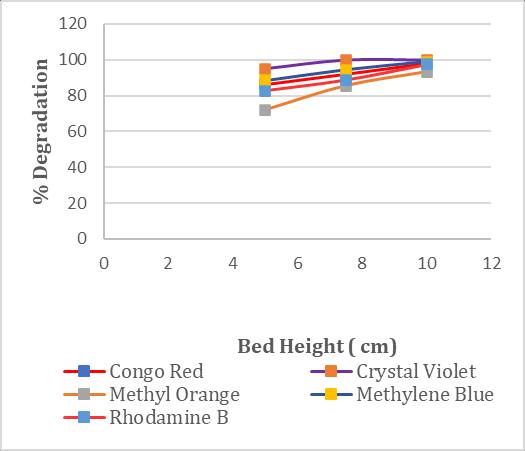
Astudywasconductedontheeffectsofdifferentbedheights (5cm,7.5cm,and10cm)inapackedbedreactor.theresult obtainedaredisplayedinchart2. Thestudymaintaineda constantflowrateof3ml/minandaninletconcentrationof 30ppm.Itisobservedthatanincreaseinbedheightresults in more adsorbent in the reactor, which leads to higher outletflowresistance.Whenthebedheightisincreasedfrom 5 cm to 10 cm, the removal percentage of dye shows improvement in decolorization. The decolorization efficiencies of different dyes exhibited notable improvements: Congo Red's efficiency increased from 86.24%to98.06%,CrystalViolet'sefficiencyincreasedfrom 95.07%to100%,MethylOrange'sefficiencyincreasedfrom 72.19% to 93.29%, Methylene Blue's efficiency increased from 88.47% to 98.76%, and Rhodamine dye's efficiency increasedfrom82.56%to97.41%.
3.5 Effect of Inlet Concentration
Eightdifferentinitialfeedconcentrations(5,10,15,20,25, 30,40,and50ppm)ofdyesolutionwereusedtoevaluate theeffectofinitialinletconcentrationwherethebedheight and flow rate were kept constant at 10 cm and 3 ml/min, respectively.Theresultsobtainedareshowninchart3.Itis observedthatastheconcentrationincreased,theefficiency of decolorization was reduced to 74.28% against Methyl Orange,followedbyRhodamineB(80.64%),MethyleneBlue (86.71%),CongoRed(89.46%),andCrystalViolet(98.05%). Theresultindicates thattheconcentrationdirectlyaffects theremovalefficiency,leadingtoareductioninadsorption capacity.
3.6 Effect of pH
3.3 Effect of Flow Rate
The effect of varying flowrate was examined with a bed heightof10cmandaninitialconcentrationof30ppm.the resultobtainedaredisplayedinchart1.Atthelowestflow rateof3ml/min,thedecolorizationefficiencywasfoundto be the highest for crystal violet, achieving a complete decolorizationof100%.Followingcrystalviolet,Rhodamine Bshowedadecolorizationefficiencyof99.19%,Methylene
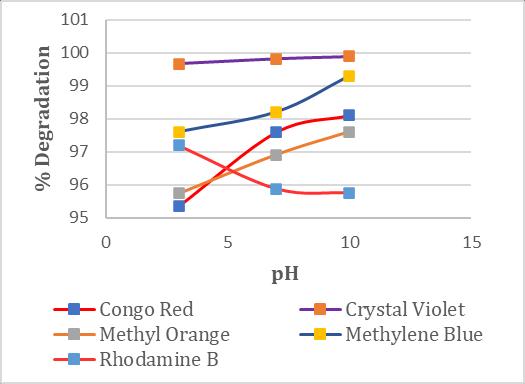
TheeffectofvaryingpHwasexaminedwithabedheightof 10cm,aflowrateof3ml/min,andaninitialconcentration of30ppm.Theresultsobtainedaredisplayedinchart4 It showsthatthedyesolutionwaseffectivelydecolorizedinall pH variation. However, the highest efficiency in decolorizationofdyesisobservedunderalkalineconditions except Rhodamine B dye. In acidic conditions, the dye solutionsnegativelyimpacttheactivityoftheimmobilized
laccase enzyme, leading to decreased reusability and reducedshelflife.
3.7 Reusability Test
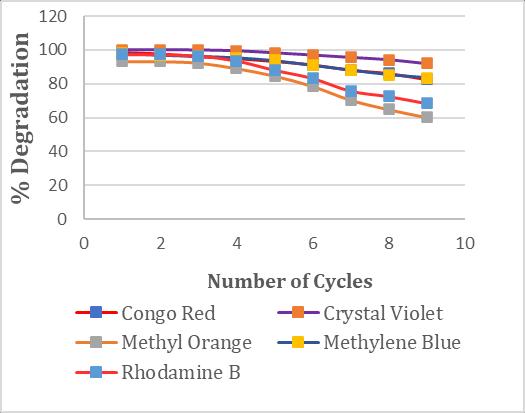
Testingthereusabilityofimmobilizedenzymesisimportant in any industry because it may reduce the cost of using enzymaticprocesses.Theresultsobtainedaredisplayedin chart5.Itwasobservedthatenzymesretaintheiractivity afterrepeatedcycling.Afterthefifthcycle,thebeadsstarted reducingtheirefficiencyofdecolorization.

3.8 Batch Decolorization of Dye solution in Packed Bed Reactor by an Immobilized Laccase Enzyme
By considering various parameters such as flow rate, concentration,pH,bedheightweconductedanexperimental study. Throughout the experiment, the flow rate was maintainedatapproximately3ml/minandaconstantbed height of 10cm, while the inlet concentration remained constantat30ppminalkalicondition.Laccaseimmobilized using sodium alginate demonstrated the highest decolorization efficiency of 100% for crystal violet dye, followedby99.40%formethyleneblue,98.18%forCongo Red,97.7%forRhodaminedye,and92.73%formethylene orange during the first cycle. It is noteworthy that crystal violetandmethyleneblue,whichareclassifiedasbasicdyes andhaveminimalreactivityintheenvironment,exhibited comparable decolorization efficiencies during subsequent cycles. Conversely, Congo Red, Rhodamine B, and Methyl Orange, which are toxic dyes with high water solubility, displayed lower decolorization efficiencies with each successive cycle, indicating a rapid decline in theirreusability.
Table -2: Decolorizationefficiencyofdifferentdye solutionsbyanimmobilizedlaccaseusingbatch decolorizationinapackedbedreactor
significantamountoftime,additionally,maintainingalow flowrateandconcentrationwasnecessary.Asanincreasein these parameters negatively affected the decolorization efficiency.Toovercomethesechallengesandenablelargescaledecolorizationinindustrialsettings,itisproposedto combine the immobilized laccase enzyme with a photochemical reactor. This integration would result in reduced treatment time, improved flow rate, increased adsorptioncapacity,enhancedrecyclabilityandreusability, and an extended shelf life of the immobilized laccase enzyme.
REFERENCES
[1] J.N.Chakraborty,Fundamentalsandpracticesin colourationoftextiles
[2] S.A.Zahran,M.Ali-Tammam,A.M.Hashem,R.K. Aziz,andA.E.Ali,“Azoreductaseactivityofdye decolorizingbacteriaisolatedfromthehumangut microbiota,”SciRep,vol.9,no.1,Dec.2019,doi: 10.1038/s41598-019-41894-8.
[3] I.N.Chukwudi,C.A.Onyetugo,andI.N.Amarachi, “Peroxidase, an Example of Enzymes with NumerousApplications,”AsianJournalofChemical Sciences, pp. 11–22, Jul. 2021, doi: 10.9734/ajocs/2021/v10i219087
[4] A.Naganthran,M.Masomian,R.N.Z.R.A.Rahman, M. S. M. Ali, and H. M. Nooh, “Improving the efficiencyofnewautomaticdishwashingdetergent formulation by addition of thermostable lipase, proteaseandamylase,”Molecules,vol.22,no.9,pp. 1–18,2017,doi:10.3390/molecules22091577.
[5] S.PramanikandS.Chaudhuri,“Laccaseactivityand azo dye decolorization potential of Podoscypha elegans,”Microbiology,vol.46,no.1.KoreanSociety of Mycology, pp. 79–83, 2018. doi: 10.1080/12298093.2018.1454006.
4. CONCLUSION
Thisworkinvestigatedtheeffectivenessofanimmobilized laccase enzyme, obtained from a vendor, for the batch decolorizationofdyesolutioninapacked-bedreactor.The experiment showed that the adsorption process of immobilized laccase enzyme depends on flow rate, bed height, initial dye concentration, and pH condition. The experiment demonstrated that a decrease in flow rate, a higher bed height, a lower initial dye concentration, and alkalinepHconditionsfavourtheadsorptionprocessofthe immobilizedlaccaseenzyme.Duringtheexperimentation,it was observed that the decolorization process required a
[6] S. Sondhi, R. Kaur, S. Kaur, and P. S. Kaur, “Immobilization of laccase-ABTS system for the development of a continuous flow packed bed bioreactorfordecolorizationoftextileeffluent,”Int JBiolMacromol,vol.117,pp.1093–1100,Oct.2018, doi:10.1016/j.ijbiomac.2018.06.007.
[7] S. I. Hussein, “Decolorization of Textile Dyes in Packed Bed-Reactor Using Batch and Continuous SystembyanImmobilizedLaccaseProducedfrom LocalIsolateofPseudomonasaeruginosaSR3,”no. October,2018
[8] S. Benkhaya, S. El Harfi, and A. El Harfi, “Classifications, properties and applications of textile dyes: A review,” 2017. [Online]. Available:
https://www.researchgate.net/publication/323960 391
[9] A. A. Telke, A. A. Kadam, and S. P. Govindwar, “BacterialEnzymesandTheirRoleinDecolorization of Azo Dyes,” in Environmental Science and Engineering,SpringerScienceandBusinessMedia Deutschland GmbH, 2015, pp. 149
168. doi: 10.1007/978-3-319-10942-8_7.
[10] S. Datta, L. R. Christena, and Y. R. S. Rajaram, “Enzyme immobilization: an overview on techniquesandsupportmaterials,”3Biotech,vol.3, no.1,pp.1–9,Feb.2013,doi:10.1007/s13205-0120071-7.[4]J.Zdarta,A.S.Meyer,T.Jesionowski,and M.Pinelo,“Ageneraloverviewofsupportmaterials for enzyme immobilization: Characteristics, properties,practicalutility,”Catalysts,vol.8,no.2. MDPI,Feb.24,2018.doi:10.3390/catal8020092.
[11] S.I.Hussein,G.M.Aziz,N.H.Haider,andA.K.AlBanaa, “Decolorization of Textile Dyes in Packed Bed-ReactorUsingBatchandContinuousSystemby an Immobilized Laccase Produced from Local Isolate of Pseudomonas aeruginosa SR3,” Current ResearchinMicrobiologyandBiotechnology2017. http://crmb.aizeonpublishers.net/content/2017/4 /crmb1157-1166.pdf
[12]
S.Selambakkannu,N.A.F.Othman,K.A.Bakar,and Z. A. Karim, “Adsorption studies of packed bed column for the removal of dyes using amine functionalizedradiationinducedgraftedfibre,”SN Appl Sci, vol. 1, no. 2, Feb. 2019, doi: 10.1007/s42452-019-0184-2.
[13] M. N. Abbas, “Modeling of Porosity Equation for Water Flow Through Packed Bed of Monosize Spherical Packing,” Journal of Engineering and Development,vol.15,no.4,pp.205–226,2011
[14]
L.Y.Junetal.,“Anoverviewofimmobilizedenzyme technologies for dye and phenolic removal from wastewater,” Journal of Environmental Chemical Engineering,vol.7,no.2.ElsevierLtd,Apr.01,2019. doi:10.1016/j.jece.2019.102961.
[15] J.Zdartaetal.,“EnhancedWastewaterTreatmentby ImmobilizedEnzymes”,AppliedandEnvironmental Microbiology, doi: 10.1007/s40726-021-001837/Published.
[16] S. Sondhi, R. Kaur, S. Kaur, and P. S. Kaur, “Immobilization of laccase-ABTS system for the development of a continuous flow packed bed bioreactorfordecolorizationoftextileeffluent,”Int JBiolMacromol,vol.117,pp.1093–1100,Oct.2018, doi:10.1016/j.ijbiomac.2018.06.007.
[17] B. Rusdi, D. Mulyanti, and M. Rodiyah, “CharacterizationofPeroxidaseEnzymefromWater Spinach (Ipomoea Aquatica Forssk.) Fraction,” Procedia Chem, vol. 13, pp. 170–176, 2014, doi: 10.1016/j.proche.2014.12.022.
[18] A.Elfarash,A.M.M.Mawad,N.M.M.Yousef,andA. A. M. Shoreit, “ Azoreductase kinetics and gene expression in the synthetic dyes-degrading Pseudomonas ,” Egyptian Journal of Basic and Applied Sciences, vol. 4, no. 4, pp. 315–322, Dec. 2017,doi:10.1016/j.ejbas.2017.07.007.
[19] O. Akpor, D. A. Otohinoyi, T. D. Olaolu, and J. B. I. Aderiye, “Dye Decolouration in Wastewater View projectAssessmentofEnergyProductionPotential ofSomeOrganicWastesUsingMicrobialFuelCells (MFCs) View project,” 2014. [Online]. Available: https://www.researchgate.net/publication/261834 688
[20] S.A.G.Z.Morsy,A.AhmadTajudin,M.S.M.Ali,and F. M. Shariff, “Current Development in Decolorization of Synthetic Dyes by Immobilized Laccases,” Frontiers in Microbiology, vol. 11. Frontiers Media S.A., Sep. 30, 2020. doi: 10.3389/fmicb.2020.572309.
[21] E.Abadullaetal.,“DecolorizationandDetoxification of Textile Dyes with a Laccase from Trametes hirsuta,”2000.
[22] B. Rodriguez-Colinas, L. Fernandez-Arrojo, P. Santos-Moriano, A. O. Ballesteros, and F. J. Plou, “Continuouspackedbedreactorwithimmobilized β-Galactosidase for production of galactooligosaccharides(GOS),”Catalysts,vol.6,no. 12,Dec.2016,doi:10.3390/catal6120189.
[23] N.S.Alsaiarietal.,“Thebiocatalyticdegradationof organic dyes using laccase immobilized magnetic nanoparticles,”AppliedSciences(Switzerland),vol. 11,no.17,Sep.2021,doi:10.3390/app11178216.
[24] S. I. Hussein Lecturer, “Hussein efficiency of immobilized polyphenol oxidase on some textile dyesdegradationusingbatchoperationsystemby packedbedbioreactor.”
[25] L.Y.Junetal.,“Anoverviewofimmobilizedenzyme technologies for dye and phenolic removal from wastewater,” Journal of Environmental Chemical Engineering,vol.7,no.2.ElsevierLtd,Apr.01,2019. doi:10.1016/j.jece.2019.102961.
[26] K. A. Al-Maqdi et al., “Challenges and recent advances in enzyme-mediated wastewater remediation areview,”Nanomaterials,vol.11,no.
11. MDPI, Nov. 01, 2021. doi: 10.3390/nano11113124.
[27] G. Swain, S. Singh, R. K. Sonwani, R. S. Singh, R. P. Jaiswal, and B. N. Rai, “Removal of Acid Orange 7 dye in a packed bed bioreactor: Process optimizationusingresponsesurfacemethodology andkineticstudy,”BioresourTechnolRep,vol.13, Feb.2021,doi:10.1016/j.biteb.2020.100620.
[28] D. Swathi, P. C. Sabumon, and A. Trivedi, “Simultaneousdecolorizationandmineralizationof highconcentrationsofmethylorangeinananoxic up-flow packed bed reactor in denitrifying conditions,”JournalofWaterProcessEngineering, vol. 40, Apr. 2021, doi: 10.1016/j.jwpe.2020.101813.
[29] I.Mesquita,L.C.Matos,F.Duarte,F.J.MaldonadoHódar,A.Mendes,andL.M.Madeira,“Treatmentof azo dye-containing wastewater by a Fenton-like process in a continuous packed-bed reactor filled with activated carbon,” J Hazard Mater, vol. 237–238, pp. 30–37, Oct. 2012, doi: 10.1016/j.jhazmat.2012.07.066.
[30] Z.Zhang,M.Jin,G.Chen,J.Lei,L.Wang,andJ.Ge, “Enzymes immobilized in wood-derived cellulose scaffold for constructing a novel modular bioreactor,”GreenChemicalEngineering,vol.4,no. 1, pp. 39–48, Mar. 2023, doi: 10.1016/j.gce.2022.03.001.
[31] S.N.Singh,“Microbialdegradationofsyntheticdyes in wastewaters,” Environmental Science and Engineering (Subseries: Environmental Science),no. 9783319109411,pp.iii–iv,2015,doi:10.1007/9783-319-10942-8.
[32] H. D. Kyomuhimbo and H. G. Brink, “Applications andimmobilizationstrategiesofthecopper-centred laccaseenzyme;areview,” Heliyon,vol.9,no.2,p. e13156,2023,doi:10.1016/j.heliyon.2023.e13156.
[33] A.Naganthran,M.Masomian,R.N.Z.R.A.Rahman, M. S. M. Ali, and H. M. Nooh, “Improving the efficiencyofnewautomaticdishwashingdetergent formulation by addition of thermostable lipase, proteaseandamylase,” Molecules,vol.22,no.9,pp. 1–18,2017,doi:10.3390/molecules22091577.
[34] Z. Zhang, M. Jin, G. Chen, J. Lei, L. Wang, and J. Ge, “Enzymes immobilized in wood-derived cellulose scaffold for constructing a novel modular bioreactor,” Green Chemical Engineering,vol.4,no. 1,pp.39–48,2023,doi:10.1016/j.gce.2022.03.001.
[35] A.Kandelbauer,O.Maute,R.W.Kessler,A.Erlacher, andG.M.Gübitz,“Studyofdyedecolorizationinan immobilized laccase enzyme-reactor using online spectroscopy,” Bioethanol Bioeng,vol.87,no.4,pp. 552–563,Aug.2004,doi:10.1002/bit.20162.
[36] H. Fogler, “Packed Bed Reactor,” Essentials of chemical reaction engineering, vol. 2, pp. 17
20, 2006,[Online].Available:www.phptr.com
[37] M. R. Khan, “Immobilized enzymes: a comprehensivereview,” Bull Natl Res Cent,vol.45, no.1,2021,doi:10.1186/s42269-021-00649-0.
[38] A.Bassoand S. Serban, “Industrial applications of immobilized enzymes A review,” Molecular Catalysis,vol.479.ElsevierB.V.,Dec.01,2019.doi: 10.1016/j.mcat.2019.110607.
[39] Z.Wang et al.,“Thestudyoflaccaseimmobilization optimizationandstabilityimprovementonCTABKOHmodifiedbiochar,” BMC Biotechnol,vol.21,no. 1,pp.1–13,2021,doi:10.1186/s12896-021-007093.
[40] G.Z.Morsy,A.AhmadTajudin,M.S.M.Ali,andF.M. Shariff,“CurrentDevelopmentinDecolorizationof Synthetic Dyes by Immobilized Laccases,” Front Microbiol,vol.11,no.September,pp.1–8,2020,doi: 10.3389/fmicb.2020.572309.
[41] R.Khlifi et al.,“Decolourizationanddetoxificationof textileindustrywastewaterbythelaccase-mediator system,” J Hazard Mater,vol.175,no.1–3,pp.802–808,2010,doi:10.1016/j.jhazmat.2009.10.079.
[42] P.M.Narayanan,S.Murugan,A.S.Eva,S.U.Devina, andS.Kalidass,“Applicationofimmobilizedlaccase from bacillus subtilis MTCC 2414 on decolourizationofsyntheticdyes,” Res J Microbiol, vol. 10, no. 9, pp. 421–432, 2015, doi: 10.3923/jm.2015.421.432.