Performance of profiled I shaped dampers as energy dissipation system for braced steel structure
Shabana K Muhammed1 , Biby Aleyas21Student, Dept.of Civil Engineering, ICET Mulavoor, Kerala,India
2Asst.Professor, Dept.of Civil Engineering, ICET Mulavoor, Kerala,India ***

Abstract -During an earthquake, severe damages may occur in the structural elements. In order to reduce the damages by earthquakes, dampers are used in the structures. It controls earthquake induced vibrations on buildings. Dampers absorb a significant amount of seismic energy to the structure and whichis dissipated by them. In this study, I shaped profiled damper (IPDs) are used. The IPDs as ductile element in concentrically braced frame systems which is responsible for energy absorption and energy dissipation. Dampers are easily replaceable and economically feasible which controls the seismic mitigation on steel structure. The main objective of this study is to perform the lateral loading testing on a braced steelframe withandwithoutdamper.Theparametricstudyiscarriedout by changing the parameters of the IPD dimensions to find the optimum size that is bests suited for the seismic performance of the structure. This study also focus on obtaininghysteresis performance and the energy dissipation capacitybyplacingIPDdamperinadifferentbracingsystem. It is expectedthat using IPD damper in braced steel frame, the energy dissipation capacity is improved avoid buckling of bracing and the output parameters like stiffness, total dissipated energy, and hysteresis behavior are compared. The complete analytical model and extensive parametric studies willbecarriedoutusingaANSYssoftware.
Key Words: I profiled dampers (IPDS)
1.I NTRODUCTION
Thefocusofresearch overthepastfewdecadeshasbeenon methods to save the main structural components and localizedamagetoafewparticularcomponentssothatthe structure's responses to powerful earthquakes may be managed. Three classifications of structural control are generallyused:active,semi-active,andpassivecontrol.The hydraulicjacks,sensors,andpowersupplythat theactive and semi active systems may use to adapt the structural reactions to the imposed loads require specialized infrastructure,whichraisesthecostofconstruction.Thecost ofconstructionforpassivesystems,however,isdetermined by the complexity and material of the damper and is not dependent on the applied forces. These kinds of systems' majorpurposeistodissipateorreducethetransmittedinput energyintothestructureviathepassivecontroldevicesin order to avoid the formation of plastic hinges into the fundamentalstructuralelements.Aspassivecontroldevices,
all forms of dampers are considered, including metallic, friction,tunedmass,andbaseisolations.
The Concentrically Braced Frame (CBF) is one of the structural systems that, despite being used extensively worldwide,exhibitsunsuitablebehaviourwhensubjectedto seismic pressure. As a result, scientists have worked very hard to modify this system's behaviours. Researchers put forthvariousdesignstandardsforCBFs(inlinewithEC8). Theirfindingsdemonstratedthattherecommendeddesign parameters enhance CBFs' earthquake performance. The bucklingofthecompressionelementsdecreasestheductility andenergywastedbythesystem,despitethefactthatithas a higher lateral stiffness than other lateral load resisting systems like Moment Resisting Frames (MRF) and Eccentrically Braced Frames (EBFs). Additionally, the expense of system rehabilitation is expensive due to the plastichinges'transformationintothediagonalbraces.
Even while reducing the slenderness ratio enhances CBF performance, deterioration ofstiffnessandstrengthanda correspondingly considerable drop in energy absorption remain grave problems. This has caused researchers to considertheuseofdampersinCBFs.Metallicdampersare morecapableandcost-effectivethanothertypesofdampers for use in CBFs and to improve the capacity to dissipate energy.Despitetheirsimplicity,thesedampershaveunique qualities including lower construction costs, simplicity of installation,increasedenergyabsorption,andlocalizationof damages to a particular portion. Additionally, the manufactureofthesedampersdoesnotrequirespecialized tools or cutting-edge technology, which lowers the cost of metallic dampers. Additionally, metallic dampers' straightforwarddesignandnumericalsimulationlowerthe designcost.
Metal dampers have the ability to transfer input energy usingavarietyofmethods,includingbending,shear,torsion, or a combination of them. The shear process, however, results in a high elastic stiffness and an ideal capacity for energydissipation.Thesedamperscanbedividedintotwo groups:thosethatareaddeddirectlytothediagonalsystems and those that can be installed on the diagonal systems. Examples of the first category include axial, shear, combteeth, slit, pre-bent strips, and ADAS dampers. The highqualityconstructionandhighpriceofthesedampersmake their use problematic even though they exhibit suitable
seismicperformance.Themostwell-knowndampersinthe secondcategoryaretheU-shapeddampersattachedtothe diagonalbracesandtheBuckling-RestrainedBrace(BRB). Despite having acceptable seismic performance, these dampers are more expensive due to the manufacturing costs anduniquefacilities.
1.2 Objectives and scopes
The primary goals of the study are lateral load testing on braced frames with and without dampers, modelling and analysis of profiled dampers, finding thebestsize of damper forperformance,andassessingthehysteresisperformance andenergydissipationcapacitywhenaprofileddamperis installedinabracedsystem.


Throughtheemploymentofanenergydissipationsystem andI-shapeddampersinthebracing,thestudywillbeused to reduce the effects of seismic control and buckling elimination. damper system that controls seismic mitigation on steel structures is easily changeable and financially viable. The models are created using nonlinear static analysisinAnsysWorkbench(2022).
2. LATERAL LOADING TEST ON BRACED FRAME WITH AND WITHOUT DAMPER
This chapter deals with modelling of a full scale model for steelstructurewithbracedconfigurationwithoutdamperand withdamper.Aftermodellinglateralloadingtestiscarriedout onthebracedframewithandwithoutdamper.Threemodels arecreatedusingANSYSsoftwareasperAISCprovisions.The different models are barced frame, braced frame with flat damper, braced frame with profiled damper. Material propertiesofthebeamsareYoung’smodulus2×105Mpa,3, Density2400kg/m3 andmaterial propertiesofsteel tubeis Young’smodulus2×105Mpa,Poisson’sratio0.3,Density7850 kg/m3 .Profiled damper; Flat web is replaced with corrugated web

2.1 Modelling
These specimens are modelled in ANSYS software with differentspecimendimensionslikeFD200x6x140mmand PD 200x6x140mm. Modelling is done by using element type SOLID186.Valuesarereferredfromjournal(Experimental Investigation of the Seismic Behavior of Low-Yield-Point Corrugated Steel Plate Dampers, Seismic response of dual concentrically braced steel frames with various bracing configurations-2022).

2.1.1 Meshing and loading
The specimens is modelled using hexahedral which is a 20- noded mesh. Programme controlled coarse mesh is adopted for meshing the models. Load is applied as displacement of 11.2 mm according to displacement convergencemethod
2.2 Analysis

Analysisiscarriedouttostudythelateralloadingtestingon the braced frame with and without damper. Nonlinear static structural analysis is carried out in ANSYS software. Deformationandloadcarryingcapacityisstudied.


2.3 Result and discussion
The result obtained from the lateral load testing of the braced frame with flat damper and braced frame with profileddamperisthencomparedwiththeresultobtained from the braced frame. From that load deflection curve is takenforeachmodel.Theloaddeflectioncurveiscompared.
damper does not have us muchstrengthasthebraced frame, hence further parametric studies are needed to carried out to determine the optimum size of the damper which give betterperformance
3. MODELLING AND ANALYSIS OF PROFILED DAMPER AND FINDING THE OPTIMUM SIZE OF THE DAMPER

Thisstudyisdealwiththedeterminationoptimumsizeof thedamperinafull-scaledamper.Theseprofileddampers are modelled and analysed. For this study various parametricstudieshavebeencarriedout.Parametricstudies aresuchaseffectoflengthratio,effectofwebthicknessratio andeffectofprofiledepth.Variousmodelareanalysedby consideringtheparametricconditions.Thesemodelshave analysedbyusingANSYSsoftware.
3.1 Modelling
Theloadanddeflectionobtainedarecompared.
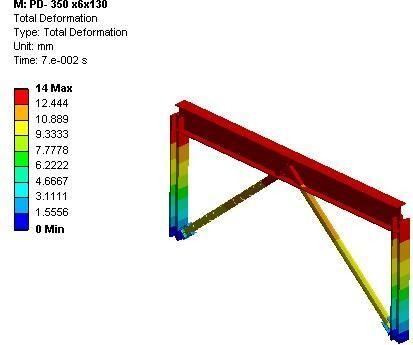
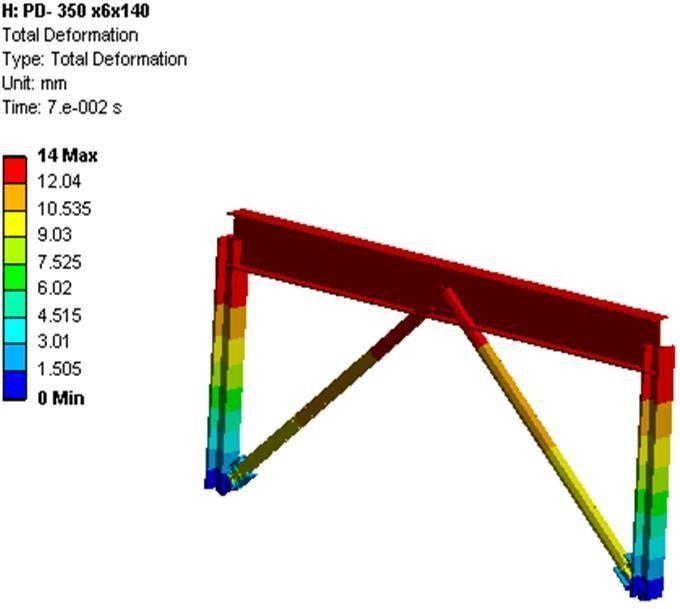
The parametricstudiesareconductedbychangingtheweb height ,web width and thickness. The specimens are PD 200X6X140,PD250X6X140,PD300X6X140,PD350X6X140, PD 350X6X100, PD 350X6X110, PD 350X6X120, PD 350X6X130,PD350X8X140toPD350X18X140.
Note;PDprofileddamper
3.2 Analysis
Analysisiscarriedouttodeterminetheoptimumsizeofthe profiled damper which gives the better performance. Non linearstructuralanalysisiscarriedoutinANSYSsoftware. Deformationandloadcarryingcapacityisstudied.
Lateral load testing of full scale braced framed is carried out successfully, it has high stiffness. Braced frame has a low ductility of 1.732 and have high strength of 4471.6 kN. By introducing flat damper and profiled damper to the braced frame the ductility of the frame is increased. By introducingflatdamperandprofileddampertothebraced frame the ductility of the frame is increased. Braced frame with flat damper has a ductility of 17.775 and have strengthof2551.4kN.Bracedframewithflatdamperhasa ductility of 17.775 and have strength of 2551.4 kN. Braced frame with profiled damper has a ductility of 2542.7andhavestrengthof2542.7kN.Braced frame with
© 2023, IRJET | Impact Factor value: 8.226 |
DeformationofPD250X6X140
DeformationofPD300X6X140
DeformationofPD350X6X120
DeformationofPD350X6X140
DeformationofPD350X6X110
DeformationofPD350X6X100




DeformationofPD350X6X130
DeformationofPD350X18X100

The result obtained for each of the above mentioned models arecomparedwiththebracedmodel.Differentparametric conditions are considered such as web height, height and thickness.Loaddeflectioncurveisplottedforeachspecimen. Theloadanddeflectionobtainediscompared.


Chart 3 Loaddeflectioncurve

Various parametric studies have been conducted to determine the optimum size of damper which give better performanceandhighstrength.Byincreasingthewebheight from200mmto350mm,strengthisincreasedto2623.4kN But it will not acquire the strength as much the braced system.Bykeepingthewebheightconstantthewebwidthis increased from 140 to 180 mm and deceases from 140 to 100mm.Decreasingthewebthicknesscausestheincrease in strength of the structure. Width of 100 mm gives a strengthof2934.7kN.Decreasingthewebwidthkeepsthe ductilityassameasthebracedsystem.Againbyfixingthe web height as 350 mm and web width as 100 mm the thicknessisincreasedfrom6mm.Atathicknessof18mm theprofiledamper(PD)attainsthestrengthmorethanthe bracedsystemie4630.1kN.Atthispointithasaductilityof 22.40. Therefore the effective size of the damper for the structureis350X18X100mm.
4. CONCLUSIONS
InthisstudyaninnovativeIprofileddamperisdisplayed.This damper is used to improve the performance of these structuresbecauseCBFs have weaknessintheirductilityand energy absorption Main benefits of this damper are its inexpensive cost of production and assembly, quick installation and lack of need for special tools. Numerous parametric studies have been carried out in order to research and create this damper .The ideal damper size thatprovidesimprovedperformancehasbeendetermined through a variety of parametric experiment If damper is added to a braced frame frame , performance will be improved
Full scale model of a steel structure with braced configurationisstudied.Itgivesaloadof4471.6KN andductilityof1.73andhavehighstiffeness.
As compared to ordinary braced frame here a I shapedprofiledamperisintroduced.inthisframe flat damper and profiled damper is introduced. Flat damper gives a load of 2551.4 kN and profiled dampergivesaloadof2542.7KN.
Variousparametricstudieshavebeenconductedin the profiled damper by changing various parameters such as wed height (from 200mm to 350mm) , web width ( 140 to 100mm), thickness(6 to18mm)
From the analysis it is found that the profiled damper of size 350x18 x100 give better load and have great strength, which is the optimum size of damper.Maximumloadobtainedis4630.1KNanda ductilityof22.50.
REFERENCES
[1] Chanachai Thongchom , Nadia M. Mirzai proposed “Improving the CBF brace’s behaviorusing I-shaped dampers,numericalandexperimentalstudy”.(2022)
[2] Young-Ju Kim , Jaehoon Bae published a journal “UtilizinganI-shapedshearlinkasadampertoimprove the behaviour of a concentrically braced frame”. (2022)
[3] Shoichi Kishiki, Haowen Zheng published a journal “Inspection of U-shaped steel dampers based on residualplasticdeformation”(2022)
[4] Ramin Tabatabaei, Mirhosseini published a journal “Modified bar-fuse damper in gusset plate detail to improveseismicbehaviorofbracingsystem” (2022)
[5] Mohsen Khalili, “Experimental and numerical investigations of a new hysteretic damper for seismic resilientsteelmomentconnections””(2022)
[6] ZhimingHe, Qingjun Chen, “Upgrading the seismic performanceofundergroundstructuresby introducing lead-filledsteeltubedampers”.(2022)
[7] WeiyangWang , Ye Liua , “Concept and performance testingofanall-steelminiaturedualstiffnessdamper” (2022)