Analysis of Sludge (from Sewage Treatment Plant) Mixing methods in Anaerobic Digesters for Production of Bio-Gas
Man Singh Mirdha1 , Mr. Hemant Kumar Agarwal2 1M.Tech Student Jagan Nath University, Jaipur Assistant Professor Department of Civil Engg. Jagan Nath University, Jaipur
Abstract - This study investigates the biogas generation of sewage sludge using anaerobic digestion from Delawas Sewage Treatment Plant located in Jaipur city, which is capital city of Rajasthan. In addition, different mixing techniques foranaerobicdigestionandpretreatmentofsewagesludgeisstudiedandimpliedforoptimumbiogasgeneration.Sludge recirculation,mostcommonmixingtechnologyiscombinedwithplateheatexchangertoheatthesludgegoinginsidethe digestersandperformanceofsamehasbeenstudiedthoroughly.Similarly,mostbasicpretreatmentofsewage sludgei.e. gravitythickeningisusedtooptimizethedigestersvolume.Severalothermixingmethodsarediscussedandusedsuchas, mechanicalagitation,gas-sludgeejector&mixingsystem.
Followingthecompletionofthisstudy,biogasgenerationwithrespecttofeeding,mixingandpretreatmentarediscussed thoroughlytopinpointtheoptimuminletparametersandmixing&feedingpatterns.
Thefindingsofthescenario analysisshowtheimpactofoptimizing OLR andconsistencyinfeedingto digestersarevery crucial for optimum biogas generation and health of anaerobic digesters. Also the effect of mixing by implying different mixingtechniquesshowspositiveresultsforenhancedbiogasgeneration.
1. INTRODUCTION
The number of rivers in India's network is as high as 113, and the country's extensive alluvial basins store an abundant supplyofgroundwater.Indiahasawealthofwaterresources.Inaddition,theIndiansubcontinentisendowedwithsnowcovered mountains in the Himalayan range, which provide the country with a diverse supply of water resources. Many regionsofthecountry'saccessiblewaterresourcesarebeingdepleted,andasaconsequence,thequalityofthewaterhas degraded.Thisisduetothecountry'sfastpopulationgrowth,aswellasthenecessitytofulfiltherisingneedsofirrigation, residential consumption, and industrial usage. Domestic sewage, industrial effluents, and agricultural runoff are the primarycontributorstowaterpollutioninIndia.
As the trend toward urbanization continues across the globe, one of the most critical problems to address is urban environmentalmanagement.Urbanplannersarefacedwithanumberofissues,oneofwhichistherequirementtoassure thecontinuousprovisionoffundamentalhumanservicessuchaswaterandsanitation.Asignificantobstacleispresented by the inadequate handling of municipal wastewater in many urban centers located in the south. In major cities, wastewater treatment and disposal is a difficult challenge. The improper disposal of wastewater contributes to the contamination of both aquatic and terrestrial environments. As a result of serving tainted water, it leads to a variety of health concerns as well as epidemics. The water bodies get eutrophicated as a result of its addition, which results in the death of aquatic biological resources. Therefore, treatment plants play an important part in the environmentally responsibleuseofwastewatersincetheyrenderthewaterusefulforavarietyofapplications.
Aknowledgeofthecharacteristicsofthewastewaterbeingmanagedisnecessaryfortheefficienttreatmentofanytypeof wastewater.Notonlyisdetailedparameterizationdata forthesecharacteristics requiredtofacilitatetheeffectivedesign ofwastewatertreatmentanddisposalsystems,butitisalsorequiredtoenablethedevelopmentandapplicationofwater conservation and waste load reduction strategies. However, wastewater characteristics must be predicted for the vast majorityofexistingprojectsaswellasalmosteverypotentialconstruction.(Kumar
&Chopra,2012)Despite possessing just 4% of the world's fresh water resources, India is responsible for more than 16% of the world's people'swell-being.InIndia,thetotalquantityofwastewatergeneratedannuallyby200citiesisroughly2,600Mm3,and theuseofsewage effluents forirrigationof agricultural fields isbecoming more prevalent, particularlyinthe peri-urban area.Tracemetalconcentrationsinsewagedischargevaryfromcitytocity.Thesewastefluidsincludesignificantamounts ofnutrientsaswellastraceamountsofharmfulmetals.Despitethefactthattheconcentrationofheavymetalsinsewage
effluentsisgenerallylow,thelong-termapplicationofthesewastewatersonagriculturalfieldsusuallyleadsinthebuildupofhigherquantitiesofthesemetalsinthesoil.Thisistrueevenwhenheavymetalconcentrationsinsewageeffluents are relatively modest. The quantityof metalsthatcanbuildinsomesoilsisaffected bythelength oftimewaste wateris permittedtoirrigatesoils.Cropsproducedonpollutedsoilabsorbmetalsinhighenoughconcentrationstocauseclinical problemsinbothanimalsandhumanswhoingestthesemetal-richplants.
Impact of Sludge mixing on AD process
Theeffectivenessoftheanaerobicdigestion(AD)processisstronglydependentonthecharacteristicsofthefeed,aswell asthefeedingpattern,pH,temperature,redoxpotential,hydraulicretentiontime(HRT),solidsretentiontime(SRT),and mixinginsidethedigester.Mixinghasaneffectontheproximityofmicroorganismstoavailablesubstratesandnutrients, consistent operating temperature and pH, HRT/SRT, and the distribution of metabolic waste, all of which are essential elementsintheaerobicdecompositionprocessandtheperformanceefficiencyofthesystem.Asaconsequenceofthis,the AD procedure is influenced by the mixing procedure, which is a physical procedure. Stirred tank digesters are built with the goal of providing external physical mixing within the digesters themselves. This is accomplished via the use of agitation.
A continuously stirred tank reactor, also known as a CSTR, is the primary component of a stirred tank digester that is completely assembled. This type of reactor is designed to process organic waste with total solids (TS) contents ranging from 3%to10%.Its plannedrange ofoperationis from 3%to 10%. TheHRT thatisnecessaryforthis process typically lasts anywhere from 10 to 20 days and is performed at a temperature of 35 degrees Celsius. The substrates are continuouslyfedintothedigesterthroughtheintake,andatthesametime,anequalnumberispermittedtoexitthedevice through the device's outflow. There is a widespread consensus that the HRT and the SRT refer to the same entity. The contents of a typical digester are continually mixed using one of the following four methods: gas recirculation, liquid/slurry recirculation, mechanical pumping and mechanical stirring, or a combination of these four techniques. Additionally,thecontentscanbemixedusingacombinationofthesefourmethods.Thisisdoneinordertomaintainthe suspension of the solids and to generate a combination that is uniform in consistency. There is a tendency for light particlessuchasfibre,straw,orfeatherstofloatonthesurfaceofthedigester,whichhinderstheproductionofbiogas.On the other side, heavy solids like stones, eggshells, sand, or other thick lumps descend to the bottom of the digester. This canhappenwithavarietyofdifferentmaterials.Thesurfaceisalsoacommonlocationforfloatingliquidsandlightsolids. Stratification, whether it is generated by sedimentation or flotation, reduces the volume of the active digester, causes mechanicalproblemswithpumpsandimpellers,obstructsthereleaseofbiogasfromtheliquidphase,andmayalsoresult intheformationoffoam,scum,andcrust.Stratificationcanbeinducedbyeithersedimentationorfloatation.
Thefollowingisalistofsomeoftheadvantagesthatcomefrommixing:
allowsforeffectiveuseofthetotalcapacityofthedigester,
haltstheprocessofstratification,whichincludesfloatingandsedimentation,
stopstheformationoffoam,scum,andcrust,
avoidspHandtemperaturefluctuations.,
responsibleforthedispersionofmetabolicendproductsaswellasanyharmfulelementsthatmaybepresentin theinfluent,
increasestherateatwhichbiogasisreleasedfromthesubstrate,
ensuresthatthebacteria,bacterialenzymes,andtheirsubstratecontinuetobeincloseproximitytooneanother,
contributestothedecreaseinparticlesize.
The fundamental purpose of mixing is to promote homogeneity in the fluid mixture and to give an equal platform for anaerobicmicrobes.
A stable habitat for anaerobic bacteria is one of the most critical criteria for attaining maximal digestion, and proper mixing is the key to meeting this prerequisite. Digesters are less prone to become blocked when enough mixing is undertaken.Inclassicsludgeanaerobicdigesters,poormixingoftenledtotheoversizingofthedigestersduetothelower HRT/SRT that it induced. This, in turn, led to decreased interaction of the substrates with the microorganisms, which resulted in poor volatile solids (VS) reduction and low biogas generation. It has been established that improper mixing withinthedigesterisasubstantialcontributiontothefailureofthedigester.Unevenmixing,ontheotherhand,canresult in the establishment of initiation zones in which methanogens can emerge and thrive, and from which they can subsequently seed the remaining areas of the digester. It is not yet apparent what degrees of mixing in AD are deemed
suitable and what levels are considered inadequate, and it is unknown whether or not it is economically viable to attain 100%homogeneityinthequesttoenhancetheenergyefficiencyofAD.
The high initial investment cost, as well as the continuous operational and maintenance requirements of mixing equipment,aresomeofthe negativesassociatedwithstirredtank digesters.Inthe past,a completestirred tank digester wouldfunctioninthesamemannerasacontinuousstirredtankreactor(CSTR),inwhichthedigesterwouldbeconstantly fed and mixed. It is estimated that the amount of energy required for mixing in a full-scale digester can account for anywherefromeightpercenttofifty-eightpercentoftheoverallenergydemand.Thevariancesinenergyefficiencymight be attributable to the varied types of substrates, TS, tank designs, mixing types and their orientations, as well as the operationalmodeofmixing.Duetothegreatpricerequiredinobtainingabsolutehomogeneity,themajorityofindustrial digesters work as a heterogeneous mixture. This is due of the high expense. The economics of AD may be improved to optimize the quantity of energy generated per unit of substrate treated, as well as the quality of the digestate, while concurrently minimizing the amount of money spent on capital and operational expenditures. When compared to the continuous mixing mode of a CSTR, optimum intermittent mixing is reported to minimize the energy consumption and maintenanceexpensewhilesimultaneouslyenhancingbiogasoutput.Thisisthesituationfromaneconomicpointofview. In an ideal circumstance, mixing should occur at the same time as feeding in order to homogenize the fresh feed that is beingdelivered,toguaranteethatthebacteria,bacterialenzymes,andtheirsubstrateareinclosetouchwithoneanother, and to produce an equal platform for the anaerobes. Therefore, in batch-fed or intermittent feeding modes, the mixing shouldcoincidewiththefeedinginordertodispersethefeed,andthenitshouldbemixedsometimesinbetweenfeedings. Thisisespeciallycriticalfordailybatch-fedorintermittentfeedingmodes(Kariyama
 etal.,2018)
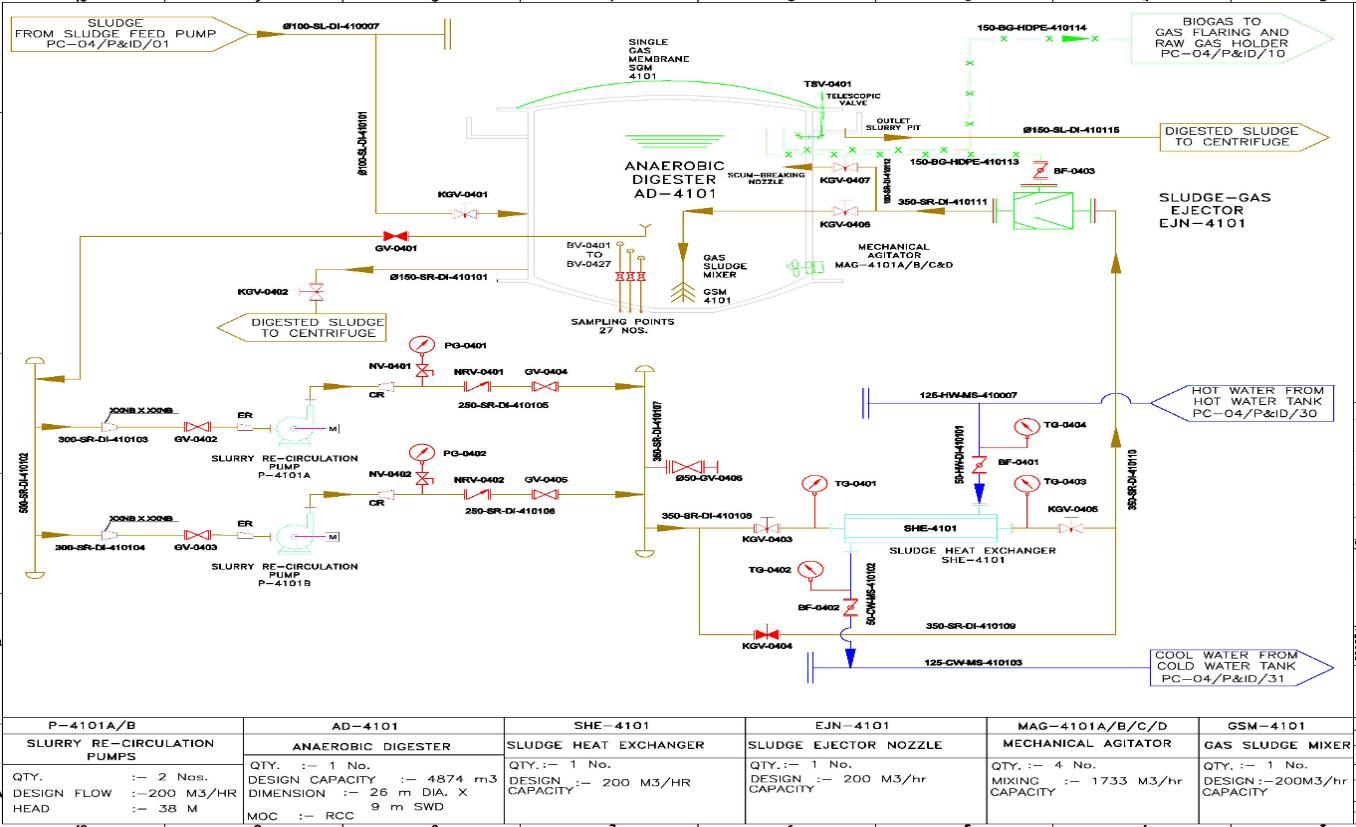
Identification of major processes
I. SludgerecirculationforAnaerobicsludgedigestion.
II. Plateheatexchangerforrecirculatingsludge.
III. Gas-SludgeEjectorforrecirculatingsludge.
IV. Gas-SludgeMixerforrecirculatingsludge.
V. MechanicalMixing.
Piping and Instrumentation of Digester A
Biogas Generation and Composition
Theamountand quality of biogasarecrucial markersforassessinganaerobic digestionsufficiency.As previouslystated, the biogas output of each anaerobic digester was recorded independently by an individual gas counter during a certain time period (approximately 24 hours), and the average gas flow for each system is determined every day. It should be notedthatthebiogasflowmayvarybetweenfeedcycles(whichoccurevery24hours).Forexample,increasedoutputmay beobservedrightafterfeeding,followedbyadropinoutputafterafewhours.Asaresult,theaveragebiogasflowperday ismoreconsistentandreliableforestimatingbiogasoutput.Thegastrapwasusedtocatchbiogaswhilethegasinvalve wasopenandthegasoutvalvewasclosed.Whenenoughbiogashadbeenstored(about700mL),aportablegasanalyzer was attached to the air lock with the gas out valve open to measure biogas composition. The gas analyzer computes the percentagesofCH4,CO2,O2,andH2S,aswellastheppmofH2S.
Thefollowingtestswerecarriedouttocharacterizetheparametersofthesludgesample.(APHA,1981)
Comparison of different mixing techniques in respect to biogas production
Thickenedsludgeisfedintothedigestersatconstantrate(AppendixA),withdifferentmixingmethodsutilizedtopenout theoptimumbiogasgeneration.
: Comparison of modes of mixing for biogas production
BiogasgenerationfromdifferentmixingtechniqueswithAverage OLR=1.83kg.VSS/m3.day Biogas generated (Nm3/day) - No mixing Biogas generated (Nm3/day) - Sludge recirculaltion Biogas generated (Nm3/day) - Mechanical Agitation Biogas generated (Nm3/day) - Both

Impact of intermittent mixing on anaerobic digestion
TheimpactofintermittentmixingforADprocessisexaminedtodeterminetheoptimalbiogasproductionincomparison toextentofsavingsinoperationalcostofdigesters.
Inadigestercycleof4hours,thebreakinmixingorsettlingtimeof60min,75min &90minisprovidedforExperimentI, II&III.
Sludgerecirculationpumps(2Working+2Standby)withbkWof35kWandmechanicalagitators(8Working –4foreach digester) with BkW of 5.5 kW. Total power consumption for 24 hour operation turns out to be 2736 kWh/day which in comparisonto1hoursettlingoveradigestercycleof4hourscomesdownto2052kWh/day.
With25%powersavings,optimumbiogasgenerationisachievedduringExperimentI.
Comparartiveofpretreatmentandmixingtechniquestoanalyse optimumbiogasgeneration

Days
Biogas generated (Nm3/day) - with thickening & no mixing Biogas generated (Nm3/day) - with thickening & continuous mixing Biogas generated (Nm3/day) - with thickening & intermittent mixing
Comparative of pre-treatment and mixing techniques to analyse optimum biogas generation
Conclusion
Anaerobic Digestion of primary sludge has been studied thoroughly during this project and following are the major conclusions:-
For completely mixed anaerobic digesters, an OLR of 1.75 to 1.90 kg.VSS/m3.day shows maximum biogas generation. Due to a lack of raw sludge, biogas generation is restricted by a low OLR, while VSS escapes undigestedat high OLR from digesters or the acetogenic process takes over methanogenic bacteria during high loadingratecausingthedigestertoturnsour.
Effect of pre-treatment of sludge (Gravity thickening) is noticed during this study which clearly shows the pretreatment of sludge positively affect the AD process. With thickening the same volume of sludge varies with different VSS concentration effecting the OLR considerably and finally leading to hamper the biogas generation. BiogasgenerationwiththickeningofrawsludgedecreasesthevolumerequirementofAnaerobicdigesters.
Sludge recirculation and mechanical agitation combined shows 17-18% increase in biogas production as comparedtonomixing.
Continuousmixingshowsbetterbiogasgeneration(4488Nm3/day)ascomparedtonomixing(3686Nm3/day), butthestudyforextentofmixingrequiredtoachievethemaximumbiogasgenerationwithrespecttooperation cost of mixing shows intermittent mixing increases biogas generation (5146 Nm3/day) and lowers the operationalcostbyupto38%.
REFERENCES
Adekunle,K.F.,&Okolie,J.A.(2015).AReviewofBiochemicalProcessofAnaerobicDigestion.AdvancesinBioscienceand Biotechnology,06(03),205–212.https://doi.org/10.4236/abb.2015.63020
APHA.(1981).StandardMethodsfortheExaminationofWaterandWastewater.AmericanPublicHealthAssociation.
Bai, S., Srikantaswamy, S., & Shivakumar, D. (2010). Urban Wastewater Characteristic and its Management in Urban Areas A Case Study of Mysore City, Karnataka, India. Journal of Water Resource and Protection, 02(08), 717–726. https://doi.org/10.4236/jwarp.2010.28082
Balasubramanian, M. (2018). Municipal solid waste management in India: Status, problems and challenges. International JournalofEnvironmentandWasteManagement,21(4),253–268.https://doi.org/10.1504/IJEWM.2018.093435
Bernard, S., & Gray, N. F. (2000). Aerobic digestion of pharmaceutical and domestic wastewater sludges at ambient temperature.WaterResearch,34(3),725–734.https://doi.org/10.1016/S0043-1354(99)00234-1