New Nomenclature for Eclipses, Transits and Occultation: Observer Oriented Approach
 Mitali Kabra1 , Sudarshan Loya2
Abstract - Humans are soon going to inhabit different celestial bodies, one of them being moon. The eclipses on Earth will seem different on the moon. For example, when a Lunar Eclipse occurs on the earth, it will be a Solar Eclipse on the moon. So, even though the celestial arrangement is same, when the observer’s position is changed, the entire phenomenon gets changed. Eclipses, transits and occultation are also used by astronomers to find details about celestial bodies. It is important to clearly name the arrangement to explain the syzygy and its meaning. This paperisanattempttoreviewthecurrentaswellaspossible new astronomical phenomena and name them precisely keepingtheobserver’spositioninmind.
Scientists have been discovering new, different and quirky systems.So,theremaybeapossibilityofvariousothertypes ofeventsoccurring,thatonemaynothaveevenimagined.It is necessary to look into such possibilities from mathematical point of view and name it, so that astronomers can use them to make their mathematical models for exo-planet and exo-moon hunting more precise. A new system is defined in here to name the possible eclipses, transits and occultation, such that any new development can be properly explored and classified. Even though authors have covered a wide range of eclipses and occultations, authors believe this may not be the end of the road.
Key Words: Eclipses, Occultation, Exoplanets, Nomenclature,Syzgy,ObserverOriented.
1. INTRODUCTION
Modern astronomy is filled with many wonders and discoveries of amazing Exoplanets, exomoons and stellar systemswhichareverydifferentfromthatofours[1]–[6] ThesediscoveriesofExoplanetarysystemalongwiththeir shapes, sizes and orbits shows that universe is filled with stellar systems which cannot be comprehended by any of the human’s current analytical or imaginative models. In lightofsuchamazingdiscoveries,onecanwondernotonly about the planetary systems; but kind of syzygy they can create. Such arrangements of planets, its natural satellite need to be studied in detail, but before that they need to beclassified.
Most people on earth are aware of two kinds of eclipses: Solar and Lunar eclipse [7], [8]. These eclipses have not only shaped our scientific understanding but also our cultural and religious beliefs[9]. But modern day discoveries demand a new classification not just for eclipses but also for transits and occultation. These classifications and nomenclatures need to be observer positiondependentashumanbeingsorspacecraftsareno longer bound to earth or just our solar system and in future may observe such phenomena from other bodies. This effort will make the nomenclature universal and usablebyfuturegenerations.
So, this paper aims to provide an insight about possible eclipses, transits and other phenomena occurring on celestial bodies, while taking into consideration the position of the observer. The ideas explained in here are using simple mathematical equations developed from similarity of triangles. Even though dwelling into a more detailed mathematical expression is not possible at this time, the ideaspresentedhere,areverymuchvalidandsurelyhave greaterscope.
1.1 Naming from Observer’s Point of View:
Many space agencies are planning to create a permanent settlement on the moon by 2035 [10], [11]. The people inhabiting the moon will see the eclipses that occur on earthinacompletelydifferentway.Insuchascenario,one shouldtakeintoconsiderationthepositionfromwherethe observer may be watching the phenomenon. Because, the eclipses that take place on the earth, are named considering the observer's position to be Earth; so, while discussing eclipses, transits and occultation on other celestial bodies, it is important to identify the observer position.
WhenthereisalunareclipseontheEarth,itwon't bea lunareclipseontheMoon.Itwouldbea solareclipse on the Moon, but to make the observer’s position clear, scientistshavenameditasa solareclipseonthemoon [12], [13]. Similarly when there is a solar eclipse on earth, the near side of the moon facing the earth, may see a small black spot moving across the surface of the earth. Though this will not be an eclipse, it will be more of black spot or shadowtransitingtheearthandhenceshouldbenamedas Self transit (moon on earth) Whentheshadowofthebody
itself is creating a spot on another celestial body which is visible from the original body, it should be named as selftransit.
Eventhoughtheastronomicalarrangementisthesame,by changing the position of the viewer, the appearance and viewing of the eclipse is changed. Hence it is important to consider the observer’s position, and name the astronomicalphenomenonaccordingly.
1.2 Planet Transits:
On earth, planetary transits are visible through special equipments [14], [15]. When Venus or Mercury move in frontofthesunwithrespecttoearth,theycanbeseenasa smallblackdotoversunsurfaceusingtelescopewithsolar filters[16].Sucheventsarecalledtransitsandnoteclipses [17],[18].Thenamingoridentificationofmosttransitsor eclipses is from earth’s point of view. But as explained before, it is important to consider other points of references like Mars, Io, etc. Not just transits, even occultation need to be reclassified based upon observer’s pointofview.
2. OCCULTATION:
Occultationisaphenomenonwhichoccurswhenanobject or celestial body passing in front of another object blocks orcoversitpartiallyorcompletely[19],[20].Occultationis a commonplace occurrence in the night sky on earth with respecttostarsorotherplanetsbeingblockedbythemoon [20]–[22]. However, on other planets occultation of one moonbyanotherwouldbequiteaviewtobehold.Someof these occultation’shave been picked byon-boardcameras of various space probes on different planets as discussed below[23]–[26].Butbeforediscussingoccultationingreat detail, one needs to clearly differentiate occultation and transits.
As defined by NASA when a smaller object passes in front of a larger object, such that only a small part of the larger objectisblocked,thenitshouldbe called a transit andnot anoccultation[27],[28].Forthearrangement to be called occultation, the body eclipsing the far away celestial object has to be apparently bigger in size from observers point of view [28], [29]. So when the object closer to the observer has a bigger apparent size as compared to the far away object,thephenomenonwillbecalledoccultation.Bodyin front may or may not cover the entire body behind it or may not be actually bigger than the body behind it, but it just has to appear bigger from the observer's position. If the body in front is appearing smaller from an observer's pointofview,theocclusionwillbecalledtransit.
Butincaseofotherplanetswhichhavemultiplemoons,the moon close to the planet can be big enough to completely block the other moon behind it and it can be visible by unaidedeyeslikethathappeningonplanetMars[19],[25],
[28], [30]. Such a phenomenon is called occultation in literature. Although transit and Occultation are used commonly in literature, most of them are defined with respecttoearth[20],[27],[31]–[38]
Asmostoftheastronomicalstudiesaredonewithrespect to earth, authors have provided the history of occultation that are regularly observed by scientists [39]–[43] Lunar occultation occurs when the moon is blocking the other celestialbody[44]–[46].Itisthemostobservedoccultation and may be observed even from unaided eyes. Asteroid Occultation is when an asteroid passes in front of a star with respect to earth [47]. Planetary Occultation happens when a planet from the solar system passes in front of other stars with respect to earth [43], [48], [49]. This has been used by scientists to understand the makeup of the planet's atmosphere like that of Pluto even before the spacecraft could have reached there. Lastly, Artificial Occultation is when a man-made object is used to block certain objects' visibility to study things in background or atthesurface[50]
Scientists in the past have used space probes to see occultationonotherplanetsnotjustinvisiblelightbutalso in the UV, IR and radio spectrum [51], [52]. These have helpedthemtoevaluatetheringstructureofSaturnaswell asshapesandsizesofvariousobjectsonotherplanets[33], [53]–[55].Occultationsofstarsbyplanetaryrings,planets, asteroidsarecalled Stellar occultation[52],[55]–[60].But this definition is confusing. As an asteroid occultation is also an asteroid passing in front of a star and so is stellar occultation. Same with planetary occultation as the planet passesinfrontofthestar.
As the human race is no more limited to the planet earth but trying to colonize other planets which have multiple moons, occultations will be more frequent. Using advance space probe and rovers, astronomers have discovered various other kinds of occultation. Hence it is of utmost importancetoclassifyoccultationsnotjustwithrespectto earthbutincommonsensewhichidentifiesthepositionof the observer as well as bodies taking partin the occultation.
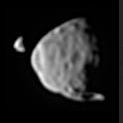
For example, Mars is an active planet for planetary observation as there are some advanced robotic probes working live on that planet [25], [61]–[63]. As seen by NASACuriosityroverthatOnAugust1st 2013,Phoboscan occult Deimos and block the visibility of Deimos from certainpositionsonMars[64].AsPhobosisapparentlyand actually bigger than Deimos while moving in front of it, suchan event iscalledlunar occultationas observed from Mars as shown in Figure. When observed from Deimos, Phobospassing in front of Mars will be a lunartransit.Even on Saturn, a man made space probe Cassini Huygens has observed Saturn’s moon Rhea occulted by Dione with respect to probe [65]–[69]. Even though this image does
not provide an observation of occultation as viewed from Saturn,itprovidesevidentialsupport.
well as transits, being classified and named as discussed above.
Table 1: OccultationandTransitClassification:
Sr. No Occultat ionType Example Nomenclature
1. Lunar Occultat ion
1. Phobosbetween MarsandDeimos andobserverat Mars
Theauthorsaretryingtoprovideauniformnomenclature to all kinds of occultation and transit. But the nomenclature should be able to differentiate them clearly suggesting the observer position along with bodies involved in the process so as to understand and communicateprecisely.
2.1 Nomenclature:
Building upon existing pattern, with slight modifications onecandescribethephenomenonpreciselyfromobserver location. In the current nomenclature system, it is a common practice to identify transit or occultation by the object in between two bodies. For example, moon is the middle body in lunar occultation. So is the case for other occultations. The only exception is stellar occultation which is named after the star which is occulted by the celestial object in front. But since stellar occultation can alsobedefinedintermsofotheroccultations,asexplained before, authors believe that one should not use the name, stellaroccultationanymore.
Following the above example on the Martian planetary system, Phobos occultation of Deimos from Mars, will be named as lunar occultation. But whenever this phenomenon is broadcasted or discussed on earth or any other celestial body, then the name needs to be more precise so that it can specify the celestial bodies taking part in the occultation and their arrangement. Hence, the name should be followed by a bracket, which will specify thecelestialbodiestakingpartintheoccultation.
Sothenameinageneralizedwaywillfollowthefollowing pattern-
Type of occultation (The position of the observer -The body that is occulting - The body that is being occulted). The same method can also be applied for already defined occultations and transits with respect to earth. The followinglistprovidesexamplesofvariousoccultationsas
2. Asteroid occultati on
2. Callistobetween GanymedeandIo andobserverat Ganymede (Hypothetical arrangementto explainthateven onemooncancome betweentwoother moons)
1. AsteroidPallas occultedstar Vulpeculaas viewedfromearth [70]
2. Asteroid163 Erigoneocculted starsRegulus viewedfromEarth [71]
1. Lunar occultation (MarsPhobosDeimos)
2. Lunar Occultation (GanymedeCallisto-Io)
3. Planetar y Occultat ion
1. PlanetVenus occultingXi-2 Sagittariiwhen viewedfromearth [72]
2. WhenDeimosis occultedbyMars fromPhobos.
3. PlanetTRAPPIST-1 bisocculted TRAPPIST-1cwhen viewedfromearth [73]
1.Asteroid Occultation (EarthPallasVulpecula)
2.Asteroid Occultation (Earth-163 ErigoneRegulus)
1. Planetary Occultation (EarthVenus-Xi-2 Sagittarii)
2. Planetary Occultation (PhobosMarsDeimos)
3. Planetary Occultation (EarthTRAPPIST-1c -TRAPPIST-1 b)
4. Artificial Occultat TheSundiskwas occultedbyApollo Artificial Occultation
ion Spacecraftwhen viewedfromSoyuz [74].
5. SelfTransit 1. Whenthereisa solareclipse,the viewfromthe moonwillbeofa self-transit.
2. Similarly,when Callistoeclipses Jupiter,theview fromCallistowillbe ofself-transit.
(Soyuz-ApolloSun)
1. Self-Transit (MoonOn Earth)
2. Self-Transit (CallistoOn Jupiter)
differentkindsofplanetarysystems,whicharenothinglike our own solar system[32]. For example, in the planetary systemofKepler1625;theplanetorbitingKepler1625i.e. Kepler 1625 b is really big compared to anything in our solarsystem [82]–[84].Suchbigplanetsarecommonplace occurrences in other planetary systems as observed in various scientific observations [85], [86]. Keplar 1625 b is supposed to be orbited by a moon Kepler 1625 b I [87], [88]. The astronomersare trying to figure out if the moon has its own moon or there is a different arrangement working on that star [89]–[91]. If this is true, it will give risetonewsetsofeclipseandtransits.
6. Planetar ytransit
1. WhenVenusor Mercurymovein frontofthesun withrespectto earth[19]
2. Whenmercury passesinfrontof sunwithrespectto Mars[75]
7. Lunar Transit 1. Phobostransiting infrontofSunas viewedfromMars [76],[77]
2. Deimostransiting infrontofSunas viewedfromMars [78]
8. Artificial Transit 1. TheISStransitsthe Sunasviewed
1. Planetary Transit(Earth -Venus-Sun)
2. Planetary Transit(Mars -Venus-Sun)
New astronomical data has found astronomical objects earlier thought to be impossible [92]. On a planetary system having dwarf stars with super Jupiter-like planets orbiting them, they can cast shadows at much longer distances, like the GJ3512 or the WD 1856+534 stellar system [93]–[99]. Can such planets cast an eclipse on another planet? Given the amazing discoveries astronomersaremakingonadailybasis,noarrangements can be ruled out, just because astronomers haven’t observedthemyet.
3.1 Eclipses on One Planet by Other Planet:
1. LunarTransit (MarsPhobos-Sun)
2. LunarTransit (MarsDeimos-Sun)
Eclipses by the moon of a planet on the planet itself are very common, but even a planet can cause an eclipse on another planet. Normally, a planet can only be visible as a bright star from another planet in the night sky, however bigtheplanetcangetbeforeithitsthelimitofturninginto a staror playing tug of warwith the original planet [100]. ButdiscoveriesoftheExoplanets,their diameters and the diameter of the star they are orbiting around raise some questions. Discovery of TRAPPIST 1 stellar system recently showed that planets can orbit so close that they can actually appear like the moon from otherplanetsinthesamestellarsystem [101],[102].Also, when one planet's orbit is too eccentric around a star, on anotherplanet;itcanappearslightlybiggerthanapointed star in the night sky. Like in the system of HR5183, HD 80606 or HD 20782, the orbit of the respective planet is very eccentric like that of a comet [103]–[107]. Recent simulation done by Kane, S, Blunt and others shows that when viewed from a rocky planet in the habitable zone of thehoststar,suchaplanetcanappearalittlebitbiggerlike asmallballshapedinthenightsky[103],[104]
Apart from occultations, there are possibilities for new kindsofeclipses
occuronotherplanetsifnoton earth. In recent times, astronomers have discovered
But to discuss the possibility, one can work with some basic conventions of shadow formation by light. For any shadow to be casted at a large distance, one can use the principle of light and its effect on solid bodies. The light source needs to be smaller with respect to the object and theobjectshouldbeclosertothesourcetocreatealonger shadow when no other light sources are present nearby. So,itisquiteclearthatSuper-Jupiterwill havethelongest shadowinanystellarsystem.Further,theshadowofsucha
super Jupiter can reach even longer, if the host star is a dwarf star which has a diameter comparable to that of superJupiter.Giventhatinoursolarsystem,theSunistoo large,thepossibilityofviewingthesunasapointedstaror small object is fairly small even from very large distances. So to see a planet big enough to cover the sun is quite impossible in our solar system and in most solar systems. But one needs to study other solar systems keeping the abovegroundrulesinmind.
RadiusofGJ3512=0.166*RadiusofSun~=115500 km[111] (1)
Radius of the GJ3512b = 1.27 *Radius of Jupiter~= 88800km (2)
Orbital Radius of GJ3512b = 0.338 AU = 0.338 * 149600000=50565000km (3)
Distance of GJ512ci from GJ3512b = Distance from EarthfromSun=1AU (4)
Since △ABC is similar to △ ADE by AA test, one can writetherationoflengthsareequal.
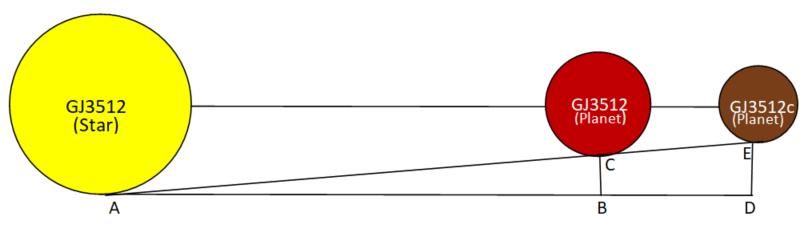
AB:AD::BC:DE (5)
0.338/1=(115500-88800)/DE (6)
DE=1*26700/0.338 (7)
DE= 79000km. (8)
2: Possibilityofplanettoplaneteclipseon imaginaryplanetinGJ3512system
Recently, astronomers have discovered one such system, GJ3512 around 31 light years away from earth; in which the Exoplanet GJ3512b is nearly the same size as the host star [97], [108]. So given the scenario, the shadow cast by GJ3512b will be very large and may reach at distances where other planets can orbit. Astronomers recently discovered second planet orbiting the same star but it is yet to be confirmed by secondary sources. This planet is orbitingatabout 1.3AUfrom itsstar. Since the prediction of another planet orbiting the star GJ 3512 is not yet validated,let’sassumeahypotheticalplanetatadistanceof 149,600,000 km or 1AU in the same plane as the first planet [109], [110]. And let the planet be called GJ3512ci where ‘i’ stands for imaginary planet. Performing simple mathof triangles to find outthe shadow distance,one can check out the possibilityof the eclipseon thehypothetical planetbyGJ3512ci.
Here,lefthandsidecircleisthestarGJ3512,middleoneis the planet GJ3512b whereas on the right hand side is the imaginaryplanetGJ3512ci.
PointAisatthecircumferenceofthestarGJ3512.
PointBisthelocationofGJ3512bfromthestarposition
PointCisthecircumferenceoftheGJ351b
PointDisthelocationofGJ3512cifromthestarposition.
PointEisonthecircumferenceofGJ3512ci
From Equation (8), the value DE is 79000 km, i.e. smaller than the radius of GJ3512 which is 115500 as shown in equation (1).Therefore, the light has not yet crossed the midpointofGJ3512ci.ThustheshadowofthesuperJupiter planet GJ 3512b can reach the planet in the Umbra region itself. In such a scenario, there is a possibility of having a planet-planeteclipse.
Another interesting example is of the stellar system WD 1856+534, a white dwarf star about 80 light years away from earth. This stellar system has a planet WD1856b which is about 10.4 times the radius of earth [94], [95], [112]. Comparing the radius of the planet and star will suggestthattheplanet'sdiameterisbiggerthanthatofits hoststar.
Radius of WD1856 star = 0.013 * Radius of sun = 0.013*695700~=9044km (9)
Radius of WD1856b = 10.4 *Radius of earth = 10.4*6378~=66000km (10)
Hence the planet can virtually block the star and cast a shadow long enough that any other planet in the system willdefinitelyexperienceaplanettoplaneteclipse.
Even though the above two examples are based upon an imaginarysecondplanet,soonastronomersmayfindouta stellar system that exists with multiple planets. Hence, a proper naming system of such eclipses will be needed baseduponthehoststarandtwoplanetsinvolved.
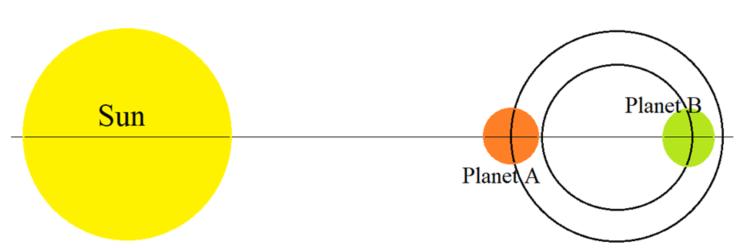
Apartfromtheabovescenariowherethetwoplanetshave separate orbits, a stellar system can exist, where two planets orbit each other with Barycenter somewhere between them. Like, there are stellar systems with two stars orbiting each other commonly called a double star system [113], [114]. Also, in our own solar system, Pluto and Charon are referred to as binary planetary systems [115]. So, it is highly possible to detect a stellar system whereonewill beabletodetecttwoplanetsorbitingeach otherasbinarysystems.Insucha scenario,itwill beeven more possible to have one planet eclipsing another planet duetotheirproximityandorbitalmotion.Followingfigure illustratesthesameinasimplepossibleway.
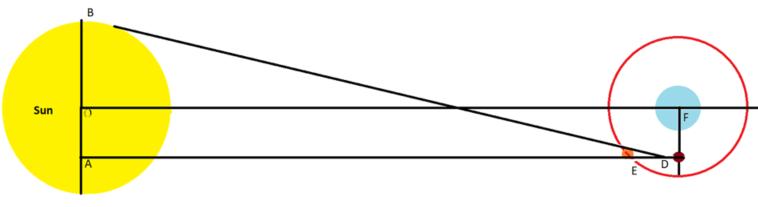
Not just on the moons of Jupiter, but such an eclipse can occur on other planets where the moons are orbiting around the planets very near to their ecliptic plane. For example, moons of Uranus namely Ariel and Umbriel are going around at very small angles to the ecliptic plane [123], [129], [130] Authors do understand that the Uranus axis is tilted and the moon of Uranus can never come in a straight line along with the sun to cause any eclipse. Butinspecialcase,ifthereisaplanetlikeUranus, whose axis is not tilted and has moons similar to Umbriel and Ariel, moving in same plane and about same distance from the planet, it is very likely to cause a moon eclipsing anothermoon.Justtofigureoutthepossibilityofthesame, authors are employing simple math on the triangles as showninfigure.
3.2 Eclipses on One Moon by another Moon:
There are other kinds of eclipses, in which one can see some evidence in our solar system. One of them is the eclipse of a moon by another moon. As discussed earlier, both moons of Mars can cause occultation with respect to Mars (Phobos-Deimos occultation) and also they have transited the sun with respect to Mars individually [116] Thatmeansboththemoonmayalsocomeinastraightline withrespecttotheSun.
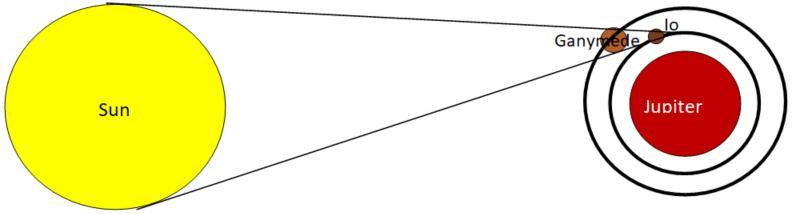
Various telescopic images prove that all four Galilean moonsofJupitercancreatesolareclipsesonJupiter[117]–[121].OutofthefourmainGalileanmoons,thelargesttwo moons Ganymede and Callisto are having approximately the same inclination i.e. 0.204 and 0.205 respectively [122]–[124].Sinceboththemoonsareorbitinginthesame planeandtheycanbotheclipseJupiter,thatmeansCallisto canalso eclipse Ganymede, when they are both passingin frontofJupiteratthesametimeinastraightline.
Some unpublished sources have claimed to have seen Io castingshadowsonanothermoonGanymede[125]–[127] Althoughtherearemultiplereportsofthese,authorshave not yet found any published source on the same, but just one article in newspaper[128]. But this gives credence to theabovetheory.
PointAisatthecircumferenceofthestari.e.ourSun.
Point B is the location of Uranus Moon Umbriel on the tangentofthesuncircumference
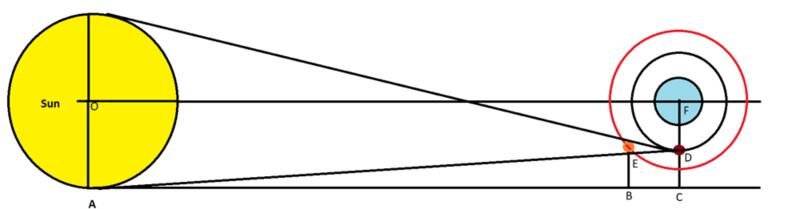
Point C is at the location of Uranus Moon Ariel on the tangentofthesuncircumference
Point D is the location of Ariel on side of Uranus when facingtheSun
PointEisthelocationoftheUmbrielinfrontofAriel
RadiusofSun~=696340km [131] (11)
RadiusoftheAriel~=1158km [132] (12)
RadiusofUmbriel~=1170Km [133] (13)
Semi Major axis distance of Ariel from Uranus ~=191020Km (14)
DistanceofUranusfromSun=2954100000Km (15)
Semi Major axis distance of Umbriel from Uranus ~=266300Km (16)
AB/CE=AD/DE (20)
887320/585=AE+DE/DE (21)
1516.8DE-DE=AE (AE is Distance of Sun from Umbriel=2,953,914,455) (22)
DE~= 1,948,750Km (23)
However the Ariel and Umbriel are at an inclination of 0.260 and 0.205 degrees from the Uranus plane respectively. Calculating the offset of the moon from the centerlinebyusingtrigonometryratios.

6: ArielEclipseofUmbrielinanimaginarysystem whereUranusisnottilted
From the above discussionone can figure out the position oftheUranusmoonUmbrielfromArielbyconsideringthe rightangletriangleDEF.
In triangle DEF, ∟EDF is right angle and hence by PythagorasTheorem,onefigureoutthedistanceDEasDF issemimajoraxisdistanceofArielfromequation(14)and EF is semi major axis distance of Umbriel from equation (16)
DE=√(EF2 - DF2) = √(2663002 - 1910202) = 185545km (17)
Consideringthe Error! Reference source not found.,theshadow of Uranus moon Umbriel will be shortest from the light coming from the opposite hemisphere of the Sun. Hence, the figure was modified to check if the shadow of the UmbrielwilleverreachAriel.
From,△DCEand△DBAaresimilar.Hencetheirsideshave tobeinequalratio.
AB=RadiusofSun+DistanceofArielfromUranus
EC=RadiusofUmbriel-1170Kmfromequation(13)
AE=DistanceofSunfromUmbrielisitinlinewithSunand Ariel.So,AEwillbeDistanceofSunfromUranus-Distance ofArielfromUmbrielfromequation(17)
AB=AO+OB=696300+191020=887320Km (18)
AE=AD-ED=2954100000-185545=2953914455 Km (19)
Figure 7: ExaggeratedviewofArialandUmbrieltiltwith respecttoeclipticplaneinanimaginarysystemwhere Uranusisnottilted.
Inthe Error! Reference source not found.,theinclinationof Ariel and Umbriel is exaggerated to make a point that the moonsmaynotbeatthecenterline.Thegoalhereistofind theoffseti.e.CDandABtoseeiftheyareoutoftheshadow castbythefrontmoonUmbrielonAriel.
From the above figure, △ODC and △OBA are right angle triangles at ∠OCD and ∠OAB respectively. Since the hypotenuseisknowninboththecasesi.e.semimajoraxis distancefromUranusandtheangleofinclinationisknown as discussed above, one can figure out the offset by using TrigonometricSinfunction.
CD=ODSIN(COD)=266300*sin(0.205)=952.8Km (24)
AB=OBSIN(AOB)=191020*sin(0.260)=866.8Km (25)
Since both the distances are nearly within a range of 100 Km which is way less than the radius of both moons i.e. about 575 Km one can see that the moon-moon eclipse is possible. The shadow of Umbriel i.e. 1948750 Km from equation (23) is about 10 times the distance between Umbriel and Ariel i.e. 185545 Km from equation (17) Hence it is quite possible that even with the offset the UranusmoonUmbrielmayeclipsethemoonAriel.
Though this is not possible due to the tilted orbit of Uranus,itsuggeststhatsuchpossibilitycanexistsandmay occur on other planetary systems. Also, in other stellar systems, there may be higher possibilities of such moonmooneclipsesgiventhatthemoonsizesarebiggerandthe starsizeissmaller.
3.3 Nomenclature:
Abovementioned eclipses need to be defined based upon thecelestialbodiesinvolvedinthephenomenon.OnEarth, eclipses are defined with respect to earth's observation of celestial bodies and named by the object which is not visibletotheobserveronearth.Duringlunareclipse,Moon is not visible and so is the case with sun during the solar eclipse. However to avoid confusion, new eclipses should bedescribedinsamewayasoccultationandtransitswere namedabove.
Incaseofoneplaneteclipsinganotherplanet,itshouldbe named as Planetary Eclipse by adding a bracket, clearly describingtheobserverposition,bodycausingtheeclipse. Herethereisnoneedtomentionthethirdbodyasitwillbe sourceoflightwhichwillbethehoststar.
There can be two types of the planetary eclipses dependingontheobserver’sposition:whentheobserveris ontheplanetthatiseclipsingtheotherone,theeclipsewill seem like the lunar eclipse on the earth, but it won’t be a lunar eclipse as the eclipse is of a planet. Such eclipses should be called as Planetary eclipse. The second type is when the observer will be on the planet that is being eclipsed.Itwillbelikethesolareclipseontheearth,socan benamedasPlanetarySolarEclipse.
The format of the name is: Planetary eclipse (observer position-thesecondbodyinthearrangement).So:Onthe stellar system GJ3512, the eclipse taking place will be named as, Planetary Solar Eclipse (GJ3512ci-GJ3512b) if the observer is on GJ3512ci, and if the observer is on GJ3512b, it will be called Planetary Eclipse (GJ3512bGJ3512ci). Similarly, in the case of WD1856+534 eclipses will be, Planetary Solar Eclipse (any planet, if foundWD1856+534 b) or Planetary Eclipse (WD1856+534 banyplanet,iffound).
Similarly, in the case of Lunar Eclipse of one moon by another moon, when the observer is on the moon that is eclipsing, it will be called Lunar Eclipse only. When the
observer is on the moon that is being eclipsed, it can be named as Lunar Solar Eclipse. In the case of Io eclipsing Ganymede, observers from Ganymede will call it lunar Eclipse (Ganymede-Io) and observers from Io will call it Lunar Eclipse (Io - Ganymede).The same format can be followedinothersystemsalso.
4. FOUR CELESTIAL OBJECTS IN ONE LINE:
As discussed before, the Curiosity rover observed that Phoboscan occult Deimosand both moonscan transit the sunindependentlyandthattheyall(Mars,Phobos,Deimos and Sun) can come together in a straight line. This phenomenon will be called a transit and not an eclipse as themoonsofMarsarenotbigenoughtocastashadow.But if on some other planet or Exoplanets, where the moons are big enough to cast a shadow, it is quite possible given the range of Exoplanets astronomers have discovered [134]. Like that happened and reported on the planet Jupiter where Ganymede is casting shadow on Europa, while the shadow of both is being casted on Jupiter at the sametime[128]
There may be a possibility of seeing multiple bodies aligninginthesameline,bigenoughtocastshadowswhich will create an observation far beyond the explanation of today’s terminology. These kinds of eclipses need to be furtherclassifiedandstudied. One canclassifythese types of eclipses on the basis of different arrangements of celestial bodies involved in the eclipses. Since, the discussion is about eclipses, alignment of small bodies which cannot cast long enough shadows like asteroids, rings,etc.areneglected.
4.1 Sun Moon –Moon Planet Syzgy:
Even though astronomers have not seen Sun-DeimosPhobos-Mars alignment, having four bodies in a straight line that can create an eclipse is surely possible. As suggested by the paper Washington post, Jupiter’s moons Ganymede and Callisto can cast shadow on Europa or Io. Astronomershavediscoveredeclipsesbyallthemoonson the planet individually. But since they all have nearly the same small inclination angle (about 0.205), the possibility of two moons coming in a straight line increases [135], [136]. For a person standing on Jupiter at the right time and right position can see a solar eclipse of two moons occurringsimultaneously.SowhileCallistowillbecastinga shadow on Jupiter, Ganymede or Europa can come in between and provide an appearance of multiple Solar eclipse. As the moon near the planet moves faster compared to moons away from the planet, it is quite possible; Ganymede or Europa can come in between and addanotherlayerofshadow.
Howeverfortheabovepossibility,boththemoonsneedto be of appropriate sizes to cast shadows long enough to reachtheplanetsurface.
4.2 Sun Moon Planet Moon Syzgy:
On a planet with multiple moons, it is quite possible that on one side of the planet; solar eclipse will be going on, while from the other side, there can be a lunar eclipse happening on another moon. The possibility of the sun, both moons and the planet coming in a straight line is quite obvious. On the planet, there cannot be a single site from where one can observe both the solar eclipse and lunar eclipse simultaneously. From the moon behind the planet,onemayneverseethesecondmooninfrontofthe planetandobservestheSun,moonandplanetinastraight line.Sameistrueforthemooninbetweenthesunandthe planet.Atnosinglesiteonthemoon,canonesee thesun; planet and the other moon align in a straight line. For example, in the Jupiter planetary system, its moon Io and Europacanhavesuchanalignment.Sincethepossibilityof such an event is rare to be visible from a single point on any of the body, there is no immediate need for naming such an event. If discovered in future, the names will be pretty obvious based upon other names given in the sectionsbelow.
4.3 Sun Planet Moon Moon Syzgy:
It is a possibility that the Sun, the Planet, and its two moons can come in a straight line leading to two solar eclipses, when observed from the last moon. It is quite possible that while a solar eclipse is going on, when viewed from one moon, another moon orbiting closer to theplanetcancomeinbetweenplanetandmoon.Thiswill create a four body eclipse when viewed from the first moon. For example, when observed from Jupiter’s moon Callisto, Jupiter can block the sun and cast a shadow on Callisto. But at the same time, Ganymede at nearly the sameinclinationcancomeinbetweenJupiterandCallisto further creating an amazing view of multiple bodies aligning at the same time. In this arrangement, the first moon is covered by the shadow of the planet, and the second moon is covered by the shadow of both the first moonandtheplanet.
Figure 9: FourbodyEclipsewithplaneteclipsingtwo moons


Similarly on Pluto, when looking from Nix or Styx, both Pluto and Charon can come in between the moon and the sun.Thefourbodiesmaybeinalignmentforasmalltime, butitwillbeasighttolookoutfor.
Eventhoughawiderangeofneweclipsesarediscussedin here, authors don't think that these will be the final frontier.Therearemanymoredifferentphenomenayetto be observed or named, but if it is possible physically or mathematically, it is a matter of time before scientists observethem.
4.4 Nomenclature:
Continuing with the same format discussed earlier; following nomenclature is suggested for describing four bodyeclipsestoavoidanyconfusion.Thenamesaregiven withrespecttoviewfromthelastbodyasthebodyinthe middlewillhaveeclipsessimilartoonediscussedearlier.
In any of the cases discussed, the observer from the last bodyisgoingtoobservetwosolareclipsescreatedbytwo differentbodiesandhenceitcanbenamedas Twin Solar Eclipses. However,itisalsoessentialtoidentifyonwhich planet or moon the eclipse is taking place and the arrangement of celestial bodies. Hence the following nomenclature:
On the planetary system Jupiter, the arrangement of Sun, Callisto,GanymedeandJupitershouldberepresentedasa TwinSolarEclipseonJupiter(Callisto-Ganymede).
On the planetary system of Pluto, when the arrangement of Sun, Pluto, Charon and Nyx come into play, it can be called as Twin Solar Eclipse on Nyx (Pluto- Charon). The samecanbeusedforotherplanetarysystemsalsowithout changingtheconvention.
3. CONCLUSIONS
The discovery of different types of Exoplanets and exomoonsorbitingvariouskindsofbigorsmallstarsmay resultindifferent,newandinterestingkindsofeclipsesor transits being observed in future. So it is necessary to do their identification and classification. Such scenarios may provide a perspective about the motion of planetary systems in the future. Since astronomers have discovered exoplanets of various shapes, sizes that orbits around different kinds of stars, discovery of the exomoons will furtheraddspicetotheentireviewingprofile.
Sobaseduponvariousobservationstillnow,authorshave extrapolated some scenarios and try to classify various eclipses, occultations and transits. With the technological advancement, these phenomena will be broadcasted live in future from other planets as fast as possible to create awareness among the space enthusiastic community. Henceidentifyingandnamingthemisimportant.
REFERENCES
[1] A. Cassan et al., “One or more bound planets per Milky Way star from microlensing observations,” Nature, vol. 481, no. 7380, pp. 167–169, Jan. 2012, doi:10.1038/nature10684.
[2] E. A. Petigura, A. W. Howard, and G. W. Marcy, “Prevalence of Earth-size planets orbiting Sun-like stars,” Proceedings of the National Academy of Sciences, vol. 110, no. 48, pp. 19273–19278, Nov. 2013,doi:10.1073/pnas.1319909110.
[3] F. J. Ballesteros, A. Fernandez-Soto, and V. J. Martínez, “Diving into Exoplanets: Are Water Seas theMostCommon?,” Astrobiology,vol.19,no.5,pp. 642
654,May2019,doi:10.1089/ast.2017.1720.
[4] M. Benisty et al., “A Circumplanetary Disk around PDS70c,” ApJL, vol. 916, no. 1, p. L2, Jul. 2021, doi: 10.3847/2041-8213/ac0f83.
[5] Z. Zhang, M. C. Liu, Z. R. Claytor, W. M. J. Best, T. J. Dupuy, and R. J. Siverd, “The Second Discovery from the COCONUTS Program: A Cold Wide-orbit Exoplanet around a Young Field M Dwarf at 10.9 pc,” ApJL, vol. 916, no. 2, p. L11, Aug. 2021, doi: 10.3847/2041-8213/ac1123.
[6] P.BrennenandK.Walbot,“ExoplanetExploration,” Exoplanet Exploration. https://exoplanets.nasa.gov/what-is-anexoplanet/overview/
[7] B. Brewer, Eclipse: History. Science. Awe, Third edition.Seattle,Wash:EarthView,2017.
[8] P. Harrington, Eclipse!: The What, Where, When, Why, and How Guide to Watching Solar and Lunar Eclipses.Wiley,1997.
[9] D. Steel, Eclipse: the celestial phenomenon that changed the course of history. Washington, DC: JosephHenryPress,2001.
[10] H. H. Schmitt, Return to the Moon: Exploration, Enterprise, and Energy in the Human Settlement of Space. New York, NY: Springer New York, 2006. Accessed: Jul. 27, 2021. [Online]. Available: http://www.myilibrary.com?id=114135
[11] D. G. Schrunk, B. L. Sharpe, B. L. Cooper, and M. Thangavelu, The moon: resources, future development, and settlement. Berlin; Chichester: Springer : Praxis, 2007. Accessed: Jul. 27, 2021. [Online]. Available: https://liverpool.idm.oclc.org/login?url=http://dx. doi.org/10.1007/978-0-387-73982-3
[12] D. Bolles, “A Solar Eclipse on the Moon,” Lunar Eclipse, 2021. https://science.nasa.gov/sciencenews/science-at-nasa/2005/20apr_lunareclipse
[13] R.NemiroffandJ.Bonell,“A SolarEclipsefromthe Moon,” Astronomy Picture of the Day, 2014. https://apod.nasa.gov/apod/ap140407.html
[14] M. Perryman, The Exoplanet Handbook:, 2nd ed. Cambridge University Press, 2018. doi: 10.1017/9781108304160.
[15] S. B. Howell et al., “The K2 Mission: CharacterizationandEarlyResults,” Publications of the Astronomical Society of the Pacific, vol.126, no. 938,pp.398–408,Apr.2014,doi:10.1086/676406.
[16] J. Lankford, History of astronomy: an encyclopedia. 2011.
[17] B. Dunbar, “When Planets Transit,” When Planets Transit. https://www.nasa.gov/feature/whenplanets-transit
[18] D.Sellers, The transit of Venus: the quest to find the true distance of the sun. Leeds: MagaVelda Press, 2001.
[19] G. F. Chambers, A Handbook of Descriptive and PracticalAstronomy.1861.
[20] H.Karttunen, Fundamental astronomy.Berlin;New York: Springer, 2007. Accessed: Jul. 27, 2021. [Online]. Available: http://site.ebrary.com/id/10230128
[21] B.O’Leary,“FrequenciesofOccultationsofStarsby Planets,Satellites,andAsteroids,” Science,vol.175, no. 4026, pp. 1108–1112, Mar. 1972, doi: 10.1126/science.175.4026.1108.
[22] J. L. Elliot, “Stellar Occultation Studies of the Solar System,” Annu.Rev.Astron.Astrophys.,vol.17,no.1, pp. 445–475, Sep. 1979, doi: 10.1146/annurev.aa.17.090179.002305.
[23] JPL Caltech, “Curiosity Observes Phobos Eclipse: Sol 2359,” Curiosity Observes Phobos Eclipse: Sol 2359, 2019. https://mars.nasa.gov/resources/22392/curiosity -observes-phobos-eclipse-sol-2359/
[24] B. Dunbar, “Rare Triple Eclipse on Jupiter,” Rare Triple Eclipse on Jupiter. https://www.nasa.gov/centers/goddard/multime dia/largest/triple_eclipse.jpg.html
[25] B. Dunbar, “Curiosity Rover,” Curiosity Rover, Mar. 04, 2020. https://www.nasa.gov/mission_pages/msl/index. html
[26] M. McAuley, “PhotoJournal,” Photo Journal of Mars, Mar. 04, 2020. https://photojournal.jpl.nasa.gov/targetFamily/M ars
[27] P.K. Seidelmann, United StatesNaval Observatory, and Great Britain, Eds., Explanatory supplement to theAstronomicalalmanac,Rev.ed.MillValley,Calif: UniversityScienceBooks,1992.
[28] A. young, “Transits and Occultations,” Eclipse 101 https://eclipse2017.nasa.gov/transits-andoccultations
[29] D. M. Popper, “Transit or occultation?,” Astrophys Space Sci, vol. 45, no. 2, pp. 391–396, Dec. 1976, doi:10.1007/BF00642673.
[30] Herodotus, A. D. Godley, Herodotus, and Herodotus, Herodotus, vol. 7, 7 vols. in The Loeb classical library, no. 117–120, vol. 7. Cambridge, Massachusetts: Harvard University Press, 1990), 1981.
[31] N.Nigro, Knacknightsky:decodingthesolarsystem. from constellations to black holes. 2010. Accessed: Aug. 31, 2020. [Online]. Available: http://public.ebookcentral.proquest.com/choice/p ublicfullrecord.aspx?p=4427158
[32] F. Mullally et al., “PLANETARY CANDIDATES OBSERVED BY KEPLER . VI. PLANET SAMPLE FROMQ1–Q16(47MONTHS),” ApJS,vol.217,no.2, p. 31, Apr. 2015, doi: 10.1088/00670049/217/2/31.
[33] J. E. Colwell, L. W. Esposito, R. G. Jerousek, M. Sremčević, D. Pettis, and E. T. Bradley, “CASSINI UVIS STELLAR OCCULTATION OBSERVATIONS OF SATURN’s RINGS,” The Astronomical Journal, vol. 140, no. 6, pp. 1569–1578, Dec. 2010, doi: 10.1088/0004-6256/140/6/1569.
[34] R.G.French et al.,“Uranianringorbitsfrom earthbased and Voyager occultation observations,” Icarus, vol. 73, no. 2, pp. 349–378, Feb. 1988, doi: 10.1016/0019-1035(88)90104-2.
[35] T. D. Robinson, L. Maltagliati, M. S. Marley, and J. J. Fortney, “Titan solar occultation observations revealtransitspectraofahazyworld,” Proceedings of the National Academy of Sciences, vol. 111, no. 25, pp. 9042–9047, Jun. 2014, doi: 10.1073/pnas.1403473111.
[36] A. J. Kliore, “Radio Occultation Observations of the Ionospheres of Mars and Venus,” in Geophysical MonographSeries,J.G.Luhmann,M.Tatrallyay,and R. O. Pepin, Eds., Washington, D. C.: American Geophysical Union, 2013, pp. 265–276. doi: 10.1029/GM066p0265.
[37] J. E. Westfall and W. Sheehan, Celestial shadows: eclipses, transits, and occultations. in Astrophysics and space science library, no. 410. New York ; Heidelberg:Springer,2015.
[38] A.SternandD.J.Tholen,Eds., Pluto and Charon.in Spacescienceseries.Tucson:UniversityofArizona Press,1997.
[39] D. W. Dunham et al., “The size and shape of (2) Pallas from the 1983 occultation of 1 Vulpeculae,” The Astronomical Journal, vol. 99, p. 1636, May 1990,doi:10.1086/115446.
[40] A. Dudhia, “SATELLITE REMOTE SENSING | Temperature Soundings,” in Encyclopedia of Atmospheric Sciences, Elsevier, 2003, pp. 1985
1998.doi:10.1016/B0-12-227090-8/00355-9.
[41] S. A. Stern, J. Wm. Parker, and C. B. Olkin, “Pluto, Charon,andtheKuiperBeltObjects,”in Treatiseon Geophysics, Elsevier, 2007, pp. 541–564. doi: 10.1016/B978-044452748-6.00169-3.
[42] N. Emelyanov, “Obtaining astrometric data from observationsofmutualoccultationsandeclipsesof planetary satellites,” in The Dynamics of Natural Satellites of the Planets, Elsevier, 2021, pp. 239
276.doi:10.1016/B978-0-12-822704-6.00012-1.
[43] S. Seager, R. Dotson, and Lunar and Planetary Institute, Eds., Exoplanets. in The University of Arizona space science series. Tucson : Houston: University of Arizona Press ; In collaboration with LunarandPlanetaryInstitute,2010.
[44] R. Nather and D. Evans, “Photoelectric Measurement of Lunar Occultations. I. The Process,” TheAstronomicalJournal,vol.75,no.5,p. 575,1970.
[45] P. Scheuer, “On the Use of Lunar Occultations for Investigating the Angular Structure of Radio Sources,” Aust. J. Phys.,vol. 15,no.3, p. 333, 1962, doi:10.1071/PH620333.
[46] J. Africano, D. Evans, and F. Fekel, “Photoelectric measurements of lunar occultations. VIII,” The AstronomicalJournal,vol.81,no.8,p.575,1976.
[47] P.TangaandM.Delbo,“Asteroidoccultationstoday andtomorrow:towardtheGAIAera,” Astronomy & Astrophysics,vol.474,no.3,pp.1015–1022,2007.
[48] J. N. Winn, “Transits and Occultations,” arXiv:1001.2010 [astro-ph], Sep. 2014, Accessed: Aug. 30, 2021. [Online]. Available: http://arxiv.org/abs/1001.2010
[49] D.Charbonneau,T.M.Brown,D.W.Latham,andM. Mayor, “Detection of Planetary Transits Across a Sun-like Star,” The Astrophysical Journal, vol. 529, no. 1, pp. L45–L48, Jan. 2000, doi: 10.1086/312457.
[50] C. J. Copi and G. D. Starkman, “The Big Occulting Steerable Satellite (BOSS),” ApJ, vol. 532, no. 1, pp. 581–592,Mar.2000,doi:10.1086/308525.
[51] K.C.FreemanandG.Lynga,“DataforNeptunefrom occultationobservations,” ApJ,vol.160,p.767,May 1970,doi:10.1086/150468.
[52] W. B. McKinnon, “Introduction to ‘Pluto, Charon, andtheKuiperBeltObjects’:PlutoontheEveofthe New Horizons Encounter,” in Treatise on Geophysics, Elsevier, 2015, pp. 637–651. doi: 10.1016/B978-0-444-53802-4.00210-4.
[53] J.E.Colwell,L.W.Esposito,andM.Sremčević,“Selfgravity wakes in Saturn’s A ring measured by stellar occultations from Cassini,” Geophys. Res. Lett., vol. 33, no. 7, p. L07201, 2006, doi: 10.1029/2005GL025163.
[54] M. M. Hedman, P. D. Nicholson, and H. Salo, “EXPLORING OVERSTABILITIES IN SATURN’S A RING USING TWO STELLAR OCCULTATIONS,” AJ, vol.148,no.1,p.15,Jun.2014,doi:10.1088/00046256/148/1/15.
[55] J.-H. Yee, R. J. Vervack, and R. Demajistre, “The Stellar Occultation Technique: Past Achievements, Recent Developments, and Future Challenges,” in OccultationsforProbingAtmosphereandClimate,G. Kirchengast, U. Foelsche, and A. K. Steiner, Eds., Berlin, Heidelberg: Springer Berlin Heidelberg, 2004, pp. 261–273. doi: 10.1007/978-3-66209041-1_23
[56] C.C.PorcoandD.P.Hamilton,“PlanetaryRings,”in EncyclopediaoftheSolarSystem,Elsevier,2007,pp. 503–518. doi: 10.1016/B978-0120885893/50031-1.
[57] J. L. Ortiz, B. Sicardy, J. I. B. Camargo, P. SantosSanz, and F. Braga-Ribas, “Stellar occultations by Trans-Neptunian objects: From predictions to observations and prospects for the future,” in The Trans-Neptunian Solar System, Elsevier, 2020, pp. 413–437. doi: 10.1016/B978-0-12-8164907.00019-9.
[58] B. Sicardy et al., “The dynamics of rings around Centaurs and Trans-Neptunian objects,” in The Trans-Neptunian Solar System, Elsevier, 2020, pp. 249–269. doi: 10.1016/B978-0-12-8164907.00011-4.
[59] A.R.Cooray,J.L.Elliot,A.S.Bosh,andL.A.Young, “Stellar Occultation Observations of Saturn’s North-Polar Temperature Structure,” Icarus, vol. 132,pp.298–310,1998.
[60] J.L.Ortiz etal.,“Thesize,shape,densityandringof the dwarf planet Haumea from a stellar occultation,” Nature, vol. 550, no. 7675, pp. 219–223,Oct.2017,doi:10.1038/nature24051.
[61] “AT WORK ON MARS,” Mars, Mar. 2021. https://www.jpl.nasa.gov/topics/mars
[62] Institute of Electrical and Electronics Engineers, IEEE Systems, Man, and Cybernetics Society, IEEE Reliability Society, and International Council on Systems Engineering, Eds., Systems engineering the Curiosity Rover: A retrospective. Piscataway, NJ: IEEE,2013.
[63] “Mars Curiosity Rover,” Mars, Mar. 2021. https://mars.nasa.gov/msl/home/
[64] T. Greicius and N. Hartono, “Before and After OccultationofDeimosbyPhobos,” Before andAfter Occultation of Deimos by Phobos, Mar. 2021. https://www.jpl.nasa.gov/images/before-andafter-occultation-of-deimos-by-phobos
[65] P. M. Schenk, R. N. Clark, C. J. A. Howett, A. J. Verbiscer, J. H. Waite, and R. Dotson, Eds., Enceladus and the icy moons of Saturn. in The UniversityofArizonaspace scienceseries.Tucson: The University of Arizona Press in collaboration withLunarandPlanetaryInstitute,Houston,2018.
[66] A. Barnett, “Occulting Enceladus,” Solar System Exploration, Mar. 2021. https://solarsystem.nasa.gov/resources/14283/oc culting-enceladus/
[67] A. Mallama and B. Krobusek, “Eclipses of Saturn’s moons,” J. Geophys. Res., vol. 101, no. E7, pp. 16901–16904,Jul.1996,doi:10.1029/96JE01604.
[68] J. Elliot, “Lunar occultation of Saturn. I. The diameters of Tethys, Dione, Rhea, Titan, and Iapetus,” Icarus, vol. 26, no. 4, pp. 387–407, Dec. 1975,doi:10.1016/0019-1035(75)90107-4.
[69] M. Dougherty, L. Esposito, T. Krimigis, and M. K. Dougherty, SaturnfromCassini-Huygens.Dordrecht London:Springer,2009.
[70] F.W.Price, Theplanetobserver’shandbook,2nded. Cambridge ; New York: Cambridge University Press,2000.
[71] D. Dunhan, “The International Occultation Timing Association 24th Annual Meeting at Mt. Cuba Observatory, Greenville, Delaware,” in International Occultation Timing Association, Greenville,Delaware,2006.
[72] J.L.Hilton,P.K.Seidelmann,andC.Liu,“Analysisof ancient Chinese records of occultations between planets and stars,” The Astronomical Journal, vol. 96,p.1482,Oct.1988,doi:10.1086/114900.
[73] R. Luger, J. Lustig-Yaeger, and E. Agol, “Planet–Planet Occultations in TRAPPIST-1 and Other Exoplanet Systems,” ApJ, vol. 851, no. 2, p. 94, Dec. 2017,doi:10.3847/1538-4357/aa9c43.
[74] G. M. Nikolskiy, A. I. Simonov, I. S. Kim, R. T. Guila, and M. D. Jenness, “Artificial solar eclipse: Experiment MA-148,” In its Apollo-Soyuz Test Proj, vol.1,pp.85–99,1977.
[75] T.Greicius,“MercuryPassesinFrontoftheSun,as Seen From Mars,” Solar Sytem, Mar. 2021. https://www.jpl.nasa.gov/news/mercury-passesin-front-of-the-sun-as-seen-from-mars
[76] S. C. Stähler et al., “Geophysical Observations of PhobosTransitsbyInSight,” Geophys.Res.Lett.,vol. 47,no.19,Oct.2020,doi:10.1029/2020GL089099.
[77] R.D.Lorenz etal.,“ScientificObservationsWiththe InSight Solar Arrays: Dust, Clouds, and Eclipses on Mars,” Earth and Space Science, vol. 7, no. 5, May 2020,doi:10.1029/2019EA000992.
[78] R.Park,“HorizonsSystem,” Solar System Dynamics, Spetmeber 2021. https://ssd.jpl.nasa.gov/?horizons
[79] G. I. Redfern, “International Space Station and Satellites,” in Astrophotography is Easy!, in The Patrick Moore Practical Astronomy Series. Cham: Springer International Publishing, 2020, pp. 305–310.doi:10.1007/978-3-030-45943-7_16.
[80] “The Transit and Tail of Halley’s Comet,” Nature, vol. 83, no. 2121, pp. 501–502, Jun. 1910, doi: 10.1038/083501c0.
[81] “The Understanding of Their Physical Nature,” in Comets,Dordrecht:SpringerNetherlands,2005,pp. 39–75.doi:10.1007/1-4020-3495-4_3.
[82] A.TeacheyandD.M.Kipping,“Evidenceforalarge exomoon orbiting Kepler-1625b,” Sci. Adv., vol. 4, no. 10, p. eaav1784, Oct. 2018, doi: 10.1126/sciadv.aav1784.
[83] A.Teachey,D.Kipping,C.J.Burke,R.Angus,andA. W. Howard, “Loose Ends for the Exomoon CandidateHostKepler-1625b,” AJ,vol.159,no.4,p. 142,Mar.2020,doi:10.3847/1538-3881/ab7001.
[84] A. S. Hamers and S. F. Portegies Zwart, “Catching a Planet: A Tidal Capture Origin for the Exomoon Candidate Kepler 1625b I,” ApJ, vol. 869, no. 2, p. L27,Dec.2018,doi:10.3847/2041-8213/aaf3a7.
[85] C. R. Kitchin, Exoplanets: finding, exploring, and understanding alien worlds. in Astronomers’ universe.NewYork:Springer,2012.
[86] “AstronomersDirectlyImageMassiveStar’s‘SuperJupiter,’” Universe, 2012. https://www.nasa.gov/topics/universe/features/s uper-jupiter.html
[87] R. A. Moraes and E. VieiraNeto, “Exploring formation scenarios for the exomoon candidate Kepler 1625b I,” Monthly Notices of the Royal Astronomical Society, vol. 495, no. 4, pp. 3763–3776,Jul.2020,doi:10.1093/mnras/staa1441.
[88] K. Rodenbeck, R. Heller, M. Hippke, and L. Gizon, “Revisiting the exomoon candidate signal around Kepler-1625 b,” A&A, vol. 617, p. A49, Sep. 2018, doi:10.1051/0004-6361/201833085.
[89] L.Kreidberg,R.Luger,andM.Bedell,“NoEvidence forLunar TransitinNewAnalysisofHubbleSpace Telescope Observations of the Kepler-1625 System,” ApJ,vol.877,no.2,p.L15,May2019,doi: 10.3847/2041-8213/ab20c8.
[90] D. Forgan, “The habitable zone for Earthlike exomoons orbiting Kepler-1625b,” arXiv:1810.02712 [astro-ph], Nov. 2018, Accessed: Sep. 14, 2021. [Online]. Available: http://arxiv.org/abs/1810.02712
[91] A. Teachey, D. M. Kipping, and A. R. Schmitt, “HEK. VI.OntheDearthofGalileanAnalogsin Kepler ,and the Exomoon Candidate Kepler-1625b I,” AJ, vol.
155, no. 1, p. 36, Dec. 2017, doi: 10.3847/15383881/aa93f2.
[92] Y. Alibert and W. Benz, “Formation and composition of planets around very low mass stars,” A&A, vol. 598, p. L5, Feb. 2017, doi: 10.1051/0004-6361/201629671.
[93] C.E.O’Connor,B.Liu,andD.Lai,“EnhancedLidov–Kozaimigrationandtheformationofthetransiting giant planet WD 1856+534 b,” Monthly Notices of the Royal Astronomical Society, vol. 501, no. 1, pp. 507–514, Dec. 2020, doi: 10.1093/mnras/staa3723.
[94] P. Brennen, “WD 1856+534 b,” EXOPLANET CATALOG, 2020. https://mars.nasa.gov/msl/home/
[95] F. Lagos, M. R. Schreiber, M. Zorotovic, B. T. Gänsicke,M.P.Ronco,andA.S.Hamers,“WD1856 b: a close giant planet around a white dwarf that could have survived a common envelope phase,” Monthly Notices of the Royal Astronomical Society, vol. 501, no. 1, pp. 676–682, Dec. 2020, doi: 10.1093/mnras/staa3703.
[96] G.Laughlin,“Theworldthatcameinfromthecold,” Science, vol. 365, no. 6460, pp. 1382–1383, Sep. 2019,doi:10.1126/science.aay7775.
[97] J. Lopez-Santiago, L. Martino, J. Míguez, and M. A. Vázquez, “A Likely Magnetic Activity Cycle for the Exoplanet Host M Dwarf GJ 3512,” AJ, vol. 160, no. 6, p. 273, Nov. 2020, doi: 10.3847/15383881/abc171.
[98] R. Alonso et al., “A transmission spectrum of the planetcandidateWD1856+534bandalowerlimit toitsmass,” A&A,vol.649, p.A131,May2021,doi: 10.1051/0004-6361/202140359.
[99] J. A. Johnson et al., “CHARACTERIZING THE COOL KOIs. II. THE M DWARF KOI-254 AND ITS HOT JUPITER,” The Astronomical Journal,vol.143,no.5, p. 111, May 2012, doi: 10.1088/00046256/143/5/111.
[100] J. Chen and D. Kipping, “PROBABILISTIC FORECASTING OF THE MASSES AND RADII OF OTHER WORLDS,” ApJ, vol. 834, no. 1, p. 17, Dec. 2016,doi:10.3847/1538-4357/834/1/17.
[101] A. Barnett, “10 Things: All About TRAPPIST-1,” Solar System Exploration, Mar. 2021. https://solarsystem.nasa.gov/news/335/10things-all-about-trappist-1/
[102] P. Brennen, “Largest batch of Earth-size, habitable zone planets,” Exoplanet Exploration, Mar. 2021. https://exoplanets.nasa.gov/trappist1/#Poster
[103] S. R. Kane and S. Blunt, “In the Presence of a Wrecking Ball: Orbital Stability in the HR 5183 System,” AJ, vol. 158, no. 5, p. 209, Oct. 2019, doi: 10.3847/1538-3881/ab4c3e.
[104] S. Blunt et al., “Radial Velocity Discovery of an Eccentric Jovian World Orbiting at 18 au,” AJ, vol. 158, no. 5, p. 181, Oct. 2019, doi: 10.3847/15383881/ab3e63.
[105] S. J. Fossey, I. P. Waldman, and D. M. Kipping, “Detectionofa transit bytheplanetarycompanion of HD 80606,” Monthly Notices of the Royal Astronomical Society: Letters, vol. 396, no. 1, pp. L16–L20, Jun. 2009, doi: 10.1111/j.17453933.2009.00653.x.
[106] M. G. Hidas et al., “An ingress and a complete transitofHD80606b,” MonthlyNoticesoftheRoyal Astronomical Society, p. no-no, May 2010, doi: 10.1111/j.1365-2966.2010.16744.x.
[107] S. J. O’Toole et al., “Selection Functions in Doppler Planet Searches,” Monthly Notices of the Royal Astronomical Society, vol. 392, no. 2, pp. 641–654, Jan.2009,doi:10.1111/j.1365-2966.2008.14051.x.
[108] Y.-H. Wang, R. Perna, and N. W. C. Leigh, “Giant PlanetSwapsduringCloseStellarEncounters,” ApJ, vol. 891, no. 1, p. L14, Mar. 2020, doi: 10.3847/2041-8213/ab77d0.
[109] J.H.ShirleyandR.W.Fairbridge,Eds., Encyclopedia of planetary sciences, 1st ed. in Encyclopedia of earthsciencesseries.London ;NewYork:Chapman &Hall,1997.
[110] B. Luque and F. J. Ballesteros, “To the Sun and beyond,” Nat. Phys.,vol.15,no.12,pp.1302–1302, Dec.2019,doi:10.1038/s41567-019-0685-3.
[111] P. Brennen, “GJ 3512 b,” EXOPLANET CATALOG. https://exoplanets.nasa.gov/exoplanetcatalog/7476/gj-3512-b/
[112] A. Merlov, E. Bear, and N. Soker, “A Red Giant Branch Common-envelope Evolution Scenario for the Exoplanet WD 1856 b,” ApJL, vol. 915, no. 2, p. L34,Jul.2021,doi:10.3847/2041-8213/ac0f7d.
[113] P.Brennen,“OrbitingintheHabitableZoneofTwo Suns,” Exoplanet Exploration, 2020. https://exoplanets.nasa.gov/resources/97/orbitin g-in-the-habitable-zone-of-two-suns/
[114] W. D. Heintz and W. D. Heintz, Double stars: Wulff D(ieter) Heintz. in (Geophysics and astrophysics monographs, no. 15). Dordrecht [usw.]: Reidel, 1978.
[115] I. Asimov and I. Asimov, Pluto: a double planet?, A Gareth Stevens Children’s Books ed. in Isaac Asimov’s library of the universe. Milwaukee: G. StevensPub,1990.
[116] J.F.Bell etal.,“SolareclipsesofPhobosandDeimos observed from the surface of Mars,” Nature, vol. 436, no. 7047, pp. 55–57, Jul. 2005, doi: 10.1038/nature03437.
[117] R.Nemiroff,“AstronomyPictureoftheDay,” APOD, Mar. 2021. https://apod.nasa.gov/apod/ap150206.html
[118] R.Nemiroff,“AstronomyPictureoftheDay,” APOD, Mar. 2021. https://apod.nasa.gov/apod/ap041111.html
[119] C.C.C.Tsang,J.R.Spencer,E.Lellouch,M.A.LopezValverde, and M. J. Richter, “The collapse of Io’s primary atmosphere in Jupiter eclipse: IO’s ATMOSPHEREINECLIPSE,” J. Geophys.Res.Planets, vol. 121, no. 8, pp. 1400–1410, Aug. 2016, doi: 10.1002/2016JE005025.
[120] G. L. Goodwin and G. J. Hobson, “Atmospheric gravity waves generated during a solar eclipse,” Nature,vol.275,no.5676,pp.109–111,Sep.1978, doi:10.1038/275109a0.
[121] V. Hue et al., “Juno‐UVS Observation of the Io Footprint During Solar Eclipse,” J. Geophys. Res. Space Physics, vol. 124, no. 7, pp. 5184–5199, Jul. 2019,doi:10.1029/2018JA026431.
[122] P. K. S. (Chair) et al., “[No title found],” Celestial Mechanics and Dynamical Astronomy,vol.82,no.1, pp. 83–111, 2002, doi: 10.1023/A:1013939327465.
[123] “Planetary Satellite Mean Orbital Parameters,” Solar System Dynamics, Sep. 2021. https://ssd.jpl.nasa.gov/?sat_elem
[124] S. Musotto, F. Varadi, W. Moore, and G. Schubert, “NumericalSimulationsoftheOrbitsoftheGalilean Satellites,” Icarus,vol.159, no.2,pp.500–504,Oct. 2002,doi:10.1006/icar.2002.6939.
[125] “MUTUALEVENTSOFTHEGALILEANSATELLITES IN 2021,” Turn Left at Orion, 2021. https://www.cambridge.org/turnleft/pages/whats _up_tonight/the_best_2021_galilean_satellite_mutu al_events
[126] T. Phillips, “JUPITER MOON MOVIE,” What’supin Space, 2009. https://www.spaceweather.com/archive.php?view =1&day=18&month=08&year=2009
[127] I. O’Neill, “Amateur Captures Solar Eclipse, By Io… On Ganymede,” Amateur Captures Solar Eclipse, By Io… On Ganymede, 2009. https://astroengine.com/2009/08/18/amateurcaptures-io-eclipse-on-ganymede/
[128] K. Patel, “Watch this ‘surreal’ Jupiter eclipse that you probably missed,” Washington post, Washington, D. C., Aug. 21, 2021. [Online]. Available: https://www.washingtonpost.com/weather/2021 /08/21/jupiter-transit-moons-mutual-2021/
[129] W. Grundy, L. Young, J. Spencer, R. Johnson, E. Young,andM.Buie,“DistributionsofH2OandCO2 ices on Ariel, Umbriel, Titania, and Oberon from IRTF/SpeXobservations,” Icarus,vol.184,no.2,pp. 543–555, Oct. 2006, doi: 10.1016/j.icarus.2006.04.016.
[130] S. S. Sheppard, D. Jewitt, and J. Kleyna, “An UltradeepSurveyforIrregularSatellitesofUranus: Limits to Completeness,” AJ, vol. 129, no. 1, pp. 518–525,Jan.2005,doi:10.1086/426329.
[131] A. Barnett, “Our Sun,” Solar System Exploration, Mar. 2021. https://solarsystem.nasa.gov/solarsystem/sun/by-the-numbers/
[132] A. Barnett, “Ariel,” Solar System Exploration, Mar. 2021.
https://solarsystem.nasa.gov/moons/uranusmoons/ariel/by-the-numbers/
[133] A. Barnett, “Umbriel,” Solar System Exploration, Mar. 2021.
https://solarsystem.nasa.gov/moons/uranusmoons/ariel/by-the-numbers/
[134] D. M. Kipping, “Transit timing effects due to an exomoon,” Monthly Notices of the Royal Astronomical Society, vol. 392, no. 1, pp. 181–189, Jan.2009,doi:10.1111/j.1365-2966.2008.13999.x.
[135] A.Barnett,“Callisto,” SolarSystemExploration,Mar. 2021.
https://solarsystem.nasa.gov/moons/jupitermoons/callisto/by-the-numbers/
[136] A. Barnett, “Ganymede,” Solar System Exploration, Mar. 2021.
https://solarsystem.nasa.gov/moons/jupitermoons/ganymede/by-the-numbers/