A Comprehensive Review of Hydrogen Automobiles Future Prospects
Om borawake1 , Yash khandarkar1 , Tariq alam1 , Dr.sandeep kore21Department Of Mechanical Engineering Vishwakarma Institute of Information Technology, Pune 411048, India
2Professor Of Department of Mechanical Engineering Vishwakarma Institute of Information Technology, Pune 411048, India

Abstract - In recognition of the harmful effects of typical gasoline automobile emissions, the scientific community is turning to environmentally benign energy sources. Despite the abundance of renewable energy sources, hydrogen is the most effective one for use as automobile fuel. Like electricity, hydrogen is a powerful energy carrier capable of carrying large quantities of energy. The capacity of the vehicle's onboard hydrogen storage must be taken into account while developing fuel cell cars. This research looks at a recent advancement in hydrogen fuel cell engines to investigate the practicality of utilising hydrogen as a primary fuel in transportation systems, A fuel cell is an electrochemical device that produces energy by reacting chemical gases and oxidants. The fuel cell separates the cation and anion in the reactant in addition to using anodes to produce power. Reactants are compounds employed in fuel cells that cause a chemical reaction that results in the production of water as a byproduct. Hydrogen is one of the most efficient energy carriers, therefore the fuel cell can provide direct current (DC) electricity to run the electric car. A hydrogen fuel cell, batteries, and a control system along with methods can be used to make a responsible hybrid vehicle.
1. INTRODUCTION
A country's economy, infrastructure, transportation, and way of living are all influenced by this energy. The discrepancy between global energy availability and use is an issue. All countries now rely on non-sustainable sources of energy, namely fossil fuels, to provide their energy. In order to meet the energy needs of the world's population, which is growing more quickly, it is crucial to switch to an alternative, sustainable energy source that hasnodetrimentalenvironmentaleffects[1,2].TheUnited
Stateshasprioritisedloweringpetroleumrelianceandthe environmental effect of the transportation industry in recent decades. One of the primary concerns with the currentenergysituationisthedepletionofnon-renewable conventional fuels, which leads to environmental challenges like the greenhouse effect and renders the energysectorunsustainable[3,4].Thepercentageoffossil fuels used today is still significant, and it is predicted that by 2050, they will produce around 75% of all energy [5]. In general, the present The energy scenario has several drawbacks. Future generations will have far more hope if they employ more of the several renewable energy sources that now exist. Environmentalists believe that various actions will prevent the worst-case scenario of globalwarminganditseffectsfromoccurring.
cars have improved in fuel efficiency over the past 20 years, and hybrid electric cars are becoming increasingly prevalent. Electricity is one of the alternative fuels in automobiles that is expanding the quickest. Electricity is not a main energy source, like traditional energy sources like coal and oil. An energy carrier is a battery that is completely charged. Battery electric vehicles (BEVs) are very effective at turning grid energy into tractive force. They also have the ability to recover energywhiledrivingbyusingregenerativebraking.Dueto the size and expense of the batteries required for the powerandenergyrequirementsofthevehicle,BEVsoften havearestrictedrange.Whencomparedtoaconventional vehicle(CV),the"refuelling"ofbatterysystemsmighttake manyhoursratherthanonlyafewminutes.Analternative is taken into consideration in order to utilise the benefits ofbothconventionalandelectriccarsandtoclosethegap between CVs and BEVs. With an energy density greater than most batteries 39.39 kWh/kg hydrogen is a chemical energy carrier that can generate electricity. There is a clear parallel between an internal combustion engine (ICE) and a fuel cell (FC). Chemical energy is
changed by an ICE. to create rotating mechanical energy, storedinthegasolinefedtotheengine[6].Thegenerated rotational energy is then concentrated through a generator to create electrical energy, which may be utilised to power a vehicle. In that chemical energy is immediatelyturnedintoelectricalenergyinanFCthrough anecologicallybenignmethod,anFCfunctionssimilarlyto an ICE [7–12]. As long as fuel is being supplied to them, internal combustion engines and fuel cells operate as continuously operating power sources, unlike batteries that deplete while being utilised to power electrical components [13]. As a result, it is anticipated that the hydrogenfuelcellwillbeabletoovercomethedrawbacks of BEVs, making hydrogen the preferred fuel for transportationinthefuture.
1.1 Hydrogen as a Transportation Fuel
The simplest form of a molecule is hydrogen, which has the highest energy content of any fuel by weight but the lowest energy content by volume. Both as a gas and a liquid, it may be found in the atmosphere and in water. Hydrogen is used as a fuel in devices like FCs and rockets due to its high energy content. One of the biggest disadvantages of fossil fuels is their production of toxic pollutants,whichhydrogeneliminates,andithasaheating value that is three times more than that of petroleum. Hydrogengenerationentails significantcosts,giventhatit isasyntheticfuelandthatrefiningpetroleumcostsnearly threetimesasmuch,[14].Thedevelopmentofaneffective and sustainable method for producing hydrogen and the use of hydrogen in engines for transportation are the subject of extensive study. Fuel cell vehicles (FCVs) using hydrogen as the fuel are now being produced by automakers including Honda, Toyota, and Hyundai. These FCVs are now on the market in North America, Asia, and Europe, and early adopters have mostly purchased them. The present consumers, or early adopters, are mostly highly educated individuals, wealthy families, and those withgreaterfamilyunits,peoplewhoareopentochanging their way of life, and those with additional traits comparabletothese[15].Morethan6500FCVshavebeen sold to customers as of June 2018. Due to the fact that Californiahasthegreatestnetworkofhydrogenrefuelling stations in the world and that manufacturers sell the cars there,thestateisthemainmarketforFCVs,receivingover 3000 of the 5233 vehicles sold globally. Several automakers are currently encouraging consumers to
purchase FCVs, which are likened frequently to BEVs. BEVs and FCVs both have electric motors, zero tailpipe emissions, and the capacity to be powered by renewable and sustainable energy sources. The driving range and refuelling method are the two main distinctions between FCVs and BEVs. With a driving range of more than 300 milesandahydrogenrefuellingtimeofunder10minutes, FCVs are more like conventional ICE fossil fuel powered cars. Future fuel utilisation of hydrogen has a bigger potential.Accordingtoestimates,bytheyear2030,Based on the technological advancements being made and the growing availability, fuel cells will be priced similarly to ICEs [14]. More effective storage is one of the biggest obstacles to broad hydrogen utilisation. Hydrogen cannot be stored as easily as conventional fossil fuels due to its lowdensity.Compression,cooling,oracombinationofthe two are necessary for hydrogen. Physical confinement, notably in pressurised tanks, is the most advantageous technique of hydrogen storage since it is practical and accessible. Metal lined composites (Type III) are occasionallyutilised,althoughallcomposites(TypeIV)are typically employed. When the hydrogen is pre-cooled, the fillingtimeforthesetanksiscompetitivewiththatoffossil fuels. The biggest obstacle to the widespread usage of compressed hydrogen (CH2) tanks is the high cost of the material and the assembly. The public's worry over deploying such high pressure (70 MPa) storage tanks in cars is another possible drawback [16]. A tank with an internal skeleton, which is a complicated design of struts under tension within the tank to resist the stresses of the compressed gas, is an alternative to conventional CH2 tanks that is currently being investigated. Storage for liquidhydrogen(LH2)thebestspecificmass(15%)ofany other car hydrogen storage device, and was greatly enhanced [17]. The usage of liquid hydrogen results in a reduction in energy efficiency. Before LH2 systems are extensivelyadopted,boiloffneedstobeimproved.Acryocompressedtank,wherehydrogenisstronglycompressed atcryogenictemperatures,isapossiblealternativedesign. To ascertain the method's long-term viability and widespread adoption, more research must be conducted. SystemsforstoringhydridesdemandTherehasbeenalot of research and development to satisfy the needs of widespread use NaAlH4 has received the greatest attention, however it lacks the capacity required for practicaluse.Basedonthefindingsofthelimitedresearch that are now available, it is suggested that tanks without internalheattransmissiondevicesmightbebuiltusingthe mildheatofhydrogenabsorptiononsurfaces[18].Despite being present inlargeamounts in theatmosphere,
hydrogen is not in its purest form. From water, hydrocarbon fuel, hydrogen sulphide, and other chemical components,hydrogenmaybeextracted[19].Hydrogenis created from its constituent components using external energy, including thermal, electrical, photonic, and biological energy. Ammonia, a chemical element with a high concentration of hydrogen, was suggested as a fuel for internal combustion engines since it may decompose onboardintohydrogenandnitrogen.Bothnon-renewable and renewable energy sources can be used to extract hydrogen.
While the production of hydrogen from nonrenewable sources releases greenhouse gases (GHG), the generationofhydrogenfromrenewablesourcesisalways ecologically favourable [22,23]. Electrochemical reactions are used to produce hydrogen from waste biomass without emitting greenhouse gases and with low energy andmanufacturingcostrequirements.
Breadscraps,cypresssawdust,andricechaffareexamples of potential biomass feedstocks [24,25]. Similar to this, newspaper might be directly electrolyzed to make hydrogen.Newspaper,whichcontains69.2%celluloseand 11.8% lignin, breaks down into aliphatic keto acid, monosaccharides,anddisaccharidesinthesolventH3PO4 under electrolysis-like conditions [26,27]. Methane that has been humidified can also be electrolyzed to produce hydrogen[28].
2. Hydrogen Storage in FCVs
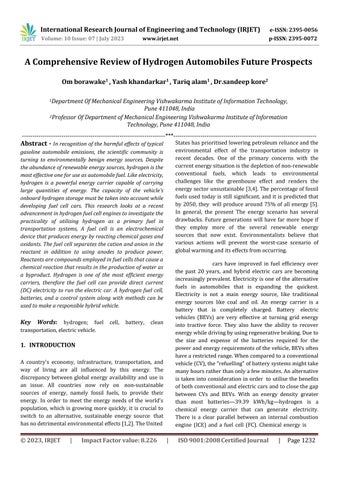
Oneofthemostcrucialscientificquestionsinthecreation of FCVs is hydrogen storage.Systems for storing hydrogen are being developed in order to use novel techniques to satisfyconsumerdemands.Itischallengingtostoreenough hydrogen on board a vehicle to have a sufficient driving range without the storage container being too big or too heavydue tohydrogen'spoor energy density.Ahydrogen FCV with on-board compressed gas storage is depicted in Figure 1 [29]. The following bullet points provide an overview of hydrogen storage methods and the necessary researchinthisarea.
2.1 Pressurized Tank Storage
Cylinders covered in carbon fibre are used to create pressurised tanks strong enough to withstand collisions whilealsoprovidingimpactprotection.A500-kmrangefor compressed hydrogen in such tanks has been demonstratedatapressureof34MPawithamassof32.5 kg and a capacity of 186 L. The tank volume is huge for individual automobiles about 90% of a 55-gallon barrel. Although the 6 wt% objective can be reached, the tank volumeisanissue.Ithasbeenpossibletoreachpressures of70MPa,andin2002,QuantumTechnology's10,000psi
(68MPa)Certificationforon-boardtankswasattained[30]. Accordingtotheofficeoftechnologypolicyreport[31][32], Toyota and Honda vehicles utilised hydrogen that was storedunderhighpressureandwereavailableforleasein the latter part of 2002. However, hydrogen cannot be retainedinthetankinlargeenoughamountsduetoitslow density when compared to other gases. Liquid hydrogen storage at low temperatures is not practical for use in normal cars, but several manufacturers still conducting low-level research on this capacity. Moreover, a liquid hydrogen.
Boilingcancausestoragesystemstoloseupto1%oftheir storage volume per day, and considerable refrigeration is neededtopreserveliquidhydrogenat20K[31].
3. Principles of Fuel Cell
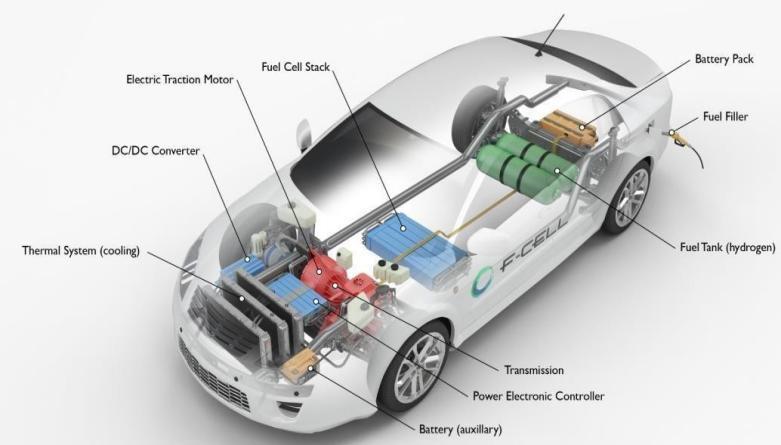
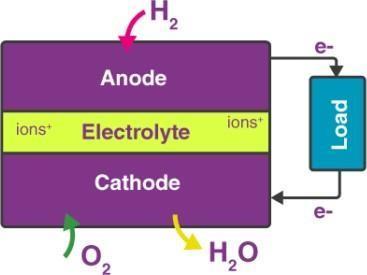
Different FC system types exist. However, the fundamentalsofhowtheyworkaresimilar.Ananode,a cathode, and an electrolyte are the three fundamental components of a fuel cell system. The type of electrolyte materialutilisedisusedtoclassifyFCs.AFCmayconsistof hundreds of different cells, yet they all share the same three essential elements. Between the cathode and the anode is where the electrolyte is placed. A schematic of a polymer electrolyte FC (PEMFC) operating diagram is showninFigure2[38].TheprotonexchangemembraneFC is another name for this type of FC. What exists is the PEMFC utilised most frequently in mobile power applications,suchcars.Fuel(purehydrogen)issupplied intotheanodecompartmentofthefuelcellwhileairor pure oxygen is injected into the cathode side of the FC. The type of electrolyte material utilised varies dependingonthetypeofFC.Electronsareseparatedon theanodesideofthecellasthegas.
The electrolyte membrane is attempted to be penetrated. Only the hydrogen ions may travel through the membrane, which serves as a filter to separate the electrons from the hydrogen ions. The hydrogen ions that crossed the membrane in the cathode compartment interact with the
oxygen atoms from the air supply to create H2O as a byproduct, along with heat [39]. In contrast to internal combustion engines, which combine fuel with air, an FC separates the fuel from the oxidant without burning it. Consequently, FCs don't emit the dangerous pollutants that IC engines generate.
POLYMERELECTROLYTEMEMBRANEFUELCELLS
1. DIRECTMETHANOLFUELCELLS
2. ALKALINEFUELCELLS
3. PHOSPHORICACIDFUELCELLS
4. MOLTENCARBONATEFUELCELLS
5. SOLIDOXIDEFUELCELLS
6. REVERSIBLEFUELCELLS
5. Working Of FuelCell?
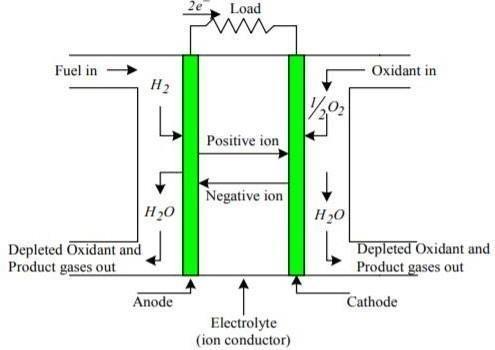
Through the usage of a fuel cell, the reaction between hydrogen and oxygen may produce energy. ThistypeofcellwasemployedduringtheApollospace project and performed two functions: it provided fuel andfunctionedasasourceofdrinkingwater(thewater vapourit generated, when condensed, wassuitable for humanconsumption)..
This fuel cell functioned by transferring hydrogen and oxygen through carbon electrodes into a concentrated solution of sodium hydroxide. The cell responseisexpressedasfollows:
CathodeReaction: O2 + 2H2O + 4e– → 4OH–
AnodeReaction: 2H2 + 4OH– → 4H2O + 4e–
NetCellReaction: 2H2 + O2 → 2H2
However, this electrochemical process has a very slow rate of reaction. With the aid of a catalyst like platinum or palladium, this problem is solved. The catalyst is coarsely splitprior to beingintroduced into the electrodes to maximise
In comparison to thermal power plants, which have an efficiency of 40%, the fuel cell described above generates energy with a general efficiency of about 70%. This significant efficiency disparity results from the fact thattheproductionofelectriccurrentinathermalpower plantrequiresthetransformationofwaterintosteamand theuseofthissteamtoturnaturbine.However,fuelcells provide a means of directly converting chemical energy intoelectricalenergy.
6. FuelCell Hybrid Vehicles
An essential component of fuel cell vehicles, the electric motor, was developed as early as the early 19th century.DespitebeingastrongcompetitortoreplaceICE cars as the primary mode of transportation in the early 20thcentury,electricvehiclesultimatelylostoutbecause of their limited range and high cost. Additionally, the priceofpetroldroppedbecausetothediscoveryofTexan oil,makingitmorecheapfortheordinaryconsumer.Asa result,ICEvehiclesovertookfuelcellandelectricvehicles throughout the most of the previous century.the fuel An embargo in 1973 sparked a resurgence ofinterest in FC power for applications involving personal mobility as countries sought to lessen their reliance on petroleum imports. K. Kordesch converted a car in the early 1970s so thatit could run on a 6-kW FCand a leadacid battery pack. For almost three years, the car was driven on public roads. Ballardintroducedafuelcell-poweredlight-dutytransitbus employinga120kWFCsystemin1993,anda 200kWFC system-poweredheavy-dutytransitbusin1995.Threefuel cell-battery hybrid buses were created by H-Power in 1994 and 1995, each having a 50 kW FC and a 100 kW nickel-cadmiumbattery.
These publications were crucial because they clarified FC technology for influential government and business decision-makers. These buses contributed to thedemonstrationofthepractical viability offuelcells.
Due to the simplicity of centralised refuelling and the decreased need for a large range capacity between fillups, fleet-vehicle operations like buses and delivery services were early adopters of fuel cell technology. In addition to other cities in Europe and North America, trialsofFC-poweredbuseshavetakenplaceinVancouver andChicago.Thefirstfuelcellcarwasleasedtoafamilyin California in July 2005, which was a significant step towardsincreasingthenumberoffuelcellautomobileson theroad.However,therearestillalotofchallengestobe solved before the FC vehicle can become a widely used mode of transportation. The requirement for a hydrogen infrastructuretoallowrefuellingofthecarsisanevident problem.Therearepresentlyhydrogenrefuellingstations in various nations throughout the world, including Canada, the USA, Germany, Singapore, Japan, Iceland, etc.Although there are presently not enough of these stations for many people to start driving FCVs, it is anticipated that when more FCVs become commercially accessible, additional hydrogen infrastructure will be created. As a result of tremendous development, hydrogen FCVs can now travel between 311 and 597 milesonasingletank.Thesevehiclesarebeingdeveloped more and more, although they still need a lot of work [14].
7. Parallel Hybrid
Theparallelhybridarchitecturewasoneofthefirst hybrid drive train designs. In this setup, the internal combustionengineandtheelectricmotormayeachbe utilisedindependentlytopowerthevehicle. TheICEis very wasteful in stop-and-go driving cycles because it produceslittletorqueatlowspeeds.Electricmotors,on the other hand, offer practically immediate torque, which makes them perfect for stop-and-go driving cycles. When a parallel hybrid system is used, each power source or both can function to various degrees depending on when it is most necessary. dependable during the driving cycle. For instance, the electric motor would beusedpredominantlywhilethe internalcombustionenginewouldbemostlyoffduring lowspeedsand stop-and-go cycles.Onthe otherhand, understeady-statehighwaydrivingcircumstances,the ICE would take over, using the high energy density of the gasoline to power the car while the electric motor would be off. When the torque requirement exceeds the torque generated by either the ICE or the electric motor, both can be operated simultaneously in the parallel arrangement. motor on their own. It enables the engine and the motor to be scaled down in size as most of the time the drive cycle will not have a high torque need since both power sources may be run simultaneously when torque demands are high. The total efficiency of the parallel arrangement may be further improved by reducing the size of both motors. Regenerative braking, a feature of the parallel hybrid drive train architecture, allows for the energy to be capturedduringdrivecycledeceleration.Regenerative
brakingmaybeusedbypracticallyall hybridvehiclesto recover mechanical brake heat energy that would otherwise be lost. It is not just possible with parallel hybrid design. During pauses and decelerations in the drivecycle,regenerativebrakingtransformstheelectric motorintoagenerator;thisenergyisthenstoredinthe vehicle's batteries for use at a later time in the driving cycle. Figure 4 below shows an illustration of a parallel hybriddrivetrain.
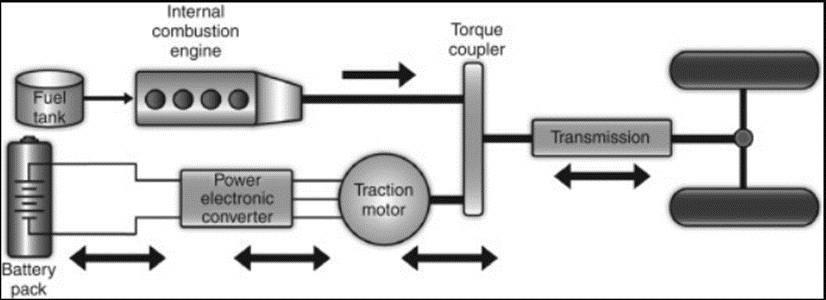
hybridconfiguration
8. Series-Parallel Hybrid
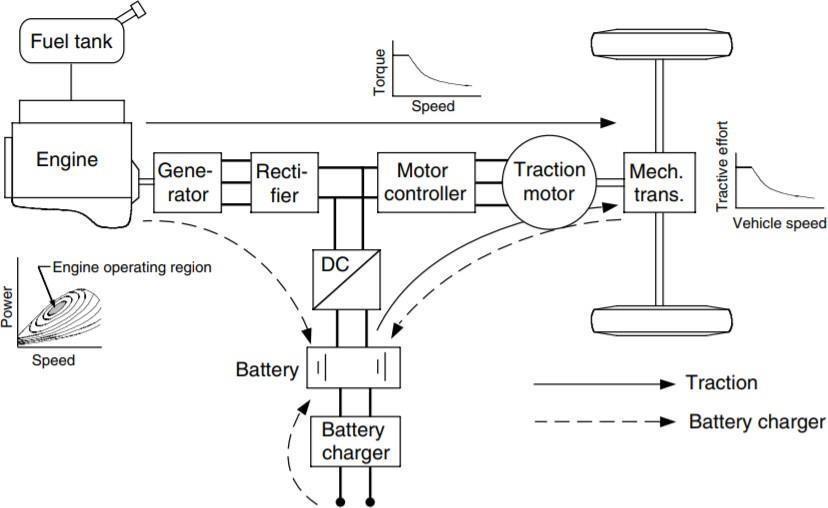
Series and parallel hybrid drive train designs are combinedtocreatetheseries-parallelhybrid.BoththeICE and the electric motor may operate the car either separatelyorintandeminaseries-parallelhybrid.TheICE may split its power between powering the vehicle and concurrently recharging the batteries. Since the modes of operation may be optimised to account for the present driving cycle, this system offers the greatest degree of control flexibility. However, this design has certain limitations,includingthenumberofhardwareisneeded.A gearboxisnecessarybecausetheICEmustbeabletomove the car, and a generator is necessary so that the ICE can charge the batteries. The series-parallel design is more adaptable to various driving cycles since it has all the advantages of both the series design and the parallel design, but it also has all their disadvantages. Figure 5 providesanillustrationofaseries-parallelhybriddesign.
3. CONCLUSIONS
This study looked examined fuel cells' use in hybrid cars and the production of hydrogen-based electricity utilising them. Applications for different FC types, namely the use of FCs in hybrid cars, were examined. Batteries may not always be the best option for applications in cars, but FCs with effective control systems may.
Hydrogen fuel cells will play a significant role in the transportationindustryinthenearfuture.Thepriceoffuel cells will reduce when producing fuel cells in large quantitiesandcommercializingthem.Wecouldexpectfuel cell-based transportation, power plants, and electricity generatorstobecomeprominentinthecomingdecades.
REFERENCES
1] Hosseini,S.E.; Andwari,A.M.; Wahid,M.A.; Bagheri, G.Areviewongreen energypotentials in Iran. Renew. Sustain. Energy Rev. 2013, 27,533–545.[CrossRef]
2] Granovskii, M.; Dincer, I.; Rosen, M.A. Greenhouse gasemissionsreductionbyuseofwindandsolarenergies for hydrogen and electricity production: Economic factors. Int. J. Hydrogen Energy2007, 32,927–931.[CrossRef]
3] Derbeli, M.; Barambones, O.; Sbita, L.; Derbeli, M.; Barambones, O.; Sbita, L. A Robust Maximum Power PointTrackingControlMethodforaPEMFuelCellPower System. Appl. Sci. 2018, 8,2449.[CrossRef]
4] Hosseini, S.E.; Wahid, M.A.; Aghili, N. The scenario ofgreenhousegasesreductioninMalaysia. Renew. Sustain. Energy Rev. 2013, 28, 400–409. [CrossRef]
5] Eriksson, E.L.V.; Gray, E.M.A. Optimization and integration of hybrid renewable energy hydrogen fuel cell energy systems A critical review. Appl. Energy 2017, 202,348–364.[CrossRef]
6] Heywood, J.B. Internal Combustion Engine Fundamentals; McGraw-HillEducation:NewYork,NY,USA,1988.
7] Costilla-Reyes, A.; Erbay, C.; Carreon-Bautista, S.; Han, A.; Sánchez-Sinencio, E. A Time- Interleave-Based Power Management System with Maximum Power Extraction and Health Protection Algorithm for Multiple Microbial Fuel Cells for Internet of Things Smart Nodes. Appl. Sci. 2018, 8,2404. [CrossRef]
8] Kerviel, A.; Pesyridis, A.; Mohammed, A.; Chalet, D.; Kerviel, A.; Pesyridis, A.; Mohammed,A.; Chalet, D. An Evaluation of Turbocharging and Supercharging Options for High-Efficiency Fuel Cell Electric Vehicles.Appl. Sci.2018, 8,2474.[CrossRef]
9] Wang, C.; Nehrir, M.H.; Gao, H. Control of PEM FuelCell Distributed Generation Systems.IEEE Trans. Energy Convers. 2006, 21,586–595.[CrossRef]
10] Somekawa, T.; Nakamura, K.; Kushi, T.; Kume, T.; Fujita, K.; Yakabe, H. Examination of a high-efficiency solid oxide fuel cell system that reuses exhaust gas. Appl. Therm. Eng. 2017, 114,1387–1392. [CrossRef]
11] Ayad, M.Y.; Becherif, M.; Henni, A. Vehicle hybridization with fuel cell, supercapacitors and batteriesbyslidingmodecontrol. Renew. Energy 2011, 36,2627–2634. [CrossRef]
12] Chakraborty, U.K. A New Model for Constant Fuel Utilization and Constant Fuel Flow in FuelCells. Appl. Sci.2019, 9,1066.[CrossRef]
13] Giorgi, L.; Leccese, F. Fuel Cells: Technologies and Applications. Open Fuel Cells J. 2013, 6,1–20.[CrossRef]
14] Offer, G.J.; Howey, D.; Contestabile, M.; Clague, R.; Brandon, N.P. Comparative analysis of battery electric,hydrogen fuel cell and hybrid vehicles in a futuresustainableroadtransportsystem. Energy Policy 2010, 38,24–29. [CrossRef]
15] Choi, H.; Shin, J.; Woo, J. Effect of electricity generation mix on battery electric vehicleadoptionand its environmental impact. Energy Policy 2018,121, 13–24.[CrossRef]
16] Aceves,S.M.;Berry, G.D.; Weisberg,A.H.; EspinosaLoza, F.; Perfect, S.A. Advanced concepts for vehicularcontainment of compressed and cryogenic hydrogen. In Proceedings ofthe 16th World Hydrogen EnergyConference 2006 (WHEC 2006), Lyon, France, 13–16June2006.
17] Michel,F.;Fieseler,H.;Allidiers,L.LiquidHydrogen Technologies for Mobile Use. In Proceedings of the 16th WorldHydrogenEnergyConference2006(WHEC2006), Lyon,France,13–16June2006.
18] Paggiaro, R.;Michl,F.; Bénard,P.; Polifke, W. Cryoadsorptive hydrogen storage on activated carbon.II: Investigation of the thermal effects during filling at cryogenic temperatures.Int. J. Hydrogen Energy 2010,35, 648
659.[CrossRef]
19] Hosseini, S.E.; Wahid, M.A. Hydrogen production from renewable and sustainable energy resources: Promising green energy carrier for clean development. Renew. Sustain. Energy Rev.2016, 57 [CrossRef]
20] Boretti, A. Novel dual fuel diesel-ammonia combustion system in advanced TDI engines. Int. J. Hydrogen Energy 2017, 42,7071–7076. [CrossRef]
21] Veziroglu,A.;MacArio,R.Fuelcellvehicles:Stateof theartwitheconomicandenvironmentalconcerns. Int. J. Hydrogen Energy 2011, 36,25–43.[CrossRef]
22] Hosseini, S.E.; Wahid, M.A.; Ganjehkaviri, A. An overview of renewable hydrogen production from thermochemical process of oil palm solid waste in Malaysia. Energy Convers.Manag. 2015, 94, 415–429. [CrossRef]
23] Hosseini, S.E.; Abdul Wahid, M.; Jamil, M.; Azli, A.A.M.; Mohamad, F.M. A review on biomass-based hydrogenproductionforrenewable energysupply. Int.J. Energy Res. 2015, 39,1597–1615.[CrossRef]
24] Hibino,T.; Kobayashi, K.; Ito, M.; Ma, Q.; Nagao,M.; Fukui,M.;Teranishi,S.Efficient Hydrogen Productionby Direct Electrolysis of Waste Biomass at Intermediate Temperatures.ACS Sustain. Chem. Eng. 2018, 6, 9360–9368. [CrossRef]
25] Hibino, T.; Kobayashi, K.; Lv, P.; Nagao, M.; Teranishi, S.; Mori, T. An Intermediate- Temperature Biomass Fuel Cell Using Wood Sawdust and Pulp Directly as Fuel. J. Electrochem.Soc. 2017, 164,F557–F563.[CrossRef]
26] Hibino,T.; Kobayashi,K.; Ito,M.; Nagao, M.;Fukui, M. Applied Catalysis B: EnvironmentalDirect electrolysis of waste newspaper for sustainable hydrogen production: An oxygen- functionalized porous carbon anode.Appl. Catal. B Environ. 2018,231,191–199. [CrossRef]
27] Hibino, T.; Kobayashi, K.; Nagao, M.; Teranishi, S. Hydrogen Production by Direct LigninElectrolysis at IntermediateTemperatures. ChemElectroChem 2017, 4, 3032–3036.[CrossRef]
28] Hori, T.; Ma, Q.; Kobayashi, K.; Nagao, M. Electrolysis of humidified methane to hydrogen and carbon dioxide at lowtemperaturesandvoltages. Int.
J. Hydrogen Energy 2019,44,2454–2460.[CrossRef]
29] AlternativeFuelsDataCenter:HowDoFuelCellElectric Vehicles Work Using Hydrogen? Available online: https://afdc.energy.gov/vehicles/how-do-fuel-cellelectric-cars-work(accessedon21May2019).
30] Devrim,Y.; Devrim,H.; Eroglu,I.Development of500W PEM fuel cell stack for portablepower generators.Int. J. Hydrogen Energy 2015, 40,7707–7719.[CrossRef]
31] Davis,C.;Edelstein,B.;Evenson,B.;Brecher,A.;Cox,D. HydrogenFuelCellVehicleStudy.PresentedatthePanelon Public Affairs (POPA), American Physical Society, 12 June2003.
32] Atkinson,K.;Roth,S.;Hirscher,M.;Grünwald, W. Carbon nanostructures: An efficienthydrogen storagemediumforfuelcells. Fuel Cells Bull. 2001, 4,9–12. [CrossRef]
33] Das, L.M. Hydrogen-fueled internal combustionengines. Compend. Hydrog. Energy 2016,177–217.[CrossRef]
34] Chen,P.; Xiong,Z.;Luo,J.;Lin,J.;Tan,K.L. Interaction of hydrogen with metal nitrides andimides. Nature 2002, 420, 302–304. [CrossRef] Ehsani, M.; Gao, Y.; Longo, S.; Ebrahimi, K. Modern Electric, Hybrid Electric, and Fuel Cell Vehicles, Third Edition;CRCPress:BocaRaton,FL,USA,2018; ISBN9780429504884.
© 2023, IRJET | Impact Factor value: 8.226 |