Machine Learning-Based Phishing Detection
Mohammed Naif1, Allen Jeriel K2, Sneh Patil3, Ananya Rangaraju4, Peraka Divyanjali5 , Kandukuri Pavan Sai Praveen6Abstract - Millions of users have been successfully connected globally by the internet today, and as a result, users' reliance on this platform for data browsing, online transactions, and information downloads has grown. Cybersecurity is a term for a collection of technologies and procedures used to safeguard software and hardware against intrusion, harm, and attacks. DoS attacks, Man-inthe-Middle attacks, Phishing attacks, SQL Injection attacks, etc. are some of the most often seen cybersecurity threats. There has been an uptick in consumers losing access to their very sensitive and private information over the past few years. These days, fraudsters utilise such methods to trick their victims in an effort to steal personal information including their username, password, bank account information, and credit card information. Attacks against users are frequently delivered via spoofing emails, illegal websites, malware, etc. To handle complicated and massive amounts of data, a structured automated technique is necessary. The most common and effective approach that can be used to address this issue is machine learning, according to research. The most widely used machine learning methods include neural networks, decision trees, logistic regression, and support vector machines (SVM). A group of deep learning and machine learning models will be trainedinthisstudytoidentifyphishingwebsites.
Key Words: Machine Learning, Cyber Security, Phishing, Neural Network, Website Security
1.INTRODUCTION
Themajorityofourdailyactivities,includingshoppingand banking,havebeenmovedonlinethankstothenetwork.A network that is unregulated or unprotected serves as a launchpad for a variety of cyberattacks, creating major security risks not only for networks but also for regular computer users, even seasoned ones. The users must be protectedfromtheseintrusions,whichiscrucial.Phishing website attacks are among the most frequent types of cyberattacks. A phishing website is a popular social engineeringtechniquethatimitatesreliableURLsandweb sites.Thephishertargetsunsuspectingwebusersthrough such attacks in an effort to deceive them into disclosing private information in order to use it fraudulently. Due to the enduser'sweakness,an attackercan evenutilise new approaches to target those seasoned users who have already provided personal information while believing that the page is real. Software-based phishing detection solutions are therefore recommended as user decision supporttools.Machinelearningalgorithmsandtechniques areusedinthisproject.The goal ofthisresearchistouse
thedatasetproducedtopredictphishingwebsitestotrain machine learning models and deep neural networks. In order to create a dataset from which the necessary URLand website content-based attributes may be extracted, both phishing and benign URLs of websites are collected. Each model's performance level is assessed and contrasted.Beforefeedingintothealgorithms,thefeature extraction will be carried out based on the address bar, domain-based, HTML, and Javascript extraction. In this project, machine learning methods like Decision Trees, Random Forests, Multilayer Perceptrons, XGBoost, and SupportVectorMachineswill beused.Themodelswill be assessed, and accuracy will be a factor in the evaluation. SinceXGBoostfeaturesbuilt-inL1(LassoRegression)and L2 (Ridge Regression) regularisation, which prevents the model from overfitting, the algorithm should perform better in this situation. Additionally, XGBoost has the capacity to handle missing numbers right out of the box. When a node has a missing value, XGBoost attempts both theleftandrighthandsplitsandlearnswhichoneresults inthehighestlossforeachnode.Thewebsite'ssecurityis a vulnerability in this project because there isn't enough securityonthesite,whichleavesitopentocyberattacks.
1.1 Novelty
Oursuggestedmethodology,whichconsidersnotonlythe URL-based features of phishing websites but also their Domain-based features, as well as the HTML and Javascript based features during feature extraction, aims to reducetheFalsePositiveRateaswellastheFalseNegative Rate and improve overall accuracy. The model may be trained to recognise phishing sites that substitute textual contentwithembeddedobjectslikeflash,javascripts,and HTMLfilesbyapplyingthisadditionalsetoffeatures.
2.ALGORITHM
1. Compile a dataset from open source platforms that includesbothphishingandtrustworthywebsites.
2. Take the necessary information out of the URL database.
3. UtiliseEDAtechniquestoanalyseandpre-processthe dataset.

4. Createtrainingandtestingsetsfromthedataset.
5. Run a few deep learning and machine learning algorithms, such as SVM, Random Forest, and Autoencoder
6. Create a programme that displays the evaluation outcomewhiletakingaccuracymetricsintoaccount.
7. Compare the outcomes obtained using the trained models,andstatewhichissuperior.
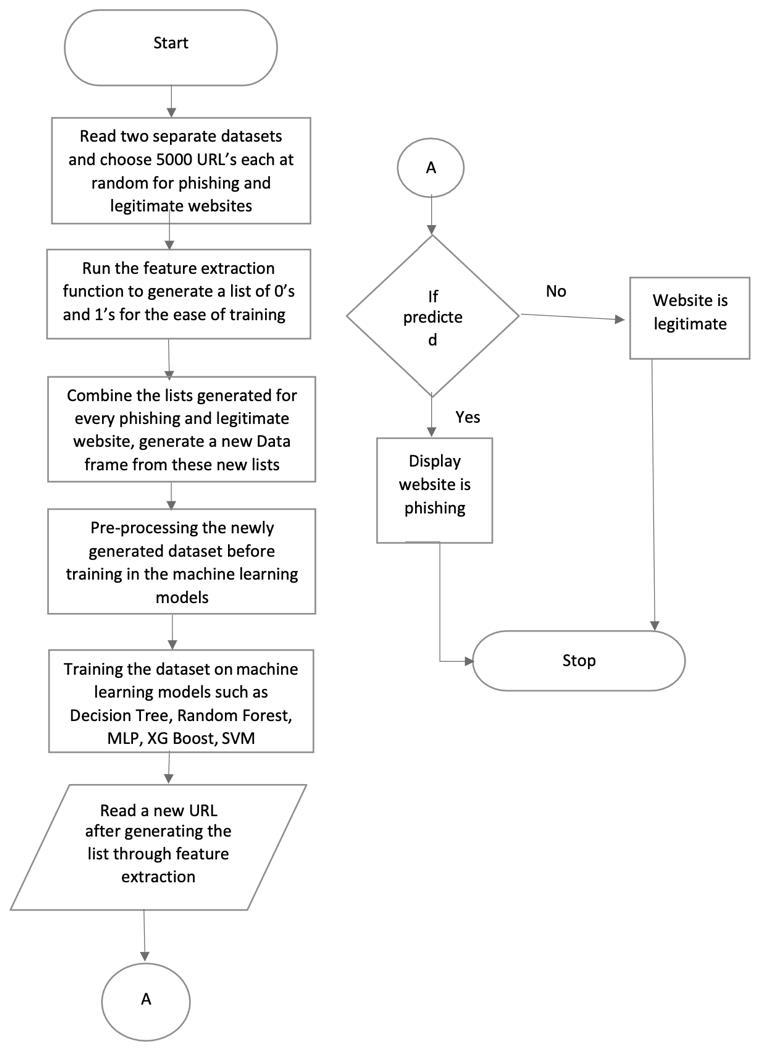
3.FLOW CHART
4.ML MODELS USED
Thisdatacollectionhasacategorizationissuebecausethe input URL can either be considered legal (0) or phishing (1). The following machine learning models (classification) were taken into account during training thedataset:
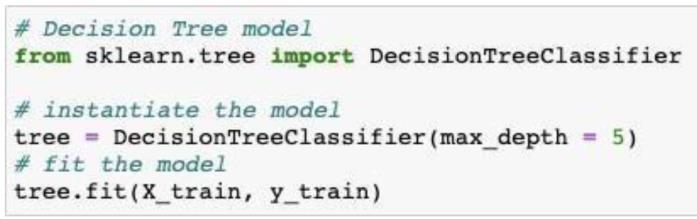
4.1 Decision Tree
Decision trees are a type of predictive modelling that can be used to map several options or solutions to a certain result. Different nodes make up decision trees. The decision tree's root node, which in machine learning typically represents the entire dataset, is where it all begins. The leaf node is the branch's termination point or the result of all previous decisions. From a leaf node, the decision tree won't branch out any further. In machine
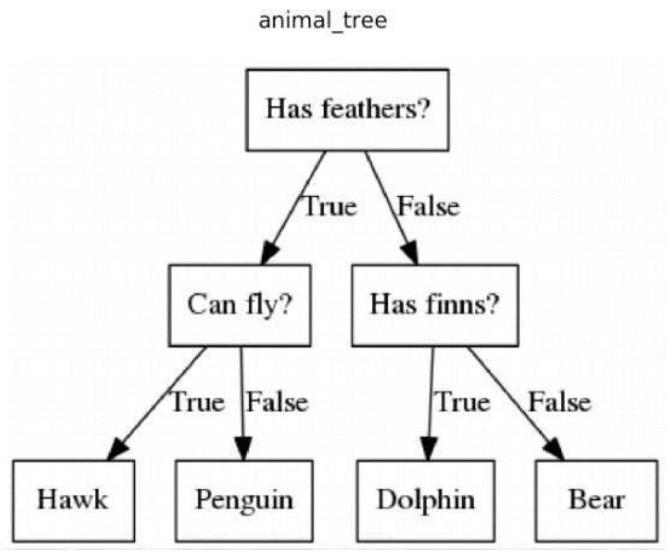
learning decision trees, the internal nodes represent the data'sfeatures,whiletheleafnoderepresentstheresult.
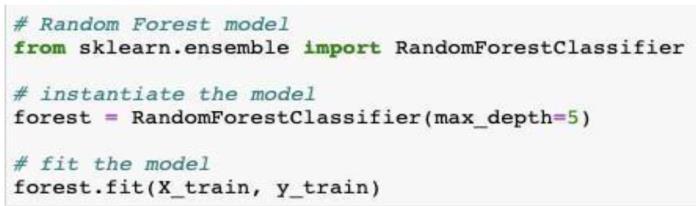
4.2 Random Forest
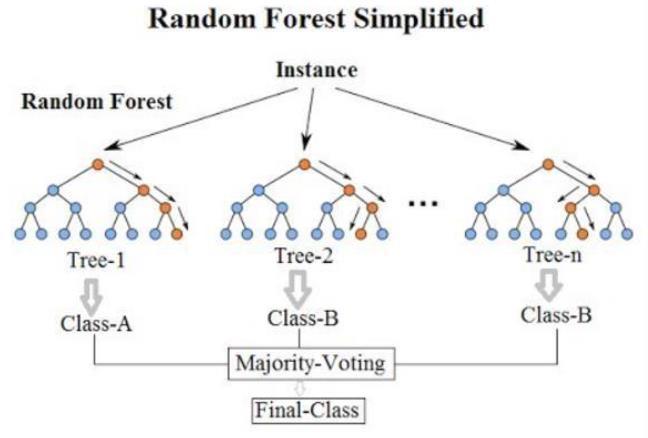
The most well-known and effective supervised machine learning approach is called the Random Forest approach. The Random Forest Algorithm can handle both classificationandregression tasks.Thisapproachbuildsa Forest with a number of Decision Trees, as the term "RandomForest"suggests.Ingeneral,apredictionismore accurateandstrongthemoretreesthereareintheforest. The Random Forest Algorithm creates a forest out of several decision trees. The process used to build a Single Decision Tree is also utilised to build a Decision Tree. To create a decision tree, the information gain and entropy arecalculated.
4.3 Multilayer Perceptron
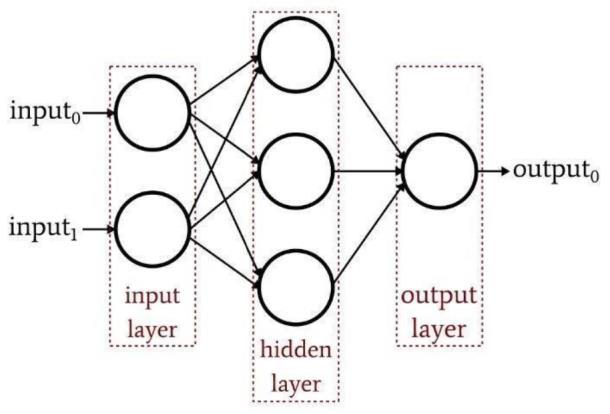
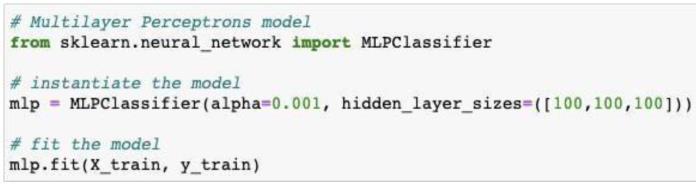
A type of feedforward artificial neural network (ANN) is called a multilayer perceptron (MLP). The name "MLP" is unclear; it can refer to any feedforward ANN in some contexts, or it can specifically refer to networks made up of multiple layers of perceptrons (with threshold activation) in others. When multilayer perceptrons have just one hidden layer, they are sometimes referred to as "vanilla"neuralnetworks.
4.4 XG Boost
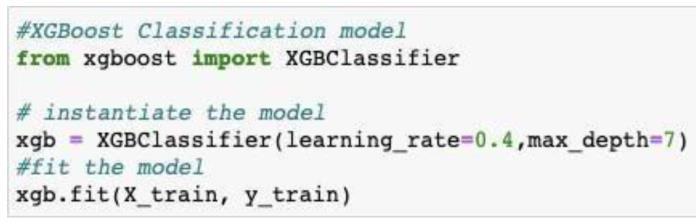
ExtremeGradientBoostingisamachinelearningapproach that depends on a decision tree and is used to solve regressionandclassification problems.In ordertoreduce the errors of the preceding tree, this algorithm generates decision trees one at a time. Every tree learns from its predecessorandupdatestheleftovermistakes.Asaresult, eachsubsequenttreeintheseriescontinuestolearnfrom themistakesmadebythepriorbranch.
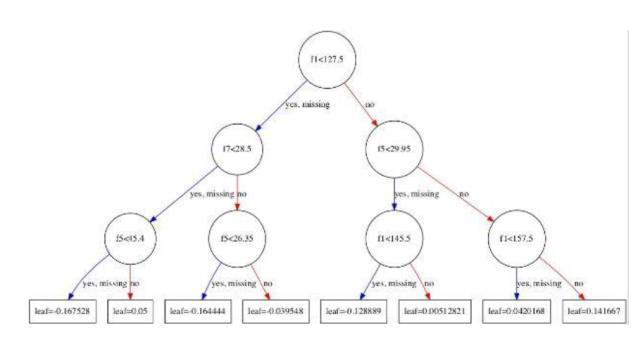
The 'weak learners' in XGBoost are the base learners, wherethebiasissubstantialandthepredictivecapacityis justslightlyhigherthanrandomguessing.Becauseeachof the weak learners provides essential data for estimation, the boosting strategy can combine the weak learners to produce a strong learner. The final effective learner eliminatesbiasandvariation.
5. MODEL EVALUATION
When evaluating the models, accuracy is taken into account. The accuracy of each of the ML algorithms mentioned above on the given data set will be calculated, andtheonewiththebestaccuracywill besavedandused forthemodel'sfurtherdeployment.
The percentage of correctly identified cases for (TP + TN)/(TP+TN+FP+FN)canbeusedtomeasureaccuracy. where the letters TP, FN, FP, and TN stand for the corresponding numbers of true positives, false negatives, FPs,andTNs.
Thecorrectclassificationsaretruepositives(TP)andtrue negatives (TN). When an algorithm's result is mistakenly anticipatedeventhoughitisactuallypresentintheimage, itisreferredtoasafalsepositive(FP).
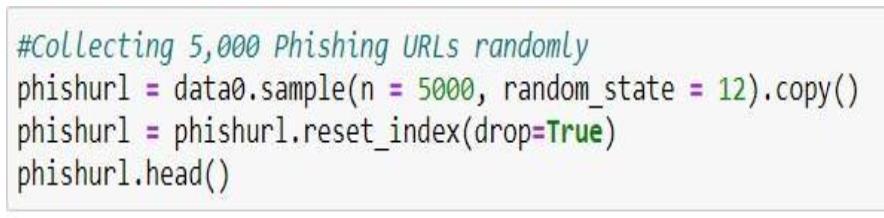
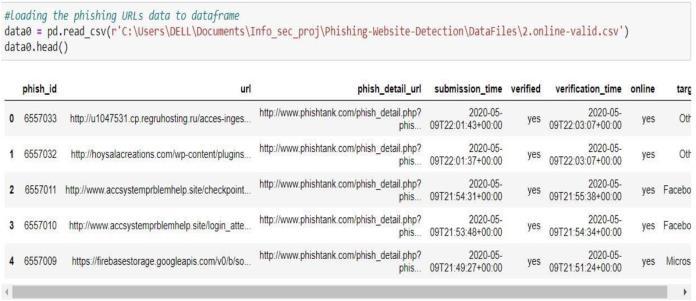
PhishingWebsiteURL’sdataset
4.5 Support Vector Machines
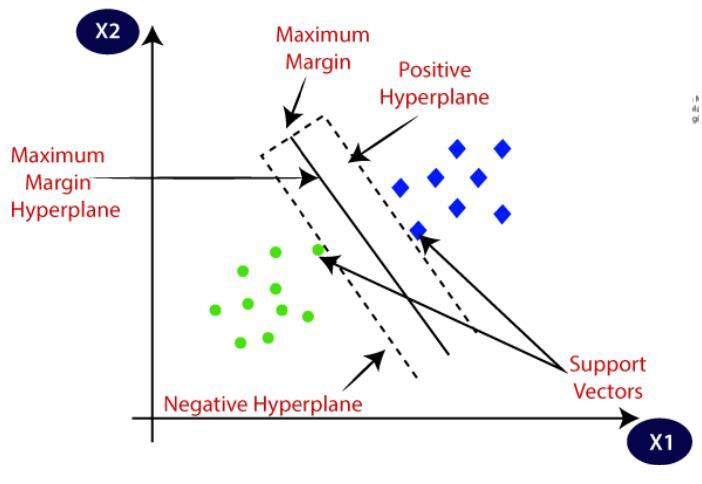
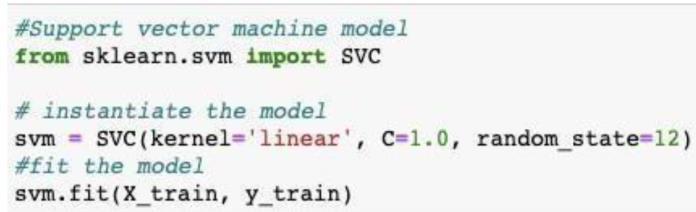
In a high- or infinite-dimensional space, a support-vector machine creates a hyperplane or set of hyperplanes that can be used for classification, regression, or other tasks like outliers detection. Generally speaking, the higher the margin,thesmallertheclassifier'sgeneralisationerror,so adecentseparationisobtainedbythehyperplanethathas the largest distance to the nearest training-data point of anyclass(so-calledfunctionalmargin).
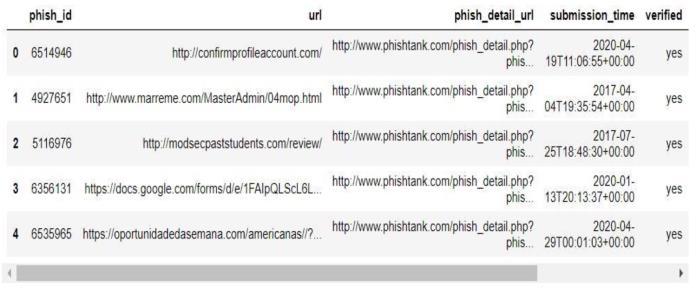
The dataset of phishing websites has 5000 URLs that wererandomlyselected.
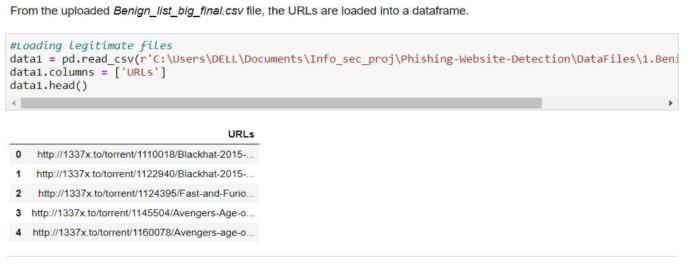
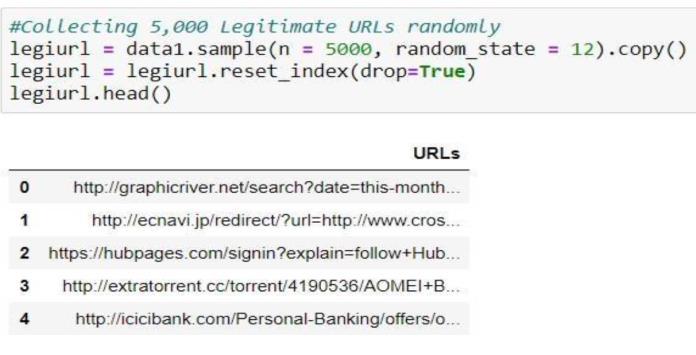
LegitimateWebsiteURL’sdataset
5.3 Multilayer Perceptron
5000 URL’s sampled at random from the legitimate websitedataset
5.4 XG Boost
5.5 Support Vector Machines
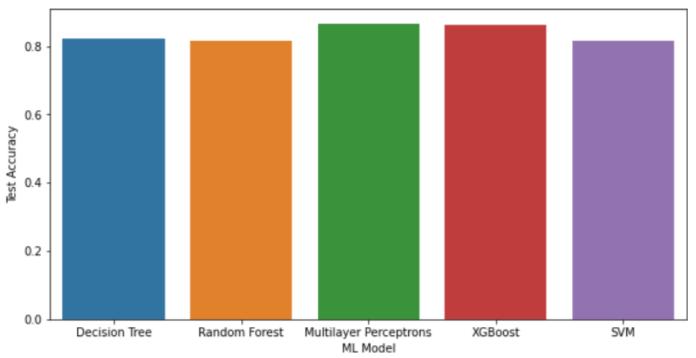
6. Comparison of Models
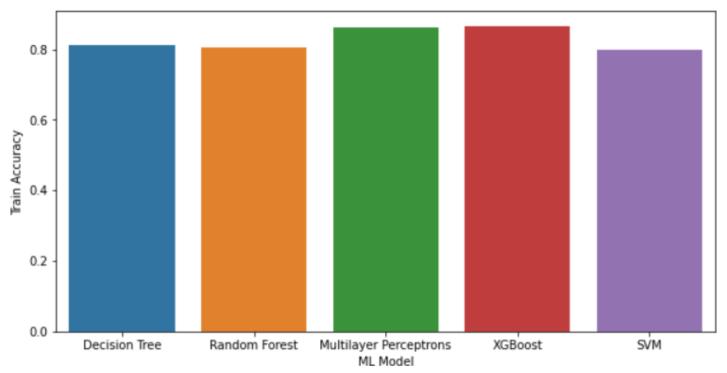
We compared the models. It is evident from the comparisonthattheXGBoostClassifierperformswellwith thisdataset.
Test Accuracy:
5. Machine Learning Models & Training
5.1 Decision Tree Classifier
4.2 Random Forest
Train Accuracy:
7. RESULTS OBTAINED
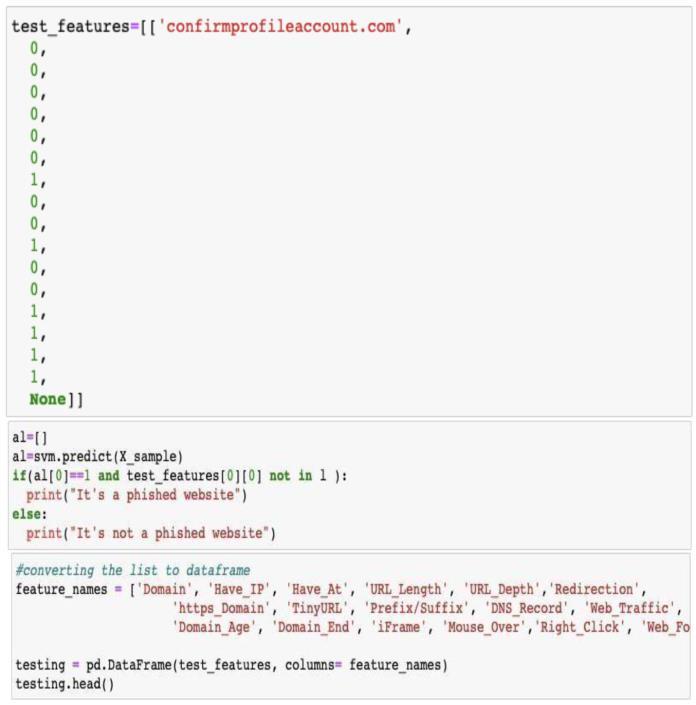
To see if the model is effective, we test it using a wellknownphishingwebsite.
application after researching several ML algorithms. Even though employing machine learning for phishing detection has numerous advantages, there are some restrictions and difficulties that need to be resolved. Making sure the algorithms can recognise new and evolving phishing attack types is one of the major problems. The training data and algorithmic feature sets must be continuously updated for this. Additionally, adversarial assaults, in which attackers alter the characteristics of phishing websites to avoid detection,mightexposemachinelearningalgorithmsto risk.Usingmachinelearningmodelsthataresecureand resistanttotheseassaultsiscrucialtoaddressingthis.
REFERENCES
[1] JunHoHuhandHyoungshickKim,"PhishingDetection with Popular Search Engines: Simple and Effective", May 12-132011,Springer.
[2] Thomas Rincy N 1 and Roopam Gupta, Design and Development of an Efficient Network Intrusion Detection System Using Machine Learning Techniques, Hindawi Wireless Communications and Mobile Computing Volume 2021,ArticleID9974270,35
pageshttps://doi.org/10.1155/2021/9974270
[3] Gadge, Jayant; Patil, Anish Anand (2008). [IEEE 2008 16th IEEE International Conference on Networks - New Delhi, India (2008.12.12-2008.12.14)] 2008 16th IEEE International Conference on Networks - Port scan detection.
[4] Vasilomanolakis, Emmanouil; Sharief, Noorulla; Muhlhauser, Max (2017). [IEEE 2017 IFIP/IEEE Symposium on Integrated Network and Service Management (IM) - Lisbon, Portugal (2017.5.82017.5.12)] 2017 IFIP/IEEE Symposium on Integrated Network and Service Management (IM) - Defending against Probe-Response Attacks. , (), 1046–1051. doi:10.23919/inm.2017.7987436
7. CONCLUSION
One of the best and simplest ways for hackers to defraud us of our money and obtain our financial and personalinformationisstillphishing.Machinelearning algorithms can learn to differentiate between trustworthy and fraudulent websites by being trained on a sizable dataset of both. This may result in the creation of efficient phishing detection tools that can instantly recognise and alert users to potentially hazardouswebsites.WehavedeterminedthatXGBoost Classifier is the best method for this particular
[5] Kalyan Nagaraj, Biplab Bhattacharjee, Amulyashree Sridhar and Sharvani GS, “Detection of phishing websites using a novel two fold ensemble model ”, July 2018, Emeraldinsight.
[6] Shweta Sankhwar , Dhirendra Pandey and R.A Khan , “Email Phishing: An Enhanced Classification Model to DetectMaliciousURLs”,April2019,EAI.