In advance accident alert system & Driver Drowsiness Detection
Anmol Ratan Tirkey Tirkey1Student,JAIN(Demmed-To-Be University), Bengaluru, Karnataka, India

2Student, CHRIST(Deemed-To-Be University), Bengaluru, Karnataka, India
3Researcher, Bengaluru, Karnataka, India
4Researcher, Bengaluru, Karnataka, India ***
Abstract - The majority of information is relayed by the eyes, which are an important part of the body. An operator's facial expressions, such as blinking, yawning frequency, and face tilt, differ from those in a rested condition when they are tired. We propose a Driver-Drowsiness Detection System in this effort, which employs video clips to monitor drivers' tirednessstatus, suchasyawning, eyeclosurelength,andhead tilt position, without having them to carry sensors on their bodies. We are using a face-tracking algorithm to improve tracking reliability due to the limitations of previous methodologies. To distinguish facial areas, we used a technique based on 68 key points. Then we assess the passengers' health using these areas of the head. The DriverDrowsiness Monitoring Method can use a tiredness alarm to alert the driver by combining the eyes, mouth, and head.
Key Words: Accident alert, Driver Drowsiness, facial features.Safety,Deeplearning.
1.INTRODUCTION
Inrecentyears,fastercarparkexpansionhasbeenrequired due to rising demand for contemporary mobility. The automobile is now a necessary form of mobility for most people.In2017,97millionvehiclesweresoldworldwide,up 0.3percentfrom2016.Accordingtoestimates,therewere approximately1billionautomobilesinoperationgloballyin 2018. Although the vehicle has altered people's lifestyles and made daily tasks more convenient, it is also linked to severalnegativeconsequences,suchasroadaccidents.The NationalHighwayroadSafetyAdministrationestimatesthat therewere7,277,000roadaccidentsin2016,accountingfor 37,461 fatalities and 3,144,000 injuries. Fatigued driving was responsible for roughly 20% to 30% of the traffic accidentsinthisstudy.Asanoutcome,drivingwhilefatigued presents a significant and concealed danger for traffic accidents. The fatigue-driving-detection technology has becomeaprominentresearchareainrecentyears.
Positivistandinterpretivistdetectionmethodsarethetwo types of detection procedures. A driver is required to participate in the subjective identification method's evaluation, which is connected to the driver's subjective perceptions through actions including self-questioning, evaluation,andquestionnairefillingout.
Thesestatisticsarethenutilizedtoestimatethenumberof cars driven by weary drivers, allowing them to better arrangetheirtimetables.Theobjectivedetectionapproach, on the other hand, does not require drivers' feedback becauseitanalysesthedriver'sphysiologicalconditionand driving-behaviorparametersinrealtime.Theinformation gathered is utilized to determine the driver's level of weariness. In addition, objective detection is divided into twocategories:contactandnon-contact.Non-contactisless expensive and more convenient than contact because the system does not need Vision - based technology or a sophisticatedcamera,allowingthegadgettobeusedinmore cars.
Duetoitslowcostandeaseofinstallation,thenon-contact method has been used extensively for the detection of fatigueddriving.ConcentrationTechnologyandSmartEye, for example, use the motion of the driver's eyes and the positionofthedriver'sheadtoestimatetheirfatiguelevel. Onemethodtoimprovesystemreliabilityintherealworldis toalertconcernedparties.
2. EXISTING SYSTEM
Accordingtotheexistingsystem,changesintheeye-steering correlationcansignifydistraction.Theautocorrelationand cross-correlation of horizontal eye position and steering wheelangledemonstratetheloweyesteeringrelationship associated with eye movements associated with road scanningmethods.Theeye-steeringcorrelationwillcontrol the connection on a straight path. Because of the straight route, the steering motion and eye glances had a low association.Thissystem'sgoalistoidentifydriverdistraction basedonthevisualbehaviororperformance;thereforeit's used to describe the relationship between visual behavior andvehiclecontrolforthatpurpose.Thismethodevaluates the eye-steering correlation on a straight road, presuming thatitwillhaveadifferentrelationshipthanacurvedroad bothsubjectivelyandnumericallyandthatitwillbeproneto distraction. Oncurvingroads,ahigheyesteeringconnection linked with this process has been discovered in the visual behavior and vehicle control relationship, which reveals a basicperception-controlmechanismthatplaysamajorrole indriving.
Trackingobjectdetectionisacrucialproblemincomputer vision.Human-computerinteraction,behaviorrecognition, robotics, and monitoring are just a few of the disciplines whereitcanbeused.Giventheinitialstateofthetargetinthe previous frame, object recognition tracking predicts the targetpositionineachframeoftheimagesequence.Thepixel connectionbetweenadjacentframesofthevideosequence andmovementchangesofthepixels,accordingtoLucas,can beusedtomonitoramovingtarget. Contrarily,thismethod canonlydetectamedium-sizedtargetthatswitchesbetween two frames. Based on recent advancements in the correlationsfilterincomputervision,Bolmepresentedthe Minimal Outcome Sum of Squared Error (MOSSE) filter, whichmaygivereliablecorrelationfilterstotracktheobject. The MOSSE has excellent processing efficiency, but its algorithmprecisionisconstrained,anditcanonlyanalysethe greyinformationofasinglechannel[1].
Trackingofvisualobjects.Incomputervision,visualobject tracking is a critical issue. Human-computer interaction, behaviorrecognition,robotics,andsurveillancearejustafew ofthedisciplineswhereitcanbeused.Giventheinitialstate ofthetargetinthepreviousframe,vision-basedmonitoring estimates the target position in each frame of the image sequence. According to Lucas, a moving target can be watched using the pixel relationship between succeeding framesofthevideosequenceanddisplacementchangesof the pixels. This technique, on the other hand, can only recognize a medium-sized target that moves between two frames[3].
4 OBJECTIVES
Real-time eye tracking technology is used to monitor the driver'seyes.Incertaindrivingsituations,adriver'sreaction timeissloweddownwhentheyarefatiguedordistracted. Thelikelihoodofanaccidentwillconsequentlyrise.There are actually three techniques to recognize driver fatigue. Thefirstisphysiologicalchangesinthebody,suchaspulse rate,brainmessages,andcardiacactivity,whichawearable wristband system can detect. The second technique is accomplished by the suggested eye tracking system using behavioral metrics including surprising nodding, eye movement,yawning,andblinking.
Thefivemainobjectivesofthecreatedsystemareasfollows:
a. Affordable:Costisoneofthemostessentialfactors throughoutthedesignphase,thusthetechnologies mustbereasonablypriced.
b. Portable: The solutions must be adaptable to variouscarmodelsandsimpletoinstall.
c. Secure:Bypositioningeachcomponentinitsright location,thesecurityofthesystemisguaranteed.
d. Quick:Thereactionandprocessingtimetoreactin the case of a driver's urgency is among the most
crucial factors because an accident happens in a matterofseconds.
e. Accurate:Themostaccuratealgorithmshaveinfact been selected because the system needs to be precise.
5. METHODOLOGY
Thereisnowaremedyfor oneofthemaincausesofrealworldtrafficaccidents.Thesystemtakesusclosertosaving livesbypreventingmishapsintherealworld. DLIB&SOLVE PNPModelsarethefoundationoftheproposedsystem.
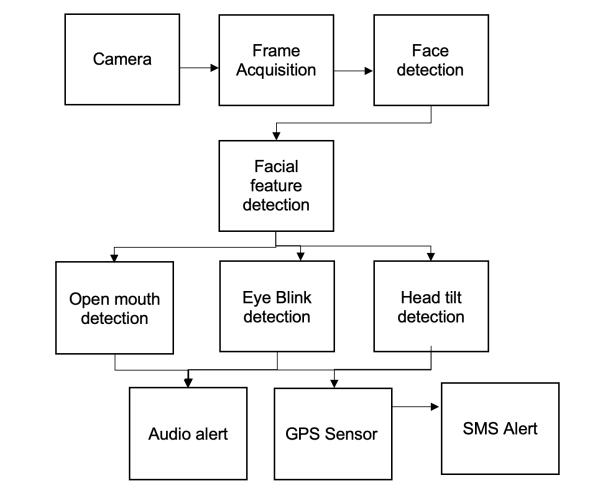
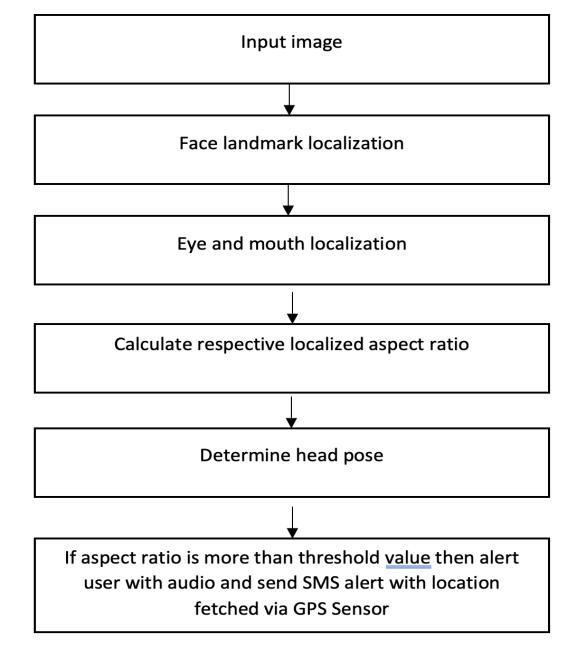
Fig -1:Architectureofproposedsystem
Thefirststageistoinitializethecamera,andthesecondisto acquireframes.Faceisfoundintheframeafterithasbeen acquired. The position of the lips, eyes, and head are detectedinthesubsequentphase.
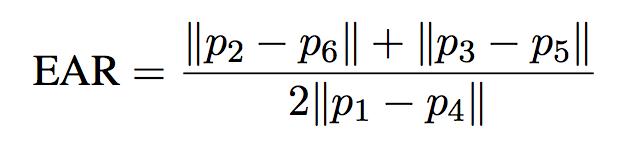
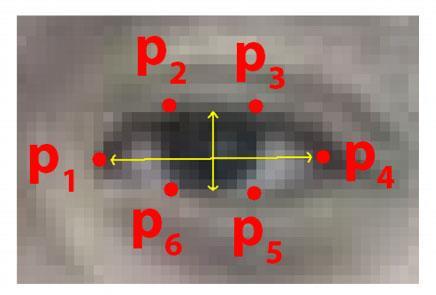
FollowingistheformulaetocalculateEyeAspectRatio:
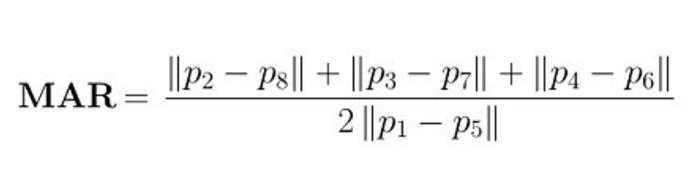
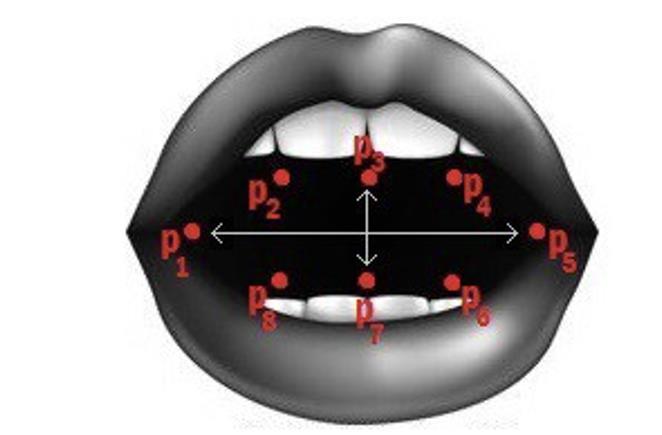
FollowingistheformulaetocalculateMouthAspectRatio:
We calculate the head Position using PnP i.e. Perspectiveend-Pointbydetecting3Dfacialpoints:
a. Tipofthenose:(0.0,0.0,0.0)
b. Chin:(0.0,-330.0,-65.0)
c. Leftcornerofthelefteye:(-225.0f,170.0f,-135.0)
d. Rightcorneroftherighteye:(225.0,170.0,-135.0)
e. Leftcornerofthemouth:(-150.0,-150.0,-125.0)
f. Rightcornerofthemouth:(150.0,-150.0,-125.0)
After calculating EAR, MAR & PnP, system alerts through speaker if it detects eyes closed for more than 5 secs and yawningsomuch.Systemalsoalertsdriverwhenhisheadis not straight. As additional security measure system also sends SMS alert to concern person including GPS location fetchedviaGPSsensor.
6. IMPLEMENTATION
Facealignment,headposeestimation,faceswitching,blink detection, and other tasks have all been effectively accomplishedusingfaciallandmarks.
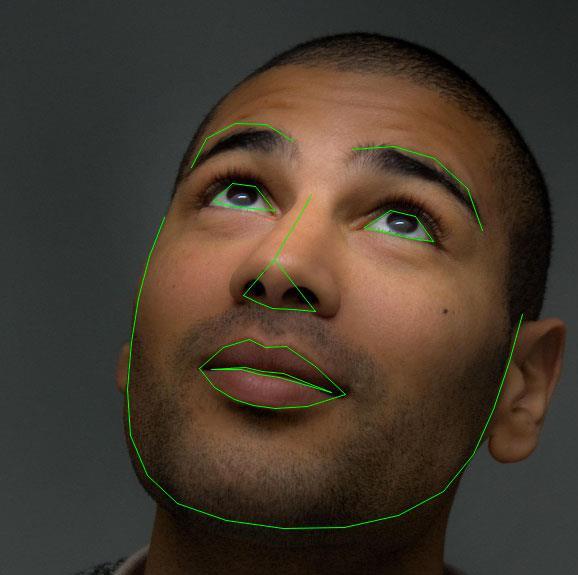
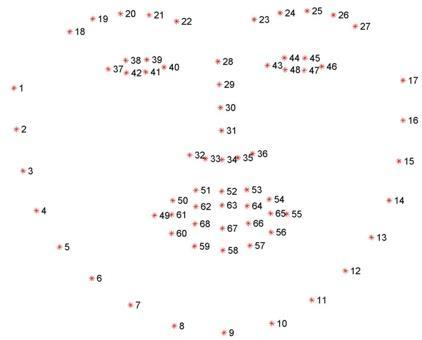
Facelandmarkdetectionisasubsetoftheshapepredicting issue. Given an input image (and generally a ROI that characterizestheobjectofinterest),ashapepredictortries toidentifyimportantpointsofinterestalongashape.Inthe fieldoffaciallandmarks,ouraimistoapplyshapeprediction techniques to identify key facial components merely from theface.
Therefore,identifyingfacelandmarksrequirestwosteps:
Step#1:Localizethefaceintheimage.
Step#2:DetectthekeyfacialstructuresonthefaceROI.
i. EYE ASPECT RATIO
Theseannotationsarefromthe68-pointiBUG300-W dataset,whichwasusedtotrainthedlibfacelandmark predictor.Six(x,y)-coordinatesareusedtosymbolize eacheye,beginningattheleftcorner(asifstaringatthe subject)andmovingclockwisearoundtheremainderof thearea:
II. MOUTH ASPECT RATIO
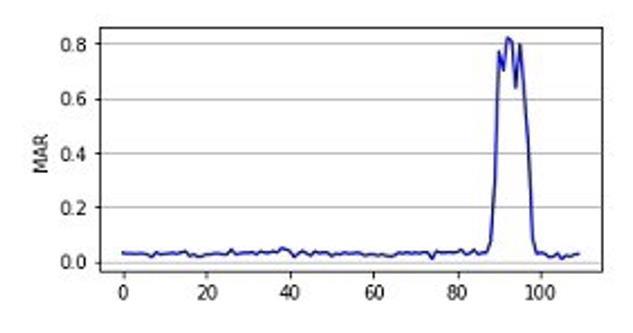
The graph unmistakably demonstrates that, as in the previous80 frames,themouthaspectratioisalmostzero wheneverthemouthisclosed.Whenthemouthispartially open,themouthaspectratioisalittlegreater.Themouth aspectratio,however,issubstantiallyhigherinformframe 80,indicatingthatthemouthisopencompletely,perhapsfor yawning.
III. PnP (For Head Tilt Detection)
An object's posture in computer vision relates to its placementandorientationinreferencetoacamera.Youcan alter the attitude by moving the object in relation to the cameraorthecamerainrelationtotheitem.
A3Drigidobjecthasonlytwokindsofmotionswithrespect toacamera.
a. Translation:Theactoftranslatinginvolvesmoving thecamerafromitspresent3D(X,Y,Z)locationtoa new3D(X',Y',Z')location.Asyoucansee,thereare three possible directions you can go in when translating:X,Y,orZ. Avectort,withthevalue1, represents translation and is equal to:
freedom in a rotation. Different graphical representations exist for rotation. It can be expressedusingEulerangles(roll,pitch,andyaw),a 3 X 3 rotation matrix, or a rotation direction (i.e. axis)andangle.
7. CONCLUSION
Toidentifyfatigue,aframeworkthatstretchesoutandkeeps trackofthedriver'smouth,eye,andheadmotionsisused. The framework utilizes a mixture of layout-based coordinatingandhighlight-basedcoordinatingtokeepthe eyes from wandering too far. Framework will almost certainlydetermineifthedriver'seyesareopenorclosed, and whether the driver is looking ahead, while following. When the eyes are closed for a long time, a bell or alarm message will sound as a warning. GPS will detect the live location and update, whenever eyes are closed, continue yawningandheadtiltedwilltriggerthesystemtosendSMS alert to provided number ensuring the safety of driver, peoplewalkingontheroadandotherfellowdrivers.
REFERENCES
[1] International Organization of Motor Vehicle Manufacturers,“Provisionalregistrationsorsalesof new vehicles,” http://www.oica.net/wpcontent/uploads/,2018.
[2] WardsIntelligence,“Worldvehiclesinoperationby country, 2013-2017,” http://subscribers.wardsintelligence.com/databrowse-world,2018.
[3] National Highway Traffic Safety Administration, “Traffic safety facts 2016,” https://crashstats.nhtsa.dot.gov.,2018.
[4] AttentionTechnologies,“S.a.m.g-3-steeringattention monitor,”www.zzzzalert.com,1999.
[5] Smart Eye, “Smarteye,” Available online at: https://smarteye.se/,2018.
[6] ZhangK,ZhangZ,andLiZet.al,“Jointfacedetection and alignment using multitask cascaded convolutional networks,” IEEE Signal Processing Letters,2016.
[7] M.Danelljan,G.HÃd’ger,F.S.Khan,andM.Felsberg, “Discriminative scale space tracking,” IEEE Transactions on Pattern Analysis and Machine Intelligence, vol. 39, no. 8, pp. 1561–1575, Aug. 2017.
b. Rotation: The X, Y,and Zaxescanalsobeused to rotatethecamera.Thus,therearethreedegreesof
[8] C.Ma,J.Huang,X.Yang,andM.Yang,“Robustvisual tracking via hierarchical convolutional features,”
IEEETransactionsonPatternAnalysisandMachine Intelligence,p.1,2018.
[9] J. Valmadre, L. Bertinetto, J. Henriques, A. Vedaldi, and P. H. S. Torr, “End-to-end representation learning for correlation filter-based tracking,” in Proc. IEEE Conf. Computer Vision and Pattern Recognition(CVPR),July2017,pp.5000–5008.