MODEL PREDICTIVE CONTROL BASED JUMPINGOF ROBOTIC LEG ON A PARTICULAR HEIGHT USING REINFORCEMENT LEARNING
Amrita Rai-1 , Shyam Dwivedi-21,2Department of Computer Science and Engineering, Rameshwaram Institute of Technology andManagement, Dr A PJ Abdul Kalam Technical University, Lucknow, India

***
Abstract A robotic limb that is controlled by an MPC and trained via reinforcement learning in a real-worldsetting will attempt to learn how to jump beyond a certain height. A dynamic controller, model predictive control regulates each process by resolving constraints. Moreover, reinforcement learning will assist in developing the robotic leg’s capacity to adapt in situations that change rapidly.
For regulating the dynamic jumping of a robotic limb through the control design, the authors of this study provide the reinforcement learning with model predictive control approach. In this situation, MPC are primarily utilized to regulate the torque, angles, positions, frictions, force, and other dynamic characteristics on joints. According to this work, hopping might be taught to a robotic leg using model predictive reinforcement learning in a practical environment. Model-based reinforcement learning includes a component called model, which refers to predetermined Kinematics and Dynamics parameters. PPO (proximal policy optimizer) and A2C (advanced actorcritic) algorithms are used in reinforcement learning. Recent years have seen the discovery of predefined forward and inverse kinematics and dynamics parameters that can assist Robotic leg to precisely jump over certain height. The first section is the introduction, which includes a discussion of recentstudy findings as well as a review of all relevant literature. A brief explanation of each phrase is covered in the second section, while the third section discusses its applications, workings, and formula. The fourth portion isthe conclusion, and the final part is a list of sources used in this study.
1. INTRODUCTION
1.1
Robots
ARobotsaremachinesthatcanbeprogrammedbycomputersandarecapableofper-formingacomplexseries oftasks on their own. An external control device or an internal control system can both control a robot. Even though some of themaremadetoresemble people,mostrobotsaretask-performingmachinesthatputbasic usefulnessbefore emotive aesthetics. The design, maintenance, implementation, and use of robots as well as the computer systems that control, sense,andprocessdataforthemareallcoveredbythefieldoftechnologyknownasrobotics.Thesetechnologiesdealwith automatedsystemsthatcanreplacepeopleinhazardoussituationsor duringproductionprocessesorthataresimilarto peopleintermsofbehaviour,cognition,orappearance.
Robots’abilityto performsimpletasks ina mannersimilartothatofhumans makes their work simple, quick, andeasy. Therearefartoomanydomesticrobotsinourdailylives.Peoplearerapidlygrowingmoredependentonrobotsbecause they do household tasks. Some of the most well-liked robots are vacuum cleaners and kitchen robots, but we also have robots that can mow the lawn, clean the windows, and iron your clothes. Robots will somedaytakeovercertainhuman tasks due to their ever-improving skills, but not all. Robotics can presently onlyautomate 25 percent of occupations in unstable,human-dependentindustrieslikenursingandconstruction.Robots,however,areandalwayswillbedependent onhumanprogramming.
Robots are automated machines that require little or no human assistance to complete specified jobs quickly and accurately. Over the past 50 years, there have been significant advancements achieved in the field of robotics, which is focusedonthedesign,creation,andapplicationofrobots.
Essentially, there are as many different types of robots as there are tasks for them to perform. While some tasks are betterperformedbypeopleratherthanmachines,othersarebetterlefttothem.
Robotsaremoreadeptatthefollowingtasksthanhumansare:
1. Inbusinessorindustrialsettings,automatemanualorrepetitiveprocesses.
2. Performdangerousorunpredictabletasksinordertofinddangerslikegasleaks.
3. Deliverandprocessreportsoncorporatesecurity.
4. FilloutprescriptionsformedicationandprepareIVs.
5. Deliverinternetorders,roomservice,andevenfoodpackagesinanemergency.
6. Helppatientsthroughoutoperations.
Currently,industrialrobotsareutilisedtotransportmassiveboxesanditemsinmanydifferentfields.Robotic handsand legs are only two examples of the many robots utilised in the medical field. This is great news for persons with disabilities.Robotsareessentialtothestudyofphysicsbecausetheycanperformtasksthathumansareunableto.Weare specifically referring to space robots, which have the ability to live in space, transport supplies for space missions, monitor space stations, or just stroll on the earth so that people may view these locations from a distance. Industrial robots are the most well-known and practical robots. An industrial robot is a versatile manipulator that can be autonomouslycontrolled,reprogrammed,andprogrammedinthreeormoreaxes.Theserobotscanalsobecustomisedby usersforvarioususes.Businesseshavebeenabletoperformhigher-levelandmoresophisticatedjobsbycombiningthese robotswithAI,goingbeyondmereautomation
1.2Legged robot
Legged robots are a subset of mobile robots that move by using movable limbs, such as leg mechanics. They canmove acrossawiderrangeofsurfacesthanwheeledrobotsandaremoreadjustable,buttheseadvantagescome attheexpense of more difficulty and power consumption. As an example of bio-mimicry, legged robots frequentlymimic other legged species,includinghumansorinsects.
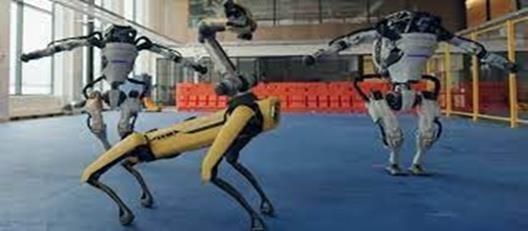
One-legged,two-legged,four-legged,six-legged,eight-legged,andhybridrobotsarejustafewofthenumerous varieties oflegsthatexisttoday.
They are walking robots that move by controlling their legs. They are employed to provide movement in extremely unstructuredsettings.Despitebeingdifficulttoconstruct,theyhaveanadvantageoverwheeledrobotswhenitcomesto navigation on any kind of surface or path. Robots with legs are more adaptable than those withwheels; they can move acrossavarietyofsurfaces.Asanillustrationofbio-mimicry,theycanmimicanimalswithlegs,suchaspeopleorinsects. Robotswithlegsarecapableofnavigatingonanysurface.
Thegaitsthatare possibleforthemcan be classifiedaccordingtohowmanylimbs they employ.Robots with morelegs maybemorestable,whereasthosewithfewerlegsaremoremanoeuvrable.Robotswithfourlegsarecommonlyknown asquadrupedrobotsor“BigDogs.”Theyaredesignedtonavigatechallengingterrain.Theyarecapableofmovingonfour legs. Compared to two-legged robots, they can benefit from greater stability, especiallywhenmoving.Comparedtotwoleggedsystems,theycanbenefitfromhavingalowercentreofgravity.
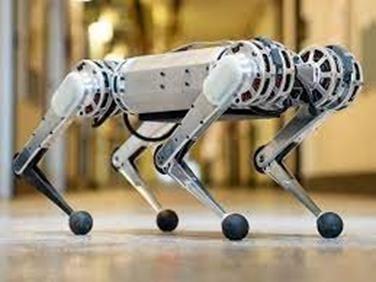
OneofBostonUniversity’stopquadrupedrobots,theMiniCheetah,hasfourlegs.Itisadynamicquadrupedal robotthat canmovequicklyoveravarietyofsurfaces.Itistheidealfusionofelectrical,mechanical,andcomputerscience.
The Mini Cheetah can move in a variety of gaits over various types of hard terrain, and to maintain balance it needsto manage its leg actuators, sensors to detect where its feet should be, and planning algorithms to choose itscourse and speed.
1.3Reinforcement Learning
A branch of machine learning called reinforcement learning (RL) studies how intelligent creatures should behavein a given environment to maximise the concept of gaining prizes. In reinforcement learning, an agent picks up information from their interactions with the environment in order to amass a cumulative reward without being watched.Bytaking actions and monitoring the results of those actions, an agent learns how to function in a givenenvironment using the feedback-based machine learning process known as reinforcement learning. Each successful action results in good feedbackfortheagent,andeachunsuccessfulactionresultsinnegativefeedbackorapunishment.UsingRL,itispossibleto tackleaspecificclassofissues,includingthoseinroboticsandgamingwherechoicesmustbemadesequentiallyandwitha long-termgoalinmind.
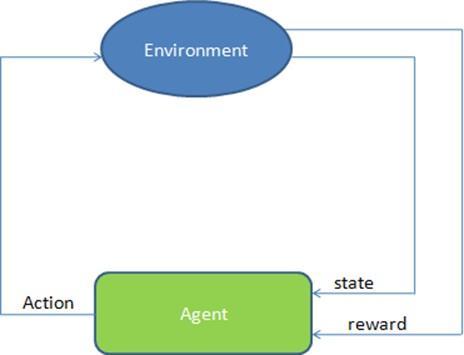
Computerscanbetaughttolearnusingthereinforcementlearningmethod,whichinvolvesrewardingorpunishingdesired behaviour.Areinforcementlearningagentcanmonitorandcomprehenditsenvironment,act,andlearn fromerrors.The agentlearnsnewinformationbytrial-and-errorlearning,andasitgainsexperience,itimprovesitsperformanceabilities. Reinforcement learning is a type of machine learning technique because it involves an intelligent agent (computer programme) interacting with the environment and learning how to function within it.The way a robotic dog learns to movehisarmsisagoodillustrationofreinforcementlearning.
The environment is typically described as a Markov decision process since many reinforcement learningalgorithms for thiscaseusedynamicprogrammingtechniques(MDP).
Themaindifferencebetweentraditionaldynamicprogrammingtechniquesandreinforcementlearningalgorithmsisthat the latter are more suited to large MDPs than exact procedures are and do not necessitate knowledge of a precise mathematicalrepresentationoftheMDP
The illustration that follows shows reinforcement learning in action. An agent behaves in the environment to achieve a purpose. The agent either works +1 or -1 depending on the action reward function. An action is performed on a state. Once the agent obtains a reward proportionate with their acts, the next state will be held, and so on until the agent achievestheirgoal.
Reinforcementlearningalgorithmslookforapolicybasedonpreviousexperiencestodirectanagenttowardsachievinga specifiedobjective.Tomodelthistask,theMarkovDecisionProcess(MDP)isemployed.ThevariablesS,A,P,andrmake upthetuplethatrepresentstheMDP.SRnstandsforthestatespace,ARmforthesetofactionstheagentiscapableof,P: SA7Sforthesystemdynamics,[0,1]forthediscountfactor,andr:SA7Rfortherewardfunctionthateitherrewardsor penalisesanactionperformedinstate.
1.4Theoretical Background
1.4.1Dynamics
The two types of dynamics are linear dynamics and rotational dynamics. Linear dynamics takes into account variables like force, mass/inertia displacement (measured in distance units), velocity (proxied in path length per unit of time), acceleration (measured in distance per unit of time squared), and momentum when it comes to moving objects in a straightline(masstimesunitofvelocity).Torque,momentofinertia/rotationalinertia,angulardisplacement(inradiansor, less frequently, degrees), angular velocity (in radians per unit time), angular acceleration (in radians per unit of time squared), and angular momentum are certain aspects of rotational dynamics (moment of inertia times unit of angular velocity).Objectsfrequentlytravelstraightandinboth directions.Movingfromoneplacetoanother,therearevelocity, position,acceleration,torqueangularvelocity, inertiaareworkingtogether.Dynamicsarereallyplayavitalroletomove anybodyandweareworkingonalegsoheredynamicsaresomuchimportant.
1.4.2Kinematics
Astrophysics uses kinematics to explain how individual celestial entities and groups of them move. An engine, arobotic arm, or the human skeleton are examples of multi-link systems, and the motion of these systems is referredto as kinematics.Itisutilisedinbiomechanics,robotics,andmechanicalengineering.Todescribethespatialpositionsofbodies orsystems of material particles,as well as theirspeeds and velocities, is the aimofkinematics(acceleration). When the generating factors are disregarded, motion descriptions are only plausible for particles with restricted motion or particlesmovingalongroutes.Inuncontrolledorfreemotion,forcesgoverntheshapeofthepath.
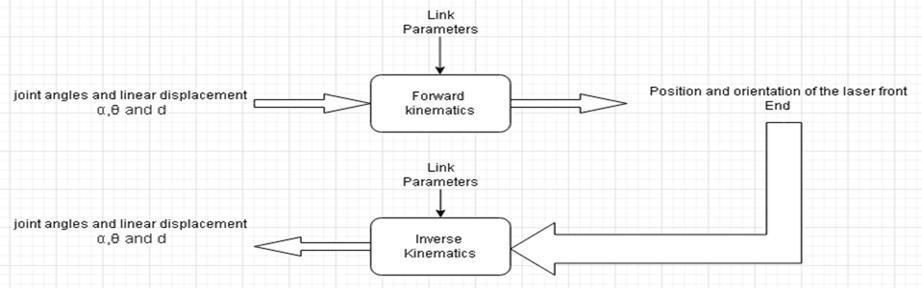
1.4.2.1 Forward Kinematics
Forward kinematics is the process of using a robot’s kinematic equations to ascertain the joint parameters that must matchtheend-positioneffector’sprescribedvalues.Fromthebaseframetotheendeffector,amanipulatorisconstructed of serial links that join to one another at revolute or prismatic joints. Forward kinematics describesthe location and orientationoftheendeffectorinrelationtothejointvariables.Aproperkinematicsmodelshouldbeusedinordertohave forwardkinematicsforarobotmechanisminasystematicmethod.TheD-Hparameter,whichcontainsfourparameters, is utilised. The values ai1, alpha, 1idi, and theta, respectively, describe the link length, twist, offset, and joint angle. A connectedcoordinateframeisused.
To determine DH parameters for each joint. There is a method for computing forward kinematics, and the coordinate frame’szaxispointsalongthegeneralmanipulator’srotationalorslidingdirection.D-HParameter:
The four parameters known as Denav t-Harte berg parameters, or DH parameters, are connected to a specific conventionforlinkingreferenceframestothelinksofarobotmanipulatororspatialkinematicchain.
ThefollowingfourtransformationparametersareknownasD–Hparameters:
d:offsetalongpreviousztothecommonnormal.DisthedistancealongiJ0Zaxistotranslate.Theta:angleaboutprevious z,fromoldxtonewx.ThetaistheangletorotatearoundtheJ0Zaxis.L:lengthofthecommonnormal(linklength).
Alpha:angleaboutcommonnormalfromoldzaxistonewzaxis.AlphaistheangletorotatearoundtheJ0Xaxis.
1.4.2.2 Inverse Kinematics
Theendofakinematicchain,suchastheskeletonofananimatedcharacterorarobotmanipulator,needstobeplacedin aspecificpositionandorientationwithrespecttothestartofthechain.Inversekinematicsisa mathematicaltechnique thatestablishesthevariablejointparametersrequiredforthis.
By employing kinematic equations, inverse kinematics can be used to predict a robot’s path to a given point. As an illustration,inversekinematicsisusedtodeterminethenecessarylocationforalegtojumporslip.Serial manipulators’ inversekinematicsproblemhaslongbeenresearched.Havingcontrolovermanipulatorsiscrucial.Inthereal-timecontrol of manipulators, solving the inverse kinematics frequently requires a significant amount of processing and takes a very lengthytime.Actuatorsworkinjointspace,whereasmanipulatorscompletetheirjobsinCartesianspace.Theorientation matrix and the location vector are both parts of Cartesian space. Contrarily, joint angles are a representation of joint space.Inversekinematicsreferstothedifficultyoftranslatingthe location and orientation of a manipulator end effector from Cartesian space to joint space. To determine the analytical inverse kinematics solution, two techniques are used: geometricandalgebraic.
1.4.3Deep reinforcement learning
A branch of machinelearning called deep reinforcement learning (deep RL) combines deep learning and reinforcement learning(RL).InRL,theissueofacomputationalagentlearningtomakejudgementsthroughtrialanderroristakeninto account. Because deep learning is incorporated into the solution, agents can make judgements based on input from unstructured data without having to manually engineer the state space. Deep RLalgorithms candecide what actions to taketoachieveanobjectivebyanalysingverymassiveinputs,suchaseverypixelpresentedtothescreeninavideogame (maximising the game score). Robotics, video games, natural language processing, computer vision education, transportation,finance,andhealthcarearejustafewofthediversefieldsinwhichdeepreinforcementlearninghasbeen applied
2. Literature Review
2.3.1 State of the art
Diego Rodriguez and Suen Banked offer a unique Deep Reinforcement method in January 2021 that allows an agent to learnomnidirectionallocomotionforhumanoidsandaccomplishesthelocomotionbehaviourwitha singlecontrolpolicy (asingleneuralnetwork).theabilityofthelearntpolicytoturnaroundtheverticalaxisatvariousspeedsandwalkinthe sagittalandlateralorientations.AsystemutilisingdeepreinforcementlearningisproposedbyGuillanmeBellegardaand Quan Nguyen in March 2021. to benefit from the challenging quadrupedaljumping nonlinear trajectory optimization solution. While the “low” gain baseline performance is inferior to the “high” gain controller under ideal circumstances because of the large rise in noise. Julian Ibaz, Jie Tan, and Chelsea Finnhypothesised inFebruary2021thatrobots can learn in a real-world context and Physical robots may now learn complicated skills in the actual world thanks to deep reinforcementlearning, whichhasalso shown promise inthis regard.All formsof movement, employing reinforcement learningtolearnbehaviourinarealenvironment.
Using discriminatively trained exemplar models, Justin Fu, John Dco-Reyes, and Sergey proposed a novelty detection algorithmforexplorationinMay2017.Theclassifiersaretrainedtodistinguishbetweeneachvisitedstateandallothers. ascalableexplorationmethodbasedondevelopingdiscriminativeexemplarmodelstoawardnoveltybonusesandreveal anovelrelationshipbetweenexemplarmodelsanddensityestimates.Anautomatedlearningenvironmentforgenerating control rules directly on the hardware of a modular legged robot is presentedby Sehon Ha, Joohyung Kim, and Katsu Yamaneinaugust2018.Bycomputingtherewardsusingavision-basedtrackingsystemandrepositioningtherobottothe startingplaceusingaresettingmechanism,thisenvironmentsupportsthereinforcementlearningprocesses.
A sample effective Deep reinforcement learning algorithm based on mechanism entropy reinforcement learning was proposed in June 2019 by Tumas Haarnoja, Sehoon Ha, Aurick Zhou, Jie Tan, George Tucker, and Sergey Levine. It only needs a small number of trials to train neural network policies and little per-task tuning. a whole end-to-endlearning systemforleggedrobotlocomotion.TedXiao,EricJang,DmitryCalashkav,SergeyLevine,JulianIbarz,KarolHausman,and Alexander Herzog will be in April 2020. According to this statement, a robot must think and move simultaneously, choosing its next course of action before the previous one has finished, much like a person or an animal. This is accomplishedinreinforcementlearningsettingswheresamplinganactionfromthepolicymustbedoneconcurrentlywith thetimeevolutionofthecontrolledsystem.
QuanNguyen,MathewJ.Powell,BenjaminKatz,JaredDiCarlo,andSangbaeKimproposedanovelmethodinAugust2019 for implementing optimum jumping behaviours on quadruped robots. This technology incorporates strong landing controllers for sustaining the robot body position and orientation after impact, accurate high- frequency tracking controllers, and effective trajectory optimisation. In addition to proving the advantages of the technology, the experimental findingsdemonstratethatthehardwarecanhandle demandingtasksrequiringhighpowerproductionand highimpactabsorption.ZhaomingXieandPatrickClarydescribeanddocumentaniterativedesigntechniqueinMarch2019 thattakesintoaccountthenumerousrewarddesigniterationsthatarefrequentlyrequiredinpractise.
Transfer learning isaccomplishedthroughout theprocessesby using deterministic actionstochasticstatetuples, which representthedeterministic policyactionlinkedtothestatesvisitedbythestochasticpolicy.Aniterative designprocess thatusesRLtolearnrobustlocomotionpolicies,theauthorsshowthatlearnedpoliciescanbe robustwithoutresorting to dynamics randomization. A novelty detection system for exploration based on discriminatively trained exemplar models is described by Fu, John, and Sergey in 2017. a scalable exploration method based on training discriminative exemplar models that shows a novel relationship between exemplar modelsanddensityestimates whilealsoawarding noveltybonuses.Inordertoprovidenoveltybonusesandshowanovelrelationshipbetweenexemplarmodelsanddensity estimation,ascalableexplorationtechniquebasedontrainingdiscriminativeexemplarmodelsisused.[15]In2020,Xiao, Kalashnikov,Levin,andcolleaguesusedreinforcementlearningtochoosetheirnextcourseofactionbeforetheprevious onehadfinished,andtheydiscoveredthatconcurrentcontinuous-timeanddiscrete-timeBellmanoperatorscontinuedto contract, maintainingtheQ-learningconvergenceguarantees.Withtheaidofaquadrupedrobot,youmaylearnpolicies for a wide range of behaviours that can then be effectively applied in the actual world. Bellman operators that were contemporaneous in continuous and discrete time remained contractions, maintaining the guarantees of Q- learning convergence.
Leggedrobotscanacquireagilemovementtechniquesbyimitatingreal-worldanimalsaccordingtoanimitationlearning systemthatPengandcolleaguesintroducein2020.Theyhavediscoveredawaytoefficientlytranslatepolicieslearnedin simulation to the actual world by teaching a quadruped robot how to do a range of actions. Standard off-policy deep reinforcementlearningalgorithmslikeDQNandDDPG,asdemonstratedbyFujimotoandMegeretal.in2019,areuseless forthisfixedbatchsituation.
3. RESEARCH METHODOLOGY
A. Model Predictive Control
There are numerous dynamics and kinematics that will function on the robotic leg to jump over a specific height.To accomplish the purpose, we can formulate specific dynamics, such as torque, velocity, position, and angles, aswell as kinematics, such as forward kinematics for position and inverse kinematics for joint angles. Leg will follow the state trajectoryinordertojumpoveraspecificheight,andMPCwilliterativelyadjusttheinputsas necessarytocausetheleg tojumpoverthespecifiedheight.MPCisacontrollerthatforeseeshowaroboticlimbwillbehaveinthefuture.InOrderto determine the best control action for jumping at a specific height, it solves constraints based on robotic legs and optimization algorithms.
B. Reinforcement learning
Reinforcement learning will be used on that robotic leg to teach it how to jump at a given height in realistic settings.A reward system will function in accordance with the feedback. PPO (proximal policy control) and A2C(advanced actor critic)algorithmsareutilizedfortrainingthatleg.Bytakingpartinanactionandreceiving feedback,anactorlearnsina real-worldsettingcalledreinforcementlearning.Roboticlegsthatjumporarereadytojumpwillberewarded,otherwise they will receive no reward or a negative reward. Leg’s environment will alterdynamically,andreinforcementlearning willassistinhelpingthemadoptthetermsandcircumstanceswhileattemptingtoreachthedesiredheight.
4. REINFORCEMENT LEARNING ALGORITHM
The agent gains knowledge through trial and error, and based on its experience, it acquires the abilities required to complete the mission more successfully. In light of this, we may say that "Reinforcement learning is a type ofmachine learning method where an intelligent agent (computer programme) interacts with the environment and learns to function within that," The way a robotic dog learns to move his arms is a good illustration of reinforcement learning. Thesereinforcementlearningtechniquescanassisttheagentinlearningandgeneratingitsbestoutput.
A policy gradient method for reinforcement learning is called proximal policy gradient. It is a recent developmentin reinforcementlearningthatoffersimprovementstotheoptimizationofTrustregionpolicies(TRPO).Weshallfirstgrasp what policy stands for in order to comprehend the algorithm. In terms of reinforcement learning, a policy is fromthe actionspacetothestatespace.Areinforcementlearningagent’spolicydetermineswhichcourseofactiontopursuebased on the current condition of the environment. When we talk about evaluating the policy function of an agent, we mean determininghowwelltheagentisperforming.Thisiswherethepolicygradient methodcomesintoplay.whenanagent islearningbutisnotawareoftheoptimumcourseofactionfortheassociatedstates.Numerousactionsareusedasinput, andthegreatestactionwill betheoutcome,muchlikea neural network.PPOisan algorithmthatstrikesacompromise between key elements such implementation and testing ease, sample complexity and efficiency, and step-function updates. In actuality, PPO is a policy gradient method that also learns from online data. The Actor-critic model, which employstwodeepneuralnetworks,ActorandCritic,isthemostpopularwaytoimplementPPO.
Lclip(θ)=El[min(rt(θ)At,clip(rt(θ),1−ϵ,1+ϵ)At)]
Et = empirical expectation overtime −steps.rt = ratio of the probabilities under then ew and old policy. (estimate advantageattimet.ϵ=hyper−parameter,usually0.1or0.2.
ForPPO,therearesignificantimplicationsorfacts.1.Apolicy-compliantalgorithmisPPO.
2. Incontextswithdiscreteorcontinuousactionspaces,PPOcanbeapplied.
3. MPIparallelizationissupportedbytheSpinningUpimplementationofPPO.
4. Ituses a policygradient optimizationalgorithm, which updates an existingpolicyineach step to trytoimprove certainparameters.
5. It makes sure that the update is not too significant, meaning that the old and new policies are not drasticallydifferent.
6. ϵisahyper–parameterdenotesthelimitoftherangewithinwhichtheupdateisallowed.
Input:initialpolicyparameters.foriteration=1,2,0,0,0.do foractor=1,2,0,0,0 do
RunpolicyπθoLdinenvironmentforTtime–stepscomputeadvantageestimateA1, ,Aiendfor OptimizesurrogateLwithrespecttoθ,withkepochsandmini–batchthem<=NTθ0ld<−−−−−θ endfor
Whatwecanseeisthatsmallbatchesofobservations,sometimesknownas“mini-batch,”areusedforupdatingandthen
discardedinordertomakeroomforafreshbatchofdata.Topreventlargerevisionsthatcouldpotentiallybeirreparably detrimental,thenewpolicywillbe“ -clipped”toatinyzone.Inother words, PPOoperatesjustlikeother policy gradient methodsinthatitcomputesthegradientstoenhancethejudgementsorprobabilitiesinthebackwardpassandcomputes the output probabilities based on various parameters in the forward pass. Like its predecessor, TRPO, it makes use of importancesamplingratio.However,italsomakessurethatexcessively substantialmodificationsarenotpermittedand that the old policy and new policy are at least within a specific proximity (denoted by). One of the most popular policy optimizationtechniquesinthereinforcementlearningspaceisnowthisone.
2.A2C
Advantage The actor-critic algorithm is a value-based algorithm that learns how to choose predictive actions or input actions.Itisapolicy-basedalgorithmthatcoversthemappingofinputstatetooutputstate.Tosolveaparticularproblem in the actor critic algorithm, the actor and critic networks work together. The agent (temporaldifference) or prediction errorisdeterminedbytheadvantagefunction.Learningahybridapproach(A2C)oraReinforcementLearningalgorithm thatcombinesvalueoptimizationwithpolicyoptimizationtechniques.A performerofanactioncanlearnwhichoftheir activities are better or worse by receiving feedback on them. Temporal difference learning agents learn by predicting rewards in the future and altering their strategy in reactionto faulty predictions. One of the remarkable things about temporaldifferencelearningisthatitappearstobeoneofthewaysthebrainpicksupnewinformation.
A2CWorking
Asiswellknown,aneuralnetworkcanbeusedtoparameterizetheQfunctionandlearntheQvalue.Thisbringsupactorcritictechniques,where:
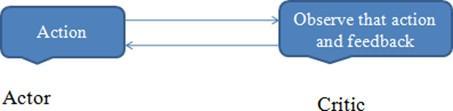
1.Thevaluefunctionisestimatedbythe“Critic.”Theaction-value(theQ value)orstate-value(theV value) mightbethis.2. Critic:AQ-learningalgorithmthatevaluatestheactionthattheActorchoseandofferssuggestionsforimprovement.Itcan benefitfromQ-learningefficiencytechniqueslikememoryreplay.Ateachupdatephase,weupdateboththeValuenetwork andtheCriticnetwork.
This indicates how much better it is to take a particular action than the typical general action at the current state. We therefore subtract the Q value part from the Value function while utilising it as the baseline function. This iswhat we'll refertoastheadvantagevalue:
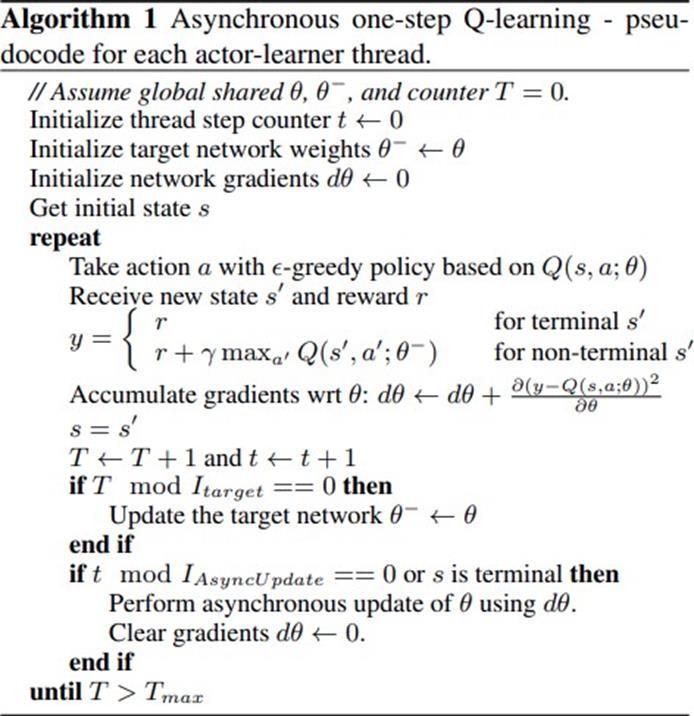
A(St,at)=Q(St,at)−v(at)Where, at=actiontakenaspertimeSt=Stateofanaction andherepseudocodeforA2Calgorithmforsolvingtheproblemsbasedonreinforcementlearning.
V. CONCLUSION
Inthispaper,weintroducedanovelmethodologyforroboticlegtojumpoveraparticularheightusingmodel predictive control withreinforcementlearning.Model predictivecontrolamethodofformulationforevery dynamicmanoeuverat everyjointofroboticleg.Reinforcementlearningisanalgorithmtotrainthatlegin real environmentforhoping overa particular height. After conducting experiments in order to accomplish the goal and analysed the findings to reach the followingconclusions:
a) By employing reinforcement learning, a model-based strategy, and no control system, model will be train tojump beyondaspecifiedheight.
b) Reinforcementlearningleadustoexplorefeasibleimplementationofhighlydynamicmovementswithoutanyequation ofmotion.
c) Usingreinforcementlearningwecanachievehigherheight.
REFERENCES
[1] D. Rodriguez and S. Banked Deep walk omnidirectional bipedal gait by deep reinforcement learning, in2021IEEE InternationalConferenceonRoboticsandAutomation(ICRA).IEEE,2021,pp.3033–3039.
[2]G. Bellegarda and Q. Nguyen, “Robust quadruped jumping via deep reinforcement learning,” arc Xiv preprintarci: 2011.07089,2020.
[3]Y. Ding, A. Mandala, C. Li, Y.-H. Shin, and H.-W. Park, “Representation- free model predictive control fordynamic motionsinquadrupeds,”122020.
[4]J.DiCarlo,P.M.Wincing,B.Katz,G.Belt,andS.Kim,“Dynamiclocomotioninthemitcheetah3throughconvexmodelpredictivecon-troll,”in2018IEEE/RSJInternationalConferenceonIntelligentRobotsandSystems(IROS),2018,pp.1–9.
© 2023, IRJET | Impact Factor value: 8.226 | ISO 9001:2008
[5]J. Ibarz, J. Tan, C. Finn, M. Kalakrishnan, P. Pastor, and S. Levine, “How to train your robot with deep reinforcement learning:lessonswehavelearned,”TheInternationalJournalofRoboticsResearch,vol.40,pp.698–721,2021.
[6]T.Haarnoja,A.Zhou,S.Ha,J.Tan,G.Tucker,andS.Levine,“Learningtowalkviadeepreinforcementlearning,”ArXiv, vol.abs/1812.11103,2019.
[7]Z.Zhang,“Modelpredictivecontrolofquadrupedrobotbasedonreinforcementlearning,”AppliedSciences,vol.13,p. 154,122022.
[8]T. P. Lillicrap, J. J. Hunt, A. Pritzel, N. M. O. Hess, T. Erez, Y. Tassa, D.Silver, and D. Wierstra,“Continuous control with deepreinforcementlearning,”CoRR,vol.abs/1509.02971,2016.
[9]S.Fujimoto,D.Meger,andD.Precup,“Off-policydeepreinforcementlearningwithoutexploration,”inICML,2019.
[10]T. Haarnoja, H. Tang, P. Abele, and S. Levine, “Reinforcement learning with deep energy-based policies,”in ICML, 2017.
[11]W.Zhicheng,W.Wei,A.Xie,Y.Zhang,J.Wu,andQ.Zhu,“Hybridbipedallocomotionbasedonreinforcementlearning andheuristics,”Micromachines,vol.13,p.1688,102022.
[12]Q.Nguyen,M.J.Powell,B.Katz,J.D.Carlo,andS.Kim,“Optimizedjumpingonthemitcheetah3r
[13]V. Tsounis, M. Alge, J. Lee, F. Farshidian, and M. Hutter, “Deepgait: Planning and control of quadrupedalgaits using deepreinforcementlearning,”IEEERoboticsandAutomationLetters,vol.5,pp.3699–3706,2020.
[14]S. Ha, J. Kim, and K. Yamane, “Automated deep reinforcement learning environment for hardware of a modular leggedrobot,”in201815thinternationalconferenceonubiquitousrobots(UR).IEEE,2018,pp.348–354.
[15]J.Fu,J.D.Co-Reyes,andS.Levine,“Ex2:Explorationwithexemplarmodelsfordeepreinforcementlearning,”inNIPS, 2017.
[16]T. Xiao, E. Jang, D. Kalashnikov, S. Levine, J. Ibarz, K. Hausman, and A. Herzog, “Thinking while moving: Deep reinforcementlearningwithconcurrentcontrol,”ArXiv,vol.abs/2004.06089,2020.
[17]Z.Xie,P.Clary,J.Dao,P.Morais,J.Hurst,andM.vandePanne,“Learninglocomotionskillsforcassie:Iterativedesign andsim-to-real,”inCoRL,2019.
[18]J.Hwangbo,J.Lee,A.Dosovitskiy,D.Bellicoso,V.Tsounis,V.Koltun,andM.Hutter,“Learningagileanddynamicmotor skillsforleggedrobots,”ScienceRobotics,vol.4,2019.
[19]P. F. Cristiano, J. Leike, T. B. Brown, M. Matric, S. Legg, and D. Amodei, “Deep reinforcement learningfrom human preferences,”inNIPS,2017.
[20]R. Liu, F. Nageotte, P. Zanne, M. De Mathelin, and B. Dresp, “Deep reinforcement learning for the controlof robotic manipulation:Afocussedmini-review,”Robotics,vol.10,pp.1–13,012021.
[21]X. B. Peng, G. Berseth, K. Yin, and M. Van De Panne, “Deeploco: Dynamic locomotion skills usinghierarchical deep reinforcement learning,” ACM Trans. Graph., vol. 36, no. 4, pp. 41:1–41:13, Jul. 2017. [Online]. Available: http://doi.acm.org/10.1145/3072959.3073602
[22]J.Hwangbo,J.Lee,A.Dosovitskiy,D.Bellicoso,V.Tsounis,V.Koltun,andM.Hutter,“Learningagileanddynamicmotor skillsforleggedrobots,”ScienceRobotics,vol.4,2019.
[23]S. Fujimoto, D. Meger, and D. Precup, “Off-policy deep reinforcement learning without exploration,” inInternational ConferenceonMachineLearning.PMLR,2019,pp.2052–2062.
[24]T. Hester, M. Quinlan, and P. Stone, “Rtmba: A real-time model-based reinforcement learning architecturefor robot control,”in2012IEEEInternationalConferenceonRoboticsandAutomation,2012,pp.85–90.
[25]A. Hill, A. Raffin, M. Ernestus, A. Gleave, A. Kanervisto, R. Traore, P. Dhariwal, C. Hesse, O. Klimov, A.Nichol, M. Plappert, A. Rad- ford, J. Schulman, S. Sidor, and Y. Wu, “Stable baselines,” https://github.com/hill-a/stable-baselines, 2018.obot,”2019InternationalConferenceonRoboticsandAutomation(ICRA),pp.7448–7454,2019.