EVALUATION OF STEEL SLAG AS PARTIAL REPLACEMENT OF CEMENT IN CONCRETE
Ashish Milind Wahane 1 , Ishant B. Dahat21Student, Dept. of Civil Engineering, G H Raisoni University, Amravati, India

2Professor Dept. of Civil Engineering, G H Raisoni University, Amravati, India ***
Abstract - A well-maintained infrastructure is crucial for modern societies, but meeting all requirements poses challenges. Concretehas been a reliableconstructionmaterial for decades, and engineers seek to enhance its performance usingmodernadmixtures and wastematerials. Incorporating waste materials in concrete consumption and improving its properties are benefits.
This research explores the use of Steel Slag as a partial replacement forcement in varyingproportions(0%,5%,10%, and 15%). The study focuses on compressive strength and other parameters suchas workability, water-to-cement ratio, setting time, and surface hardness, which impact concrete performance. Results indicate that Industrial steel slag is a promising cement substitute, outperforming reference concrete.
Implementinga circular economyinconstructionnecessitates studying waste utilization as material replacements. Substituting cement with slag reduces cement consumption, lowers CO2 emissions, and addresses waste management concerns. Embracing such sustainable practices will lead to a more resilient and eco-friendly infrastructure.
Key Words: Steel Industry, Cement, Steel Slag, partial replacement of cement, Admixtures.
1.INTRODUCTION
Concrete is a widely used construction material due to its durability,versatility,andcost-effectiveness.However,the production of ordinary Portland cement (OPC), a key componentofconcrete,isassociatedwithsignificantcarbon dioxide (CO2) emissions, contributing to environmental concerns.Asaresult,thereisagrowinginterestinexploring alternative materials that can partially replace OPC in concretemixtures,reducingitsenvironmentalimpact.
Onesuchalternativematerialissteelslag,abyproductofthe steel manufacturing process. Steel slag possesses cementitiouspropertiesandhasthepotentialtoenhancethe performance of concrete while offering a sustainable solutionforwastemanagement.Byincorporatingsteelslag inconcrete,notonlycanthedemandforOPCbereduced,but theoverallcarbonfootprintoftheconstructionindustrycan alsobeminimized.
Thisresearchprojectaimstoinvestigatethefeasibilityand efficiency of using steel slag as a partial replacement for ordinaryPortlandcementinconcrete.Thestudywillfocus on evaluating the mechanical properties of concrete with varying proportions of steel slag, including compressive strength and split tensile strength. Additionally, the durability parameters ofthe concrete will be examined to ensurethelong-termperformanceofthematerial.
Theoutcomesofthisresearchholdsignificantimplications for sustainable construction practices. Finding an optimal combination of cement and steel slag can lead to reduced CO2 emissions and a more cost-effective concrete mix. Moreover, the study contributes to the circular economy concept by promoting the reuse of industrial byproducts, thereby moving towards a greener and more environmentallyfriendlyconstructionindustry.
Byaddressingtheseresearchobjectives,thisstudyseeksto pavethewayforamoresustainableandresilientapproach to concrete production, aligning with the global efforts to mitigate climate change and foster environmentally consciousconstructionpractices.
1.1 RESEARCH SIGNIFICANCE
This research holds significant importance for several reasons:
1. The potential discovery of a new concrete with improvedstrengthanddurability.
2.Gainingvaluableinsightsintothebehaviorofconcrete throughvarioustests.
3.Contributingtosubstantialresearchontheresistance andviabilityofreplacementmaterials.
1.2 OBJECTIVES
Themainobjectivesofthisstudyareasfollows:
1. To utilize industrial waste Steel Slag in concrete, providing an environmentally-friendly alternative for its disposal.
2. To enhance the overall strength of concrete by incorporatingSteelSlagasapartialreplacementforcement.
3. To investigate the feasibility of using Steel Slag as a replacement material for cement in concrete through the followingtests:
a.Compressivestrengthtest
b.SplitTensilestrengthtest
2. REVIEW OF LITERATURE
Kounrounis et al. (2007); conductedastudytoexplore composite cement with varying proportions of steel slag, ranging up to 45% by weight. The steel slag used in the researchwasinthesizerangeof0–5mm.Severaltestswere performed on cement pastes and mortars, including assessments of initial and final setting times, standard consistency,flowofnormalmortar,autoclaveexpansion,and compressivestrength.
Theauthors'findingsindicatethat"slagcanbeeffectively incorporatedintotheproductionofcompositecementwith strengthclasses42.5and32.5asperEN197-1standards." Moreover, they observed that slag cement demonstrates satisfactoryphysicalproperties.Thepresenceofsteelslagin theblendedcementleadstoareductioninthehydrationrate, attributedtothemorphologyofthecontainedC2S(dicalcium silicate)anditslowcontentofcalciumsilicates.
Thisresearchhighlightsthepotentialofusingsteelslagas asupplementarymaterialincementproduction,providing valuable insights into its effects on cement properties and performance.
V. Subathra Devi et al. (2014); conducted an experimental study to investigate the impact of partially replacingcoarseandfineaggregateswithsteelslag(SS)on the strength and durability properties of concrete. The researchemployedamixdesignofM20gradeconcrete.The study aimed to determine the optimal percentage of replacementforbothfineandcoarseaggregateswithsteel slag.
Theworkabilityoftheconcretewasassessedusingthe slumptest,revealingagradualdecreaseinworkabilityasthe percentage of replacement increased. Various strength parameters,includingcompressivestrength,tensilestrength, and flexural strength, were examined alongside durability tests involving acid resistance (using HCl and H2SO4) and Rapidchloridepenetration.
Theresultsindicatedthatreplacingaportionoffineand coarseaggregateswithsteelslaginconventionalconcreteled to improvements in compressive, tensile, and flexural strength. Additionally, the mass loss observed in concrete cubesimmersedinacidswasfoundtobeminimal,suggesting enhanceddurability.
This research sheds light on the potential benefits of incorporating steel slag as a partial replacement for aggregates in concrete, offering insights into how it can positivelyaffectconcrete'sstrengthanddurabilityproperties.
Venkata Kiranmayi K. et al. (2014); conductedastudy focusingonwastemanagement,aprevalentandchallenging global issue. The research specifically addressed the solid wastegeneratedbythesteel-makingindustry,knownassteel slag. Steel slag is a residue produced during steel-making operations.Thestudyexploredthepotentialofutilizingsteel slagasaviablealternativetosandinvariousapplications.
Despitebeingconsideredasolidwastepollutant,steelslag canbeeffectivelyemployedinroadconstruction,asclinker raw materials, filling materials, and other suitable applications. The research highlights the beneficial usesof steel slag, contributing to waste reductionand sustainable practicesinthesteelindustry.
3. METHODOLOGY
Thefollowingfigureshowsthemethodologyinvolvedintheentireprojectwork
3.1 MIX PROPORTIONS

Cement=420kg/m3
Water=164l/m3
Fineaggregate=786kg/m3
Coarseaggregate20mm=549.25kg/m3 10mm=549.25kg/m3
Chemicaladmixture=2.1kg/m3(0.6%bytheweightof cement)
Densityofconcrete=2450kg/m3
Water-cementratio=0.39
MixProportionByweight=1:1.871:2.615
Table -1: MixproportionsforM40byweight
3.1.4 SPECIMEN DETAILS
Forthetests,specimensarecastfollowingthedesignedmix.
ToconducttheCompressiveStrengthTest,ConcreteCubes arecastusingamildsteelmouldwithdimensionsof150mm x150mmx150mm.
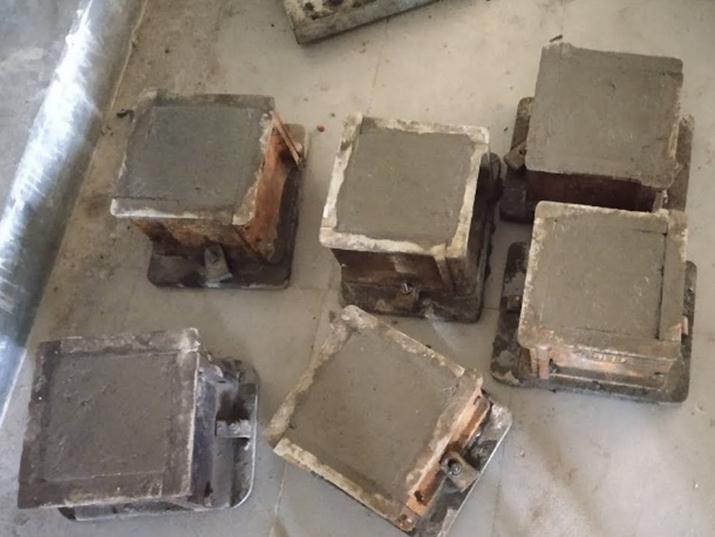
For the Split Tensile Strength test, Concrete Cylinders are castusingabarrel-shapedformwithadiameterof150mm andalengthof300mm.

3. CONCLUSIONS
In this study, the impact of Steel Slag as a partial replacement for cement in concrete was investigated, and thefollowingconclusionsweredrawn:
1. Workability: As the percentage of Steel Slag replacement decreased, the workability of the concrete increased. Slump values showed an increasefrom110mmto120mmforreplacement percentages of 5% and 20% of Steel Slag, respectively.
2. CompressiveStrength:ReplacingcementwithSteel Slag at 15% and 20% led to an increase in compressivestrength.However,whentheSteelSlag replacementexceeded15%,compressivestrength decreased.Thus,itisconcludedthatreplacing15% of cement with Steel Slag is optimal for concrete performance.

3. Split Tensile Strength: Similar to compressive strength,thesplittensilestrengthincreasedwitha 5% replacement of cement with Steel Slag and decreased with higher replacement percentages. Hence,theidealreplacementpercentageforcement by Steel Slag is 15% for enhanced split tensile strength.
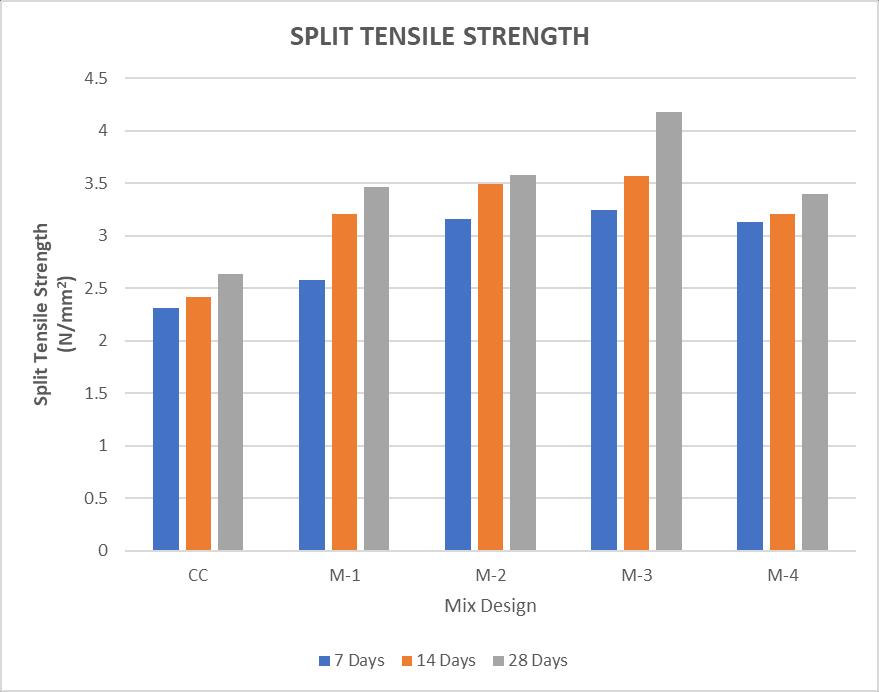
Based on the test results, it can be inferred that a 15% partial replacement of cement with Steel Slag improves workability,compressivestrength,andsplittensilestrength more effectively than conventional concrete. Therefore, incorporating Steel Slag in concrete mixtures is recommendedfortheconstructionofvariousstructures.
REFERENCES
[1] V.SubathraDevi,B.K.Gnanavel,“PropertiesofConcrete Manufactured Using Steel Slag”, Procedia Engineering Volume97,2014,Pages95-104.
[2] DilipKumarSinghaRoy,AmitavaSil,(2012)“Effectof Partial Replacement of Cement by SilicaFume on HardenedConcrete”,InternationalJournalofEmerging TechnologyandAdvancedEngineering,IJETAE,Volume 2,Issue8.
[3] Veena G. Pathan, Vishal S. Ghutke, Gulfam Pathan, (2012), “Evaluation of Concrete Properties Using Ground Granulated Blast Furnace Slag” International JournalofInnovativeResearchinScience,Engineering andTechnologyVolume1,Issue1.
[4] P.S.Kothai and R.Malathy, (2012), “Utilization Of Steel SlagInConcreteAsAPartialReplacementMaterialfor Fine Aggregates” International Journal of innovative researchinscienceengineeringandtechnology.Volume 3,Issue4.
[5] AnsuJohnandElsonJohn(2013),“StudyonthePartial ReplacementofFineAggregateusingInductionFurnace Slag”, American Journal of Engineering Research, Volume4,Issue5.
[6] Ajay Wanode, Ranjana Samrit, Kanchan Suryawanshi, (2015),“EffectofIndustrialSteelSlagonCompressive StrengthofConcrete”,Internationaljournalofemerging trendsengineeringbasicsciences,Volume2,Issue4.
[7] Banothu Ravinder, (2017), “Experimental study for investigatingpropertiesofconcretebyusingsteelslag”, IJRETVolume4,Issue11.
[8] M.S.Shetty,(2004),“ConcreteTechnologyandTheoryof Practice”,S.Chand&Co.Ltd2004
[9] DomoaaR.Hussein,MohammedM.SalmanandKhalid M.Owaid,(2016),“ImpactofIraqisteelslagusedasa
partial replacement on ordinary Portland cement properties”Appliedresearchjournal.Volume3,Issue6.
[10] Samdish Abrol, Puneet Sharma, Nitin Verma, Ismitpal Singh (2018), “Effect of steel slag in concrete” International journal research of Engineering and Technology.Volume5,Issue7.