Deep Learning and Big Data technologies for IoT Security
Pranesh Kathavate1, Suvidhi Solanki21Student, Computer Engineering Dept, Vishwakarma University, Pune, India

2Student, Computer Engineering Dept, Vishwakarma University, Pune, India
Abstract - An As there are millions to billions of connected Internet of Things (IoT) devices and systems sending enormous raw and processed data through the IoT network, we need to be able to use big data analytical techniques and solutions with an effective classification of possible attacks using deep learning in order to protect the security and privacy of IoT data and services from a wide range of attackers. The vast volume of organized, semistructured, and unstructured data that is produced in the digital era has made the term "big data" popular in recent years. But this vast amount of data is trackable and can be used for financial gain, which violates people's privacy. The attack surfaces of the IoT system are investigated, along with any potential risks related to each surface. The use of deep learning to find security flaws has proved successful in earlier research. The data generated by IoT devices is abundant, diverse, and reliable. We then discuss the advantages, disadvantages, and strengths of each Deep Learning technique for IoT security. As a result, big data technology makes it possible to organize and perform tasks better. In this paper, we have focused on combining the potentiality of Big Data processing with Deep Learning
Key Words: IoTSecurity,BigData,DeepLearning,Botnet, DDoS,AccessControl,Malwaredetection,RNN
1.INTRODUCTION
The number of common devices equipped with sensors and capable of internet communication has significantly increasedduringthelastfewyears.Accordingtoanarticle inIoTBusinessNews,thenumberoflinkeddevicesinthe IoTglobeispredictedtoreachabout75billionby2030.[1] These devices are capable of recognizing their current situation,sharing,andmanagingdatathatcanbeusedfor a variety of purposes. The Internet of Things (IoT) was quickly developed and adopted in a variety of industries, including business, agriculture, and the military. Big data is getting bigger and more complicated, especially from newsources.Theseenormousdatasetscan'tbeprocessed using conventional methods. Despite the overwhelming amount of data, it might be helpful in resolving business issues that you were previously unable to handle. These gadgets are equipped with a range of sensors that enable them to collect data in real time from distant physical devices. For example, the Internet of Things (IoT) has substantially increased traditional detection of surrounding situations. IoT technologies have the
potential to gather, quantify, and grasp data about their surroundings, enabling modernizations that improve people's quality of life[3].The Internet of Things will encompass all aspects of our lives, with applications rangingfromhomeautomationtosmarttransportationto smart agriculture to wearable devices and e-Health. IoT devicesareeasytargetsforbotnetdevelopersduetotheir vulnerability. The proliferation of IoT malware presents new security challenges for network managers. In this part, we will first describe the intrinsic characteristics of IoT ecosystems that make them difficult to safeguard. Then,wediscussthemostfrequenttypesofvulnerabilities found in IoT ecosystems, as well as how IoT botnets operate. We then explain a number of proposed solutions forIoTsecurity,aswellastheirdrawbacks. Deeplearning techniques are widely used for high-dimensional object analysis. This is owing to their high ability to generalize data. The method for adjusting such structures is focused atapproximatingtheformationofsuchasetthatincludes both training elements and elements not encountered duringthetrainingprocess. In[4], theauthorsuggesteda deep learning-based approach for detecting internet intrusions in the IoT. The authors underline the framework'seffectivenesswithinthecontextofthe''smart city'' notion. The investigated strategy has the advantage of improving the classification accuracy and creating a trade-off balance between the correctness of attack detection and the speed of this process. In [5}, the research focuses on developing a distributed attack detectionsystemusingadeeplearningmodel.Thecreated system's application is the detection of assaults in the socialIoT
1.1 Big Data
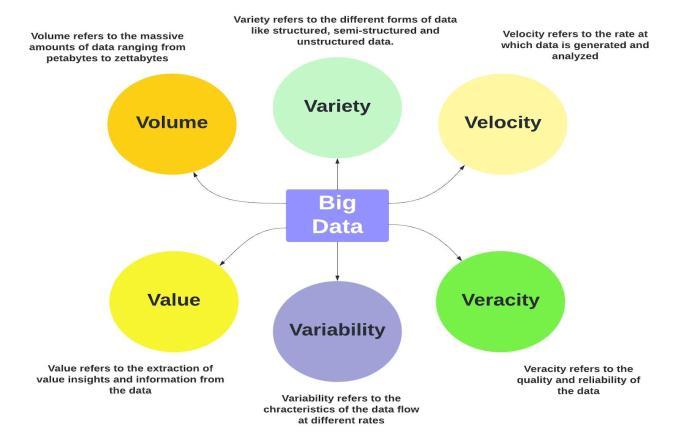
Big data is being particularly collected in massive amounts, which raises complexity. Modern technology is unable to handle these large data quantities. Innovative data processing techniques are necessary because of the massive volume of data collected and its quick change. This terminology is required to improve judgment, gain a deeper understanding of processes, and make them function more effectively. We may refer to data as "Big Data" if traditional or modern technology has trouble gathering, processing, storing, filtering, and visualizing it. In a word, "Big Data" technology involves gathering, storing, and extracting knowledge from enormous data volumes. Huge data is a term for a significant volume of
information that is characterized by deep relationships between different data sets and a more complex form of information. Apache applications like Hadoop, Spark, Stormareaviableuse-case.
1.2 Deep Learning
Neural networks are used in deep learning to carry out complex calculations on vast volumes of data. It is made up of numerous artificial neural network layers. Some of theneuronsineachofthelayershaveactivationfunctions thatcanbeusedtogeneratenon-linearoutputs.Thereare three main types of neural networks namely ANN, CNN, RNN. The neuronal structure of the human brain is allegedlythesourceofinspirationforthistechnology.
Three methods namely supervised, semi-supervised, and unsupervised learning are used in deep learning. In supervised learning, the input is correctly labeled and utilizedtotrainthearchitecture;inunsupervisedlearning, the input is incorrectly labeled and the architecture tries tobuildastructurebyextractingkeyinformation.
protectionoftheentireIoTdeploymentarchitecturefrom assaults.Variousconsiderationsmustbeconsideredwhen building IoT security solutions. The following are the security requirements that must be addressed when buildingIoTsecuritysolutions.Deeplearningandbigdata technologies have enormous capabilities that can be used to detect a pool of security breaches related to security criteria. The connected cyber-physical infrastructure causes IoT vulnerabilities. There is a strong demand for solutions with real-time, scalable, and distributed monitoring infrastructure technologies to reduce IoT security threat that can be used to identify a pool of security breaches related to security requirements. Confidentiality allows information to be securely transmittedduringallcommunications.Wheninformation isdeliveredwithoutauthenticationorencryption,enemies have the opportunity to breach the owner's privacy. Big data technologies typically include safe data transport via encryption approaches, preventing data from being compromised by adversaries. An adversary may compromise the integrity of an IoT system. As a result, integrityensuresthatthedatareceivedwasnottampered with during transmission. Furthermore, Apache Spark, a big data solution, supports data quality checks in the Spark DataFrame. Users can use this to perform data integrity checks on the IoT system. In IoT systems, availability refers to ensuring that legitimate users may access the system and that illegitimate access is denied. Oneofthekeypurposesofbigdatatechnologyistoassure theuser'somnipresence.Furthermore,theycanberunon several nodes, ensuring the application's high availability. Authentication is the process of verifying the identity of the peer with whom IoT devices communicate. Furthermore, it is concerned with valid users having suitablenetworkaccessfornetworkfunctionssuchasIoT devices and network control. Furthermore, big data solutions like Apache Spark have authentication techniques for Remote Procedure Call (RPC) channels. Access control in an IoT system should act as a means of ensuring that the authenticated nodes are limited to access what they are privileged to and nothing more. Furthermore, it is known that big data technologies provideaccesscontrolsupportforitsapplications.Afilter is necessary for this to be achieved and each application canbeequippedwithitsownaccesscontrollist.
2. PROBLEM STATEMENT

Fig2.BranchesofDeepLearning
1.2 IoT Security
Due to the fact that IoT is widely employed in mobile devices, transportation facilities, public facilities, and homeappliances,thisequipmentcanbeusedforIoTdata collection. Furthermore, equipment utilization in various applicationsthatareconnectedtotheIoTnetworkcanbe operated remotely. IoT security is defined as the
Therehave been varioussortsofstudies in the domain of big data security in IoT contexts. However, it has been discovered that massive data security is a difficult operation.Deeplearningalgorithmsforclassificationmust be employed for attack categorization. Furthermore, an optimization mechanism is necessary to obtain the optimal answer, so that deep learning-based training and testing processes deliver improved accuracy as well as better performance. Filtering a dataset on the basis of
optimal value would result in excellent accuracy and performance.
3. RELATED WORK
The designed system architecture allows for the updating ofeachcooperativenode'slearningparametersonasingle master node and the distribution of the resulting updates to the worker nodes. According to the research made by the author [6], The deep neural network is considered in the context of mobile big data analytics in the following distributed learning problem. The proposed method was implementedintheSparkenvironmentandconsistsofthe following steps, learning partial models (worker nodes tune neural networks using different data partitions), parameter averaging (model parameters are transmitted to the master node for averaging), and parameter dissemination (updated parameters are passed to worker nodes, which tune neural networks once more). This process is done multiple times until the convergence condition is met. Since a two-layer neural network has a straightforward structure and a respectable learning rate, we have decided to focus on it for the time being. Investigationintothepracticalityofdeepneuralnetworks isplannedforthefuture.
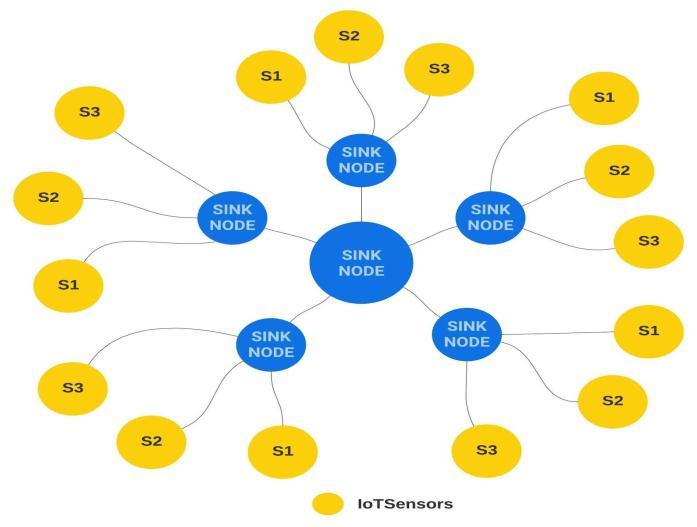
can perform processing of more than terabytes and petabytes of data. From the above figure, at a very large scale, we can see petabytes and exabytes of data being fetched from IoT sensors can be safely stored inside sink nodes and there would be a single junction sink node wheredatawillbestoredfromallinterconnectednodes.In the event of a security breach, big data analytics can be used to conduct forensic analysis of data to identify the root cause of the breach and help prevent similar attacks in the future. HDFS will play a vital role in storing this humongoussensordata.
Big data analytics can be used in IoT security to identify patterns, anomalies, and potential threats. Deep Learning threat detection with a big data analytics model can be usedtodetectpotentialsecuritythreatsbyanalyzingdata from various sources such as network traffic, device logs, and user behavior. This can help identify abnormal patterns and behavior that could indicate a potential attack. By using real-time analytics, it is possible to monitor IoT devices and networks continuously, which can help detect and respond to threats as they occur. Big data analytics can be used to analyze historical data to identifytrendsandpredictpotentialthreats.Thiscanhelp security teams to proactively implement security measures to prevent attacks before they happen. Big data analytics can be used to correlate data from multiple sources, including IoT devices, to identify potential securitythreats.Bycorrelatingdatafromvarioussources, it is possible to identify patterns and trends that may not beapparentfromindividual datasources.ApacheHadoop
Apache Hadoop isabatchprocessingsolutionthatisboth scalableandfault-tolerant.Hadoopcanhandlepetabytesof data andallows programstooperateon numerous nodes. Furthermore, log data is broken down into blocks and distributed to Hadoop cluster nodes. Furthermore, Hadoopispopularbecauseofitsabilitytoquicklyretrieve and search log data, as well as its scalability, faster data insertion,andfaulttolerance.[6]
Apache Spark is a unifying architecture used for distributed data processing. Apache Spark adds a data sharingconceptcalledResilientDistributedDataset(RDD) totheMapReducearchitecture.Apache Spark can capture and process workloads such as SQL, streaming, machine learning,andgraphprocessingusingthisextension.[6].
Apache Storm is a real-time calculation system that is open source. Apache Storm makes it possible to process data streams in real time. It can also process millions of tuples per second per node. It is quick, scalable, faulttolerant, and easy to use. It also has the ability to incorporate databases into the processing.[6].Overall, big data analytics can be a powerful tool in improving IoT securitybyenablingsecurityteamstodetectandrespond to threats in real-time, predict potential threats, and conductforensicanalysistopreventfutureattacks.
The vulnerabilities from open ended IoT sensors have increased over the period of time. These sensors can be attacked through some of the common malware attack practices such as BotNet, DDOS attacks, routing attacks, middleware attacks etc. A botnet is a network of multiple botsdesignedtoundertakeharmfulactivitiesonthetarget network and are controlled by a single unit known as the botmaster via command and control protocol. Bots are infected computers that are remotely controlled by the botmasterandareusedtocarryoutmaliciousoperations. Botnet sizes range from a few hundred bots in a small botnetto50,000hostsinalargebotnet.Hackersdistribute botnetmalwareandoperateinsecrecy,leavingnotraceof their presence, and can remain effective and operational foryears.Communicationwithbotsisrequiredtoprovide commands to the bots in order for them to carry out destructiveoperations[7].

operations. The botnet's life cycle is divided into numerous stages, including dissemination and infection, secondary injection, connection, malicious command and control, update, and maintenance. DDoS attacks are the most popular type of cyber-attack in which the attacker's computers simultaneously transmit a significant amount of malicious traffic to the target server in order to overwhelm the target network [7]. DDoS attacks aim to dramatically disrupt regular server operation by flooding the target device with large traffic, such as fraudulent requests, in order to oversaturate its capacity, causing disruption or denial of service to legitimate traffic. DDoS assaults have an impact on the server's system resources suchasCPUandmemory,andcanalsocausethenetwork bandwidth to become oversaturated with a significant volume of data. As a result, genuine computers will be denied service since the server is preoccupied with dealing with the DDoS attack. DDoS attacks are launched by hackers using a botnet. Following below table demonstrates the most commonly detected attacks at variouslayersofexecution.
Physical Layer Attacks Network Layer Attacks Application Layer Attacks
Botnet Man in the Middle Malware
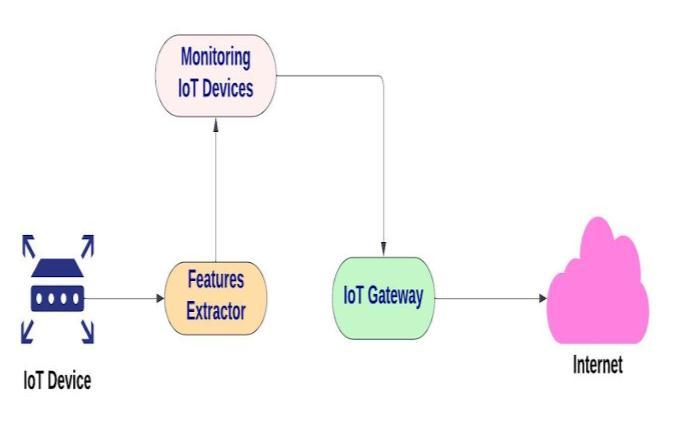
Fig4.BotnetArchitecture
Botmaster always stays hidden in the botnet network by using minimal bandwidth and providing concealed services. Botmaster and bots constantly communicate via commandandcontrolserver.Bots'principalpurposeisto remaininconspicuousuntiltheyarenecessarytodogiven duties. Bots are difficult to identify since they do not disturbregular
Sleep Deprivation Denial of Service(DOS) Phishing
Node Tampering andJamming Routing Attacks CodeInjection

EavesDropping Middleware Attacks BGPHijacking
Datasets are one of the basic ways to practice and study detection of several attacks through processing some of the commonly found patterns in Big Data being fetched from the IoT Sensors. The following datasets are frequently used for experimental analysis on deep learning, big data technologies, and/or IoT security or networksecurity
IoTPOT: TheIoTPOTdatasetcontainsIoTnetworktraffic, regular and malware-based network traffic, which is primarilyutilizedinDDoSassaults.Thedataset isdivided intofivemalwarefamilies:ZORRO,GAYFGT,KOS[7]
host operation and remain silent until they receive a command from the botmaster to undertake assigned
Kyoto: In 2006, the Kyoto dataset was created for IntrusionDetectionSystem (IDS)research. Thisdataset is based on three years of real-world network traffic data. This dataset also includes 14 features obtained from the
KDDCUP99 as well as an additional 10 features. Furthermore, their honeypot data includes 50,033,015 normal sessions and 43,043,255 assault sessions. Furthermore, the three attack kinds, exploits, shellcodes, andmalware,arecovered.
CICIDS2017: The Canadian Institute for Cybersecurity (CIC) generated the CICIDS2017 dataset in 2017. It comprises data from real-world benign and malicious network traffic. This dataset has 225,746 records and 80 characteristicsintotal.Furthermore, thisdataset includes BruteForce,DDoS[7].
CIDDS-001: CIDDS-001 is a labeled flow-based dataset designed for NIDS evaluation based on anomalies. The dataset includes normal and attack traffic statistics collected over a four-week period. This dataset also includes 14 features and four types of assaults, including DoS, PortScan, Brute Force, and Ping Scan. Sometimes, detecting advanced issues could not be possible by just merely going through the processing of the datasets mentioned above. We can achieve enhanced assault detection by making use of certain mathematical algorithms. Deep Learning based mathematical solutions provide a way to detect complex and difficult patterns usedbyhackingsourcesforIoTSecurity
The Support Vector Machine
The SVM is built by establishing a separating hyperplane withthepropertyofequidistancefromobjectsofdifferent classes that are close to it. The algorithmic expression is depictedbelow: where wi – weight coefficients, which are the product of nonzero Lagrange multipliers and the desired output values, xi – support vectors (i = 1, . . . , Ms), b – bias parameter.
KNN (K-nearest neighbors) method

The KNN can match the analyzed vector to a label of that class,whoseinstanceshavethehighestnumberamongall K training items that are closest to the provided vector z. Formally,themethodologyisasfollows:
The two layer Artificial Neural Network (ANN)
Atwo-layerartificialneuralnetworkisalayeredstructure thatperformslinearandnonlineartransformationsonthe inputvector.Thecompositionofthe non-linearactivation function and the weighted sum of the components of that vector that is output for the (k 1)-th layer is conducted afterpassingthrougheachk-thlayer.
customizableparametersarethereinthelearningprocess, ϕ - activation function, θ (1) and Hθ (2) are bias parameters.
wherex01,...,x0k–trainingvectorsforwhichthevalue PK i=1 z − x 0 i is minimal among all training vectors, omega classes.We may state that this strategy does not

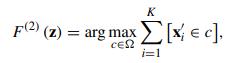
necessitate any prior training. It is sufficient to keep the wholetrainingsampleforittofunction
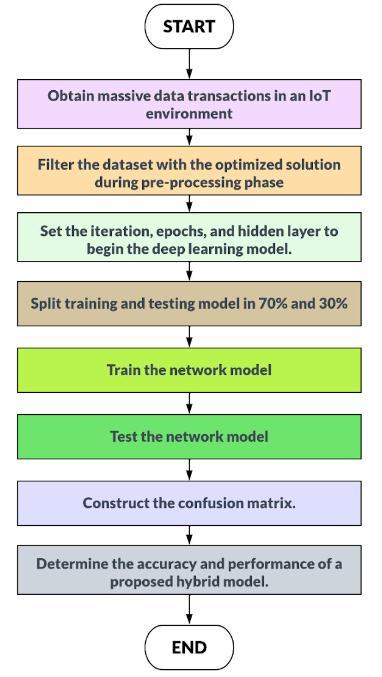
Fig6.AlgorithmdetectingIoTsecurityattacksthrough deeplearning
The above algorithm is a high-level understanding of categorization of the raw amount of massive data fetched from IoT sensors in the sink nodes of the hadoop cluster. The algorithm works in an efficient way through fetching terabytes and petabytes of data transactions through various physical IoT devices which are connected in an integrated environment. Data gets transformed and collectedintoaCSVorExcelfileformattoperformfurther
processing. As the obtained data consists of a lot of unstructuredorunfilteredcontent,webasicallycreateand defineanoptimizedsolutionwhichhelpstoappropriately filterthedatavaluesduringtheprocessingphaseandgets readyfortheconventionaldeeplearningexecution.
In the following table below, we have outlined the research that has included deep learning and big data technologies, including big data technologies, deep learning architectures and IoT security related possible threatdetections.
Table2.BigdatatechnologieswithDeepLearning architectures
Big Data Technologies
IoT Security Domain Deep Learning Model Architecture
ApacheSpark RNN Intruder detection
ApacheSpark ANN DDoS attack detection
ApacheStorm CC4 neural network and MLP
Real time intrusion detection
ApacheHadoop DNN Malware detection
3. CONCLUSIONS
The growing number of IoT devices has increased the amount of awareness of the security dangers associated with them. IoT devices have been shown to be vulnerable as a result of recent increased attacks such as the Carna and Mirai botnets. Furthermore, IoT devices generate a significant volume, velocity, and variety of data. Existing solutions become less efficient as a result, necessitating the use of modern solutions. Deep learning has gained popularity among academics and organizations due to its high accuracy, capacity to learn deep features, and lack of humansupervision.
Furthermore, big data technologies have sparked attentionduetotheirabilitytoprocessenormousvolumes ofdataaswellastheirabilitytoprocessdatainarangeof scenariossuchasreal-time,batch,andstream.Ourfindings showthatmanystudieshavecombineddeeplearningwith IoT security or deep learning with big data technologies; however, there is a lack of research in combining deep learning and big data technologies for IoT security; however, our investigations revealed that two studies have demonstrated the efficiency and feasibility of combiningdeeplearningandbigdatatechnologiesforIoT securityovertraditionalmodels.
4. REFERENCES
[1] R.H. Weber, Internet of things–new security and privacychallenges,Comput.LawSecur.Rep.26(1)(2010) 23–30.
[2] Parker2005, “The IoT in 2030: 24 billion connected thingsgenerating$1.5trillion”
[3] P. Mishra, V. Varadharajan, U. Tupakula, E.S. Pilli, ADetailed Investigation and Analysis of Using MachineLearning Techniques for Intrusion Detection, IEEECommunicationsSurveys&Tutorials,2018.
[4] Y. Zhou, M. Han, L. Liu, J. S. He, and Y. Wang, ‘‘Deep learningapproachforcyberattackdetection,’’inProc.IEEE INFOCOM IEEE Conf. Comput. Commun. Workshops (INFOCOMWKSHPS),Apr.2018,pp.262–267.
[5] A. A. Diro and N. Chilamkurti, ‘‘Distributed attack detection scheme using deep learning approach for Internet of Things,’’ Future Gener. Comput. Syst., vol. 82, pp.761–768,May2018.
[6] Mohamed Ahzam Amanullah, Riyaz Ahamed Ariyaluran Habeeb, Fariza Hanum Nasaruddin, Abdullah Gani,EjazAhmed,AbdulSalamMohamedNainar,Nazihah Md Akim, Muhammad Imran, “Deep learning and big data technologiesforIoTsecurity”,ComputerCommunications, Volume151,2020,Pages495-517,ISSN0140-3664,
https://doi.org/10.1016/j.comcom.2020.01.016.
[7] Pokhrel, Satish & Abbas, Robert & Aryal, Bhulok. (2021). “IoT Security: Botnet detection in IoT using Machinelearning.”