
A Study on Dynamic Amplification Factor for Highway Bridges
Mr. Prajwal Ulape1 , Dr. M.R. Shiyekar 2 ,
1PG Student, Structural Engineering Department, Government College of Engineering, Karad, Maharashtra, India
2Professor, Structural Engineering Department, Government College of Engineering, Karad, Maharashtra, India.

Abstract - Moving vehicle mass induces significant vibratory effect on the bridge structure. Such dynamic effects on bridge can cause higher stresses and deflections in bridge than the static deflections and stresses of equal magnitude. Hence, dynamic effects of bridges are needed to be taken into considerations. The term Dynamic amplification factor (DAF) is used to evaluate the dynamic effect of the bridge. The total dynamic effect of live load is obtained by multiplying. DAF to static response of the structure Accurate investigation of dynamic response of the bridge is complicated and cumbersome procedure, which involves various parameters. Therefore, there is an urgent need to develop an accurate method to evaluate DAF. In actual practice, there exists no rational method to evaluate DAF caused due to moving load over structure. An analytical investigation is carried out to find the effect of vehicle velocity and span length on DAF for bridge structure using SAP2000. The main focus of this study is to analyze the static and dynamic behavior of RCC longitudinal girder and Concrete decks bridge caused by the vehicular loading IRC Class A and Class B loading with different vehicle velocity. Considering different span lengths subjected to IRC class A and class B loading with variable velocity, Dynamic amplification factor (DAF) is evaluated. It is observed that DAF varies with change in vehicle velocity. Also, DAF values for both class A and class Bloading are different.
Key Words: DAF, impact factor, dynamic response, SAP2000, vehicle-bridge interaction, IRC loading, Finite element analysis.
1. INTRODUCTION
The moving vehicle mass system causes vibration on the highway bridge, whichhas become a crucial problemthat must be investigated. Moving vehicles on the bridge generate significantly more stresses and deformations than static deformations and stresses of equal magnitude at a single section [1]. The dynamic response of a bridge and its mechanism is complex problem involves vehicle bridge interaction and the influence of a large number of components such as bridge dynamic features, vehicle characteristics, road surface roughness, vehicle speed, traffic flow conditions, and so on [2]. Many bridge engineers tackle such induced vibration concerns by takingsolelytheimpactfactorsstipulatedintheirnational codes into account, even though vibration response may
depend on factors mentioned above [3]. In past years, theories are proposed if the impact factors mentioned in various national specifications are adequate for present traffic flow and road conditions. According to reports, impact factors calculated using current codes may drastically underestimate bridge response in many circumstances.[4]. Dynamic effects caused due to live loads must be considered while bridge design. The dynamic amplification factor (DAF) can be defined as, a dimensionless number which describes how many times the deflections or stresses should be multiplied to the deflections or stresses due to static loads when structure issubjectedtodynamicloading [5].Asreferredinvarious national design specifications, the total dynamic effect of live load is calculated by multiplying DAF to static response of the structure [6]. In general, a dynamic amplification factor analysis of a highway bridge under movingloadsisperformed,whichprovidesoftenaccurate resultsdependingontheparametersstated,andthevalue is compared to the standard values specified in national codes. In India IRC class A and class B loading are considered for designing bridges including impact factor asspecifiedbyIndianRoadCongressinIRC-06.Aspecified inIRC-6[14]. impactfactor for bridgestructuresubjected to moving vehicle of IRC class A and class B loading depends upon the bridge characteristics viz. if the bridge is Steel bridge or Reinforced Cement Concrete (RCC) bridge. Impact factor due to live loading is influenced by span length of the bridge. When bridge is subjected to moving vehicle loading dynamic response of the bridge changes with variation in vehicle velocity. At present vehicle velocity is completely ignored while designing bridge structure [7]. The research of all parameters is necessary to arrive at the correct quantitative value of DAF,anditiscrucialtoaccuratelyanalysehowahighway bridge behaves when heavily loaded both for the improvement of design methodsand forthe evaluation of existing bridges. This study mainly focuses dynamic response of five simply supported bridge structures subjected to moving vehicle load. IRC class A and class B loadingareconsideredasdesignloads.Staticanddynamic response ofthe bridgeare computedforeachspanlength and vehicle velocity. A simply supported 2-lane bridge structure is modelled [8] using bridge wizard provided in SAP2000 software. SAP2000 allows static and dynamic analysis of bridge structure subjected to vehicle-bridge interactionwitheaseandaccuracy.
2. METHODOLOGY
In this study, RCC T-beam girder bridge is considered for investigating dynamic behavior of bridge structure subjected to moving load. The bridge is modelled as per IRC-06andIRC-21[13] Fivedifferentspanlengthofbridge subjected to moving vehicle is considered to study the dynamic response characteristics. Five typical R.C. girder bridges with span length ranging from 20, 25, 30, 35 and 40 meters are considered [15,16]. The bridge span is considered to be simply supported at both ends to investigate dynamic responses of vehicle-bridge interaction.
2.1 Design Considerations
• SpanofBridge:-20mts–40mts
• WidthofBridge:-10mts
• Carriagewaywidth:-7.5mts
• Footpathlength:-1.25mts
• No.oflongitudinalGirder:-3Nos
• Centre-to-centerdistancebetweenlongitudinalgirders: 3.0mts
• Centre-to-center distance between cross girders: 5.0mts
• Materialproperties
• GradeofConcrete:-M30grade
• Gradeofsteel:-Fe415
2 2 Design Vehicle Loads for
IRC loading
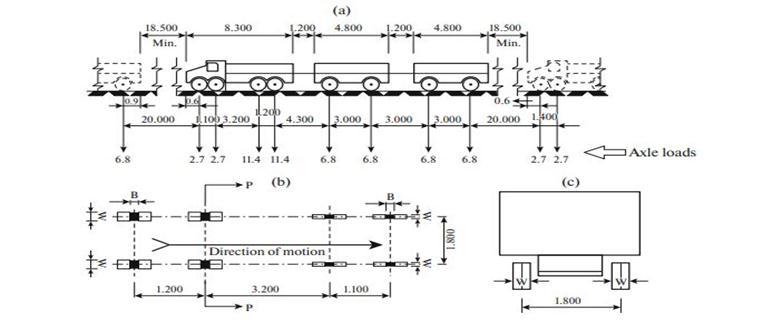
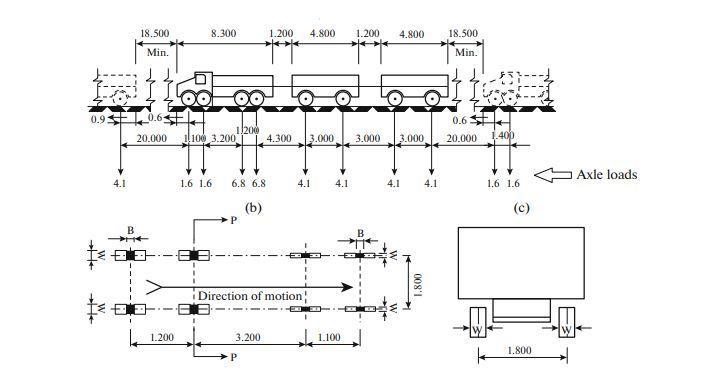
• IRC-6isusedfordesigningbridgesinIndia.ClassAand classBloadingisconsideredforthisstudy.
2.3 FEM modelling and Analysis
Finite element analysis software SAP2000 is used for modellingtheRCCT-girderbridge.
Static Analysis
For obtaining static response of the bridge structure, we use Nonlinear Static Analysis. Using SAP2000 we obtain results in terms of bending moments, shear force and displacementsfordifferentvehiclevelocityandspanlength ofbridgeunderIRCclassAandclassBloading.
Dynamic Analysis by Time-History analysis
A random loading is applied to a time-history analysis to identifythedynamicresponse.Whendynamiceffectsmust be taken into account, such as when calculating the dynamic response to a time-varying load or when analyzing the propagation of waves in a structure, the dynamicequilibriumisapplied.Thedynamicequilibriumis giveninformof
Ku(t)+Cu’(t)+Mu’’(t)=r(t)[9]
WhereKisthestiffnessmatrix;Cisthedampingmatrix;M is the diagonal mass matrix; u, u’, and u’’ are the displacements, velocities and accelerations of the structure;andristheappliedload.Whentheloadincludes ground acceleration, the displacements, velocities, and accelerations are measured in relation to this ground motion. The stiffness, damping, and load in a nonlinear analysis can all be influenced by displacements, velocities, and time. This requires and iterative solution to the equationsofmotion.Generallymodalsuperpositionisused in solving these equations of motion but the process becomes time consuming. SAP2000 version 14.A offers Direct integration of these equations without need of modal superposition [12]. For performing Direct integration Time-History analysis, the “Hilbert- HughesTaylor alpha” (HHT) method was used. In HHT a single parameter alpha is used. Values of ‘α’ ranges between 0 and-1/3.InHHTmethodα=0,themethodcanbesameas the Newmark method [10], where γ = 0.5 and β = 0.25, whichisequivalenttoaverageaccelerationmethod[12].It is recommended that for higher accuracy results ‘α = 0’ shouldbeused.
3. RESULTS AND DISCUSSION
Thedynamicresponseofthevehicleatlowerspeedsuchas 20kmph for each span of the bridge is evaluated. Vehicle velocity is then further increased gradually to 130 kmph anddynamicresponsesintermsofdisplacements,bending moment.
Bendingmoment
•It can be observed that maximum value of bending moment for span length 20-30mts is observed for vehicle velocity of 90 kmph. Positive correlation between vehicle velocityandbendingmomentcanbeobserved.
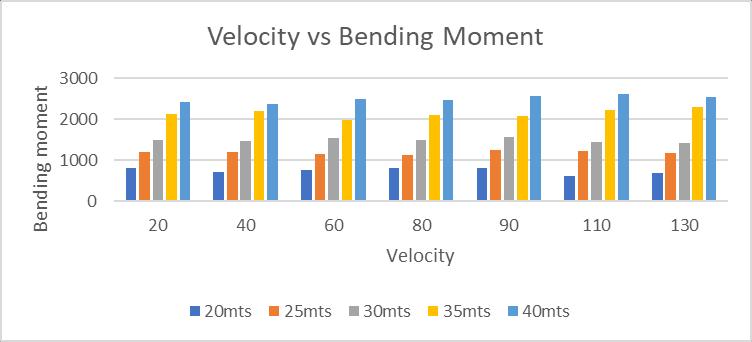
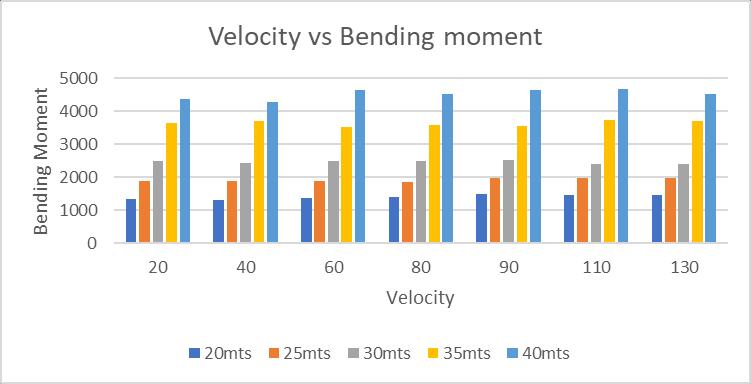
•For span lengths35mts and 40mts maximum value of bending moment is observed at vehicle velocity of 110 kmphand130kmphrespectively.
•For all span lengths considered in study about 5-11% increase in bending moment is observed when vehicle velocity is increased from 20 kmph to 90 kmph for IRC classAloading
•ForIRCclassBloading,forallspanlengthsconsideredin study about 8-22% increase in bending moment is observedwhenvehiclevelocityisincreasedfrom20kmph to130kmph.
Displacements
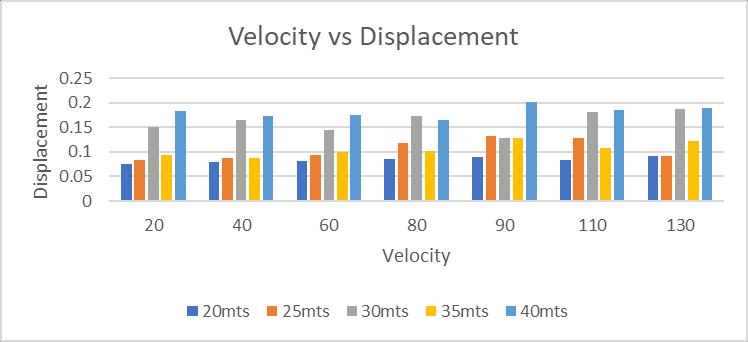
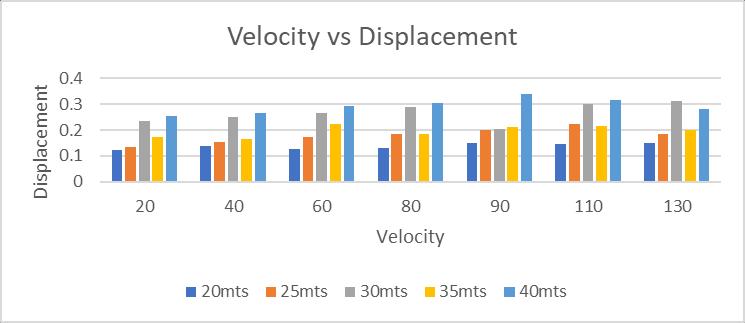
•Maximum dynamic displacement is observed near midspan of the section. Displacement values were increasing withincreaseinvelocityofloading.
•For class A loading- For all span lengths dynamic displacement increases 20-39% as vehicle velocity increasesfrom20kmphto130kmph.
•For class B loading- It is observed that dynamic displacement for all span lengths increases 18-36% as vehiclevelocityisincreasedfrom20kmphto130kmph.
3.1 Dynamic Amplification Factor (DAF) calculations
DynamicAmplificationfactorDAFcanbeevaluatedasratio ofmaximumdynamiceffectstothemaximumstaticeffects onthebridgestructurecausedbythevehicleloading.
DAF=
•ForIRCclassAloading–DAFvalueincreases3-6%when vehiclevelocityisincreasedfrom20kmphto130kmph.
•For IRC class B loading – DAF value increases 5-13% when vehicle velocity is increased from 20kmph to 90 kmph.
•It can be observed that DAF values are different for IRC classAandclassBloadingwhichiscontradictorytotheas mentionedinIRC-06.
Followingconclusionscanbedrawn,
•Bending moment and displacement increases with increaseinvehiclevelocityandspanlengthofthebridge.
•Vehicle velocity plays an important role in influencing Dynamic amplification factor, it can be observed that DAF increases as vehicle velocity increases maximum value of DAF is calculated at vehicle velocity 90 kmph –130kmph.

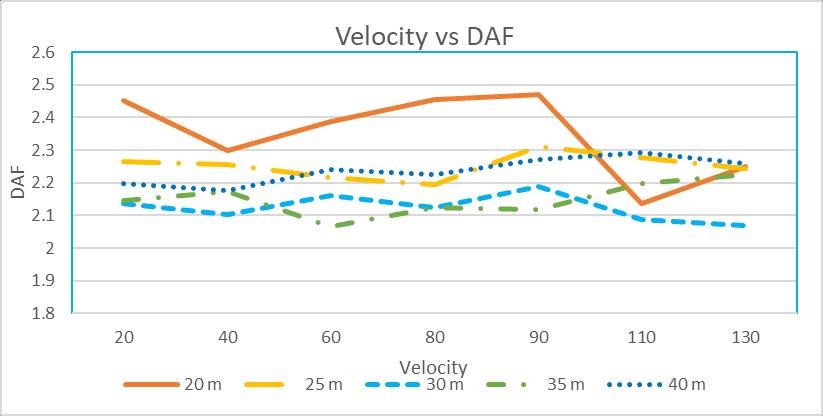
•ItisclearlyobservedthatDAFvaluesforIRCclassAand classBloadingaredifferent.
•Maximum calculated value of DAF obtained was 2.47, which was achieved on a 20mts span length bridge by IRC class B loading moving at 90 kmph. Lowest calculatedvaluewasforSpanlength30mtssubjectedto IRCclassAloadingwith130kmphvehiclevelocity2.046.
•Hence, it can be observed that the DAF value for lighter vehicle is 16.68% more than that for heavier vehicles eventhoughconsideredsameinIRC-06.
5. REFERENCES
[1] H. K. Sharma, “INFLUENCE OF DYNAMIC AMPLIFICATION FACTOR ON RESPONSE OF STEEL HIGHWAYBRIDGE,”vol.4,no.3.
[2] Q.Zou,L.Deng,T.Guo,andX.Yin,“ComparativeStudy of Different Numerical Models for Vehicle–Bridge Interaction Analysis,” Int. J. Struct. Stab. Dyn., vol. 16, no. 09, p. 1550057, Nov. 2016, doi: 10.1142/S0219455415500571.
[3] D. Chang and H. Lee, “Impact Factors for Simple‐Span HighwayGirderBridges,”J.Struct.Eng.,vol.120,no.3, pp. 704–715, Mar. 1994, doi: 10.1061/(ASCE)07339445(1994)120:3(704).
[4] Y.-B. Yang, S.-S. Liao, and B.-H. Lin, “Impact Formulas for Vehicles Moving over Simple and Continuous Beams,”J.Struct.Eng.,vol.121,no.11,pp.1644–1650, Nov. 1995, doi: 10.1061/(ASCE)07339445(1995)121:11(1644).
4. CONCLUSIONS
The main aim of this study was to investigate effect of vehicle velocity on dynamic response of the bridge. From the results obtained, it can be observed that, vehicle velocity plays an important role in influencing dynamic responseofbridgestructure.TheDAFisevaluatedforIRC class A and class B loading accordingly. From the results obtained it can be observed that DAF varies significantly withincreaseinvehiclevelocityandhencevehiclevelocity mustbeincludedasanimportantparametertoinvestigate DAFalongwithotherparameters.
[5] Z. Chao, H. Hong, B. Kaiming, and Y. Xueyuan, “Dynamic amplification factors for a system with multiple-degrees-of-freedom,” Earthq. Eng. Eng. Vib., vol. 19, no. 2, pp. 363–375, Apr. 2020, doi: 10.1007/s11803-020-0567-9.
[6] J. Kalin, A. Žnidarič, A. Anžlin, and M. Kreslin, “Measurementsofbridgedynamicamplificationfactor using bridge weigh-in-motion data,” Struct. Infrastruct. Eng., vol. 18, no. 8, pp. 1164–1176, Aug. 2022,doi:10.1080/15732479.2021.1887291.
[7] B. Nunia and T. Rahman, “A Study of Vehicle-Bridge Dynamic Interaction due to Indian Road Congress (IRC)ClassAandBLoading,”Mech.Solids,vol.55,no. 3, pp. 437
459, May 2020, doi: 10.3103/S0025654420030115.
[8] S. P. Brady, E. J. O’Brien, and A. Žnidarič, “Effect of Vehicle Velocity on the Dynamic Amplification of a VehicleCrossingaSimplySupportedBridge,”J.Bridge Eng., vol. 11, no. 2, pp. 241–249, Mar. 2006, doi: 10.1061/(ASCE)1084-0702(2006)11:2(241).
[9] D.Negrut,R.Rampalli,G.Ottarsson,andA.Sajdak,“On an Implementation of the Hilber-Hughes-Taylor Method in the Context of Index 3 DifferentialAlgebraic Equations of Multibody Dynamics (DETC2005-85096),”J.Comput.NonlinearDyn.,vol.2, no.1,pp.73–85,Jan.2007,doi:10.1115/1.2389231.
[10] M.Ralbovsky,S.Deix,H.Friedl,andK.Alten,“Dynamic load amplification on short and medium span bridges,”2011.
[11] J. R. Yang, Y. Bai, X. D. Yang, and Y. Feng, “Dynamic Amplification Factor Measuring of T-Girder Bridges,” Key Eng. Mater., vol. 540, pp. 29–36, Jan. 2013, doi: 10.4028/www.scientific.net/KEM.540.29.
[12] “CSI Analysis Reference Manual”, For SAP2000 version19
July2016.
[13] Design of Bridge Structures by, T.R. Jagdesh and M.A. Jayaram.2013
[14] IRC:6-2017 STANDARD SPECIFICATIONS AND CODE OF PRACTICE FOR ROAD BRIDGES, SECTION: II LOADSANDLOADCOMBINATIONS
[15] IRC:21-2000STANDARDSPECIFICATIONS ANDCODE OF PRACTICE FOR ROAD BRIDGES, SECTION: III CEMENTCONCRETE(PLAINANDREINFORCED)
[16] IRC:112-2011 CODE OF PRACTICE FOR CONCRETE ROADBRIDGES