Interference Mitigation using Adaptive Digital Beamforming for 5G Applications
Bhavya V S1, Ketha Siva2, Dr. Arathi R Shankar31Post Graduate Student, Department of ECE, BMS College of Engineering, Bengaluru, India
2Member Research Staff, Central Research Laboratory, Bharat Electronics Limited, Bengaluru, India

3Associate Professor, Department of ECE, BMS College of Engineering, Bengaluru, India
Abstract - Present and upcoming wireless communication technologies requires high signal to noise ratio, gain, and signal intensity in order to reduce interference. Modern communication relies heavily on adaptive digital beamforming to improve desired signal reception while reducingsidelobeandinterferenceeffects.Thisstudyproposes a method for suppressing sidelobes, interference and to mitigate noise using adaptive digital beamforming for 5G applications based on the Minimum Variance Distortionless Response (MVDR) algorithm specially for the operating frequencyrangeof3.5GHz. Theadaptivedigitalbeamforming employingtheMVDRalgorithmwillbeextremelyimportantin providingtheseamless connectionandvarietyofservicesthat 5G promises to bring as it continues to develop and is more extensively adopted. The suggested solution takes advantage of the MVDR algorithm's adaptive properties to dynamically changethe weightsofanantennaarray,alteringtheradiation patterntodirecttheprimary beamtowardsthedesiredsignal source while dampening unwanted signals. The MVDR adaptive beamforming algorithm is applied towards the desired signals at baseband mainly to suppress sidelobes by introducing nulls in the direction of interference, which helps to reduce the sidelobes, mitigates interference and noise.
Key Words: Adaptive Beamforming, MVDR algorithm, Interference, Sidelobes,5G Communication.
1.INTRODUCTION
Thedemandfromcustomersforaneffectivecommunication systemtosupporttheseamlessoperationofdailyactivities and at work has accelerated the development of telecommunicationtechnology.Forinstance,thetransition fromthe2ndGeneration(2G)tothe3rdgeneration(3G)to the4thgeneration(4G)isintendedtoenablethefunctionof data transmission over the internet network on a mobile station (MS) device. The development and transition betweenonenetworktechnologyfromonegenerationtothe nextisintendedwiththeaimofcoveringupshortcomings anddevelopingtechnologyfromitspredecessorgenerations [1].Morethanonecommunicationdeviceisnowconnected to the network by some telecommunication service subscribers.Inordertohandleeverycommunicationactivity fromtheusertothecentralnetworkwithoutanyproblems, weobviouslyneedadatatransmissiontechnologysystem. FifthGeneration(5G)technologyhasbeenusedtoaddress thisproblem[2].
Several techniques have been developed for the data communication system to enhance signal transmission performance, raise the SINR, and adjust other associated parameters.Inthatcase,thesignalqualitycanbeassessed by making reference to the antenna choice and the highly accuratebeamstrengthestimation.Userscancommunicate utilizing the signal band in the 5G communication-based networkingsystemthatisavailablefordatatransmissionat increasedspeedsfromantennasignalpropagation[3].Itis necessary for communication systems that are unable to connect with the user module to strengthen the signal by carefullychoosingtheirantennaarray.Thiscanbedoneby usinganoptimizationmethodtochoosetheoptimalantenna andfigureoutthebestDOA(DirectionofArrival)pathtothe device for higher SINR. By identifying the antenna parameters,thecommunicationmodel'ssignal strength is improved[4].TheoptimalchoiceofDirectionpathfromthe overallstructureinestimatedparameterswasfoundusing optimizationmethods.Additionally,itestimatesthenumber of antennas with DOA characteristics that are ready to connecttothedeviceandaredistributedtouserswiththe bestantennacapacitymatch[5].
High data rate, high SNR, high signal integrity, and high bandwidthareessentiallytheendgoalsofacommunication system network in current and future wireless communicationtechnology.Withanincreaseinthenumber of users in a communication system network, these characteristic performances decline. 5G technologies are beingadoptedtoovercometheseissues,anditisanticipated that they will significantly expand the use of the current communicationinfrastructure[6].Additionally,itwillenable connectivitybetweenpeopleandmachines(theInternetof Things), enabling applications for remote healthcare, autonomous self-driving cars, and virtual and augmented reality (VR/AR), and more. By adopting spatial diversity, massive antenna array deployment also aids in reducing some of these issues and improving data throughput in wirelesscommunicationchannels.Sincetheantennaarray signals are integrated at the transceiver in mmWave application, the adoption of beamforming technology significantly enhances the channel propagation characteristicsaswellasthecoveragearea[7].
Adaptivebeamformingistheprocessofformingtheantenna beam pattern using a Digital Signal Processor (DSP) algorithms. BecauseseparateRFchainsareneededforeach
antenna element, hardware complexity, excessive power consumption,andhighoverheadcostsprovidethebiggest obstacles to the implementation of completely digital beamforming transceiver systems. Due to these Digital Beamforming Forming (DBF) restrictions, analogue and hybrid beamforming are still highly appealing. In recently examinedcircumstances,severaldoablesolutionshavebeen putouttohandlesomeofthesedifficulties[8].
Applying beamforming techniques is one of the methods utilizedin5Gtechnologytoimprovesystemdependability, UsingthetechniqueofAdaptiveBeamforming,antennaswill becapableoffocusingthebeamonthechosenmobiletarget Findingorapplyingaweightingvaluetoeachelementofthe arrayinputinordertoguidethemainbeam(alsoknownas mainlobe,whichisanothernameforsignalofinterest)in the desired signal direction is known as adaptive beamforming [10]. Thus, electronic beam by directing eliminates the requirement for the components to rotate mechanicallyduringtheprocess.Thesystemcantypicallybe constructedfromanarrayofsensors(suchasmicrophones, speakers, or antennas), each of which is connected to an amplifierunitand/oraphaseshifterthatiscontrolledbya signalprocessor.Asaresult,asignalprocessingalgorithmis neededtodeterminetheproperweightingvalues.Itismeant forthesystemtofunctionatitsbest[11].
2. LITERATURE SURVEY
In [1] authors proposed the adaptive beamforming technique for 5G communication with an operating frequency of 2.4GHz using a linear array antenna at receptionend,theauthorsusedLeastMeanSquare(LMS) adaptive algorithm to perform beamforming for 5G communications.
In [2] authors proposed machine learning technology for performanceevaluationofadaptivebeamformingwhenitis deployedto5Gusingmassivemultipleinputmultipleoutput cellularnetworksinordertoincreasespectralefficiencyand energyefficiency.
In[3]theauthorsproposedsolutionthatcanmathematically achieveconstructionsbetweentheSportsofthebasestation (BS)andtheUportsofthereceivingantennaarray,making itpossibletomeasurethethroughputofaterminalwithan adaptive beamforming array as per the air interface standards,usinganewlydeveloped4×45GMIMOdevice. Theoutcomesperfectlycapturehowthesuggestedsolution performsinreal-worldoperatingscenarios.
In [4] authors proposed the adaptive beamforming algorithmnamedRecursiveSpectralClassification(RSC)for 5Gnetworks,hereRSCadaptivebeamformingtechniqueis usedonsmartantennapropagationmainlytoimprovethe coverageareafor5Gnetworks.
In [5] authors proposed the adaptive beamforming technique at reception end for 5G uplink communication
system. The proposed adaptive beamforming algorithm is Salp-Bird Swarm Optimization(S-BSO), which is the combination of both Shark Smell Optimization Algorithm(SSO)andBirdSwarmAlgorithm(BSA),herethe authorshaveanalyzedtheperformanceofeachalgorithmin termsofBitErrorRate(BER),SignaltoNoiseRatio(SNR).
In [6] authors proposed performance analysis of adaptive beamformingalgorithmsbyconsideringconvergencerateas amajorfactorfor5Gapplicationsatthereceptionend.The adaptivebeamformingalgorithmsusedbyauthorsareLeast MeanSquare(LMS),NormalizedLeastMeanSquare(NLMS), Leaky Least Mean Square(Leaky-LMS), Sign-Leaky Least MeanSquare(Sign-LeakyLMS)
In[7]authorshavedonecomparisonbetweentwodifferent adaptivebeamformingalgorithmsnamelyLMSandMVDR algorithm, based on number of antenna elements and antenna element spacing to signal quality using MIMO (Multiple Input Multiple Output) for Millimeter Wave 5G Applications
In[8]authors,proposedConventionalbeamformingmethod named KaiserWindowmethodandsuppressedsidelobes for a Massive MIMO Structure using the 3D beamforming method.
In [9] the authors proposed a sidelobe canceller null widening method that is computationally effective. This technique, a covariance matrix taper-based technique, widenstheacutenullbyintroducingartificialinterferences intopictures.Thesuggestedmethodismoreefficientthan currentmethodsintermsofcalculationcostsandcandeliver satisfactoryperformance.
In [10] the authors proposed current sheet array (CSA) subarrays' grating lobe angular position is initially analyticallyretrievedinthisresearch.Thegratinglobesof the subarrays were then nulled using the suggested technique by adjusting the CSA elements' weights. The resultsofthesimulationshowthatthe sidelobelevels (SLLs)andpeaksideloberatio(PSLR)inthepowerpattern achieved by the suggested approach are superior to the earliermethods,alsoknownasproductandminprocessors.
In[11]authorsproposedadaptivebeamformingalgorithms, evaluated and compared with conventional beamforming techniqueatreceptionendmainlytoreduceinterferenceby placing nulls in the direction of interference signal and to obtainmainlobeinthedesiredsignaldirection,authorshave evaluatedthesidelobelevelandthemainlobelevelforeach beam, authors had used conventional beamforming technique to form a beam. Later they have compared this conventional beamforming technique with three different adaptive beamforming methods by the help of adaptive beamforming algorithms, they are MVDR, Recursive Least Square(RLS)andSampleMatrixInversion(SMI).
3. METHODOLOGY
3.1 Conventional Beamforming
By properly weighing the signals received at the various array members, the conventional beamforming method producesabeamthatpointsinthedirectionoftheintended signal.Thearrayweightsarecommonlychosenintraditional beamformingtomaximizethestrengthoftheintendedsignal atthebeamformer'soutput
3.2 Adaptive Beamforming
In antenna array processing and signal processing applications,MVDRadaptivebeamformingisamethodused to boost the intended signal of interest while reducing interferenceandnoise.Itisatypeofadaptivebeamforming that instantly modifies an antenna array's weights in response to signals being received. The calculated covariancematrixoftheinterferenceandnoise,alongwith thereceivedsignals,areusedtoiterativelyupdatethearray weightsinMVDRadaptivebeamforming.Thebeamformer's output power is reduced throughout the weight update process while still maintaining distortion-free responsivenesstothetargetsignal.

q=2π/λ………………………………………………… …(3)
λ is wavelength of received signal and d is interelement spacing,Lrepresentsnumberofantennaelements,
The weight vector equation for conventional beamformer becomes,
w(t+1)=w(t)+��[p(t)-Ry(t)w(t)]………………………….…..…(4)
w(t)=a/||a||…………………………………………………….…………...(5)
Ry=XT(t)XH(t)…………………………………………………………… (6) μisthestepsizeparameter.
FortheAdaptiveMVDRThecovariancematrix,Ryisgiven below,
Ry=σ²s a(θs,Φs)aH(θs,Φs)+ σ²i a(θi,Φi)aH(θi,Φi)+ σ²nIdL………………………………………………………………….….…(7)
Rs=σ²sa(θs,Φs)aH(θs,Φs)…………………………… …..(8)
Ri+n= σ²ia(θi,Φi)aH(θi,Φi)+σ²nIdL………… ……..(9)
IdLisLXLidentitymatrix, MVDR weight vector that gives the solution as per the followingformula,
WMVDR=a(θs,Φs)R-1y/aH(θs,Φs)R-1ya(θs,Φs)……….......(10)
Finally,theSINRisdefinedastheratiooftheaveragepower of the desired signal divided by the average power of the undesired signal for Adaptive MVDR and SINR for conventionalisgivenbelow,
Letthesignalstransferredinthebeamformerbe, signal={1,2,......M}
Andthetotalreceivedsignalrepresentedas, x={1,2,.......M}.
LetthetotalreceivedsignalbeXT(t),whichincludesdesired signal Xs(t) and interference signal Xi(t) and noise signal Xn(t),thereceivedsignalXT(t)canberepresentedas,
XT(t)= Xs(t)a(θs,Φs)+ Xi(t)a(θi,Φi)+Xn(t)…(1)
WhereθistheazimuthangleandΦistheelevationangle, andaisthesteeringvectorwhichisdefinedas,
a(θ,Φ)=[1,e-jqdsin(θ)sin(Φ) ,e-jq2dsin(θ)sin(Φ) ,……,e-jq(L-1)dsin(θ)sin(Φ)](2)
Whereqiswavenumberdefinedas,
Adaptive_SINR=wHRsw/wHRi+nw ….…(11) WherewisweightvectorofAdaptiveMVDRbeamformer,Rs desired signal covariance matrix and Ri+n is covariance matrixofinterferenceandnoise.
Conventional_SINR=(|wᴴa|^2)/(σn²)…………………………(12) w is the weight vector of the conventional MVDR beamformer, a is the steering vector representing the desiredsignaldirection,σn²isthenoisepower.
4. RESULTS
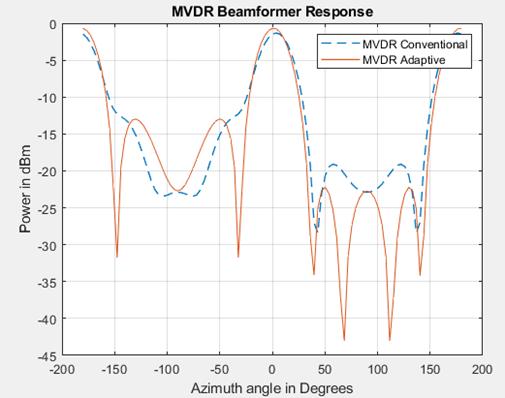
From figure 2 compare to conventional MVDR, adaptive MVDRsuppressedsidelobesefficiently,wheredesiredsignal location for both method is zero degree, the antenna elementsconsideredforbothcasesisL=4.
5. CONCLUSION
MVDR algorithm-based adaptive digital beamforming technology shows, significant promise for upgrading 5G communication systems. Higher data speeds, greater spectrumefficiency,andimprovedconnectiondependability arerequirementsofthe5Geraandcanbeaccomplishedby employingeffectiveandadaptivebeamformingtechniques. The MVDR-based beamforming technique demonstrates robustness, adaptability, and reliability in a dynamic and quicklychangingwirelesscommunicationenvironment.Itis idealfor5Greal-worldapplicationsbecauseitcanmanage changesinthepropagationchannel,interferencesources,and user mobility. The calculations and practical results have demonstratedthat,intermsofsuppressingsidelobelevel, andsuccessfullyrejectinginterference,andreceivedhigher SINR in adaptive beamforming compared to Conventional beamforming and compared to the MVDR-based adaptive digitalbeamformingmethodologyoutperformsconventional fixedbeamformingmethod.In5Gcommunicationsystems, thisperformanceboostdirectlycorrelatestobetterspectrum efficiency, expanded coverage, and improved connection reliability. Adaptive digital beamforming employing the MVDRalgorithmin5Gcommunicationisacriticalenablerfor realizingthefullpotentialofthisgame-changingtechnology, andithasenormouspotentialtoinfluencethedevelopment ofwirelesscommunicationsystemsinthefuture.
ACKNOWLEDGEMENT
HeartfullthankstoMr.ShashikantY.Chaudhari,GroupHead and Mr. Rajeev Kumar E, Manager, Central Research Laboratory, BharatElectronicsLimited,fortheirguidance andsupportincarryingoutthisresearch.
REFERENCES
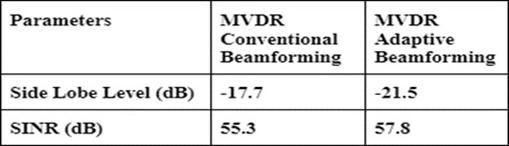
From table 1, compared to conventional MVDR, adaptive MVDR suppressed Side Lobe Level by 3.8dB and Signal to NoiseplusInterferenceRatioincreasedto2.5dB.
[1] B. Aswoyo, M. Milchan and A. Budikarso, "Adaptive Beamforming Based on Linear Array Antenna for 2.3 GHz 5G Communication using LMS Algorithm," 2022 International Electronics Symposium (IES), Surabaya, Indonesia, 2022, pp. 436-441, doi: 10.1109/IES55876.2022.9888682.
[2] S. Lavdas, P. Gkonis, Z. Zinonos, P. Trakadas and L. Sarakis,"ThroughputBasedAdaptiveBeamformingin 5GMillimeterWaveMassiveMIMOCellularNetworks via Machine Learning," 2022 IEEE 95th Vehicular Technology Conference: (VTC2022-Spring), Helsinki, Finland, 2022, pp. 1-7, doi: 10.1109/VTC2022Spring54318.2022.9860566.
[3] P. Shen, Y. Qi, W. Yu, F. Li, X. Wang and X. Shen, "A DirectlyConnectedOTAMeasurementforPerformance Evaluationof5GAdaptiveBeamformingTerminals,"in IEEEInternetofThingsJournal,vol.9,no.16,pp.1536215371, 15 Aug.15, 2022, doi: 10.1109/JIOT.2022.3150038.
[4] D. Bansal, M. R. Tripathy and S. Padhi, "Adaptive Beamforming Method based Optimal Smart Antenna SelectionwithRSCAlgorithmin5Gsystem,"2022IEEE WirelessAntennaandMicrowaveSymposium(WAMS), Rourkela, India, 2022, pp. 1-6, doi: 10.1109/WAMS54719.2022.9848054.
[5] I.BorseandH.D.Patil,"ANovelAdaptiveBeamforming Model for5GMillimeter WaveUplink Communication System," 2022 Second International Conference on Artificial Intelligence and Smart Energy (ICAIS), Coimbatore, India, 2022, pp. 1476-1484, doi: 10.1109/ICAIS53314.2022.9742935.
[6] S. Enahoro, S. Ekpo and A. Gibson, "Massive MultipleInput Multiple- Output Antenna Architecture for Multiband 5G Adaptive Beamforming Applications," 2022 IEEE 22nd Annual Wireless and Microwave Technology Conference (WAMICON), Clearwater, FL, USA, 2022, pp. 1- 4, doi: 10.1109/WAMICON53991.2022.9786100.
[7] S.Enahoro,S.C.Ekpo,M.C.Uko,A.Altaf,U.-E.-H.Ansari andM.Zafar,"AdaptiveBeamformingformmWave5G MIMOAntennas,"2021IEEE21stAnnualWirelessand MicrowaveTechnologyConference(WAMICON),Sand Key, FL, USA, 2021, pp. 1-5, doi: 10.1109/WAMICON47156.2021.9443616.
[8] T. Kundu, A. Ghosh, I. S. Misra and S. Kumar Sanyal, "KaiserWindowBasedSideLobeLevelSuppressionin 3D Beamforming for Massive MIMO Structure," 2020 IEEE Calcutta Conference (CALCON), Kolkata, India, 2020, pp. 268-272, doi: 10.1109/CALCON49167.2020.9106469.
[9] Z. Liu, S. Zhao, G. Zhang and B. Jiao, "Robust Adaptive Beamforming for Sidelobe Canceller With Null Widening,"inIEEESensorsJournal,vol.19,no.23,pp. 11213-11220, 1 Dec.1, 2019, doi: 10.1109/JSEN.2019.2936681.
[10] G. S. Moghadam and A. A. Beheshti Shirazi, "A Novel SidelobeReductionAlgorithmBasedonNullSynthesis Method Under Mainlobe Perturbation Minimization Constraint for Co-Prime Sensor Array," 2019 5th Conference on Knowledge Based Engineering and Innovation(KBEI),Tehran,Iran,2019,pp.327-331,doi: 10.1109/KBEI.2019.8735080.
[11] I.P.Gravas,Z.D. Zaharis,T.V.Yioultsis,P.I.Lazaridis andT.D.Xenos,"AdaptiveBeamformingWithSidelobe SuppressionbyPlacingExtraRadiationPatternNulls," inIEEETransactionsonAntennasandPropagation,vol. 67, no. 6, pp. 3853-3862, June 2019, doi: 10.1109/TAP.2019.2905709.KornackandP.Rakic,“Cell Proliferation without Neurogenesis in Adult Primate Neocortex,”Science,vol.294,Dec.2001,pp.2127-2130, doi:10.1126/science.1065467.