DEVELOPMENT AND QUALITY ASSESSMENT OF MANGO JAM
1Munnangi Manasa, ²Anil B, 3Neeti Harshitha M, ¹MSc Student, ²Head and Professor, 3LecturerDepartment of Nutrition, Capital Degree and PG College, Shapur Nagar, Hyderabad, Telangana, India ***

Abstract
A mango is an edible stone fruit; the scientific name of mango is Mangifera indica. Mangoes are rich in betacarotene,antioxidants,andvitamin-c,whichaidstheimmunity,ironabsorptionandgrowthandrepair.italsoagoodsource offibre, which canhelp to regulate digestion and preventconstipation. Mango jam islowincalories yet highin nutrient, andithelpstomaintainthehealthyweight.Thisstudyfocusonthedevelopmentofmangojambyusinglocalmangoesand evaluate the sensory evaluation, nutritional values, and shelf life. The mango jam made using mango pulp, sugar, lemon. ThedifferentproportionsofingredientsusedareMango-200gm+sugar120gm+1smallsizeoflemon(sampleA),Mango200gm+ 100 gm of sugar+ 2 tablespoons of lemon (sample B), Mango-200gm +70 gm of sugar+ 1 tablespoon lemon (sample C). sample A demonstrated desirable sensory evaluation based on the taste panel. The selected sample A has a CHO-(56gm), protein-(6.41gm),fat-(<0.1),crude fibre-(<0.1),moisture-(37.60),ash - (<0.1).In Sample A,the microbial growth was not observed till the end of the end of the storage period and the total plate count is <10, so it was safe for consumption.
Key words:Mangopulp,nutrientanalysis,sensoryanalysis,microbialanalysis.
1. INTRODUCTION
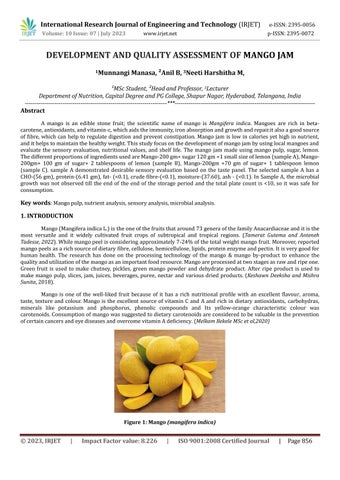
Mango(MangiferaindicaL.)istheoneofthefruitsthataround73generaofthefamilyAnacardiaceaeanditisthe most versatile and it widely cultivated fruit crops of subtropical and tropical regions. (Tamerat Gutema and Anteneh Tadesse, 2022) Whilemangopeelisconsideringapproximately7-24%ofthetotalweightmangofruit.Moreover,reported mangopeelsasarichsourceofdietaryfibre,cellulose,hemicellulose,lipids,proteinenzymeandpectin.Itisverygoodfor human health. The research has done on the processing technology of the mango & mango by-product to enhance the qualityandutilizationofthemangoasanimportantfoodresource.Mangoareprocessedattwostagesasrawandripeone. Green fruit is used to make chutney, pickles, green mango powder and dehydrate product. After ripe product is used to make mango pulp, slices, jam, juices, beverages, puree, nectar and various dried products. (Keshawn Deeksha and Mishra Sunita,2018).
Mango is one of the well-liked fruit because of it has a rich nutritional profile with an excellent flavour, aroma, taste, texture and colour. Mango is the excellent source of vitamin C and A and rich in dietary antioxidants, carbohydras, minerals like potassium and phosphorus, phenolic compounds and Its yellow-orange characteristic colour was carotenoids.Consumptionofmango wassuggestedtodietarycarotenoidsareconsideredtobevaluableintheprevention ofcertaincancersandeyediseasesandovercomevitaminAdeficiency.(Melkam Bekele MSc et al,2020)
Duetoitsuniquecharacteristics natureofhorsemango,whenitripe,ithasastrongaroma andacoarsetexture, the ripe horse mango is eaten or used relatively rare, resulting in relatively low prices for fresh fruit. Farmers therefore prefertousehorsemangoforcooking.However,therearestillalotofhorsemangoesthatcannotbesold.Mostly,thehorse mangoisconsumedasa ripefruit,anditiswelllikelyconsumedasasavourydish suchas yellowcurry.Theresearchers find that, there is an only few products that can be apply horse mango as an ingredient. These studies that can concentrated on the antioxidant properties of commercial mango (Mangifera indica), no research article has been publishedonthehorsemango(Mangiferafoetida)variety.Thus,thereisaneedtoexplorethehealthpromotingproperties ofthisunderutilizedfruit (Saowapan Palasuwan & Dudsadee Sapbua, 2020). Approximately,1/3rd ofallfreshfruitshaslost beforeit reaches totheconsumers. The Anotherestimationsuggeststhat isabout 30%-40%of total fruitsproducedand lost between harvest and final consumption and these changes are in the fresh fruits can’t be stopped but it can be slow down within certain limits of factors that responsible for such deterioration or by converting the most of the fruits into preserves and conserves forms such as jams, marmalades, jellies and candies that can be enhance its shelf life and availability (Emelike NJT and Akusu, 2019).
Jamisasemi-solidfoodproductmadebymixingoffruitpulp,sugaralongwiththickeningagentandacidswithcontinuous heatingpractice.Sometimesotheringredientssuchas(preservatives,colours,andtastyingredients)arealsoaddedforthe beststabilityandincreasededibility.AccordingtoCodexAlementariouscommission,thetotalsolublesolidsofjamshould not belessthan68ºbrix. (Muhammad Yaseen, et al, 2018). Jamisanintermediatemoisture food preparedby boilingfruit pulp with sugar (sucrose), pectin, acid, and other ingredients (preservative, colouring, and flavouring materials) to a reasonably thick consistency, firm enough to hold the fruit tissues in position According to Bureau of Indian Standards (BIS) and Prevention of Food Adulteration (PFA) specifications, jam should contain more than 68.5% total soluble solids (TSS)andatleast45%fruit. (Santanu Basu, U.S. Shivhare,2010)
Thesuccessinmaking thefruitjam isinfluenced byfillers.Fillersare the foodadditives whichare addedto improvethe qualityoftheproductbeingmade.Thefillersinthemanufactureofthemangojamaresugar,lemon(citricacid)andpectin. However, when viewed from the price and how to get it, pectin tends to be expensive and difficult to obtain. Apart from pectin,CarboxylMethylCelluloseorCMChascheaperpriceandeasiertoobtain,canalsobeusedasathickenerinmaking jambecauseitisabletobindwatertoformagelstructureintheproduct.Theadditionofsugarinmakingjamcanincrease theviscosityoftheresultingjam.Inaddition,theuseofsugarcanalsosharpentheappearanceofcolourandhelpgelation of pectin Therefore, it is necessary to do this research to determine the addition of sugar and CMC and the right concentrationtoproducemangojamwiththebestcharacteristics. (Ni
Wayan Ani Maryani, et al, 2023)
2. MATERIALS AND METHODS
2.1 Collection of raw samples
Best quality fresh, juicy, and mature mangoes were selected and bought from local fruit market. Sugar and lemon were purchasedandbroughtfromlocalsupermarket,Hyderabad ThestudywasperformedininCapitaldegreeandPGCollege, shapurnagar,Hyderabad,Telangana.
2.1.1 Extraction of pulp
Freshandripemangoeswerewashed,peeledandpulpwasextractedwiththehelpofpulper.(Muhammad Yaseen, et al, 2018).
2.2 Standardization:
Differentproportionsareusedtodevelopedstandardrecipe.Therepeatedtrailsaredone,andthesampleis finalizedbasedonthetexture,appearance,taste,aroma,mouthfeel,andoverallacceptance.
Table -1: Different proportions of mango jam
Volume: 10 Issue: 07 | July 2023 www.irjet.net
2.3 Preparation of mango jam
Collected the fresh, juicy, and mature mangoes. Wash and peel the mangoes.
Cook until it thickens reaches jam consistency.
Filled into sterilized glass jar in hot conditions
2.4 Sensory evaluation
Stir continuousl y to avoid burning!
Allowing to cool and settling.
Cut the flesh and grind it.
Once Sugar is dissolved add the lemon
2395-0072
The pulp pours into a pan and cook for 4-5 minutes.
It starts to bubble add the sugar & mix it.
Once it cooled stored in refrigerator
It was carried out by a descriptive test quantifying the sensory differences by 20 panel members, who determined the sensory properties of the samples in the parameters of aroma, appearance, texture taste, mouth feel, overall acceptance. The evaluation was made using a scale of 1 to 5, being 1 the most unpleasant and 5 the most agreeable. Mango jam formulations(A,B,C)wereevaluated.
2.5 Nutritional analysis
Thenutritionalanalysisoftheselectedsample–A,wasasfollows:










Table-2 Nutritional qualities and methods of Mango jam
Nutritional qualities Methods
Carbohydrates
Protein
IFSH/SOP/C/TE/142
IS7219:1973
Moisture AOAC925.10
Ash FSSAIManualforcereal&cerealproducts
Crudefibre FSSAIManualforcereal&cerealproducts
Fat FSSAIManualforcereal&cerealproducts
2.6 Statistical analysis:
Data was obtained from the sensory analysis were subjected to mean and standard deviation and it was statisticallyanalysedbyone-wayANOVAbyusingasignificanceof0.05.

3. RESULTS AND DISCUSSION

3.1 Sensory evaluation:
Thesensoryevaluationofthethreesampleswasperformedin Jeedimetla-IDA,Hyderabad.Thedatainthetable-3 showstheaverage(mean) andthestandarddeviationofthesensoryscoresfordifferentparameters.Inthe evaluationof aroma,Sample-Aratingof4.75,sampleBreceivedascore4andSampleCscored3.49.Inthetermofappearance,SampleA appealing rating 4.75, Sample B received slightly lower 4.17 suggesting very small variability and Sample C obtained a lower score 3.4 Regarding to texture, Sample A received the highest rating of 4.9 indicating a pleasant and consistent texture,SampleBscored4.17andSampleCreceivedascoreof3.49indicatingaslightlylessconsistenttexture.
Inthetermoftaste,SampleAshowedwithahighscoreof4indicatingafavourabletaste,SampleBscored4.2and SampleCobtainedascoreof3.22 Inthemouthfeelcategory,SampleAagainreceivedahighscoreof4.82givesapleasant sensation,SampleBobtainedaslightlylowerscoreof4.22indicatingamoderatepleasantsensation andSampleCscored 3.25 suggesting a less consistence mouthfeel compared to the other two samples. In overall acceptability, both Sample A and Sample B obtained high scores of 4.85 and 4.25, respectively, and Sample C obtained a score of 3.37 indicating the lesseroverallacceptability.
3.2 NUTRITIONAL ANALYSIS OF SELECTED MANGO JAM
ThenutritionalanalysiswasperformedatInterteklabs, Jeedimetla,Hyderabad.Asshownintable 4,theselected mango jam sample had 56 g/100g of carbohydrates, <0.1 g/100g of fat, 6.41 g/100g of protein, <0.1 g/100 g of crude fibre,37.60g/100g ofmoisturecontent,<0.1 g/100g ofash. According to oneof the articletheapple mango varieties was observedthatmoisturecontent(71.30%),Ashcontent(0.36%). (Melkam
According to another research article jam and marmalade’s, result revealed that moisture content of the jam samplesrangedfrom23.29%-45.21%forPineappleJamandGuavaJam,ash0.19MangoJam-0.82%Sour-SapJam,protein 0.20 PJ-0.73% Sour-Sap Jam, crude fat 0.02 Lemon Jam-0.44% Cashew apple Jam and carbohydrate 53.64%-74.87% for samples Guava Jam and Pineapple Jam, respectively. Results for the proximate analysis of marmalades showed that moisture content ranged from 24.92%-49.02%, ash 0.24%-0.62%, protein 0.28%-0.86%, fat 0.08%-0.22%, and carbohydrate50.03%-74.19%.(EmelikeNJTandAkusuOM,2019).
Table- 4. Nutritive values of the mango jam
S.NO PARAMETERS RESULTS UNITS
1 Carbohydrates 56.00 g/100g
2 Protein 6.41 g/100g
3 fat <0.1 g/100g
4 Crudefibre <0.1 g/100g
5 moisture 37.60 g/100g
6 ash <0.1 g/100g
Microbial parameters
7 Totalplatecount <10 CFU/gm
3.3 SHELF-LIFE OF MANGO JAM
Theshelf-lifeanalysiswasperformedatInterteklabs,Jeedimetla,Hyderabad.Theselectedmangojamsamplewas kept for 1 month of storage In selected mango jam, the microbial growth was not observed till the end of the storage periodandthetotalplatecountis<10cfu/gmbytotalplatecounttestparameter(Table4)
there are three verities of mango jams which were taken like Abusamaka, GulbAltour, Magloba. In that the first mangojamofAbusamakavariety,inwhichinitialand60 th daystorageperiodtimewasnotdetectedanytotalvibalcount (CFU/G)waszero(0),120daystotalvibalcountwas-12CFU/Gandin2nd varietyofGulbAltourmangojaminwhichinitial daytotalvibalcountwas-12CFU/Gand60th daystotalvibalcountwas-10CFU/G,120daystotalvibalcountwas-5CFU/G thefinalvarietyofMaglobamangojaminwhichinitialdaytotalvibalcountwas-16CFU/Gand60th daystotalviblecount was-zero(0),120daystotalvibalcountwas-13CFU/G(AbdelazimA.M.Nour,etal,2011).
4. CONCLUSION
The mango jam standardized with 200 mango pulp with 120 of sugar and 1 small size of lemon, was highly acceptableintermsofsensoryevaluationsuchasaroma,appearance,texture,taste,mouthfeel,andoverallacceptance.The standardized recipe of mango jam was highly nutritious which can help to regulate digestion and prevent constipation. Mangojamislowincaloriesyethighinnutrient,andithelpstomaintainthehealthyweight.carotenoidsareconsideredto bevaluableinthepreventionofcertaincancersandeyediseasesandovercomevitaminAdeficiency Themicrobialgrowth wasnotobservedtilltheendofthestorageperiodandthetotalplatecountis<10,soitwassafeforconsumption.
REFERENCES
1. Abdelazim A. M. Nour1, Khalid S. M. Khalid1 and Gammaa A. M. Osman2 1 Dept. of Food Science and TechnologyFacultyofagric.UniversityofKhartoum,Sudan2NationalCentreforResearch,Khartoum,Sudan, 2011,ISSN:2153-649Xdoi:10.5251/ajsir.2011.2.1.17.23.
2. Emelike NJT and Akusu OM Department of Food Science and Technology, Rivers State University, Nkpolu Oroworukwo, P.M.B., 5080, Port Harcourt, Rivers State, Nigeria, Emelike and Akusu, J Food Process Technol 2019,10:5DOI:10.4172/2157-7110.1000790
Volume: 10 Issue: 07 | July 2023
3. https://www.researchgate.net/publication/325676710_Stabilization_physiochemical_and_sensory_evaluatio n_of_mango_jam_with_jaggery_stored_at_ambient_temperature_25-30C
4. https://www.sciencedirect.com/science/article/pii/S2468227620300156
5. Keshwani Deeksha and Mishra Sunita Department of Food and Nutrition, School for Home Sciences, BabasahebBhimrao,AmbedkarUniversity,ACentralUniversity,Lucknow,UttarPradesh,India,AsianJournal ofScienceandTechnologyVol.09,Issue,10,pp.8896-8901,October,2018.
6. MelkamBekeleMSc,NeelaSatheeshPhD,SadikJ. AM.Sc. Mango: Powerhouse of nutrients. Scientific African journal,volume7,March2020,e00277.https://doi.org/10.1016/j.sciaf.2020.e00277
7. MuhammadYaseen,SumayyaRani1,UzmaShahni,ZiaurRahman,NabilaKhan,BeenaSaeed,JawadAliShah, Jamal Abdul Nasir and Hammad Wahab, Pure Appl. Biol., 7(2): 427- 434, June, 2018, http://dx.doi.org/10.19045/bspab.2018.70053.
8. Ni Wayan Ani Maryani, Luh Suriati, Putu Candra, Food Science and Technology Department, Faculty of Agriculture, Warmadewa University, Denpasar- Bali, Volume 07, Number 01, April 2023, Pages:39~51 http://dx.doi.org/10.22225/seas.7.1.6599.39-51
9. SantanuBasu,U.S.Shivhare, Journal of Food Engineering, Volume 100, Issue 2,September 2010, Pages 357365,https://doi.org/10.1016/j.jfoodeng.2010.04.022
10. Saowapan Palasuwan & Dudsadee Sapbua, Program in Culinary Technology and Service, School of Culinary Art, Suan Dusit University, Trang Centre, Huai Yot, Trang, 92000 Thailand, Journal of Food Health and BioenvironmentalScience(May-August2020),13(2):46-52.
11. Tamerat Gutema and Anteneh Tadesse, ISSN: 2224-0616 Int. J. Agril. Res. Innov. Tech. 12(1): 155-160, June 2022,DOI:https://doi.org/10.3329/ijarit.v12i1.61046.