
Voltage Source Inverters in microgrid along with power quality improvement techniques and fuzzy logic performance-Review.
Anjali J Nair, Preethi P Nair, Srihari S Dept. of Electrical and Electronics Engineering, NSS College of Engineering, Palakkad, Kerala, IndiaAbstract
Power Generation through various renewable energy sourcesisconsideredasanalternativepowergeneration source in the present scenario. The requirement at this pointistoprovidethethree-phaseloadswithripple-free sinusoidal voltages with fixed frequency and amplitude. A proper system is necessary for connecting generation systems to the load with proper controlling techniques forproperstabilityresponseandminimizingerrors.This paperprovidesananalytical overview,proofofthemost suitable and efficient digital control techniques, and optionsavailabletoresearcherstoimprovethequalityof power, along with their strengths and weaknesses. Eventually, in this review paper, we analyse the performance evaluation of voltage source inverter (VSI) controlschemesandproposevariousaspectstoconsider when choosing power electronics inverter topologies, reference frames, filters, and control strategies. Thanks to the power electronic interface, micro-sources,and the distribution system can operate with the necessary flexibility, security, and dependability. Also, the fuzzy logic performance is evaluated which is applied to a voltage source inverter or converter that serves as an activepowerfilterisreviewedinthisstudy.
Keywords
VSI,Powerquality,Fuzzylogic.
Introduction
At present, the demand for energy is getting bigger and more distributed over time. Energy production (DG) especially from wind power, solar cells, fuel cells, and their connections to Power conversion systems is very much appreciated. Many current issues such as grid instabilityandlowpowerconsumptionastheamountof energy increases, power distribution factors, and blackouts also increase. However, the DG Power system hasproventobeasensiblesolutiontosuchproblems[1]. It has relatively strong stability and provides an added flexibilitybalance.Inaddition,theirusageinthegridcan also be better managed, by reducing CO2 emissions. VSI is widely required for commercial as well as industrial applications. It plays an important role in changing DC voltages and currents typically generated by various DG applications.Itisconverted toACbeforeitisdischarged tothegridandusedbyaload.Somecontrolsystemsare
***
provided so as to facilitate this,so various schemes have been proposed and numerous techniques have been updated. 3-phase VSI control. These control scheme goals are high and low-frequency electro smog and zero power factor active power delivery Communication network.AsmoothandstablesinewaveisTherefore,the mostsuitableoutputoftheinverter,whichusuallyenjoys special standards. Properties need to be controlled to providetheloadandmainswaveform.
In general, it has been observed that some problems arise when connecting the DG power system to the grid Or loading the grid into a bi-directional inverter[12]. so there is an increase in grid instability, waveform distortion, and attenuation as well as big and small errors arising [1,2,3,4]. Therefore, to overcome these problems and provide High-quality performance, a suitable controller with fast response, compatible algorithms, Stable error rejection, short run time, high trackingability,lowtotalharmonicdistortion,THDvalue Smooth sine wave output. Various controllers have been designedtoaccomplishthis.
Some schemes for designing controllers to improve the DC-AC inverter output voltage quality have been discussed here. The control scheme in island mode DG units, the control technique is suitable for DG-balanced load conditions, a system when it is electronically combined. However, this method islimited to small load variationsWhenlargeloadfluctuationsoccur,thesystem cannot stabilize. However, it cannot handle non-linear loadswell.Soinordertoovercomeitaniterativecontrol is implemented to control the inverter, but the response isrelativelyslow.Andthelackofasystematicmethodto stabilize the error dynamics is the core problem, A simple controller can help reduce load disturbances considerablyfortherange providedby the feed-forward compensator, but limited to symmetrical load-only conditions. the current can be controlled using a spacebased repeated control approach with a single-phase inverter[8]. Under nonlinear loading conditions, the results are satisfactory. but It does not guarantee the optimum tracking function of the three-phase inverter[12]. However, it is necessary under fluctuations in system parameters. Calculations are complex and require certain predefined values for parameters of an output voltage regulator based on resonant harmonic filters is presented. That is Capacitor current and load current in the same sensor. Unbalanced voltage

conditions and harmonics Distortion are corrected with this controller. But, THD values are not well defined. So, judging the quality of the controller is complicated. Based on adaptive control technology shows a proportional derivative controller for pulse width modulated inverter operation. In island grids for distributed generation, voltage regulation is done under different load conditions. Furthermore, the frequency and voltage are well controlled, actively and reactively controlled.Powerasymmetryiswellcompensatedforby small-signal modeling of the inverter[8]. The main objective of this study is to provide a comprehensive overview of digital controls[3]. plans for different types ofthree-phaseinvertersinbothstandaloneandgrid-tied modes are discussed. Description, discussion, and comparison of different control strategies correspondinglyisdetailedinthismanuscript.
Filter is turned on to counterbalance harmonics produced by the non-linear load. In this review we will compares the effectiveness of fuzzy logic controllers in mitigating harmonics in ac mains current in an accurate manner[3]. The basic dynamic behaviour of the process serves as the foundation for fuzzy control rule formulation.
Classification of VSIs
Theinvertersareclassifiedintovarioustypes.Thefigure depictsthecompletedetailofcategoriesinwhichvoltage sourceinvertersareclassified.
Various controls
Analog controls: A control system whose inputs and outputsare designed and analyzed are runcontinuously using Time analysis or Laplace transform (in s-domain) using state-space formulation. Using analog control the system assumes that representations of time-domain variables are infinitely accurate. With this, model in the form of state-space equations are obtained which are differential equations. These equations are obtained
Using a computer, microcontroller, or programmable logic controller (PLC). Execution of these analog Signals is typically done using op amps, capacitors, etc. Robustness against crashes or failures, Wide dynamic range, analytical configuration accessibility, and continuous processing are advantages of analog control systems[3]. However, slow processing speed, interference, comparison logic, intelligent control systems, neural networks, etc is a drawback of some analogcontrolsystems

Digital control is most often implemented through computer software and is, therefore, the most economical to control plant. Additionally, software configuration and recovery are relatively easy. also, Programs can adapt to memory limits at no additional cost[4]. Accordingly, the controller complies with program limits and can be changed. The digital one in contrast to analog is less sensitive to the change in environmental conditions. However, it's slow, has a low dynamicrange,anddoesn'thaveauser-friendlyinterface are limitations of digital control systems. Digital controllersareexecutedinavarietyofwaysandfallinto severalcategoriesofcurrenttechnology.
Power quality
Power quality can be defined as strictly maintaining a pure sine wave Voltage waveform with predefined magnitude and frequency within the prescribed limits and without deviation in shape and size. Power quality failure Happens in the system when there is a deviation power waveform size and frequency exceeding limited valuethus,creatingproblemsforcustomers[2].
Variouspowerqualityfailurestypesare:
Due to some existence and widespread use of sensitive electrical and electronic equipment for industrial use and Commercial sector, power quality and reliability issues importance has increased in recent years. Distribution generation (DG) and combination of
resources in the micro grid format improves network quality and therefore, the reliability of the service provided to meet the demand is customer needs. The best performance can be achieved by operating in two differentmodes.SeparatelypoweringupPriority/critical load during power outages from the supply network. Migrating from grid-connected, standalone mode can be run for seamless operation using a Static forwarding switch with an intelligent controller to avoid disturbing sensitiveloads.
Power quality is a main concern in small off-grid systems. Non-linear and unbalanced loads together in a large percentage of the total load. This causes problems such as voltage distortion and Voltage dips/swells in relatively weak systems. Disturbance such as voltage distortion occurs in operation and imbalance can occur as well as in line impedance If very high and results in uneven load distribution Compare with grid tide mode. to exclude Harmonics and imbalances that suppress performance control electronic interface converters (inverters)are effective. In grid-coupled mode, interference such as unbalanced supply voltages and voltagedipsareCommonproblems[2].
The voltage obtained from renewable sources like wind, solar, fuel cells, etc., are highly non steady in nature, so they cannot be connected directly to the grid. So, an interface converter is necessary to connect the power output from these sources to ac distribution power system.AninterfaceconverterisRequiredtoconnectthe output power of these sources to the AC power supply distribution system. The power electronics Interface used for integration are The Renewable energy source and energy storage system. the need for power electronics interfaces Subject to RES-related requirements and their findings in power operation [5]. UseDGinverterforconversionDCtoAC conversion.The adjustment of phase angle and amplitude of the output voltage are Appropriate control techniques which ensures that the required real numbers and Reactive power are limited. Hence network quality issues are Compensatedwiththehelpofcontrolstrategiesinterface inverter[12].
Power Quality Improvement with Controllers
Based on the Distributed Power Generation Systems, there are various ways to control the VSI in a microgrid system (DPGS). Improvement of the stability and dynamicsofthesystemcanbe efficientlydoneusingthe controllers.
By using the controllers, the quality of the power delivered can be increased, leading to the system performing satisfactorily. There are two types of voltage regulationdesignusedininverter-basedDG:1)Designof the voltage control loop, and 2) Design of the current controlloop.
PI controller (proportional-integral)
PIcontrollershavebeenaroundforawhile,especiallyin thestationaryreferenceframe, buttheycome withtheir own set of problems like steady-state errors and sensitivity to parameter changes, etc. Because they perform well while controlling DC values, proportionalintegral (PI) controllers are employed to create the component of reactive current, particularly in directquadrature axis reference (d-q) frame. Although PI controllers are straightforward and capable of controlling the essential component, their bandwidth is constrained, and their harmonic correction is subpar, whichresultsinsteadystateinaccuracy.
Dual PI controllers are used for regulation of ac voltage and management of inner current is the controlling techniques for three-phase VSI that integrates the 3phase load to the utility grid, and the dc microgrid (DCMG)undervariousoperatingconditionsmentioned.
To create the reference parameters, proportionalintegral (PI), proportional resonant (PR), and dead beat (DB) controllers have been built. The performances of the controllers are reviewed under defective grid situations. When a synchronously rotating (d, q) reference frame is utilised, the PI control technique performsbetterinbalancedsystems.
Themostfrequentsituationinmicrogridsisunbalanced, which is not relevant to the PI controller [5,6,7]. Exact active and reactive power control and sharing is also madepossiblewiththeaidofaproportional-integral(PI) controller. A proportional-integral (PI) controller aids in the correct regulation and distribution of active and reactive powerina system linkedtogrid. Thecontroller is used to regulate reactive power in a steady condition andcompensateforimpedancevoltagedrop.
Proportional –Resonant (PR) controller
When the control variables are sinusoidal, proportional resonant(PR)controllersarefrequentlyutilisedbecause, when applied to a stationary reference frame, they improve reference tracking performance. The PR controller is made to guarantee superior reference trackingand,asaresult,controlstheloadvoltage.
A negative-sequence output impedance control (NSIC) technique is suggested to successfully transferred to the oscillatorysectionsoftheloadpowerwhereunbalanced loads are present. Conventional droop controller [6]is utilised to share the average power components of the loads. A control scheme based on stationary reference frame is proposed for the compensation of voltage unbalance in an islanded mode. Theauthorsused droop controllers, a virtual impedance loop, voltage and current controllers of the resonant type, and a compensatorforunbalancecompensation.
Proportional –Resonant (PR) controller

Repetitive controller
The principle of internal model, which explains periodic error occurring in dynamic systems, which is the source of repetitive control. Figure depicts the repeating controller'sblockdiagram.Thefundamentalideabehind repetitive feedback controllers (RC) is iterative learning control (ILC). Utility converters with reference signals and/orperiodicdisturbancesmakeagoodcandidatesfor repetitive controllers. A repetitive controller can reduce the periodic error in the system because, in addition to its closed loop control function, it also serves as a periodicwaveformgenerator
Hysteresis controller
A controller containing hysteresis comparators and nonlinear control loopsisknown asa hysteresiscurrent control. Fig. depicts the hysteresis controller's block diagram.Thecurrentdeliveredtothegridmustfollow a referencevaluewhenaVSIiscontrolledwithahysteresis controller. The hysteresis controller has a straightforward design, is resilient by nature, and is not affected by changes in load parameters. Additionally, it offers a good transient response. The controller's switching frequency is not fixed, which is the only drawback. It is necessary to develop a controller with adaptingbandtoacquirefixedswitchingfrequency.

Hysteresis controller
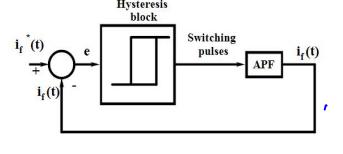
The power distribution network that is based on the Unified Power Quality Conditioner compensates for voltage sags and swells, current harmonics, and voltage harmonics primarily via adaptive hysteresis band control. In order to make the inverters follow the generated reference currents, a unique current tracking controlmethodcombiningthehysteresiscontrolandthe one cycle control is devised in. A novel intelligent controller that serves as an active power filter (APF) for the main source grid has been developed. It independently detects any power quality issues, filters out harmonics caused by loads, and compensates unbalances and/or DC offsets brought on by local AC loadsconnected at the pointof common coupling (PCC). The issue is fixed by using a remodified hysteresis currentcontrollertoproducethedrivingsignalsforVSI.
Repetitive controller
Dead Beat controller
Hightrackingspeedandcontrolaccuracyareadvantages of deadbeat control, however, this type of control is susceptible to the quality of the system model. The reference current produced by the other controllers in thesystemismonitoredbyadeadbeatcurrentcontroller. The authors employed a hybrid voltage controller to generate the reference current in order to achieve adequate voltage regulation and to reduce voltage disturbances. the authors examined the performance constraints of a three-phase voltage source converterapplicable digital dead-beat current controller taking stability into account. They then created a modified line voltage estimation technique to increase the performance quality of the controller when there are variationsinparameters[12].
Power Quality Improvement Filters
The power quality compensator proposed in may carry out the following two tasks: control of power and active power filter. The major goals of the power quality compensator are to eliminate harmonics, make up for reactive power, and reduce load unbalance. Two voltage source inverters that function as series active and shunt activepowerfilters[9]makeuptheunifiedpowerquality conditioner system suggested. A novel reference current generation method is used in the development of controllers for the Unified Power Quality Conditioner to
correctproblemswiththecurrentandvoltagequalityof sensitive loads. The power quality compensator proposed in may carry out the following two tasks: powercontrolandactivepowerfilter.Themajorgoalsof the power quality compensator[10] are to eliminate harmonics, make up for reactive power, and reduce load unbalance.Twovoltagesourceinvertersthatfunctionas series active and shunt active power filters make up the unified power quality conditioner system suggested. A new reference current generating method is used in the developmentofcontrollersfortheUnifiedPowerQuality Conditioner to correct problems with the current and voltagequalityofsensitiveloads.
Power Quality Compensators
The major goals of the suggested power quality compensator are to increase the system's flexibility by obtaining high power factor and minimal distortion[2]. Insteadoftheinverteroutputcurrent,thegridcurrentin thiscaseisbalancedsinusoidalandmade tobeinphase with the grid voltage. The Power Quality Compensator proposed in ismadeup of a seriesinverter and a shunt inverter. The series inverter is used to keep a set of balanced line currents by adding negative and zero sequence components to account for voltage unbalance and to restrict the flow of large fault currents when the voltage level drops below the limit (sag), and the shunt inverter is controlled to keep a set of balanced sensitive load voltages and to distribute power and share the demandwiththeotherparallellyconnectedDGs[3].
Introduction to fuzzy logic control
Numerousresearchersinvariousdomainsandatvarious times have noted the usage ofthe mathematical concept known as fuzzy logic[11]. Using fuzzy logic has resulted inasignificanttransformation.Fuzzylogichasmadealot ofthingssimpler,whichhasallowedpeopletosavetime, money, and energy. Lotti Zadeh originally put out fuzzy logic in 1965. Many researchers, including Plato, Hegel, Marx, Lukasiewicz, and others, made significant contributions to this topic prior to Zadeh. Some of them offered three valued logic, while others offered four- or five valued logic, which is an extension of Boolean logic, which only accepts the binary values true or false (0 or 1)
In his article "Fuzzy sets," Lotti Zadeh defined mathematics as fuzzy sets and fuzzy logic. Prior to the development of fuzzy logic, mathematics could only reach two conclusions, namely valid or invalid (0 or 1). Fuzzylogic,however,hasexpandedthis rangetoinclude actualvalues(0,1).Inthisessay,theideaoffuzzylogicis introduced, along with a brief overview of how it has been used in various domains. This study shows how fuzzy logic has been used in various sectors and how it helpstosimplifyideasandconcepts.
Concept of Fuzzy logic
Onlytwovalues trueorfalse areacceptedbyBoolean logic(0orl).
In this, one may discuss low or high. It says nothing between them, i.e., it does not take the idea of the medium. This can be accomplished using the more comprehensive fuzzy logic notion, which accepts values [O, l]. Because of this idea, it is possible to discuss low, high, medium, very low, and very high. Therefore, it is a moreadvancedkindofBooleanlogic.Uncertainmeaning is not well-known or not sufficiently clear[12]. A statementusing fuzzy logic couldbe either true or false, or it could have a range of possible true values. It is designedtodealwiththeideaofpartialtruth.
The membership function gives the degree of truth. Any function from a set X to a real unit interval [O, l] is a membership function on that set. A false value is representedbythevalue0;truthvalueisrepresentedby the value l; and partial truth is represented by the value between 0 and l. The similarity between fuzzy logic and humanreasoningisone ofitsmainadvantages.Inorder tosimplifythis,linguisticvariablesareused[11].
Fuzzy control schemes
The capacitor dcvoltage is compared with the reference valueoftheobtainederrorandthechangeinerrorinthe sampling is taken as the input to the sampling unit. The fuzzy controller'soutputis regardedastheamplitudeof theImax,thereferencecurrentafteracertainpoint.The systemlossesandactivepowerrequirementsoftheload are handled by this current Imax[11]. The converters switching signals are produced by comparing the actual source currents with the reference current in the hysteresiscurrentcontroller.
Fuzzy algorithm
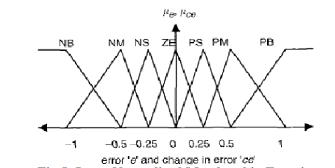
The Fig. depicts the fuzzy controller's internal construction. The system's real-world numerical variables are error (e) and change in error (ce). As depicted in, these numerical variables are transformed into linguistic variables using the following seven fuzzy levels or sets: NB (negative large), NM (negative medium), NS (negative small), ZE (zero), PS (positive small),PM(positivemedium),andPB(positivebig).The fuzzy controller can be described as follows: i. For each input and output, seven fuzzy sets. ii. For ease of use, triangular membership is used. iii. Fuzzification using the ongoing conversation universe. iv. Application of the "min" operator by Mamdani. v. Using the "centroid" approachfordefuzzification.
Rule base
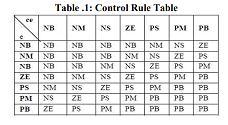
According to the theory, minor mistakes require fine control in the steady state, which calls for fine input/output variables, whereas big errors require coarse control in the transient state, which calls for coarse input/output variables. Based on this, the rule table's elements are obtained, as shown in Table, using the inputs. fuzzy logic control logic is a widely used efficientsoftcomputingtechnique[3].
control rule table
The basic fuzzy logic architecture
Fig7showstheInputNormalizedMembershipFunction, plotted error and change in error using the centroid method.
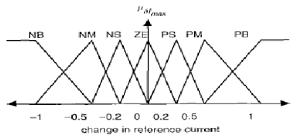
Output Normalized Membership Function
fuzzy architecture
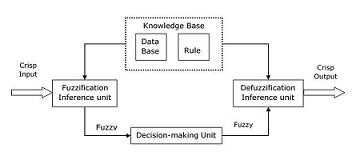
Fig 6 shows the basic fuzzy logic architecture which consists of the main fuzzification and defuzzification unit, processed by retrieving data from the knowledge base. theknowledge base consists of a databaseand the rulestorunthecommand.
Input Normalized Membership Function
InputNormalizedMembershipFunction
fig8showstheoutputNormalizedMembershipFunction whichisplottedbasedonthechangeinreference current.
Conclusions
Theadvancementsinmicrogridtechnologyandhowthey mightbecontrolledtoenhancepowerqualityhavebeen examined in this research. Under unbalanced and nonlinear load conditions, many control strategies used in the literature for improving power quality in isolated and grid-connected microgrid systems have been reviewed. The study of microgrids, their control strategies, and the challenges in integrating with the utility aiming to generate and feed quality and reliable power to the grid/customers is very well needed in the field of renewable energy as the research and development throughout the world is mainly focusing implementationofsmartgridonthereal-time.
Due to the fluctuating nature of renewable energy sources and their rapid increase, the integration of microgrids into the current power system will be the main priority shortly. Therefore, it is essential to take action to enhance the control features to successfully integrate the microgrid with the main grid while improvingpowerquality.
Because of the fluctuating nature of renewable energy sources and their rapid increase, the implementation of microgrids into the current power system will be the main priority shortly. Therefore, it is essential to take action to enhance the control features to successfully integrate the microgrid with the main grid while improvingpowerquality.
REFERENCES
Blaabjerg, F.; Teodorescu, R.; Liserre, M.; Timbus, A.V. Overview of control and grid synchronization for distributed power generation systems. IEEE Trans. Ind. Electron.2006,53,1398–1409.
INTERNATIONAL
JOURNAL of RENEWABLE
ENERGY
RESEARCHV.LavanyaandN.S.Kumar,Vol.8,No.1,March 2018 A Review: Control Strategies for Power Quality ImprovementinMicrogrid
T Jagan Mohan Rao et al Int. Journal of Engineering ResearchandApplicationsISSN:2248-9622,Vol.4,Issue 5( Version 1), May 2014, pp.46-50, Voltage Source Inverter/Converter for the Improvement of Power QualityUsingFuzzyLogicController
Blaabjerg, F.; Teodorescu, R.; Liserre, M.; Timbus, A.V. Overview of control and grid synchronization for distributed power generation systems. IEEE Trans. Ind. Electron.2006,53,1398–1409.
\bibitem{b5} Kassakian, J.G.; Schlecht, M.F.; Verghese, G.C. Principles of Power Electronics; Addison-Wesley: Reading,PA,USA,1991;Volume1991.
\bibitem{b6} Mohan, N.; Undeland, T.M. Power Electronics: Converters, Applications, and Design; John WileyandSons:NewDelhi,India,2007.
\bibitem{b7}6. Abdel-Rahim,N.M.;Quaicoe,J.E. Analysis and design of a multiple feedback loop control strategy for single-phase voltage-source UPS inverters. IEEETrans.PowerElectron.1996,11,532–541.
\bibitem{b8} Lee, T.-S.; Chiang, S.-J.; Chang, J.-M. H/sub/splinfin//loop-shapingcontrollerdesignsforthe single-phase UPS inverters. IEEE Trans. Power Electron. 2001,16,473–481.
\bibitem{b9}Willmann,G.;Coutinho,D.F.;Pereira,L.F.A.; Libano, F.B. Multiple-loop H-infinity control design for uninterruptible power supplies. IEEE Trans. Ind. Electron.2007,54,1591–1602.
\bibitem{b10} Taha Selim Ustun, Cagil Ozansoy, and Aladin Zayegh, “Recent developments in microgrids and example cases around the world A review”, Renewable andSustainableEnergyReviews,Vol.15,No.8,pp.40304041,2011
\bibitem{b11} R Makkar ,Application of fuzzy logic: A literaturereview
\bibitem{b12} Do, T.D.; Leu, V.Q.; Choi, Y.-S.; Choi, H.H.; Jung, J.-W. An adaptive voltage control strategy of threephase inverter for stand-alone distributed generation systems.IEEETrans.Ind.Electron.2013,60,5660–5672. [GoogleScholar][CrossRef]