A Wideband Wearable Antenna for ISM and WLAN Applications
Kavisha Singh1 , Dr. Nand Kishore21M. Tech Scholar, Dept. of Electronics Engineering, Harcourt Butler Technical University, Uttar Pradesh, India

2Assistant Professor, Dept. of Electronics Engineering, Harcourt Butler Technical University, Uttar Pradesh, India ***
Abstract - A wideband slotted patch antenna with a partial ground for wearable applications is presented in this article. The dimensions have been optimized to obtain a compact structure of 30x20x0.8 on FR4 epoxy substrate. A triple band operation with resonant frequencies at 2.4 GHz, 3.8 GHz and 5.8 GHz is observed. A peak gain of 3.7 dB is found for the center frequency of 5.8 GHz with 97% efficiency. The average value of SAR simulated on a three-layer human body phantom for an input power of 1 mW is 0.0175 W/kg. The antenna is appropriate for implementation in Wireless Body Area Networks.
Key Words: Wearable, Complementary split ring resonator, Return loss, SAR
1.INTRODUCTION
Theworldofwearableshasgainedatremendousincreasein the last decade owing to their relevance in the areas of healthmonitoring,diagnosis,trackingandlocationsensing [1].Wearableantennasaremostcommonlydevelopedfor operationatspecificfrequencieskeepinginviewtheareaof application. These antennas are most widely used in WirelessBodyAreaNetworks(WBAN)duetotheirpromise invarioushealthcareapplications.Asetoffrequencybands are designated to commercial WBAN systems including frequencies in the range of 402 MHz to 10.6 GHz [2]. The realizationofwearableantennashasstrongdependenceon the lossy nature of body tissues. The close proximity of human body, structural deformation, robustness and wearer’scomfortarethecrucialaspectsinwearableantenna configuration. These antennas also tend to suffer from frequencydetuning[1]. Astheseantennasformapartofon bodycommunicationsystem,theyneedtobelightweight, compactandwaterresistant.
Microstrip patch antennas form a viable solution for wearableantennadesignastheyproduceomnidirectional radiationpatternandcanbeminiaturizedbythechoiceof suitablesubstrates.Theeaseoffabricationandlowcostadd totheadvantagesofmicrostrippatchantennas[3].
In[2]authorshavepresentedaphotopaperbasedflexible antennaoperatingin2.5GHzand5.8GHzfrequencybands. Thoughphotopaperisflexibleandlowcostbutitisproneto degradation.In[4]anantennafabricatedonafeltsubstrate with dual band operation is proposed for on/off body wearable applications. The antenna spans the ISM and WLANfrequencies.Inreference[5]authorshavepresented
a triband electronic bandgap array antenna operating in WLAN and WiMAX bands. In [6] three forms of dual band (2.45GHzand5.2GHz)antennaswithelectronicbandgap structure have been discussed. Though the use of EBG structure beneath the antenna makes them bulky. The authorsof[7]havepresentedasemiflexiblehybridMoore fractalantennaoperatingin1.38-1.8GHzand2.45-4.88GHz bands.Theproposedantennahasacompactgeometryand lowervaluesofSAR.Ameanderlinepatchantennaspanning frequenciesbetween2.36-2.46GHzisdiscussedin[8].In[9] theauthorshaveproposedanantennaincorporatingafoam spaceroperatingat2.45GHz.Awidebandminkowskifractal geometry-basedantennaispresentedin[10]withoperation infrequencyrangeof700MHzto4.71GHz.Theauthorsof [11]havepresentedanIDEbandgapunitcell-basedantenna foruseinMBANapplications.In[12]a2.45GHzISMband antennawithdoubleflexiblesubstratesisdiscussed In[13] anISMbandantennawithdenimasasubstateispresented. However, textile antennas are susceptible to water and moisturecontent.
Thisworkpresentsatriplebandcompactwearableantenna with an acceptable value of SAR. The antenna shows a widebandoperationandissuitableforWBANapplications. The comparatively simple design and smaller size as comparedtopreviousworksmakesitagoodalternativefor wearableapplications.Freespaceandonbodyanalysishave been performed for the proposed antenna. The reflection coefficient,acceptablegainandonbodySARsimulationsalso showthefeasibilityoftheproposedwork.
2. GEOMETRY
TheantennaisstructuredonaFR-4epoxysubstratewitha relativepermittivityof4.4andadissipationfactorof0.02.A highdielectricconstantsubstratewasutilizedtobringdown the measurements of the proposed antenna [14]. The resulting geometry has compact dimensions of 30mm x 20mm x 0.8mm. The design process started with the modellingofasquareshapedpatchandapartialground.The limited size of ground plane helps in broadening the bandwidthofantenna[15].Foursquareshapedslotsatthe corners of the patch and a 0.5 mm wide single complimentary split ring resonator were incorporated to achieve resonances at the desired frequencies. The dimensions of slots have been optimized to obtain the desiredoperation.Inordertoimprovethereturnloss,three slotsofequalsizewereetchedfromthelateralextremitiesof thepatch.AnupturnedSshapedgroovewasetchedtorefine
theoperationoftheantenna.TheSshapedslotalsohelped in achieving operation in 3.8 GHz band. A microstrip line feedof50Ωisappliedtotheantenna.Fig.1showsthelayout oftheplannedantenna.
3. RESULTS
Acomputationalanalysishasbeenperformedtodetermine thereturnlossoftheintendedantenna.Thesimulated findings reveal the triband operation of the antenna. Resonanceisachievedatthefrequenciesof2.4GHz,3.8GHz and5.8GHz.Therelatedreturnlossfiguresare-16.18dB,13.03dBand-34.93dBrespectively.Theantennashowsa widebandoperationfrom4.5GHz-6.4GHz.Fig.2depictsthe reflection coefficient curve of the planned antenna. The monitored E plane and H plane radiation patterns for the resonantfrequenciesaredisplayedinFig.3.


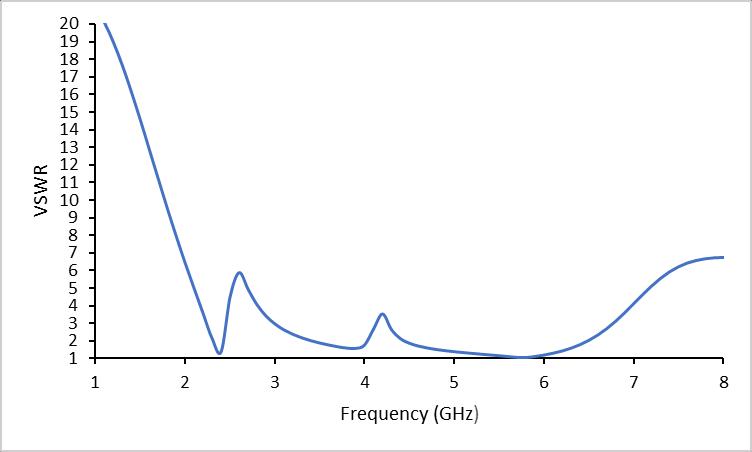
Theobservedgainatfrequenciesof2.4GHz,3.8GHzand5.8 GHzare0.6155dB,2.7226dBand3.7205dBrespectively. TheVSWRcharacteristicsrepresentedinFig.4exhibitfair levelsofimpedancematchingoftheantenna.
Wearableantennasfunctioninpropinquityofhumanbody therefore the antenna behavior is dependent on the dielectricpropertiesofbodytissues.Thevaryingelectrical propertiesofdifferentlayersoftissuesrequiretheantenna tobeoptimizedwithahumanbodyphantominthedesign process.Ahumanbodyphantomcomprisingthreelayersof tissues was utilized to study the impact of human body reciprocity with the antenna. The dimensions of the phantom are 50mmx50mmx33 mm. The three-layered phantom is made up of skin, fat and muscle tissues of thickness2mm,8mmand23mmrespectively.Therelative permittivity,conductivityandlosstangentatfrequencies2.4 GHzand5.8GHzhavebeenspecifiedintable2.
The antenna reflection coefficient characteristics when placedonthephantomareshowninfig.6.Theresultsshowa slight detuning at the frequencies of resonance. The resultsshowoperationinthedesiredbands.Theradiation patternforonbodysimulationshavebeendepictedinfigure 7.


5. SAR ANALYSIS
Themagnitudeofradiation thatcanbesustainedperunit mass of human body is called SAR. According to InternationalStandardsthestipulatedvaluesofSARare1.6 W/kgaggregatedover1gmoftissueand2W/kgover10gm oftissuerespectively[1].TheamountofSARwasmeasured forthefrequenciesof2.4GHzand5.8GHz.Radiationpattern analysis of on body measurements reveal the reduced amountofbackloberadiationswhenantennaisemplaced onphantom.Thereducedbackloberadiationscorrespondto lesseramountofSAR.


ThemeasuredSARfor1mWinputpowernormalizedover1 gm of tissue at 2.4 GHz is 0.0175 W/kg and at 5.8 GHz is 0.0879 W/kg. The SAR analysis also reveals that the penetration depth of electromagnetic waves is lesser at higherfrequencies.


REFERENCES
[1] Paracha, K.N.; Rahim, S.K.A.; Soh, P.J.; Khalily, M., “WearableAntennas:AReviewofMaterials,Structures, and Innovative Features for Autonomous Communication and Sensing”, IEEE Access, vol.7, pp. 56694–56712,April2019.
[2] Jabbar,A.,etal:“Aphotopaper-basedlow-costwideband wearable antenna for wireless body area network applications”. IET Microwaves Antennas Propagation 16(15),962-970(2022).
[3] Akinola, S., Hashimu, U., & Singh, G., “Gain and Bandwidth Enhancement Techniques of Microstrip Antennas:ATechnicalReview”, International Conference on Computational Intelligence and Knowledge Economy (ICCIKE), December,2019.
[4] Zhou,L.,Fang,S.,&Jia,X.,“Dual-bandandDual-polarised circular patch textile antenna for on-/off-body WBAN Applications”, IET Microwaves Antennas &Propagation, 14(7),643-648(2020).
[5] Li, R.;Wu, C.; Sun, X.; Zhao, Y.; Luo,W, “An EBG-Based Triple-BandWearableAntennaforWBANApplications”, Micromachines 2022,13,1938.
[6] Ahmad,A.,Faisal,F.,Ullah,S.,&Choi,D,“DesignandSAR Analysis of a Dual Band Wearable Antenna for WLAN Applications”, Applied Sciences, 2022,12,9218.
[7] Khan,U.R.,Sheikh,J.I.,Junaid,A.,Amin,R.,Ashraf,S.,& Ahmed,S.,“DesignofaCompactHybridMoore’sFractal Inspired Wearable Antenna for IoT Enabled BioTelemetry in Diagnostic Health Monitoring System”, IEEE Access, 10,116129-116140,November2022.
[8] Ibrahim, H.H.; Singh, M.J.; Al-Bawri, S.S.; Ibrahim, S.K.; Islam, M.T.; Soliman, M.S.; Islam, M.S, “Low Profile Monopole Meander Line Antenna for WLAN Applications”, Sensors 2022,22,6180.
6. CONCLUSIONS
:SARAnalysis
The proposed antenna has a tri band operation in ISM, WiMAX and WLAN frequency bands. The impedance bandwidths measured across the three bands are 4.61%, 13.33% and 34.86% respectively. The range of operation shows that the proposed work is acceptable for WBAN applications.Theon-bodyreflectioncoefficientandradiation patternresultsalsoshowtheefficacyoftheproposeddesign. TheantennahasfairvaluesofgainandSARmeasurement whichmakeitsuitableforonbodycommunication.
[9] Kiani, S., Rezaei, P., & Fakhr, M, “A CPW-fed wearable antenna at ISM band for biomedical and WBAN applications”, Wireless Networks,27(1),735-745(2020).
[10] Wang.F.,Bin,F.,Jingmin,F.,&Ye,H.,“ACompactUHF AntennaBasedonComplementaryFractalTechnique”, IEEE Access, 5,21118-21125,September2017.
[11] Rano, D., & Hashmi, M.S, “Extremely compact EBGbackedantennaforsmartwatchapplicationsinMedical Body Area Network”, IET Microwaves Antennas & Propagation,13(7),1031-1040.(2019).
[12] Mustafa,A.B.,&Rajendran,T.,“AneffectiveDesignof WearableAntennawithDoubleFlexibleSubstratesand
Defected Ground Structure for Healthcare Monitoring System”, Journal of Medical Systems, 43(7),(2019).
[13] Ashyap,A.Y.I,ZainalAbidin,Z.,Dahlan,S.H.,Majid,H.A., Kamarudin, M. R., Oguntala, G. A., Abd-Alhameed, R., Noras, J. M., “Inverted E-shaped Wearable Textile Antenna for Medical Applications”, IEEE Access, 6, 35214-35222,2018.
[14] Abdelgwad, A. H., “Microstrip Patch Antenna Enhancement Techniques”, International Journal of Electronics and Communication Engineering, 12(10), 703-710,(2018).
[15] Sharma,S.&Rattan,M.,“AnalysisofBroadbandingand Minimization Techniques for Square Patch Antenna” IETE journal of research,vol.56,no.2,April2010.
[16] http://niremf.ifac.cnr.it/tissprop/htmlclie/htmlclie.php