Detection of Spam in Emails using Machine Learning
Bhavya V S1, Yashas R2, Nithin G M3, S. Akhila41Post Graduate Student, Department of ECE, BMS College of engineering, Karnataka, India

2Post Graduate Student, Department of ECE, BMS College of engineering, Karnataka, India
3Post Graduate Student, Department of ECE, BMS College of engineering, Karnataka, India
4 Professor, Department of ECE, BMS College of engineering, Karnataka, India ***
Abstract - With fast development of web clients, E-mail spams are increasing alarmingly. People are misusing these spam mails in several ways, to transfer malicious content, unwanted, unsolicited, irrelevant advertisements which can hurt one’s framework and spoof on our framework. It could contain malware, such as ransomware and spyware. Creation of a forged or the fake kind of profile and fake email accountis far easier for spammers and they create spam mail that is difficult to distinguish from real mail. Thus, it is required to differentiate spam mails and prevent their entry into the inbox. This has been attempted using machine learning techniques. Spam detection throughvariousmachinelearning algorithms has been attempted and it is found that Multinomial naive Bayes algorithm is more efficient and gives the highest Spam detectionwithfinestaccuracyandexactness.
Key Words: Spammail,spamdetection,machinelearning, dataset,classifiers
1.INTRODUCTION
Thefullformofemailiselectronicmail.Emailspamrefersto the use of electronic mail to send malicious mail or publicizingmailtogatherarecipient'sdata.Thesemailsare mailsthataresenttouserswhoarenottheauthenticated recipients. These spam mails have caused mishaps on the webbyconsumingmorebandwidthandspace.Programmed filtering of mail will be the foremost viable strategy for identifying mail spam, however these days spammers can effortlessly dodge all the applications of spam filtering effectively [1]. Initially, maximum of the spam mails were blockedusingSpamfilterswhichhavebeenforwardedfrom certainemailaddresses.Themostimportantmethodstothe spam mail filtering involves investigation of text, domain names boycotts, community and primarily centered techniques.Textassessmentofsubstancesendsisabroadly utilizedtechniquetothespams.Theapproachof machine learningforspamrecognitionanddetectionhasfoundtobe moreefficientcomparedtothefilteringtechniques[2].With emails becoming one of the strategic means of communication,identifyingordistinguishingaspamfroman authentic mail becomes crucial since these spam mails consumeclienttimeandassetproducingnovaluableyield [3].
MultinomialNaiveBayesisasupremerenownedalgorithm connected in the current processes. Though, dismissing sendsbasicallysubordinateondatasetinvestigationcanbea challenging matter within the occasion of false positives, frequentlytheorganizationandtheclientdonotwantany true-bluemessagesoremailstobemisplacedandthereject methodhasbeenlikelythebetterstrategysoughtafter,for separation of spams [4]. The procedure is mainly to recognizeallthesendersoutofthosefromthezoneoremail ids which are specifically rejected and with latest, the regions which are approaching into the arrangement of spammingspacenamesand thisproceduremonitorson a work so fine [5]. Another approach is called white list approach,itistheapproachoftoleratingthesendsfromthe domain names and the addresses straightforwardly whitelisted, putting others in less significant lines. It is conveyed most viable after the sender reacts to a confirmationsentthroughthejunkorthespammailsifting system[6].
Spam and Ham, concurring from Wikipedia, utilizing electronic mail and informing frameworks to send spontaneousmajoritymailsormessages,particularlyframe notice, malicious joins are called spam. Spontaneously impliesthattheuserdidnotinquireformessageswhichare comingfromthesources[7].So,ontheoffchancethatthe userdoesn’tknow,almostallthesendermailmaybecome spam.Peoplenormallydon’trealizetheyarefairlymarked for those kinds of mailers, when they download any free supervisionsandprogramswhilemodernizingorupdating the program. Ham is the term, which was given by Spam Bayesintheyear2001andhamischaracterizedasEmails which are not generally hankered and not considered as spam[8].
TheMachinelearningmethodologiesarefurthereffective, thesetoftraininginformationwillbeutilizedandthosetests are set of e-mail which are pre-classified, the machine learningmethodologieshassectionofalgorithmswhichcan beutilizedformailsiftingandthesealgorithmsincorporate Naive Bayes approach and the support vector machines, NeuralSystems,K-nearestneighbourandsoon[9][10].
2. LITERATURE SURVEY
In [1] the authors studied the three machine learning methods (SVMs, decision trees, and Naive Bayes) for classifying spam emails. authors developed a supervised classificationpipelinetocategoriseemailsasspamorreal. Theselectionoffeaturesisoneofthekeyprocessesinthe categorizationofspamemails.Thetop20 mostoftenused termsinspamandvalidemailsareselectedusingtheTerm FrequencyInverseDocumentFrequency(TF-IDF)algorithm. TheauthorsstudiedSVMs,decisiontrees,andNaiveBayes with specific characteristics to test their effectiveness in identifyingandcategorisingspamemail.
In[2]theauthorsprovideathoroughexaminationofthe approaches used in the framework's first component, focusing solely on the domain and header-related data containedinemailheaders.Thisworkhasalsolookedat a unique feature reduction technique that uses a group of unsupervisedfeatureselection algorithms.Inaddition, the datasourceincludesathoroughfreshdatasetwith100,000 recordsofspamandjunkemails.
In [3] the authors primarily focus on the machine learning-basedspamcategorizationtechnique.Additionally, authorsofferathoroughanalysisandassessmentofprevious researchonvariousmachinelearningmethodologies,email properties,andtechniques.Additionally,itoutlinespotential pathsforfuturestudyaswellasdifficultiesencounteredin thefieldofspamcategorization.
In [4] authors tried to investigate how spam and ham emails may be grouped using unsupervised learning. The basic objective of the project is to create an unsupervised frameworkthatentirelyreliesonunsupervisedtechniques usinga clusteringstrategy thatuses a number of different algorithms,mostlyusingtheemailbodyandsubjectheader. Auniquebinarydatasetwith22,000entriesofspamandham emailsand10features(reducedfromeleventotenafterthe feature reduction) was used for the clustering. From a multiangularpointofview,sevenofthesetenelementsare exclusive to this study and were designed to reflect key analyticalemailproperties.
In[5] authors introduced a technique for spam email detection using machine learning algorithms that are enhanced using bio-inspired techniques. A survey of the literature is conducted to investigate effective techniques usedonvariousdatasetstogetgoodoutcomes.Anintensive studywasconducted,alongwithfeatureextractionandpreprocessing,tobuildmachinelearningmodelsutilisingNaive Bayes, Support Vector Machine, Random Forest, Decision Tree, and Multi-Layer Perceptron on seven distinct email datasets.ParticleSwarmOptimisationandGeneticAlgorithm, twobio-inspiredalgorithms,wereusedtoenhanceclassifier performance.
3. METHODOLOY
Thedifferentclassifiers/algorithmsareusedtoinvestigate the information of the mails that mainly depicts critical information classes. A classifier is used mainly to build expectationoflessonnameslikespamorham.Multinomial Naïve base is a classifier used for spam recognition, it classifiesthespamemailsandprobabilityofwordbeingin thetrainingsetplaysfundamentalpart.
Supportvectorclassifierisusedforissuesofclassificationof mailsinmachinelearning,anotherclassifierusedisDecision treewhichmajorlydoesnotrequireanysettingofparameter ordomaininformationforidentificationandexaminationof information.Thisclassifierprécisesonunnoticeddata.The random forest classifier consists of diverse sort of choice trees which are of different size and shapes. For datasets with noisy features or unbalanced class distributions, randomforestsmaynotbethebestoptionsincetheycanbe computationally costly. They are also more difficult to comprehendthanindividualdecisiontrees.Arandomforest classifier is often used to generate predictions on fresh, unknowndataafterbeingtrainedonalabeleddatasetand having its hyper parameters (such as the number of trees and tree depth) adjusted, K-nearest neighbour, a lazy classifier is another classifier used in the data set model whichtriestomemorizethemethodthroughtrainingsinceit isnotaselflearningalgorithm,becauseitdoesnotlearnby itself, another classifier is used in the model is Gradient Boostingclassifierwhichismainlyablendofbootstrapand aggregating,anotherclassifierusedinthismodelisextreme gradientboostingwhichprovidesparalleltreeboostingand solves ranking problems, another classifier used in the modelisadaboostalgorithmitmainlycreatesanewmodel which will predict the value target variable, another classifierusedinthemodelisinformationretrievalwhichis majorlyacollectionofalgorithmswhichhelpsinrelevancy ofpresenteddata.
Thefirststepwillbedataprocessing,herethedatasetwith thenumberofrowsandthecolumnswillbedistinguished and here not only the data set containing the case informationwhichalsoincludesthesounds,images,video records. In data processing the steps involved are data cleaning. In data cleaning mainly filling of missing values, smoothing of noise, resolving irregularities will be done. Nextprocessafterdatacleaningis,dataintegrationindata integrationexpansionofdatasethasbeenperformed,next processisdatatransformationwherenormalizationisdone to scale a particular value, next process is data reduction where it gets mainly rundown of the data set and gets analyticalresults.Afterthisthedatasetwillbeembedded fortestingpurpose,thenthemachinewillcheckforthedata setforupheldencodingandontheoffchancethatoneofthe upheld encodingandselecttheuserneededtotrain,testor comparethedataset.Nowontheoffchancethatwillnotbe
oneoftheupheldencodingthenthemachinewillalterthe encodingofembeddedrecordintobackedencodingsandat thatpointonlyattemptsforoncemoretoencode.Afterthe abovementionedprocess,intheeventtrainischosenthen train will be selected automatically and machine selects whichclassifiertoprepareforutilizingtheupdatedorthe inserteddatasetanditdiscoverstheparametervaluesand handlesthecontenttohighlightandtrainthemodel,spares the highlights, so results will appear utilizing the inserted dataset, then checks for not a number (NAN) values and copies,afterthishighlightsthesparedintrainingstageofthe model. Next when the event test and compare is chosen firstly it compares the selected and also compares all the classifiersutilizingtheinserteddatasetandfinallyresultsof theclassifiersareshown.
4. IMPLEMENTATION
The platform which is used to execute the model is visual studiocodeandinthismodule,adatasetwhichisavailable inthe“Kaggle”websitehasbeenusedaspreparingdataset. Thedatasetinsertedtobeginwithchecksforduplicateand invalidvaluesforsuperiorexecutionofthemechanism.At thatpoint of time, the datasethas been partedin two sub datasetnamely,traindatasetandtestdatasetwiththerange of60:40.Formerlytrainandtestdatasetisconcededasthe parameters for text-processing at that point, in textprocessing,mainlythepunctuationsymbolsandthewords whicharewithinthelistofstopwordsareremovedandthey arereturnedbackascleanwordsandthesecleanwordsare formerly conceded or passed for feature Transform, In highlightchangethecleanwordswhicharereturnedfrom the process of text-processing are further used for fit and transform to make clear vocabulary for machine and the datasetisadditionallypassedfortuningofhyperparameter tofindoutidealvaluesfortheclassifierbywhichdatasetis used accordingly. After getting the values from hyper parametertuning.Byusingtherandomvaluesthemachine willbebestfittedandtheunseendatahasbeenstoredfor furthertesting.Usingtheclassifiersfromthepresentmodule whichislearnedinpython,machinesarepreparedutilizing thevaluesgottencommencingabove.
5. RESULTS
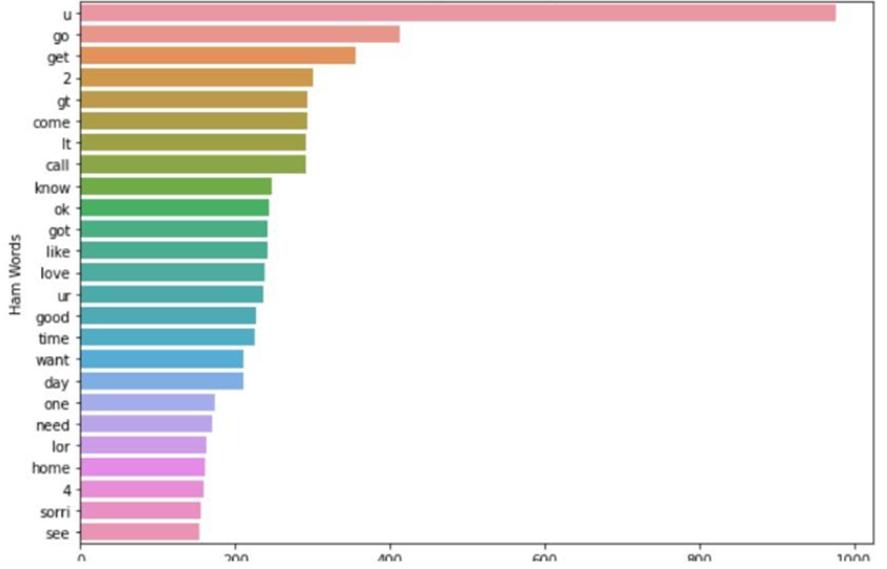
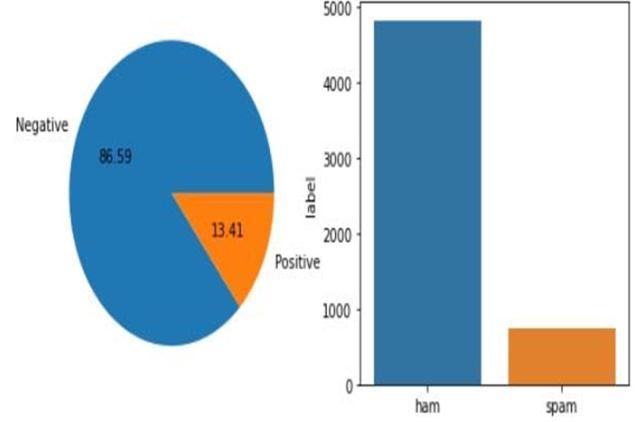
The proposed model of ours has been prepared utilizing numerous classifiers to compare and check the results furtherfornoticeableaccuracy.Whereeveryclassifierwill provide its assessed result, after all the classifiers which returnitsresultstotheuseratthatpointtheuserwhowill compare the obtained result with dataset and with other results to understand whether the information is ham or spamandeachclassifiersresultswillbeappearedincharts andtablesforgreaterperceptionanddatasetwhichhasbeen takenasinputfromKagglewebsitefortrainingandtitleof the dataset utilized is ‘emailspamidentify.csv’. To test

preparedmachines,adiversecommonseparatedvaluefile inshortform ascsvfile hasbeendeveloped withcovered informationthatisinformationwhichisnotutilizedtotrain themachine.





6. CONCLUSION
With the obtained outcome, it can be decided that MultinomialNaiveBayesprovidesthebetterresultbutithas acertainlimitduetoclassconditionalindependencewhich creates a machine to misclassify a few tuples. Gathering strategieshavebeenprovenasvaluableastheuserutilizes numerousclassifiersforthepredictionofclass.Thesedays, loadsofmailsarereceivedandsentanditistroublesomeas ourmodelisabletotestmailsutilizingarestrictedquantity ofcorpus,Inourmodelorproject,hencethespamlocationis capableofshiftingsendsandgivingitbacktothesubstance mail and not concurring to space names and any further
criteria.Therefore,atpresentitisonlyalimitedbodyofmail andTherecouldbeawide-rangingcredibilityofchangein ourprojectandtheconsequentdevelopmentscanbedonein future.
REFERENCES
[1] J,CuiandX.Li,"ContentBasedSpamEmailClassification usingSupervisedSVM,DecisionTreesandNaiveBayes," ICMLCA2021;2ndInternationalConferenceonMachine LearningandComputerApplication,2021,pp.1-4.
[2] A.Karim,S.Azam,B.ShanmugamandK.Kannoorpatti, "EfficientClusteringofEmailsIntoSpamandHam:The FoundationalStudyofaComprehensiveUnsupervised Framework,"inIEEEAccess,vol.8,pp.154759-154788, 2020,doi:10.1109/ACCESS.2020.3017082.
[3] M. RAZA, N. D. Jayasinghe and M. M. A. Muslam, "A Comprehensive Review on Email Spam Classification usingMachineLearningAlgorithms,"2021International Conference on Information Networking(ICOIN),2021,pp.327332,doi:10.1109/ICOIN 50884.2021.9334020.
[4] A.Karim,S.Azam,B.ShanmugamandK.Kannoorpatti, "An Unsupervised Approach for Content-Based Clustering of Emails Into Spam and Ham Through Multiangular Feature Formulation," in IEEE Access,vol.9,pp.135186135209,2021,doi:10.1109/ACCE SS.2021.3116128.

[5] S.Gibson,B.Issac,L.ZhangandS.M.Jacob,"Detecting SpamEmailWithMachineLearningOptimizedWithBioInspiredMetaheuristicAlgorithms,"inIEEEAccess,vol. 8, pp. 187914-187932, 2020, doi: 10.1109/ACCESS.2020.3030751.
[6] S.Kaddoura,O.AlfandiandN.Dahmani,"ASpamEmail DetectionMechanismforEnglishLanguageTextEmails Using Deep Learning Approach," 2020 IEEE 29th International Conference on Enabling Technologies: InfrastructureforCollaborativeEnterprises(WETICE), 2020, pp. 193-198, doi: 10.1109/WETICE49692.2020.00045.
[7] S. Nandhini and J. Marseline K.S., "Performance Evaluation of Machine Learning Algorithms for Email Spam Detection," 2020 International Conference on Emerging Trends in Information Technology and Engineering(ic-ETITE),2020,pp.1-4,doi:10.1109/icETITE47903.2020.312.
[8] R.Al-Haddad,F.Sahwan,A.Aboalmakarem,G.Latifand Y.M.Alufaisan,"Emailtextanalysisforfrauddetection throughmachinelearningtechniques,"3rdSmartCities

Symposium (SCS 2020), 2020, pp. 613-616, doi: 10.1049/icp.2021.0909.
[9] N. Govil, K. Agarwal, A. Bansal and A. Varshney, "A MachineLearningbasedSpamDetectionMechanism," 2020 Fourth International Conference on Computing MethodologiesandCommunication(ICCMC),2020,pp. 954-957, doi: 10.1109/ICCMC48092.2020.ICCMC000177.
[10] M.S.HaghighiandM.Sahebi,"Acceleratedsupervised learning to detect spam using feature selection and Apache Spark architecture," 2020 6th Iranian ConferenceonSignalProcessingandIntelligentSystems (ICSPIS), 2020, pp. 1-6, doi: 10.1109/ICSPIS51611.2020.9349587.