Experimental Investigations on Building Demolition Waste Using as a Fine Aggregate in Concrete
A.Loganathan1, R.D.Chandiran1 , M.Harikaran2 and M.Sanchaya21UG Scholar, Department of Civil Engineering, Muthayammal Engineering College, Rasipuram-637408, Tamilnadu, 2Assistant Professor, Department of Civil Engineering, Muthayammal Engineering College, Rasipuram-637408, Tamilnadu, India ***
Abstract - Due to continuedmining andhigh transportation costs, the key ingredient in concrete, fine aggregate (river sand), is in short supply, which has become a significant concernfor the constructionsector. Limitingtheabuseofriver sandandproviding analternatesupplyforfineaggregatesare the major goals of this research. Inthis experiment,pulverized concrete from razed structures will take the place of fine aggregates. When correctly disassembled, the concrete from the destroyed building is used as fine aggregate in new concrete. Recycling helps us reducethequantityofgarbagewe have to dispose of in landfills It is a substance that helps the environment and makes it possible to protect natural resources. There are no requirements or regulations for using recycled concrete aggregate in constructions. In this experiment, recycled aggregate was substituted for fine aggregate in a range of ratios, including 0%, 10%, 20%, 30%, 40%, and 50%. Concrete made with recycled aggregates has the potential to store 42% more water. The optimal percentage for replacement concrete is 30% replacement construction debris.Whencomparedtoconventionalconcrete, that 33% replacement concrete is sturdy. Flexural strength is improved by 5.71%, split tensile strength is increased by 0.57%, and compression strength is enhanced by 1%.
Key Words: Recycled aggregates, Mechanical properties, Crushed concrete, Fine aggregates

1.INTRODUCTION
Theworld'slargestman-madesubstanceisconcrete,which isnotable.Manyrecyclingtechniquesforrecoveredconcrete aggregate have been carefully investigated and developed duringthepasttwentyyears.Theserecyclingmethodslimit theamountofwastethatisdumpedinlandfills,cutdownon transportationcosts,andsaverawmaterials.Construction anddemolition,sometimesknownasC&DWaste[1],isthe process of constructing new structures as well as maintaininganddemolishingexistingones.Concretemakes up40%ofthetotalbuildingdemolitiongarbage,ceramics 30%, plastic 5%, wood 5%, metal 5%, and various combinations 10% [2]. According to a report by Global Insight,risingconstructioncostswouldriseby4800billion USdollarsin2013.Giventhatrecoveredconcreteaggregates makeupthemajorityofoldconcrete,recyclingaggregates from demolition trash might close the supply-demand imbalance[3].Constructiontrashisproducedasaresultof
natural disasters (earthquakes, hurricanes, etc.). The structure was chosen as the primary source of recovered aggregate because itcan recyclea considerablevolume of broken demolition cement concrete [4]. The test results show that RCAs are around 20% lighter than common aggregates,bothcoarseand fine.Thelower densityofthe RCAswasduetotheoldermortar'sadhesiontothecommon aggregates [5]. The initial slump of recycled aggregate concretewasnotsignificantlyaffectedbytherelativewater absorption of aggregates, but the rate of slump loss increased as the relative water absorption of aggregates increased [6]. The first slump of new concrete somewhat decreasedasthereplacementamountofrecycledparticles increased.Theinitialslumpofrecycledaggregateconcrete wassignificantlyinfluencedbythemoisturecontentofthe aggregates[7].Thecompressivestrengthofconcreteusing recycled fine aggregate with better absorption was lower than that of the control specimen by 20 to 40%. Relative compressivestrengthisdevelopedatagesof1and3days. [8] Thecompressivestrengthsforallcombinationsafter1, 14, and 28 days of curing show that there is a bigger replacement of recycled aggregates the lower the compressivestrengthforallcuringdurations.Bothcoarse and fine recycled aggregates weaken during compression [9].Thedifferencebetweenthelowerandhigherstrengths was 7% and 13% for testing ages of 7 days and 90 days, respectively,indicatingthatthecrushingagehadafarless significant impact on recycled OPC concrete. The fall in splittingtensilestrengthbroughtonbytheuseofRCAsas opposedtoconventionalaggregatesismorenoticeableina normal-strength-normal-aggregate concrete [10] than the reduction in compressive strength. Recycled concrete aggregates(RCA)causemoreconcretetoshrinkthannatural aggregatesduetotheirlowerelasticmodulusandtendency forshrinkage[11].
2.MATERIALPROPERTIESANDMIXPROPORTIONING
2.1 Cement
In the widest sense of the word, cement is a binder a substancethatbindsothermaterialstogetherandsetsand hardens on its own. Cement acts as a binder in concrete, holding the other elements together and forming a substantialmassstructure.OrdinaryPortlandCement(OPC) ofgrade43isthesubstanceused[12].
River sand that went through a 4.75 mm filter and was retained on a 600 m screen, both of which complied with ZoneII ofIS383-1970,servedasthefineaggregateinthe currentexperiment.Thesandhasnobiologicalimpurities, clay, or silt. The aggregate was assessed for its physical characteristics, including gradation, fineness modulus, specific gravity, and bulk modulus, in accordance with IS: 2386-1963 [13]. The particle size distribution curves for riversandandrecycledfineaggregateareshowninChart1.

Although there are many various components that go into making concrete, the coarse aggregate is the key one that providesthefinishedproductitsstrengthandhomogeneity. Coarse aggregate is used in a variety of building projects becauseitresemblesregularrockfragmentsratherthanfine aggregate,whichmorecloselyresemblessand[14].

Coarse aggregate is a crucial component in many construction-related applications. It can also be used in combinationwithothermaterials,suchasasphaltorconcrete mixtures, or on its own as a granular foundation poured beneathaslaborpavement.
Ingeneral,rocklargerthanatypicalNo.4.78mmsieveand lessthan50.8mmisreferredtoascoarseaggregate[15].
Concrete that complies with the requirements of IS 4562000ismixedinaportablewatersourcewithapHvalueof 7.0,curingthespecimen[16].
II IS383-1970
3. EXPERIMENTAL INVESTIGATIONS
3.1 Compressive Strength Results
In Chart-2, the compressive strength of various concrete mixtures was shown visually. According to the observed data[17], recycled concrete mix has higher strength comparedtoreferenceconcreteat30%replacementoffine aggregate, and there is a strength loss at more than 30% replacementoffineaggregate.
3.2 Split Tensile Strength
ThesplittensilestrengthoftheconcreteisshowninChart3 with a significant decrease in this parameter as the percentageofFNAreplacementwithFRArises[19].Giventhe moreporouscharacteroftherecycledaggregates,itfollows thatareductionhappensasthereplacementratioincreases [20].Therecycledconcretemixhasa 15%betterstrength than the reference concrete at a 30% replacement of fine aggregate[21].
Chart -2:Compressivestrengthofnaturalandrecycled aggregateconcrete
Duetoinsufficienthydrationandaweakinterfacezonethat formed between various concrete matrixcomponents asa result of a significant amount of old cement paste on the surfaceofrecycledaggregates,thisdecreasecanresultina poordevelopmentofthecompressivestrengthofconcrete [18].Inaddition,anunevensurfaceofrecycledfineaggregate wouldresultinmanymicrocracksbetweentheaggregates andcementpaste,loweringthecompressivestrengthofthe concrete.
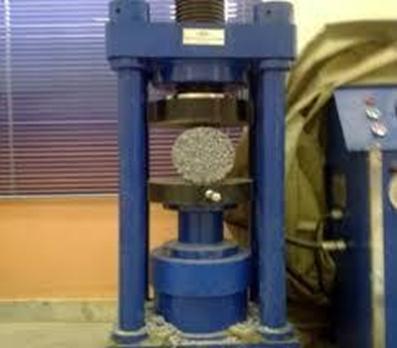
TensileTestingMachine

3.3 Flexural Strength
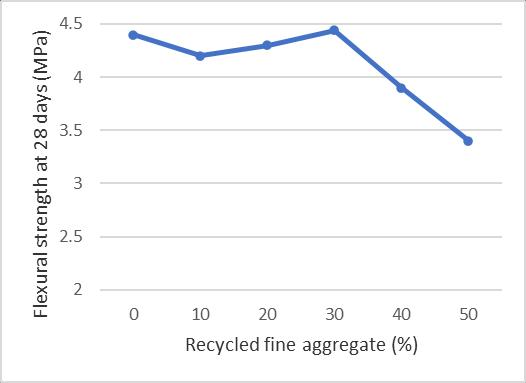
The observed findings show that recycled concrete mixes with50%ofthefineaggregateoffera 20.8%reduction in flexuralstrengthandhigherstrengthcomparedtoreference concrete up to a 30% replacement level [22]. The lower flexural strength would be brought on by the weaker connection between the various elements of the concrete matrix brought on by the cement paste on the surface of recycledaggregates[23].


3. CONCLUSIONS
1. Recycled aggregate concrete absorbs 42% more water thannaturalaggregateconcrete.
2.Thegreaterwaterabsorptionofrecycledfineaggregate had very little impact on the early slump of concrete containingrecycledmaterial.
3. The compressive strength of the 30% replacement concretewas1%greaterthanthatofstandardconcrete.
At 7, 28, and 56 days, concrete's compressive strength is reduced by 20–40% when the replacement level for fine aggregateismadeupmostlyofrecycledmaterial.
4. Flexural strength and tensile splitting on concrete with 30% replacement increased by 0.568 and 5.71%, respectively.Oncethereplacementratioexceeds30%,both tensilesplittingandflexuralstrengthsteadilydecline.
REFERENCES
[1] M. Harikaran, S.Gokulakannan, A. Loganathan, R.D. Chandiran, M. Ajith, V. Dhanasekar, “Metakaolin cement concrete evaluation using industrial by-products as fine aggregate” , Materials Today: Proceedings, 2023, https://doi.org/10.1016/j.matpr.2023.04.586
[2] Adel Gorjinia Khoshkenari, Payam Shafigh , Mahmoud Moghimi, Hilmi Bin Mahmud, “The role of 0–2 mm fine recycledconcreteaggregateonthecompressiveandsplitting tensilestrengthsofrecycledconcreteaggregateconcrete” , MaterialsandDesign,2015
https://doi.org/10.1016/j.matdes.2014.07.048
[3]M.Sanchaya, M.Harikaran, K.Cheran, M.Varoon, P.Jayaprakash,G.Navin,“Experimentalinvestigationonrice husk ash and coconut shell used in building materials” ,
MaterialsToday:Proceedings,2022
https://doi.org/10.1016/j.matpr.2022.08.264
[4] Sajan K.C., Rishav Adhikari, Bharat Mandal, Dipendra Gautam,“Mechanicalcharacterizationofrecycledconcrete under various aggregate replacement scenarios”, Cleaner Engineering and Technology,2022, https://doi.org/10.1016/j.clet.2022.100428
[5] M. Harikaran, P. Kulanthaivel, A.R. Krishnaraja, P.C. Murugan,“Performanceenhancementofconcretebyusing ceramic waste as a partial replacement for coarse aggregate”,JournalofCeramicProcessingResearch,Volume 24,Issue2,266-273.
[6]M.Harikaran,R.Vijayan,P.Senthilkumar,R.S.Suganth,R. Nithishkumar,Vijay,V.“ExperimentalStudyonPropertiesof Paver Block using Coconut Fibre & Nylon Fibre”, Grenze International Journal of EngineeringandTechnology,9, 1, 2023
[7] J.F. Dong , Q.Y. Wang , Z.W. Guan , H.K. Chai, “Hightemperature behaviourof basaltfibre reinforcedconcrete made with recycled aggregates from earthquake waste” , Journal of Building Engineering,Volume 48, 1 May 2022, 103895,https://doi.org/10.1016/j.jobe.2021.103895
[8] M.Harikaran and N.Balasundaram, “Performance enhancementofconcretebyreplacingcoarseaggregatewith tyre rubber: A Study”, Ecology, Environment And Conservation, Vol. 25, Issue No.2 , ISSN No. 0971-765X, pp.702-705,Dateofpublication(January2019)
[9]M.HarikaranandN.Balasundaram,“DeflectionBehaviour ofRCBeamsusingReshapedWasteTyreRubberasPartial ReplacementofCoarseAggregate”,InternationalJournalof RecentTechnologyandEngineering,Vol.8,IssueNo.2,ISSN No. 2277 -3878,Date of publication (July 2019), DOI: 10.35940/ijrte.B3189.078219.
[10] Zhuping Liu, Xingzhong Yuan, Yanlan Zhao, Jia Wei Chew, Hou Wang, “Concrete waste-derived aggregate for concrete manufacture”, Journal of Cleaner Production Volume 338, 1 March 2022, 130637, https://doi.org/10.1016/j.jclepro.2022.130637
[11]P. Keerthana Devi,M. Sanchaya,M.Harikaran, J.Gopi Krishna,V.Kaviyarasan,N.Venkatesh,“Effectiveutilization ofwastepapersludgeashasasupplementarymaterialfor cement”, Materials Today: Proceedings, 2023, ISSN 22147853,https://doi.org/10.1016/j.matpr.2023.05.599.
[12] S. Gokulakannan, M. Harikaran, K. Mounesh, S. Sankaranarayanan, R. Sathishkumar, R. Sivakumar, “Experimentalstudiesondurabilityanddeflectionbehavior of concrete in metakaolin cement concrete”, Materials Today:Proceedings,2023,ISSN2214-7853, https://doi.org/10.1016/j.matpr.2023.05.236.
[13] M. Harikaran, P. Keerthanadevi, S. Inbarasan, N. Tamilan, R. Manimaran, S. Jayavikram, “Experimental examinationofconcreteusinghazardousplastic-fiberand rubber– fiber”, Materials Today: Proceedings, 2023, https://doi.org/10.1016/j.matpr.2023.04.598
[14]MarijaNedeljković,JeanetteVisser,BrankoŠavija,Siska Valcke, Erik Schlangen, “Use of fine recycled concrete aggregates in concrete”, Journal of Building EngineeringVolume38,June2021,102196, https://doi.org/10.1016/j.jobe.2021.102196
[15]B.Sasivarman, Dr.R.Nagalakshmi and Dr.M.Harikaran, “Treatment of wastewater by slow sand process with polystyrene”, Materials Today: Proceedings, https://doi.org/10.1016/j.matpr.2022.08.082
[16] Hamed Dabiri , Mahdi Kioumarsi, Ali Kheyroddin, Amirreza Kandiri, Farid Sartipi, “Compressive strength of concretewithrecycledaggregate;amachinelearning-based evaluation”, Cleaner Materials ,Volume 3, March 2022, 100044,https://doi.org/10.1016/j.clema.2022.100044
[17] M.Harikaran and N.Balasundaram,“Evaluation of Concrete Using Reshaped Waste Tyre Rubber as Partial ReplacementofCoarseAggregate”,InternationalJournalof Recent Technology and Engineering, Vol. 7 ,Issue No.6S5 , ISSNNo.2277-3878,,Dateofpublication(April2019)
[18] Amnon Katz, “Properties of concrete made with recycled aggregate from partially hydrated old concrete” , Cement and Concrete Research Volume 33, Issue 5, May 2003,Pages703-711, https://doi.org/10.1016/S0008-8846(02)01033-5
[19] Dr.R.Shanmugam., Dr.M.Harikaran., S.Gokulakannan., P.KeerthanaDevi. “Compressive Axial Behavior of Short Columns Incorporating Bottom Ash and Reshaped Waste Tyre Rubber”, Journal of Xi’an Shiyou University, Natural ScienceEdition,19,02,2023
[20] Dushyanth V Babu R., Mukesh P., Menka pandey.,HarikaranM.,BalajiG.,MonishaKM,“Experimental StudyOfConcreteByReplacementOfCementWithPolymer Resin”,IOPConf.Series:EarthandEnvironmentalScience, DOI10.1088/1755-1315/1125/1/012014
[21] Dr.M.Harikaran, P.Mukesh, P.Senthil kumar, R.S.Suganth, R.Nithishkumar, V.Vijay, “Study of structural bonding strength with tyre rubber instead of coarse aggregate and water hyacinth ash instead of cement” , Materials Today: Proceedings, Volume 68, Part 5, 2022, Pages1330-1334, https://doi.org/10.1016/j.matpr.2022.06.359
[22] Emmanuel Roziere , Ahmed Z. Bendimerad, Hamza Samouh , Ahmed Loukili,”Assessing the relaxation of recycled aggregates concrete from free and restrained
shrinkagetests”,JournalofBuildingEngineeringVolume64, 1 April 2023, 105549, https://doi.org/10.1016/j.jobe.2022.105549
[23]M.Harikaran,Sampath Boopathi,S.Gokulakannan:M. Poonguzhali,“StudyontheSourceofE-WasteManagement and Disposal Methods, Sustainable Approaches and StrategiesforE-WasteManagementandUtilization”,39-60, 2023,DOI:10.4018/978-1-6684-7573-7.ch003
[24] Sankar. P, P. Suresh, T. Aravind, V.K. Buvanesvari, M. Harikaran, R. Raja, “Investigation on Supply Chain Distribution Network Problem using RFID Technique” , International Journal of Innovative Research in Science, Engineering and Technology (IJIRSET), 12, 1, 2023, DOI:10.15680/IJIRSET.2023.1201094.
[25] Sankar. P, P. Suresh, T. Aravind, V.K. Buvanesvari, M.Harikaran,R.Raja,“AnalysisandOptimizationofSupply ChainTravellingSalesmanProblemUsingK-MeansCluster based Genetic Algorithm”, 12, 1, 2023, DOI:10.15680/IJIRSET.2023.1201095.