EXPERIMENTAL INVESTIGATION ON CONCRETE WITH PARTIAL REPLACEMENT OF AGRO WASTE IN COARSE AGGREGATE WITH WAX CURING
ABSTRACT : This study focus and generating the product using agro waste (or) agricultural waste has well develop and alternative construction material. Every year the world produces millions of tons of waste, the majority of which is not recyclable. Recycling garbage also require energy and emits pollution. Coconut shell are major agricultural waste that is heavily available and can be easily assessed in many tropical countries. Due to the depletion of natural resources and also increasing the water scarcity many researches have made focusing on an alternative materials of ingredients in concrete. In this row replacement of coarse aggregate by coconut shells and curing by wax were tried. Concrete cubes had casted using coconut shell as a partial replacement of the coarse aggregate in the proportion of 10%, 20%,30% replacement.
Key Words: Coconut Shell, Compressive Test, Fine Aggregate, Coarse Aggregate, Wax Curing
1.INTRODUCTION
For the majority of civil engineering projects, concrete is a widely utilised building material made of cement, coarse aggregates, and fine aggregates combined withwater,whichhardensovertime.Buildingconstruction hasincreasedasaresultofthepopulationincreaseandthe quickprogressofglobalisation,whichhasraisedtheneedfor constructionmaterials.
The part of the concrete's coarse aggregate that consists ofthe bigstonesincorporatedintothemixture is called coarse aggregate. Coconut shell can be used in this project to partially replace the coarse aggregate with wax curing.
1.1 AGRO WASTE
Agrodebris,sometimesreferredtoasagricultural waste or crop residue, is a term used to describe the remnants or leftovers produced during agricultural operations.Itconsistsofavarietyoforganicwasteproducts made during farming, including crop stalks, husks, leaves, stems, shells, and other agricultural waste. Agro waste is oftenproducedaftercropsareharvested,anditdiffersbased onthetypeofcropandfarmingtechniques.Ricehusks,corn stalks,sugarcanebagasse,wheatstraw,coconutshellsand fruitpeelsareafewtypicalformsofagriculturalwaste.
India's substantial agricultural sector makes agro waste a seriousproblemthere.
Crop residues, coconut shells, sugarcane bagasse, cotton stalks, and oilseed residues are some of the primary agriculturalwastesourcesinIndia.
1.2 COCONUT SHELL AS A AGRO WASTE
Indiaisoneofthecountriesthatproducesthemost coconutsglobally,whichresultsinabigvolumeofgarbage fromcoconutshells.Aspreviouslyindicated,coconutshells can be used for a variety of purposes, including the manufacturingofactivated carbon,charcoal,andconcrete aggregates.
Afterthecoconuthasbeenprocessedtogenerateits final goods, manufacturers or farmers either collect the leftovergarbageorcoconutshellsfordisposalorleavethem alone.Thebiggesthazardtoourenvironmentmightnotbe thegarbagefromcoconuts.Thecoconutshellswillstillbe difficulttodisposeofiftheyarenotrecycled.Duetoitshigh content of lignocelluloses, which are the primary componentsofplantcellwalls,thecoconutshelldegrades relativelyslowly.
1.3. OBJECTIVE OF THE PROJECT
Themainobjectiveistoencouragetheuseofthese productsasconstructionmaterialinbuilding.
To evaluate the coconut shells with wax curing, compressivestrengthat7days,14daysand28days byreplacinginconcrete.
To reduce the usage of the aggregates and water requirements

To reduce the cost of construction without compromisingthequality.
Toeffectivelyutilizethenaturalwastematerial.
Toreducethedepletionofnaturelresources.
1.4 ADVANTAGES COCONUT SHELL
Coconutshellaremoreresistanttowardscrushing impactandabrasion
Itpromotesgreenconstruction.
Recycling and reusing waste effectively thus protectingtheenvironmentfrompossiblepollution effect.
Tointroduceanewaggregateinthemixdesignto lowertheconcretedensity.
Coconut shells needs no pretreatment, except for waterabsorption.
1.5 ADVANTAGE OF WAX
Easytoapply,saveslaborcosts
Doesnotaffectthesettingtimeofconcrete.
Doesnothaveanycontaminantslikechlorides,etc.,
Eliminates use of water, hessian or polyethylene filmcompletely

Improved caring of concrete helps in providing a moredurableconcrete
Excellent solar reflectance, which keeps the concretetemperaturelow,
especially helpful during the early stages of concretehydration.
2.MATERIALS USED
Cement
FineAggregate
CoarseAggregate
CoconutShell
EpoxyResin
Water
Wax
2.1CEMENT
Cement can be defined as the bonding material having cohesive & adhesive properties which makes it capable to unite the different construction materials and form the compacted assembly. today ordinary Portland cement is the most widely used building material in the world. the commonly used Portland cement in India is branded as 33 grade [ IS: 269-1989], 43 grade [IS: 81121989, 53 grade [IS :12269-1987] having 28days mean compressivestrengthexceeding33Mpa,43Mpa,and53Mpa respectively. here we used 53 grade Ordinary Portland CementconformingIS12269:1987.
2.2FINE AGGREGATE
Fineaggregategenerallyconsistofnaturalsandor crushedstone.Naturalsandistheaggregateresultingfrom the natural disintegration of rock and which has been deposited by streams or glacial agencies. The code to be referredtounderstandthespecificationforfineaggregateisIS 383:1970.NaturalsandconfirmsgradingzoneII.Accordingto size, the fine aggregate may be described as coarse sand, mediumsandandfinesand. Thesandisgenerallypassing through 4.75mmISsieveand retainedon2.36mmISsieve especially we use medium sand having a bulkdensity of 1680kg/m3. The physical properties of sand are specific gravity, bulk density, sieveanalysis, fineness modulus etc., weredeterminedas
2.3 COARSE AGGREGATE
Coarseaggregatecanbedefinedasinertgranular materialsobtainedaftercrushingastone.Coarseaggregate wasusedofsize20mmconformingtoIS383isused.Coarse aggregatespassingthrough20mmandretainedon12.5mm sieveareusedintheexperiment.Good-qualityofaggregate whichisclean,hard,strong,havedurableparticles,andbe freeofabsorbedharmfulchemicals,coatingsofclay,orother contaminatesthatcanaffecthydrationofcementorreduce thepaste-aggregatebond.
2.4 COCONUT SHELL
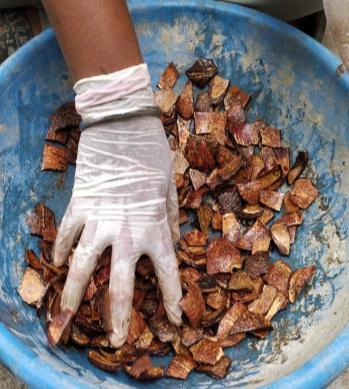
Coconutshellsfromanearbytemplewereusedin the study. Before employing the coconut shells as an aggregate, they are sun-dried for five days. Sandpaper is usedtocleanthecoconutshell,andwaterisusedtoclean thetinyabrasionsontheoutsidefaceofthecoconut.
Theoutershellisthendividedintopiecesassmall as20mm.Withtheuseofa30kghammer,coconutshells arebroken.Followingthat,anIS20mmsieveisusedtofilter the shattered pieces, and an IS 12 mm sieve is utilised to keepthepieces.
2.5 EPOXY RESIN

Epoxyresincoatsthesurfaceandpreventsitfrom absorbing water while also altering the aggregate's characteristics.Epoxyresinisutilisedasabinderforhighfriction aggregate and as an adhesive to connect it to the pavementduetoitshighadhesivecapabilities.Forfurther robustness,coconutfibresarenaturallycoatedwithepoxy resin.Increasedflexuraleffectsfromcoconutshell.
Athickcoatingwilllubricatetheskinandimpairthe bond with the concrete; thin coatings are required to be placed.Epoxyresinwasusedasthesortofcoatingonthe coconutshell,anditwasappliedwithapaintbrushutilisinga catalystandreagenttospeedupthehardeningprocess.To haveanexcellenttime
Function
Cementhydrationprocessdemandsthatwaterbe presentinthesystemCuringisadoptedtopreventtheloss of water from the hardening concrete, so that strength developmentisnotimpaired.Conventionalcuringmethods like sprinkling, ponding or damp covering is not reliable because they depend heavily on environmental condition uncontaminatedwaterandmanpower.CERAPOLYCURE-W entrap the moisture within the concrete by formation of barrierinformoffilmontheconcretesurface.Thefilmdoes notleavemoistureoutofthesystemtillhydrationproceeds toitscompletion.
The strength of concrete is largely dependent on water. It needs around 3/10th of its weight in water to hydrate completely. It has been demonstrated in practise thatstandardconcreteneedsawater-cementratioof0.48at the very least. Cement and water interact chemically, creatingcementpastethatbindswithbothcoarseandfine particles. if additional water is utilised. The concrete weakensduetosegregationandbleeding,butthemajorityof thewaterwillbeabsorbedbythefibres.So,itcouldprevent bleeding. Water content that is too high might result in bleeding. The needed workability cannot be attained with less water. To utilise water in the concrete, it must be potableandsuitablefordrinking.
CERA POLYCURE-W is a wax based curing compound which when applied on concrete forms a seamlessfilmandpreventstheevaporationofmoisturefrom thecapillariesofconcrete.

Appearance White liquid
Specificgravity@29C 1.02±0.01
Viscosity@27°CFordcupNo:4 17
Waterlossafter72hoursASTMC 156 Not more than 0.48kg/Sqm.
Reflectance,% 80
Dryingtime
Lessthan3Hrs
Solidcontent 26%
3. PREPARATION OF MIX DESIGN
Differenttypesofmixeswerepreparedbychangingthe percentage of replacement of coarse aggregate by coconut shell. Total 4 types of mixes are prepared along with conventionalmixes.Thecoarseaggregatesarereplacedby 10%,20%and30%ofcoconutshellwithwaxcuring.
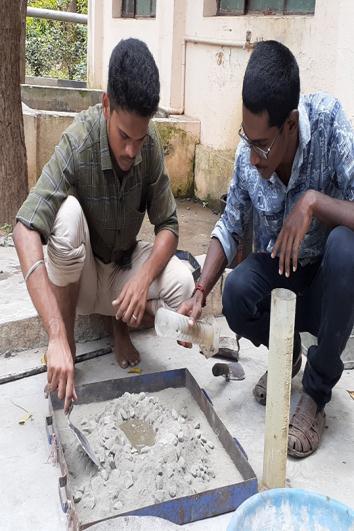

Table: 2 - Details of Aggregate Replacement
Concrete mix design is the process of finding the proportions of concrete mix in terms of ratios of cement, sand and coarse aggregates. For eg, a concrete mix of proportions 1:1.5:3 means that cement, fine and coarse aggregate are in the ratio 1:1.5:3 or the mix contains one partofcement,oneandhalfpartoffineaggregateandthree partsofcoarseaggregate.
3.1 CASTING:
Theacceptancecriteriaofqualityconcretearegivenin IS-456. In all the cases, for check of the criterion for acceptance or rejection of the concrete is the compressive strengthat28-days.7dayscompressivestrengthofconcrete canalsobeusedtogetarelativelyquickerideaofqualityof concrete.Forthecompressionstrengthtesting,fourcastings werecompletedwith0%,10%,20%and30%replacementof natural coarse aggregates. In every casting number of six cube specimens of dimension 150 x 150 x 150 mm were castedfortestingofcompressionstrengthat7daysandat28 days.

After24hours,thecubemustbetakenoutofthemoulds andsubmergedincleanwaterheatedtobetween240and 300degreesCelsiusuntilitis7,14,or28daysoldandready fortesting.Thecubesmustundergotestinginbothsaturated anddry-on-the-surfaceconditions.

Extracubesmustbecast,stored,andcuredinconditions identical to those of the structure in order to accurately representthestrengthoftheconcreteinthatstructure.They mustthenbetestedattherequisiteage.
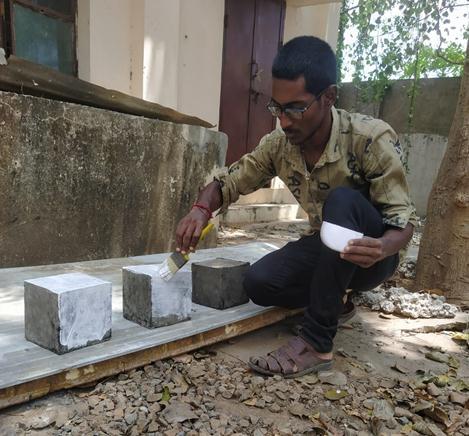
Make sure the concrete surface has been well cleaned with water after the formwork has been removed before applyingCERAPOLYCURE-W.
Makesurethetreatedsurfaceismechanicallycleansed beforeplasteringorpaintingtopromotebetteradherence. For larger parts, spray application is advised; for smaller sections,brushesandrollerscanbeutilised.
Whenappliedtoconcrete,CERAPOLYCURE-W,a waxbased curing chemical, creates a smooth layer and stops moisturefromevaporatingfromtheconcrete'scapillaries.


As soon as the formwork has been removed or the elementhasbeendemolded,CERAPOLYCURE-Waxshould besprayedontoallsurfaces.
Specimensofsize150x150x150mmwerecastedforall theproportionsandtestedcompressiontesting machine. Capacity of machine is 2000KN.Compressive strengthcalculatedbyusingequation
F = P/A
Where,
F=compressivestrengthinN/mm2
P=maximumloadinNewton
A=crosssectionalareainmm2
Procedure
Preparetheconcreteintherequiredproportionsand make the specimen by filling the concrete in the desired mouldshapeof150mmx150mmx150mmcubewithproper compaction,a24hoursplacethespecimeninwaterforcuring
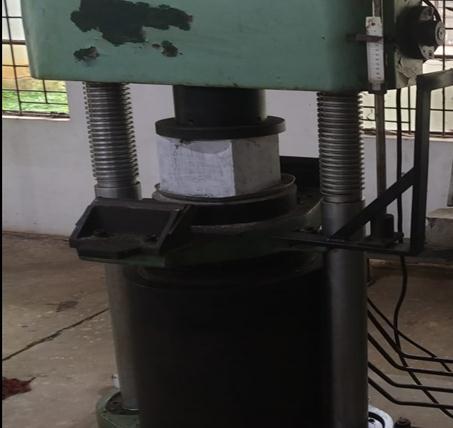
Take away the specimen from water when such as naturalprocesstimeandwipeoutexcesswaterfromthe surface.

Takethedimensionofthespecimentotheclosest0.2m. Cleanthebearingsurfaceofthetestingmachine
Placethespecimenwithinthemachineinsuchafashion that the load shall be applied to the other sides of the cubeforged.
Alignthespecimencentrallyonthebottomplateofthe machine
Rotatethemovableportiongentlybyhandsoittouches thehighestsurfaceofthespecimen.
Apply the load step by step while not shock and incessantlyatthespeedof140kg/cm²/minuteuntilthe specimen fails. Record the utmost load and note any uncommonoptionswithintheformoffailure
Recordtheutmostloadandnoteanyuncommonoptions withintheformoffailure
4. CONCLUSIONS
This study intended to find the effective ways to reutilize the waste particles as coarse aggregate and minimizethewaterrequirement.Itisalsoobservedthatthe compressive strength of concrete is found to be optimum whencoarseaggregateispartiallyreplacedbycoconutshell andbywaxcuring.Intheprojectanattempthasbeenneed tostudythestrengthpropertiesofM20gradeconcrete.

The quantity of specimens and the tests to be conducted have been predetermined. The percentage of replacement 10%, 20%, 30% in coconut shell with wax curing.
Fromtheabove experimental work,thefollowing conclusionsweremade.
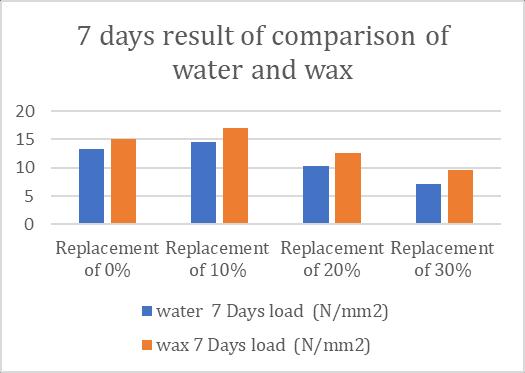
The maximum compressive strength has been achievedby10%forpartial replacementofcoconutshell withwaxcuringfoundtobegreaterthantheconventional concrete.
It is observed that the strength is gradually decreasingat20%&30%replacementofcoconutshell.
Soweconcludethatthecoarseaggregatereplaced with coconut shell at 30% in concrete is not suitable for construction.
5. REFERENCES
[1].ACICommittee305,Hot-WeatherConcreting,ACI305R99,AmericanConcreteInstitute,FarmingtonHills,Michigan, 1999.
[2]. ACI Committee 306, Cold-Weather Concreting, ACI 306R-88, Reapproved 1997, American Concrete Institute, FarmingtonHills,Michigan,1997.
[3]. ACI Committee 308, Standard Practice for Curing Concrete,ACI308-92,Reapproved1997,AmericanConcrete Institute,FarmingtonHills,Michigan,1997.
[4] ACICommittee330,GuideforDesignandConstruction of Concrete Parking Lots, AC 330R-92, Reapproved 1997.AmericanConcreteInstitute,FarmingtonHillMichigan, 1997.
[5]. ACI Committee 362, Guide for the Design of Durable Parking Structures, ACI 362.12. 97. American Concrete Institute,FarmingtonHills,Michigan,1997.
[6]. ACI Committee 516. "High Pressure Steam Curing: Modern Practice and Properties d Autoclaved Products, "ProceedingsoftheAmericanConcreteInstitute,Americas ConcreteInstitute,FarmingtonHills,Michigan,August1965.
[7] ASTM Designation C 150 - 05 (2005). Standard Specification for Portland Cement. Annual Book of ASTM Standards,AmericanSocietyforTestingandMaterial.[10] BritishStandardInstitution.TestingFreshConcrete.Slump Test.BSEN12350-2:2009.
BIOGRAPHIES
First Author: Mr.S.Balaji, B.ECivilEngineering,A.V.Ccollege of Engineering, Mannampanda), Tamilnadu.

Second Author: Mr. S. Kalaiyarasan, B.ECivilEngineering,A.V.Ccollege of Engineering, Mannampandal, Tamilnadu.


Third Author:Mr.K.Dhineshbabu, B.ECivilEngineering,A.V.Ccollege of Engineering, Mannampandal, Tamilnadu.
FourthAuthor: Mrs. K Ashwini, Assistant Professor, Department ofCivil Engineering, A.V.C college of Engineering, Mannampandal, Tamilnadu.