Protection of Secret Textual Data Using Steganography Based System
Khalid Buryk S Alqarni Bishah University, Faculty of computing and Information Technology, Department of Cybersecurity, Bishah City, Saudi Arabia***
Abstract – Recently, capabilities of attackers have been increased dramatically in terms of compromising secret data exchangedamongusersovertheInternet.Usingcryptographic approaches contribute to ensure confidentiality of data, but they do not provide secrecy of communication between the connected parties. Steganography can be used to strengthen cryptographic approaches by hiding secret data within innocent audios after passing an encryption stage. This adds secondlevel of protection against attacks as well ashidingthe communication itself between sender and receiver. This work proposed an enhanced steganography-based approach to protect secret data by embedding within audio files. Encryption using 3-DES is employed to createthefirstdefense, while hiding in Least Significant Bit (LSB) creates the second defense with respect of ensuring high matchingbetweencover file and stego file, high resistance against attacks, and high accuracy of retrieving the hidden data. The proposed approach achieves better performanceintermsofPSNR,SSIM, and correlation.
Key Words: Cover_object, Hidden_Data, Stego_key, Stego_object,LSB,Attacker.
1.INTRODUCTION
Steganography and the logic behind it. Steganography isthetechniqueofhidingsecretdatawithinanordinary,nonsecret,fileormessageinordertoavoiddetection.Thelogic behinditisrelatedtothefactthatstates"everythingstored onthecomputerisconvertedintozerosandones",andthus, itispossibletohidezerosandones(secretdata)withinother zerosandones(otherfiles)[1]
Terms in steganography domain. Secretdata,whichis thedatathatrequiresprotectionagainstmaliciousactions, suchasillegalmodificationandunauthorizedaccess.CoverObject, which is the file that hosts the secret data. StegoObject, which is the file that is generated as an output of performinghidingprocess.Stego-Key,whichisthekeythatis usedforencryptingsecretdata[2].
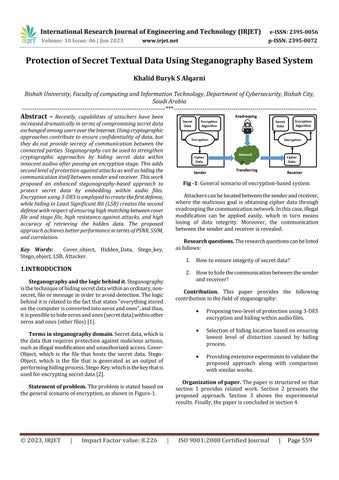
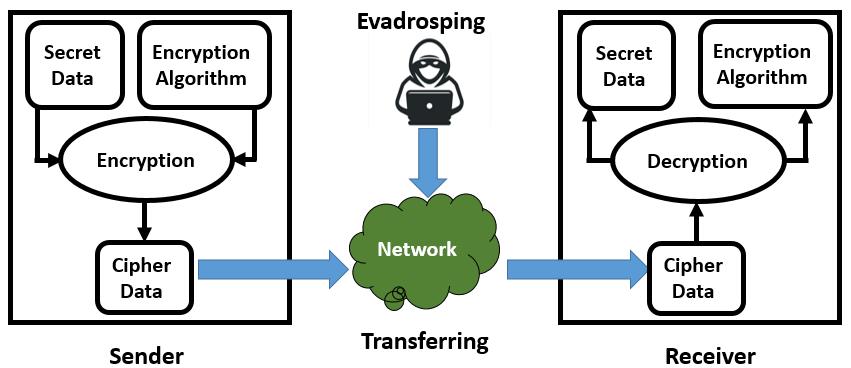
Statement of problem. Theproblemisstatedbasedon thegeneralscenarioofencryption,asshowninFigure-1.
Attackerscanbelocatedbetweenthesenderandreceiver, where the malicious goal is obtaining cipher data through evadrospingthecommunicationnetwork.Inthiscase,illegal modification can be applied easily, which in turn means losing of data integrity. Moreover, the communication betweenthesenderandreceiverisrevealed.
Researchquestions Theresearchquestionscanbelisted asfollows:
1. Howtoensureintegrityofsecretdata?
2. Howtohidethecommunicationbetweenthesender andreceiver?
Contribution. This paper provides the following contributioninthefieldofsteganography:
Proposingtwo-levelofprotectionusing3-DES encryptionandhidingwithinaudiofiles.
Selectionofhidinglocationbasedonensuring lowest level of distortion caused by hiding process.
Providingextensiveexperimentstovalidatethe proposed approach along with comparison withsimilarworks.
Organization of paper. Thepaperisstructuredsothat section 1 provides related work. Section 2 presents the proposed approach. Section 3 shows the experimental results.Finally,thepaperisconcludedinsection4.

International Research Journal of Engineering and Technology (IRJET) e-ISSN: 2395-0056
Volume: 10 Issue: 06 | Jun 2023 www.irjet.net p-ISSN: 2395-0072
2. RELATED WORK
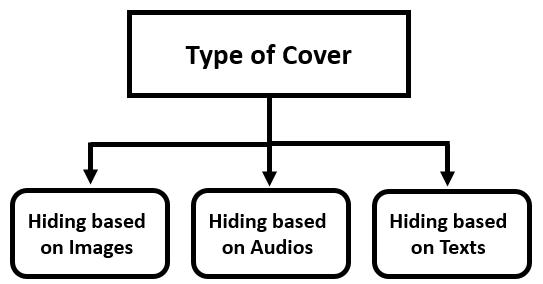
This section provides the state of the art. Systems of steganographycanbeclassifiedbasedonthetypeofcover,as showninFigure2.
encrypted using Huffman encryption to be embedded in convertedaudiofile Finally,embeddingisperformed.The extractionphaseisperformedusingIDCTtransformation.
2.3 Hiding based on texts
UsingHiditextascover,asteganography-basedsystemis proposed in [10]. The key idea behind this system is to replacethefirstletterofeachwordbyaletterfromsecret message.Specialfeatureofthissystemisrelatedtoconvert numbers incover intotextto increasethespaceofhiding. Similarly, [11] provided an approach to embed a secret informationwithinArabicandPersiantextfiledependingon severalintersectionsbetweenthesetwolanguages.Intheir proposedwork[12],researcherspresentedaschemebased on cryptography using SSCE, where the secret key will be directlyexchangedbetweenthesenderandreceiverforboth hidingandextractingasecretmessageusingRSAalgorithm
3. PROPOSED SYSTEM
2.1 Hiding based on images
The problem that authors of [3] handled is related to small size of payload (hidden secret data) that can be inserted in the cover file. The proposed system mainly depends on spreading bits of secret data on all pixels of image cover not only on LSB. they used pixel indicator techniqueforrandomizing.Protectingsecretdatabasedon onelevelonlyisthemainissuethattheresearchersofthe work [4] targeted. They strengthen steganography-based levelofprotectionbyencryptionlevelusingAESalgorithm. However, the basic disadvantage is related to high complexityintheprocessofextraction.Infrequencydomain, anapproachispresentedinthework[5],whereitusesDCT transformation to hide the secret information in the high frequency coefficients for the purpose of achieving stegoimageofhighquality
2.2 Hiding based on audios
In [6] a dual-protection approach is provided, where a levelofencryptionforhidingdataiscreatedbasedonASCII codingbeforeinsertingthesecretmessagewithinthesignal ofaudiofile.Although[7]achievedsteganographydepending onLSB,itsfinalobjectivewasprovidingtestingenvironment forsteganographysystemsthatuseaudiofilesascovers.The experiments conducted within the proposed environment proved that LSB technique was weak against rotation and compressionattacks.Inaddition,LSBissimpleintermsof implementation and may include some code-based vulnerabilities. Relying on modified Vigeneve cipher algorithm, authors in work [8] took intoconsideration the importanceofaddingalevelofsecuritytoprotectsecretdata. However, they only applied this approach on textual data ignoring other types of data. The system proposed in the work[9]startstoconverttheaudiofileintofrequenciesin wavedomainusingDCTtransformation.Then,secretdatais
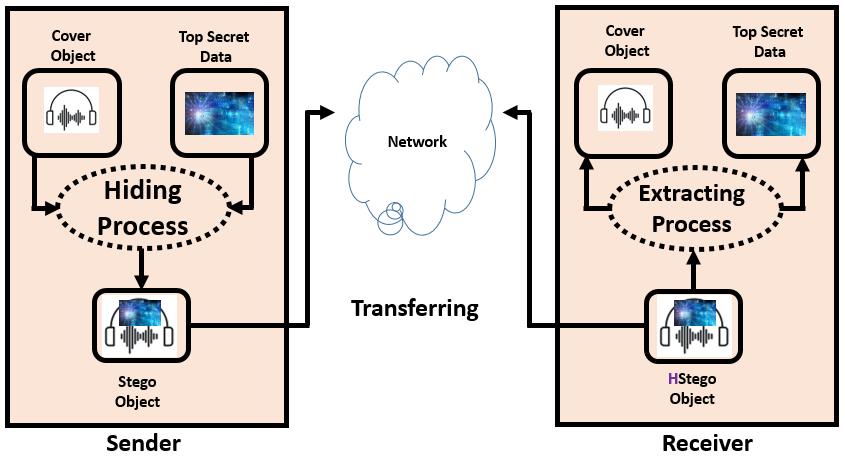
Theproposedsystemconsistsoftwomainphases,which arehidingphaseandextractionphase.Figure3providesthe structureoftheproposedsystem.
3.1 Actions at sender side

Themainactionperformedatthesendersideishiding.It isexpressedaccordingtothefollowingformula:
(Cover_Object)+(Hidden_Data)=Stego_Object (1)
To achieve double protection and to answer the first researchquestion,3-DESencryptionalgorithmisemployed. The secret data is encrypted first before performing the hidingprocess.AsshowninFigure4.
3-DESalgorithmworksasfollows:TripleDESoperatesin three steps: Encrypt-Decrypt-Encrypt (EDE). It works by taking three 56-bit keys (K1, K2 and K3) known as a key bundleandencryptingfirstwithK1,decryptingnextwithK2 and encrypting a last time with K3. A Triple DES two-key versionexists,wherethesamealgorithmrunsthreetimes butK1isusedforthefirstandlaststeps[13].Therefore,K1 willbethemasterkey.
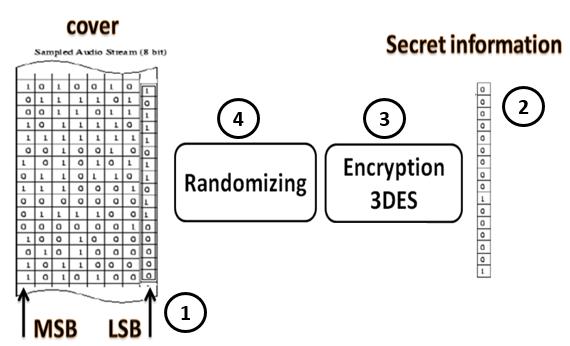
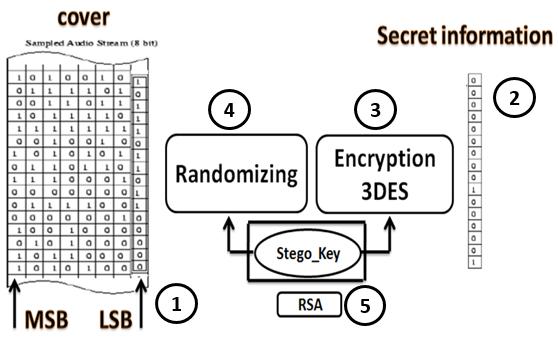
Toanswerthesecondresearchquestion,LeastSignificant Bit(LSB)techniqueisutilized.ThekeyideabehindtheLBS techniqueistohidethebitsofsecretdatawithinthefirstbit ofeachsampleaudio.Thelogicbehindthisbasedonthefact thatstates"thestartpointofanaudioincludessomesilence spots during recording". This means that it is a suitable locationforhidingsinceitleadstolowestlevelofdistortion. LBSrepresentsthesecondlevelofprotection.Figure5shows whereLSBbitsarelocatedwithinagivenaudiofile.
ThefirststepistodefinetheLBScolumnwithintheaudio cover file. This is done by analyzing the audio file after convertingittobinarymod.Thesecondstepistoobtainthe bits of the secret data. This can be done by some skills in programmingorusingsometoolsavailableontheInternet.
Toachievedoublelevelofprotection,bitsofsecretdata areencryptedbeforehiding.However,attackerscanobtain theLSBcolumnandmodifyit,whichmeansloosingintegrity. To solve this problem, a randomization step is added, as showninFigure7.
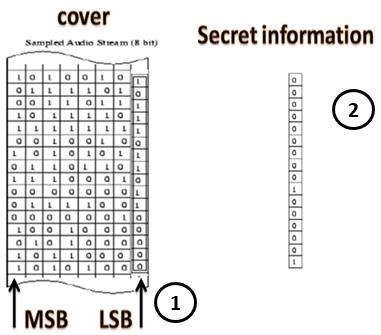
AsshowninFigure5,LSBlocatedinanarraythatweights the least when compared to other locations, which inturn meansthatifLBSbitsarereplacedormodifiedthedamage will be minimum. In contrast, any alternation in Most SignificantBit(MSB)leadstomaximumdamageordistortion.
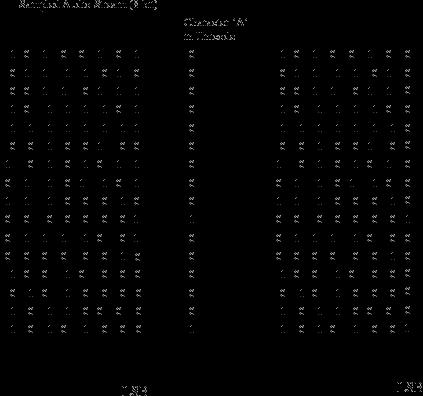
After determining thelocation of hiding which ensures minimum distortion, hiding process starts as described below.Figure6illustratesthefirsttwosteps.
Here,eventheattackertriestoobtainLSB,hewillfacea problemofreconstructing(orreforming)LSBinthecorrect order. In other words, he needs to know the algorithm of randomization.
3-DES algorithm has a key and also randomization algorithm. There is a need for safely exchange the keys
betweensenderandreceiver.Inthiswork,thesamekeyused for encryption is also used as a seed of the randomization algorithm. RSA algorithm is employed for the purpose of safelyexchangethekey(calledStego-key).RSAalgorithmis performed based on four steps (supported by Java statements)[14].Asdescribedbelow.
RSA algorithm
Step 1: ConstructiontheRSAmodel
Theprocessstartswithselectionoftwoprimenumbers (RandO),andthencalculatingtheirproductW,as:
W=R*O (2)
Step 2: DerivedNumber(S)
Considernumber(S)asaderivednumberthatsatisfies thecondition>1andlessthan(R-1)and(O-1).Theprimary conditionwillbethatthereshouldbenocommonfactorof (R-1)and(O-1)except1
Step 3: Publickey
Thespecifiedpairofnumbers(W)and(S)formstheRSA publickeyanditismadepublic.
Step 4: PrivateKey
PrivateKeyViscalculatedfromthenumbersR,OandS. The mathematical formula that adjusts the numbers is as follows:
SV = 1 mod (R-1) (O-1) (3)
Encryption and decryption using RSA
Encryption Formula:
Consider a sender who sends the plain\clear\readable textMSGtosomeonewhosepublickeyis(W,S).Toencrypt theplaintextMSG,werelyonthefollowingexpression:
CPH=RSmodW (4)
Decryption Formula:
The decryption process is very straightforward and includesanalyticsforcalculationinasystematicapproach. Receiver(K)hastheprivatekey,theresultmoduluswillbe calculatedas:
Plaintext=KmodW (5)
Figure8showsthewholeprocessofhidingthatachieves twolevelofprotection.
From mathematical point of view, hiding process is expressedbythefollowingformula:
Cover_Object+Hidden_Data+Stego_Key=Stego_Object (6)
3.1 Actions at receiver side
Atthereceiverside,extractionprocessisperformed.This includes extracting LSB firstly. Then, revising the randomization algorithm to reconstruct the correct LSB. Finally,theconstructedLSBisdecryptedusingStego-keythat issafelyexchangedusingRSAalgorithm.Extractionprocess is expressed by the following formula from mathematical perspective:
Stego_Object+Stego_Key=Hidden_Data (7)
4. Experimental results
Thissectionprovidestheresultsbasedonsomemetrics andalongwithcomparisonwithsomesimilarworks.
4.1 Setup
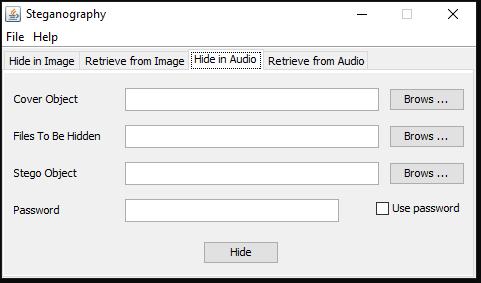
The proposed steganography system is implemented using Java programming language. The following screen showsthemaininterfaceofthesystem.
Fromprogramingpointofview,Table1summarizesthe usedclasses.
Table -1: Usedclasses
BitErrorRate[17]whichcalculatestheamountofnoise causedbyhiding.Itisgivenbythefollowingformula:
send bits of number total errors of number
4.3 Results
Weusedsongaudiofile(downloadedfromtheInterne)to represent thecover. To ensure coveringall types ofsecret data,atextfileiswrittenmanually(containing5linestaken fromthisarticle),anothersongaudiofile,andanimagetaken bymobilephone. Table2providestheobtainedresults.
Table -2: Results.
4.2 Security metrics
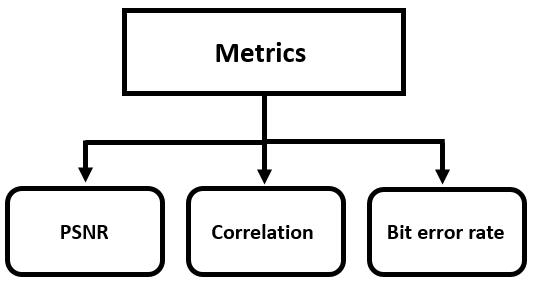
Threemetricsareusedforthepurposeofevaluatingthe proposedsystem,asillustratedinFigure10.
AsshowninTable2,thelowestBERisgeneratedwhen hidingsecretdataastexts.Actually,mosttypeofsecretdata is textual form. To evaluate the ability of hiding of the proposed system without increasing the level of BER dramatically, the text file of the secret data is duplicated. Table3summarizestheresults.
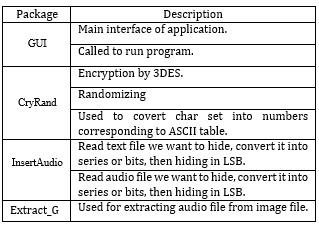
Table -3: Resultsunderduplicatedtextfileofsecretdata.
PSNR [15]measuresthePeak Signal toNoiseRatio.It needstocalculateMSE.Itisgivenbythefollowingformula:
To measure the quality of our proposed system, correlation [16] is used, which measures the similarity between the cover and stego_object. It is given by the followingformula:
Table2showsthatthereisasmallamountofincreasing intheBER.Thismeansthattheproposedsystemissuitable forhidingsecretdataoftextualform.
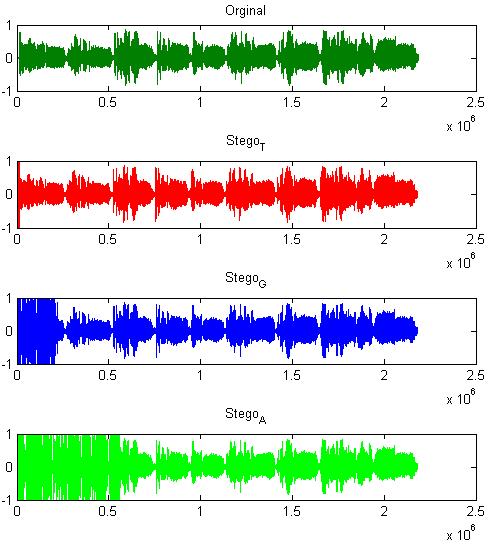
Visually,theaudios(coverandStego-object)areevaluated basedonthewaveform,asshowninFigure11.
Figure11showsthatthereisasmallchangeinthewave oforiginalaudio(cover)andtheStego-objectwhenhiding textual secret data. Thissupportsthe results obtainedand summarizedinTable3.
5. CONCLUSION
In this work, a double-level protection technique is proposedusingencryptionandsteganography.Thefirstline ofdefenceisrepresentedbyencryptionofsecretdatabefore hiding.Thesecondlineofdefenceisrepresentedbyhiding process.Anadditionalconfusionisaddedtofacetheabilityof attacker when it comes to talking about obtaining theLSB bitsfromtheStego-object.Resultsshowedthattheproposed system provides lower level of BER and it is suitable for hidingtextualsecretdata.
Asafuturework,theproposedsystemwillbeenhanced based on deep learning techniques to discover the best locationofhiding.
REFERENCES
[1] Chanu, Yambem Jina, Themrichon Tuithung, and Kh Manglem Singh. "A short survey on image steganographyandsteganalysistechniques." 2012 3rd National Conference on Emerging Trends and Applications in Computer Science.IEEE,2012.
[2] Hashim,Mohammed,MOHDSHAFRYMOHDRAHIM,and ALI ABDULRAHEEM ALWAN. "A REVIEW AND OPEN ISSUES OF MULTIFARIOUS IMAGE STEGANOGRAPHY TECHNIQUES IN SPATIAL DOMAIN." Journal of Theoretical & Applied Information Technology 96.4 (2018).
[3] Pan, Yi-Lun, and Ja-Ling Wu. "Rate-Distortion-Based Stego:ALarge-CapacitySecureSteganographyScheme forHidingDigitalImages."Entropy24.7(2022):982.
[4] Sakshi,Sakshi,etal."LeastSignificantBitSteganography for Text and Image hiding." 2022 3rd International ConferenceonIntelligentEngineeringandManagement (ICIEM).IEEE,2022.
[5] Xu, Youmin, et al. "Robust invertible image steganography." Proceedings of the IEEE/CVF Conference on Computer Vision and Pattern Recognition.2022.
[6] Abdulkadhim, Hussein Abdulameer, and Jinan Nsaif Shehab."Audiosteganographybasedonleastsignificant bits algorithm with 4D grid multi-wing hyper-chaotic system." International Journal of Electrical and ComputerEngineering(IJECE)12.1(2022):320-330.
[7] Mahmoud, Mahmoud M., and Huwaida T. Elshoush. "EnhancingLSBUsingBinaryMessageSizeEncodingfor High Capacity, Transparent and Secure Audio Steganography–AnInnovativeApproach."IEEEAccess 10(2022):29954-29971.
[8] Geleta, Margarita, et al. "Pixinwav: Residual steganographyforhidingpixelsinaudio."ICASSP20222022 IEEE International Conference on Acoustics, SpeechandSignalProcessing(ICASSP).IEEE,2022.
[9] Abood, Enas Wahab, etal."Audiosteganography with enhancedLSBmethodforsecuringencryptedtextwith bit cycling." Bulletin of Electrical Engineering and Informatics11.1(2022):185-194.
[10] Thabit, Reema, et al. "CSNTSteg: Color spacing normalization text steganography model to improve capacityandinvisibilityofhiddendata."IEEEAccess10 (2022):65439-65458.
[11] Osman, Omnia Mohammed, et al. "Hybrid multistage framework for data manipulation by combining cryptographyandsteganography."BulletinofElectrical EngineeringandInformatics11.1(2022):327-335.
[12] Roy,Sangita,andManiniManasmita."Anovelapproach toformatbasedtextsteganography."proceedingsofthe 2011 international conference on communication, Computing&Security.2011.
[13] Ardiansyah, Giovani, Christy Atika Sari, and Eko Hari Rachmawanto."Hybridmethodusing3-DES,DWTand LSBforsecureimagesteganographyalgorithm."2017 2nd International conferences on Information Technology, Information Systems and Electrical Engineering(ICITISEE).IEEE,2017.
[14] Zhou, Xin, and Xiaofei Tang. "Research and implementation of RSA algorithm for encryption and decryption." Proceedings of 2011 6th international forumonstrategictechnology.Vol.2.IEEE,2011.
[15] Sara, Umme, Morium Akter, and Mohammad Shorif Uddin."ImagequalityassessmentthroughFSIM,SSIM, MSE and PSNR a comparative study." Journal of ComputerandCommunications7.3(2019):8-18.
[16] Kasetty,PraveenKumar,andAniruddhaKanhe."Covert speech communication through audio steganography using DWT and SVD." 2020 11th International Conference on Computing, Communication and NetworkingTechnologies(ICCCNT).IEEE,2020.
[17] AlSabhany, Ahmed A., et al. "Digital audio steganography: Systematic review, classification, and analysis of the current state of the art." Computer ScienceReview38(2020):100316.
BIOGRAPHY
Khalid: receivedtheB.S.degree incomputersciencefromBishah Universityin2016,andtheM.S. degrees in cybersecurity from Bishah University in 2022. His current research interests include information security, IoT, artificial intelligence and deeplearning.