Performance of overburden waste rocks as aggregate in concrete
Ashwini R. Raut1, Dr. Bhushan H. Shinde2 1M.Tech Structural Engineering G.H.Raisoni University Amrawati 2Assistant Professor, Dept. of Civil Engineering, G.H.Raisoni University Amrawati, Maharashtra, IndiaAbstract - The objective of this research study was to investigate sustainable aggregate replacements in concrete. Waste overburden rock from the mining industry was added as a coarse-aggregate replacement by 0%, 15%, 30 %, 45%, 60% and 75 %. This has the potential to reduce material cost while having a beneficial impact on the environment. Mechanical properties of concrete were evaluated and the results were analyzed using SPSS. The study involves 130 concrete specimens with various combinations of these materials, which were prepared, cured, and tested. The mechanical properties, including compressive strength, tensile strength, and modulus of elasticity of concrete were investigated and compared to those of ordinary concrete. The results were numerically analyzed indicating the R2 coefficient, which provided a consistency of 0.77 indicating positive results for the replaced concrete. A generalized formula was developed for analyzing the strength, in linear form, which indicated decreased concrete strength, while remaining useful up to 50% replacement. The aggregate improved the mechanical properties of concrete and can potentially replace up to 50% of natural coarse aggregate. A combination of overburden waste dumps can be used to allow replacement of coarse aggregate in concrete by 50% with considerable in concrete strength.
Key Words: PrincipalComponentAnalysis,Compressive strengthanalysis,wastetowealth
1.INTRODUCTION
The research work is to estimate the impact of aggregate replacement in the concrete with overburdened waste dumpsandtominimizetheusageofnaturalaggregatesin theconcreteproduction.
The term sustainable utilization implies the use of waste totheirfullpotential.

While at the same time conserving natural resources and finding ways to minimize the environmental impacts associated both with overburden dumping in the mining region.
The results of previous research indicate that the complete replacement of natural aggregate with waste materials is impractical. Decreases in both tensile and compressive strength have been previously observed whenidentifiedwastesareusedathighreplacementrates.
However, there is a lack of research into quantifying the decrease or increase in strength using mathematical correlation in concrete development. In addition, overburden rocks have negative impacts on the environment. However, these materials are readily available in Bhandara District due to the presence of mining belts. The Chikla mines have abundant and inexpensive sources of waste rock materials which are a constant problem as they consume fertile land and are non-degradable. In this research, gneissic rocks as per IS2358 were added to concrete with natural aggregate partially replacing it. This was done to increase the concrete tensile and compressive strength. This combination may have improved mechanical properties when compared to normal mixtures containing only natural aggregates.
1.1 OBJECTIVES
Before you To assess the strength and toughness of concrete mixtures containing partial coarse- aggregate replacement with overburden waste rocks. The mechanical properties of the modified concrete were compared to those of ordinary concrete, while keeping local conditions in consideration. Developing empirical equationsinordertoanalyzetheconcretebehaviordueto similarreplacementinthenearfuture.
2. MATERIAL COLLECTION
2.1 Cement:- In this work, Ordinary Portland cement (OPC) [IS 122269] was used. The main reason of using OPC is that suitable for all type of concrete, and it gives high compressive strength at early stages and at 28 days. OPC cement also has increased workability and higher strengthatlaterstages.
2.2 Fine Aggregate:- According to IS 383, most of the aggregate which will pass through 4.75mm IS sieve and entirely retained on 75 µ sieve is considered as fine aggregate. Eg: Sand crushed stone, ash or cinder, river sand.
2.3 Coarse Aggregate:- If the size of aggregate is bigger than 4.75 mm, then the aggregate is considered as coarse aggregate.Collectedfromminearea.
2.4 Water:- water is the main ingredient used to mix all thecontents.Tapwateratroomtemperaturewasusedfor allconcretemixtures.
3.
4. RESULTS AND DISCUISSIONS
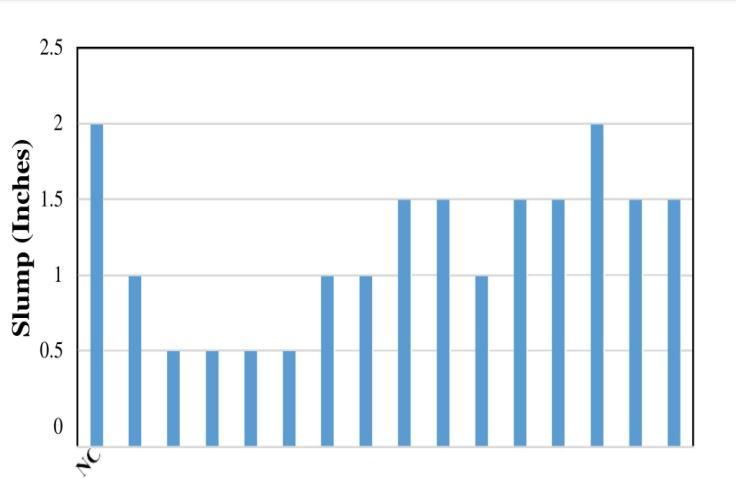
4.1 Slump test:- Slump test was performed to determine the workability of fresh concrete by following ASTM C143 standard procedure. It shows the results of normal concrete, plastic aggregate, slag aggregate and combine aggregate mixtures. Compared to normal aggregate mixture, the slump decreases for plastic aggregate and slag aggregate mixtures. However, for combine mixture C15 slump remained similar to normal concrete,however,decreasedforC30andC45.
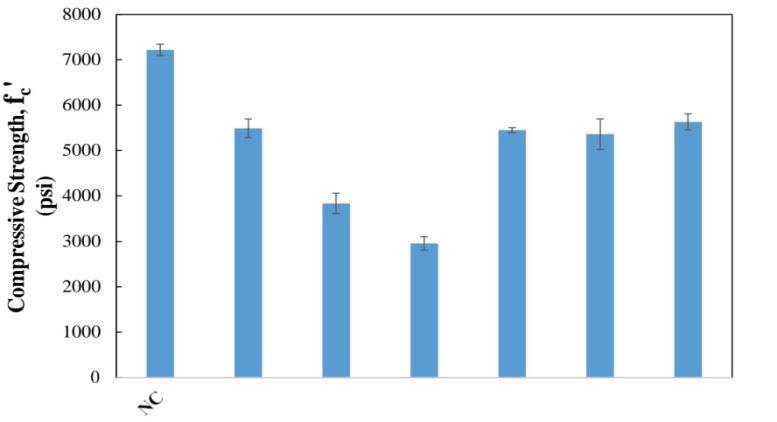
4.2 Compressive Test Results:- summarize the 28-day test results of compressive strength of concrete. The concrete mixtures contained replacement rates of overburden waste rocks at 15%, 30%, 45%, 60%, 75%, 90%and100% respectively,anda W/Cratioof0.45.The same mixtures were used for tensile test and modulus of elasticity test. Overburden replacement: The results indicate that with comparison to reference concrete (NC), there was a statistically significant decrease in compressivestrengthofconcreteastheplasticpercentage increases in concrete mix from 15% to 45% (P15, P30, P45).
4. 2.1 - Summary of OB replacement results.
mixture.ThecombinedmixP15-SF7.5-GF1hadadecrease instrengthof29.07%relative.
4.3.1- Summary of Plastic replacement results
4.3 -Tensile Test Results
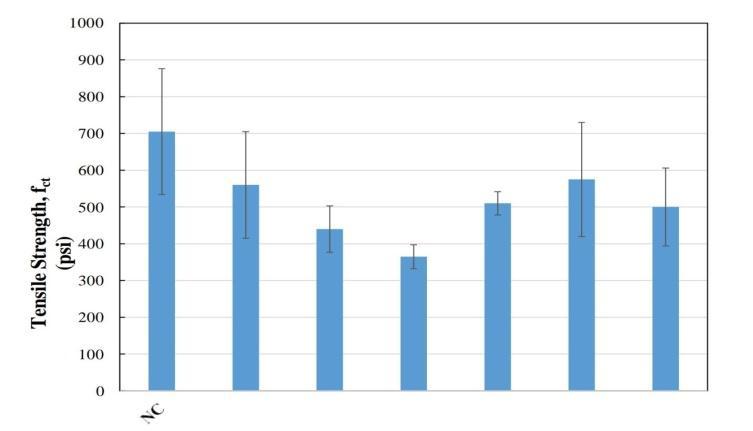
The 28-day concrete tensile strength test results are shown in Table Overburden waste Rock replacement The results indicate that with comparison to reference concrete(NC),thetensilestrengthdecreasesforOB15,OB 30, and OB 45 by 20.56%, 37.58%, and 49.50% respectively A decrease in tensile strength was shown when silica fume and glass fibers are added to P15, individually and combined. Individually, the percent strength decrease was 27.65% for the P15-SF7.5 mix and 18.43% for P15-GF1 mix when compared to the NC
4.4- Modulus of Elasticity Test Results
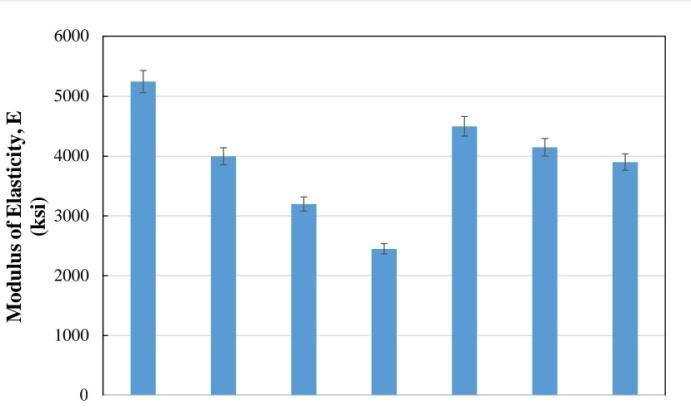
The28-dayModulusofelasticity(MOE)testresultsare shown in Tables Overburden replacement: An increase of overburden waste quantity in concrete had a statistically significant effect on the modulus of elasticity of concrete. The results in Table indicate that when compared to reference concrete NC, the MOE of concrete decreaseswiththeincrease ofwastequantityinconcrete. Silica fume and glass fibers were added to OB15 and additional modulus of elasticity tests were performed. In comparison to reference materials (NC) the MOE decreasedforP15-SF7.5,P15-GF1andP15-SF7.5-GF1.The percent decrease in MOE of concrete in comparison to reference materials are 23.8%, 39.05%, 53.3%, 14.28%, 20.95%and25.71%,respectively.
4.4.1-Summary of OB replacement results
b) TensileStrength
Xob90=-19.976+T’YNC (ii)
c) MoE
Xob90=-20.332+(T)’YNC (iii)
The Analysis was carried out using the result on 28th day between normal concreteandreplaced overburden waste mixed concrete. The result data removed anomalies like results of OB45 and OB60 and presented a uniform relationbetweenNCandOB90.
5. CONCLUSIONS
5.1 Compressive strength: Natural aggregate can be replaced by recycled/waste plastic by 15% without reducingthemechanical propertiestoprecludetheuse in structuralapplications.Similarly,slagcanpartiallyreplace natural stone aggregates up to 45%. Significant reduction in mechanical properties were observed when the plastic replacement percentage was increased from 15% to 30% or 45%. For slag replacement, initially compressive strength was increased to 15% replacement, however, a slight decrease of compressive strength was shown for 30% and 45%. The Overburden dump waste rock were used in this study in order to evaluate the approximate strengthinrelationshiptothenormalconcrete.Thestudy found out that it had an approximate 89% near equivalencewithnormalconcrete.
In comparison to NC, increase or decrease in strength ofmixturesareasfollows:
4.5 Statistical Analysis of Data for developing the Equation
Thetestresultswereusedasinputdataagainsteachofthe category of test. The correlation was established between Normal Concrete and each dataset with the replacement concrete. The detail of the test result is presented under annexure I. Three correlation equations are presented below from Eq. 1 to 3. The equation considers the Property test result as dependent and the composition of OB 10 to OB 90 as Independent. The R2 of the three relations had indicated weak collinearity and hence these equations can predict strength characteristics up to 77% of the total experimentally valid strength of replaced concrete.Thismakestheconcreterelativelysafe.
TheEquationsarerepresentedasunder:
a) CompressiveStrength
Xob90= -21.976 +(T)’YNC (i)
Aggregate replaced by plastic up to 15% decreases the compressive strength by approximately 24%, while 15% overburden replacement resulted in a compressive strength increasesof6.05%.
ForOBP15-OB50, the compressive strength reduction was 22% while the compressive strengthofOB90increased6.93%.
ForthecombinedmixtureOB90,thecompressive strengthremainsthesameasNC.
Theresultsindicatethatthecompressivestrength of concrete was unsatisfactory effected by increasing quantity of Overburden waste dump. However, an addition of slag quantity can have a positive impact on compressive strength with combinationasreviewedintheliterature.
5.2 Tensile strength: Comparing to NC, an increased percentage in concrete of plastic and slag reduced the tensilestrengthofconcrete[15-30].
In comparison to NC, a decrease in tensile strength of the mixtureswereasfollows:
For 15% aggregate replaced by plastic OB15, a significant reduction of tensile strength up to 20.5%wasobserved.
Similarly, strength reduction for OB15 was 29.07%,ascomparedto11.35%forOB50.
For the combine mixture C15 and C30, the strength was reduced by 14.18%, and24.82%, respectively.
5.3 Modulus of Elasticity:
In comparison to NC, the modulus of elasticity of concrete decreases with an increase in plastic quantity in concrete. However, increasing the slag quantity in concrete had no effects on MOE up to 15% of slag replacement and MOE increased for 30% slag replacement[12-14]. When 7.5%silica fumeand1% glass fibers were added to plastic and slag individually and altogether, a significant decrease in MOE was shown for plastic.However,forOverburdenmixturestheMOEeither remainedthesameoraslightdecreasewasnoted.
In comparison to NC, increase or decrease in MOE of concreteasfollows:
ForP15,theMOE reduction was23.8%. While forS15,theMOEremainedthesame.TheMOE decreased by 25.71% for P15-SF7.5-GF1 and 5.7% for S15-SF7.5-GF1. The combined mixtures C15 and C30 resulted in a MOE reduction of 17.14%, and 22.85%, respectively.
Theresultsindicatethatthequantityofplastic had an unsatisfactory impact on tensile strength of concrete. However, the slag quantity indicated a satisfactory impact on MOEofconcrete.
REFERENCES
1) ASTM C496 / C496M-17,StandardTestMethodfor Splitting Tensile Strength of Cylindrical Concrete Specimens, ASTM International, West Conshohocken,PA,2017,www.astm.org
2) ASTM C39 / C39M-18, Standard Test Method for Compressive Strength of Cylindrical Concrete Specimens, ASTM International, West Conshohocken,PA,2018,www.astm.org
3) ASTM C469 / C469M-14,StandardTestMethodfor Static Modulus of Elasticity and Poisson’s Ratio of Concrete in Compression, ASTM International, West Conshohocken,PA,2014,www.astm.org
4) ASTM C143 / C143M-15a, Standard Test Method for Slump of Hydraulic-Cement Concrete, ASTM International, West Conshohocken, PA, 2015, www.astm.org
5) ASTM C192 / C192M-16a, Standard Practice for Making and Curing Concrete Test Specimens in the Laboratory, ASTM International, West Conshohocken,PA,2016,www.astm.org
6) Ashwini Manjunath B T, (2016) “Partial replacement of E-plastic Waste as Coarse-aggregate in concrete” Procedia Environmental Sciences Volume35,2016,Pages731-739
7) A.A. Al-Manaseer, T.R. Dalal, (1997). “Concrete containing plastic aggregates”. Concrete International19(8):47-52
8) Bag, S., Yadav, G., Wood, L. C., Dhamija, P., & Joshi, S. (2020). Industry 4.0 and the circular economy: Resource melioration in logistics.ResourcesPolicy,68,101776.
9) Bahoria B.V,.Parbat D.K,.Nagarnaik P.B,.Waghe U.P (2013), “Experimental study of effect of replacement of natural sand by quarry dust by quarry dust and waste plastic on compressive strength of M20 concrete.” 4th Nirma University International Conference on Engineering, Ahemdabad,Gurat,India
10) Behzad Nematollahi,Hamid Behbahani (2011). “Steel Fiber Reinforced Concrete: A Review”. ICSECM2011
11) Celik T, Marar K, Effects of crushed stone dust on some properties of concrete, Cement Concrete Res., 26(7),(1996)1121-1130.
12) DeLarrardF,BellocA,Theinfluenceofaggregateon the compressive strength of normal and highstrengthconcrete”ACIMaterJ.,94(5):(1997)417–426.