MIMO-OFDM WIRELESS COMMUNICATION SYSTEM PERFORMANCE ANALYSIS FOR CHANNEL ESTIMATION
Sanjay Kumar1, Mr. Pradeep Pal21M.Tech, Electronic and Communication Engineering, GITM, Lucknow, India

2Assistant Professor Electronic and Communication Engineering, GITM, Lucknow, India
Abstract - This study proposes a hybrid Wiener filter-based pilot-based low-complexity channel estimator for use in the LTE-A downlink using cell-specific reference signals (C-RS) and user equipment reference signals (UE-RS). Sub-optimally, the suggested system only needs 8.8 and 74.5 percent as many calculations as the optimum system and other sub-optimum systems, respectively. In addition, a Fast Fourier Transform (FFT)-based CE technique is developed, which requires less computing power. End-to-end LTE-A system throughput validation of the reportedpilot-basedsystem demonstratesthe feasibility of the proposed system. Next, we provide a novel blind CE method for SIMO and MIMO systems that makes use of a hybrid OFDM symbol structure. It is shown that the created system achieves comparable performance to a pilotbased system with an equivalent level of complexity and improved spectrum efficiency, provided that a sufficient number of receive antennas are used. Last but not least, we offer alternative Resource Grid (RG) configurations that support the blind-based CE method designed for MIMO-OFDM systems, with the goal of enhancing MSE performance while reducing the number of necessary receive antennas. From the standpoint of the investigated blind-based CE scheme, the results reveal that the suggested RG configurationsgive better MSE performance than the LTE-A RG configuration.
Key Words: MIMO-OFDM,wirelesscommunication,channel estimation,performanceanalysis,leastsquaresestimation, linearminimummeansquareerror(LMMSE),zero-forcing (ZF).
1. INTRODUCTION
AMIMO-OFDMwirelesscommunicationsystemisatypeof wirelesscommunicationsystemthatutilizesmultiple-inputmultiple-output (MIMO) technology and orthogonal frequency-divisionmultiplexing(OFDM)modulation.MIMO technologyusesmultipleantennasatboththetransmitter andreceivertoincreasethesystem'scapacityandimprove its performance by reducing interference and improving signalquality.
OFDM modulation, on the other hand, divides the data stream into multiple subcarriers and modulates them separately. This helps to mitigate the effects of channel fadingandimprovesthesystem'sspectralefficiency.MIMOOFDMsystemscombinethesetwotechnologiestoprovide
high-speed, reliable wireless communication over a wide rangeofdistances.
MIMO-OFDM wireless communication systems are commonlyusedinmanyapplicationssuchaswirelessLANs, cellular networks, and digital broadcasting. They offer severaladvantagesovertraditionalwirelesscommunication systems, including higher data rates, better coverage, and improvedresistancetointerferenceandfading.
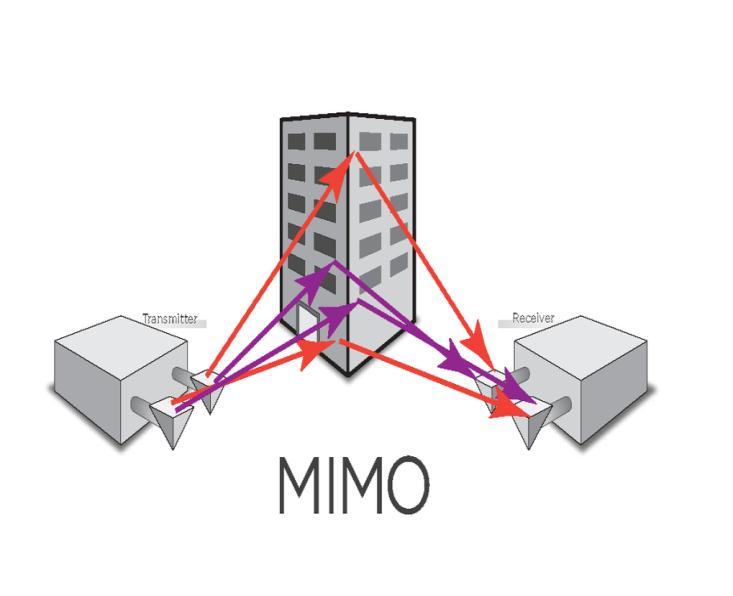
The basic principle of a MIMO-OFDM wireless communicationsystemistodividetheavailablefrequency bandintomultiplesubcarriersanduseOFDMmodulationto transmitdataoverthesesubcarriers.Eachsubcarriercarries asmallportionofthedata,andthedataisdistributedacross all the subcarriers in a way that maximizes the spectral efficiencyofthesystem.
InaMIMO-OFDMsystem,multipleantennasareusedatboth the transmitter and receiver end to exploit the spatial diversity of the wireless channel. The signals transmitted from each antenna are combined at the receiver, which improvesthequalityofthereceivedsignalandincreasesthe datarate.
TheMIMO-OFDMsystemusesadvancedsignal processing techniques to mitigate the effects of multipath fading and interference.Thesystemusesdifferentalgorithmstoprocess
the received signals, such as Space-Time Block Coding (STBC),SpatialMultiplexing(SM),andBeamforming.These techniquesimprovethesignalquality,reducetheerrorrate, and increase the overall performance of the wireless communicationsystem.
ThepurposeofaMultiple-InputMultiple-OutputOrthogonal Frequency Division Multiplexing (MIMO-OFDM) wireless communication system is to provide a high-speed and reliablewirelesscommunicationlinkbetweentwoormore devices. The system is designed to achieve the following objectives:
1. Increasethedatarate:AMIMO-OFDMsystemcan providehighdataratesbyusingmultipleantennas at both the transmitter and receiver ends. The systemexploitsthespatialdiversityofthewireless channeltotransmitandreceivemultiplestreamsof datasimultaneously.
2. Improve spectral efficiency: By dividing the availablefrequencybandintomultiplesubcarriers, the MIMO-OFDM system can transmit data over multiplechannelssimultaneously.Thismaximizes theuseoftheavailablespectrumandimprovesthe spectralefficiencyofthesystem.
3. Enhancethequalityofthewirelesslink:TheMIMOOFDM system uses advanced signal processing techniques to mitigate the effects of multipath fadingandinterference.Thesetechniquesimprove the signal quality, reduce the error rate, and increase the overall performance of the wireless communicationsystem.
2. TECHNIQUES FOR CHANNEL ESTIMATION
Channel estimation is crucial in wireless communication systems to estimate the characteristics of the wireless channelandcompensateforchannelimpairments.InMIMOOFDMwirelesscommunicationsystems,therearemultiple antennasatboththetransmitterandreceiverends,which makes channel estimation even more complex. Some common techniques for channel estimation include pilotbased estimation, compressed sensing-based estimation, maximum likelihood estimation, and Kalman filter-based estimation.Pilot-basedestimationinvolvesinsertingknown pilotsymbolsintothetransmittedsignal,whilecompressed sensing-based estimation utilizes the sparse nature of the wirelesschannel.Maximumlikelihoodestimationmaximizes thelikelihoodfunctionofthereceivedsignal,whileKalman filter-based estimation uses a recursive algorithm to estimate the channel. These techniques are essential for achieving reliable wireless communication and improving theperformanceofMIMO-OFDMsystems.
3.PROBLEM STATEMENT
The ever-increasing demand for high-speed and reliable wirelesscommunicationsystemshasledtothewidespread adoption of Multiple-Input Multiple-Output (MIMO) and Orthogonal Frequency Division Multiplexing (OFDM) technologies. In MIMO-OFDM systems, accurate channel estimationplaysacrucialroleinachievingoptimalsystem performance. However, various factors such as channel fading,noise,andinterferenceposesignificantchallengesto the accurate estimation of the channel state information. Therefore,thereisaneedforacomprehensiveanalysisof MIMO-OFDMwirelesscommunicationsystemperformance specificallyfocusingonchannelestimationtechniques.This researchpaperaimstoaddressthisgapbyinvestigatingand evaluatingexistingchannelestimationtechniquesinMIMOOFDMsystemsto identifytheir limitations,strengths, and potentialareasforimprovement.Byconductingadetailed performanceanalysis,thisresearchaimstoprovidevaluable insightsandrecommendationsforenhancingtheaccuracy andefficiencyofchannelestimationinMIMO-OFDMwireless communicationsystems.
4.RESULT AND ANALYSIS
Utilising a hybrid Wiener filter, it is claimed that a pilotbasedreducedcomplexitychannelestimatorforCell-Specific ReferenceSignals(C-RS)andUserEquipmentRS(UE-RS)in LTE-A Downlink (DL) systems may be created. This estimator will be used in the system. The system that has been developed is a sub-optimum scheme that needs between8.8and74.5percentofthenumberofcalculations that are needed by the optimal system and other suboptimumsystems,respectively.Inaddition,aCEapproach thatisbasedontheFastFourierTransform(FFT)andhasa lowercomputationalcomplexityispresented.Becausethe throughput of the provided pilot-based system has been tested in an end-to-end LTE-A system, this demonstrates that the suggested system is acceptable for practical application. Next, a brand new CE method for SIMO and MIMO systems that is based on a hybrid OFDM symbol structureisdescribed.Thismethodisblind-basedanduses CE. It has been shown that the proposed system, when equipped with an adequate number of receive antennas, operatesjustaswellasapilot-basedsystem,whilehavinga comparable level of complexity and a higher spectral efficiency.Finally,novelResourceGrid(RG)configurations that service the blind-based CE scheme designed for the MIMO-OFDM system are described. These configurations have been developed with the intention of improving the Mean Squared Error (MSE) performance while simultaneouslyminimisingthenumberofnecessaryreceive antennas. Whencomparedtothe LTE-ARGconfiguration, the results demonstrate that the suggested RG configurationsprovideimprovedMSEperformancefromthe pointofviewoftheblind-basedCEschemethatisthesubject oftheinquiry.
5. TIME-FREQUENCY RESOURCE GRID OF LTE
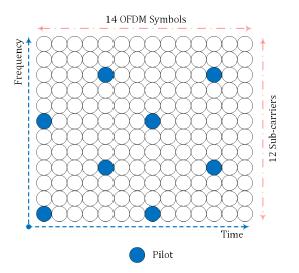
The Long-Term Evolution (LTE) wireless communication standardusesaTime-FrequencyResourceGridtotransmit data over the air interface. The Resource Grid is a twodimensionalmatrixthatrepresentsthetimeandfrequency domainsofthesignal.TheResourceGridisdividedintotime slotsandsubcarriers,whichareusedtotransmitdatainthe timeandfrequencydomains,respectively.Eachsubcarrieris modulated using Orthogonal Frequency Division Multiplexing(OFDM)modulation,whichenableshighdata ratesandefficientspectrumusage.TheResourceGridisalso dividedintoPhysicalResourceBlocks(PRBs),whichconsist ofagroupofsubcarriersandtimeslots.ThesizeofthePRBs can be adjusted to accommodate different channel conditions and data rates. The Resource Grid is a fundamental component of the LTE standard and plays a crucialroleinachievinghigh-speedwirelesscommunication.
utilizedforequalizingtheMPSKsymbols,inamannerthatis comparabletohowtheSIMOscenarioswouldbecarriedout.
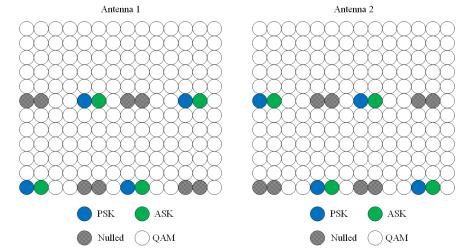
6. ACROSS FREQUENCY MIMO 1-D F.OSBCE
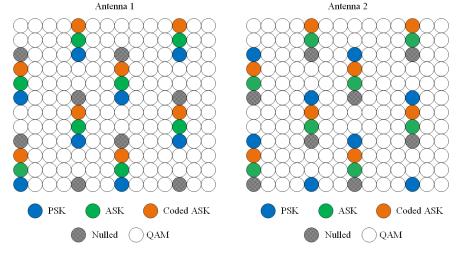
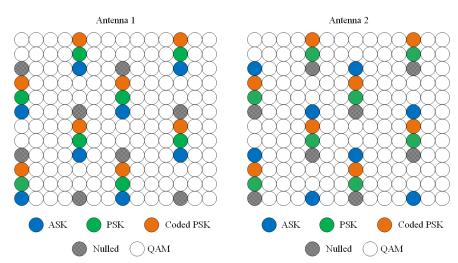
ThepilotsforthisversionofOSBCEarespreadoutinone dimension,allwhileremainingcontainedwithinthelimitsof asingleOFDMsignal(frequency).Thesignaliscanceledout byAntenna2,whileAntenna1isutilizedtodeliverMASK symbols to the positions of the original pilots. The MASK signalfromAntenna1wouldbetheonlysignalthatwould be received at the exact OFDM symbols on particular subcarriersasaconsequenceofthis,andtherewouldbeno interferencefromanyothertransmitantennas.Thiswould bethecasesincetherewouldbenoothertransmitantennas. Inlightofthis,thephaseofthereceivedMASKwouldserve asaless-than-preciseestimateofthechannelthatwouldbe
6.1. Mode-01 M.
Inthissectionofthearticle,amodifiedMIMOOSBCEacross frequencywillbeshownasaviablesolutiontotheongoing problemofdistortion.Thissolutionwillbediscussedinthe context of the article. This issue has been lingering for a considerableamountoftime.Itwillbenecessarytoalterthe locationsoftheMASKandMPSKsothattheupdatecanbe finished,anditwillalsobenecessarytomovetheminthe otherdirection.
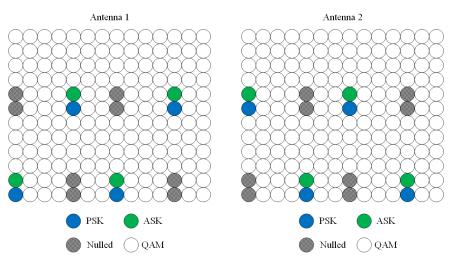
We will proceed to the following stage on the assumption thatthesystemmodelsetupandvariablesarethesameand that we have an RG with 12 subcarriers and 14 OFDM symbols.Figure6depictshowtheMPSKandMASKsymbols willbegroupedinsidethesameOFDMsignalinthefuture. Thesemarksaregoingtobeputonthesubcarriersthatare nearby. As can be seen in Figure 6, the MPSK and MASK symbols are positioned inside the same OFDM signal at neighboringsubcarriers.
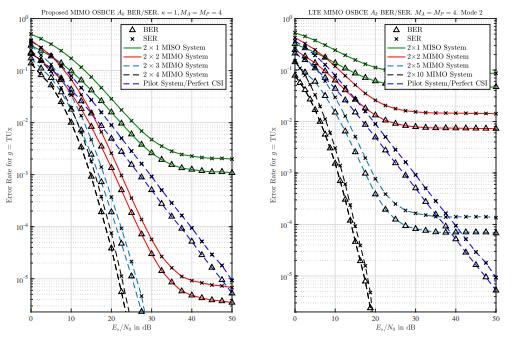
The suggested configurations together with the LTE configurations are shown functioning in a TUx channel environmentinfigure-7.Inaddition,thesymbolerrorrate (SER)andthebiterrorrate(BER)aregiveninthisfigureas afunctionofthesymbolnoiseratio(SNR).Theperformance oftherecommendedMIMOF.OSBCEissuperiortothatofits LTEcounterpart,eventhoughithasalowerpricetag.The LTE standard calls for the usage of five receive antennas; however, the configuration that is being recommended employsjusttwooftheseantennas,whichresultsinahigher SER.Inaddition,whenutilizingtheproposedconfiguration withNRx=2,theA(m)kSERoutperformstheA(m)kSER withperfectCSIupuntiltheSNRislessthan50dB.
9. DISTRIBUTION PROPOSAL FOR MIMO 1-D T.OSBCE
MIMO 1-D T.OSBCE (Multiple-Input Multiple-Output OneDimensionalTarget-OrthogonalSpaceBlockCodewithError Correction)isacommunicationtechniquethatisdesignedto improvethereliabilityofwirelesstransmissions.Thegoalof T.OSBCE is to transmit data over multiple antennas while minimizinginterferencebetweenantennasandincreasing thesignal-to-noiseratio(SNR)atthereceiver.
Toproposea distributionforMIMO1-DT.OSBCE,wefirst needtounderstandthebasicprinciplesofthetechnique.In T.OSBCE, the transmitted signal is divided into multiple parallelstreams,eachofwhichistransmittedonadifferent antenna. These streams are designed to be orthogonal to eachother,whichmeansthattheydonotinterferewitheach otherduringtransmission.Atthereceiver,thesignalsfrom eachantennaarecombinedtorecovertheoriginaldata.
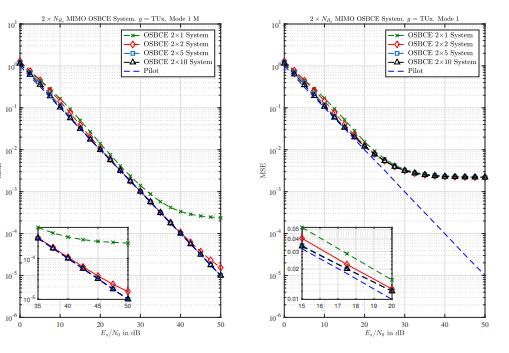
When wireless communication networks are ultimately implemented, the RG configurations that have been made accessible for OSBCE will be put to good use. When constructing the RG arrangements, this goal was kept in mind.Todothis,theyuseawidevarietyofimplementation strategies, including an LTE-A prototype setup. There are twoseparatestrategies,andthetitlesMode1andMode2 reflectthelabelsappliedtoeachstrategy.Afterasuccessful Mode 1 encoding reception, the MASK signals, and MPSK symbolsarecombinedanddeliveredtoseveralREsitesfor decoding. Since the RE sites are being nulled, no other transmitantennasarebroadcastingMPSKsymbols.OSBCE maybeutilizedwithoutissueinMode1sincetheencoding allowsfortheextractionoftherequisiteMASKsymbolfor each transmits aerial. All other transmitting antennas' RE sitesaretemporarilydisabledtopreventinterferencewith Mode2operations.Thisisdonesothatthesamefrequency may be used for the transmission of MPSK- and MASKencodedsignalsthroughthesameaerial.AlthoughMode2 hasthepotentialtoachievehigherspectralefficiencythan Mode1,itsoverallperformanceissignificantlylower.The performance of the non-default Mode 1 configuration is betterthanthatofthedefaultMode2.Thedefaultsettingis Mode2.Mode2isthedefaultmode.TherecommendedRG settingsforOSBCEprovidebettermeansquarederror(MSE) performancethantheLTERGsetup.Thisisespeciallytrue fortheMIMOMode2examples.Toattainthesamedegreeof performance,theproposedRGwouldonlyneedhalfasmany receiveantennasasthepilot-basedsystem,butitstillonly generates half as many interpolation points as the pilotbasedsystem.
REFERENCE
[1]J.G.ProakisandM.Salehi,DigitalCommunications,2008.
[2] B. Sklar, “Rayleigh fading channels in mobile digital communication systems part I: characterization,” IEEE CommunicationsMagazine,vol.35,no.9,pp.136–146,1997.
[3]Y.Li,L.J.Cimini,andN.R.Sollenberger,“Robustchannel estimationforOFDMsystemswithrapiddispersivefading channels,” IEEE Transactions on Communications, vol. 46, no.7,pp.902–915,1998.
[4]H.Lin,“FlexibleconfiguredOFDMfor5Gairinterface,” IEEEAccess,vol.3,pp.1861–1870,2015.
[5] E. Dahlman, S. Parkvall, and J. Skold, 4G: LTE/LTEAdvancedforMobileBroadband,2013
[6]A.Al-Dweik,B.Sharif,andC.Tsimenidis,“AccurateBER analysis of OFDM systems over static frequency-selective multipath fading channels,” IEEE Transactions on Broadcasting,vol.57,no.4,pp.895–901,2011.
[7]E.Al-Dalakta,A.Al-Dweik,A.Hazmi,C.Tsimenidis,andB. Sharif, “PAPR reduction scheme using maximum crosscorrelation,”IEEECommunicationsLetters,vol.16,no.12, pp.2032–2035,2012.
[8] A. Al-Dweik, S. Younis, A. Hazmi, C. Tsimenidis, and B. Sharif,“EfficientOFDMsymboltimingestimatorusingpower differencemeasurements,”IEEETransactionsonVehicular Technology,vol.61,no.2,pp.509–520,2012.
[9] A. Al-Dweik, A. Hazmi, S. Younis, B. Sharif, and C. Tsimenidis,“CarrierfrequencyoffsetestimationforOFDM systemsovermobileradiochannels,”IEEETransactionson VehicularTechnology,vol.59,no.2,pp.974–979,2010.
[10] , “Blind iterative frequency offset estimator for orthogonal frequency division multiplexing systems,” IET Communications,vol.4,no.16,pp.2008–2019,Nov2010
[11]A.S.Khrwat,B.S.Sharif,C.C.Tsimenidis,S.Boussakta, andA.J.Al-Dweik,“Channelpredictionforlimitedfeedback precoded MIMO-OFDM systems,” in IEEE International Symposium on Signal Processing and Information Technology,ISSPIT2009,2009,pp.195–200.
[12]ETSI,“LTE;EvolvedUniversalTerrestrialRadioAccess (E-UTRA); Radio Resource Control (RRC); Protocol specification,”Tech.Rep.Release12,2015.
[13]I.Eizmendi,M.Velez,D.Gomez-Barquero,J.Morgade,V. Baena-Lecuyer, M. Slimani, and J. Zoellner, “DVB-T2: The secondgenerationofterrestrialdigitalvideobroadcasting system,”IEEETransactionsonBroadcasting,vol.60,no.2, pp.258–271,2014.
[14]R.Marks,“IEEEStandard802.16:ATechnicalOverview of the WirelessMAN Air Interface for Broadband Wireless Access,” IEEE Communications Magazine, no. June, p. 12, 2002.
[15]L.a.N.Man,IEEEStandardforInformationtechnologyTelecommunications and information Local and
metropolitan area networks - Part 11 : Wireless LAN MediumAccessControl(MAC),2007,vol.2007,no.June.
[16] Cisco Mobile, Cisco Visual Networking Index: Global Mobile Data Traffic Forecast Update, 2016-2021 White Paper,2017.
[17]D.Gesbert,M.Kountouris,R.W.Heath,C.B.Chae,andT. Sälzer,“ShiftingtheMIMOParadigm,”IEEESignalProcessing Magazine,vol.24,no.5,pp.36–46,2007.
[18] M. Kobayashi, N. Jindal, and G. Caire, “Training and feedbackoptimizationformultiuserMIMOdownlink,”IEEE TransactionsonCommunications,vol.59,no.8,pp.2228–2240,2011.
[19] V. Stankovic and M. Haardt, “Generalized design of multi-userMIMOprecodingmatrices,”IEEETransactionson WirelessCommunications,vol.7,no.3,pp.953–961,2008.
[20]G.CaireandS.Shamai,“Ontheachievablethroughputof a multiantenna Gaussian broadcast channel,” IEEE TransactionsonInformationTheory,vol.49,no.7,pp.1691–1706,2003.
[21]P.ViswanathandD.N.Tse,“Sumcapacityofthevector Gaussianbroadcastchannel anduplink-downlinkduality,” IEEETransactionsonInformationTheory,vol.49,no.8,pp. 1912–1921,2003.