DETERMINATION OF STRENGTH OF SOIL AND ITS STABILITY USING NON DESTRUCTIVE TESTS
 Aajeev1 , Abhitkarsh2 , Ayush Raj Singh3 , Kunal Sawlani4
1,2,3,4Student, Department of Civil Engineering, Dayananda Sagar CollegeOfEngineering, Bengaluru, Karnataka, India
***
ABSRACT
The alteration or modification of one or more soil properties to enhance a soil's engineering qualities and performance is known as soil stabilization. A practical and environmentally responsible way for improving soils is to use industrial waste products. Ultrasonic testing is used in this study to determine density. This technique can offer a quick and easy way to ascertain the properties of compacted stabilized soil. As an alternative to currently utilized methods for analyzing laboratory or field compacted soils, this non-destructive technique can be applied. The compaction parameters of stabilized soil are identified in this work using measurements of ultrasonic velocity.
Analysis was doneon how the density and water content of compacted stabilized soils affected the ultrasonic velocityvariation. The effects of soil type and velocity-dependent compaction conditions were examined.
Keywords: soilstabilization,Ultrasonic PulseVelocity, NDT method
1. INTRODUCTION
Compactioncharacteristicsofsoilmaybedeterminedbyanalyzingtheconnectionbetweensoil'sdrydensity(unitweight) andwatercontent.Proctorcompactiontests(ASTMD698)areoftenusedin laboratoriestoevaluatehowchangesindry densitywithwatercontent.Theconnectionbetweenthesoil's drydensityand water contentisdepicted by a compaction curve.Thecompaction characteristicsoffieldsoilsandthoseofsoilstestedinalabarecomparedtodetermineifbuilding methods are effective. The use of in-situ methods necessitates more time. The ultrasonic pulse velocity method is an alternativestrategythatthisstudyefforttriestoshow.Ultrasonictestingmakesitsimpleandrapidto identifythetraitsof compacted soils. This non-destructive technique can be used in place of the current ones to assess soils that have been compactedinalaborinthefield.
Following the completion of standard tests on soil samples with varied degrees of plasticity, such as black soil, an ultrasonicpulsevelocitytestwascarriedoutonthesamples,andagraphillustratingthelinkbetweendensityandvelocity andwatercontentwasproduced.Anultrasonicpulsevelocitytest broughttheresultstoaconclusionaftertheassociation wasestablishedbyextrapolatingtheresultsofpriorconventionalinvestigations.Thestandardvaluesareacquiredduring the course of the laboratory tests, and the outcomes are then verified using the data from the ultrasonic pulse velocity measurement.
2. SCOPE AND OBJECTIVES OF PRESENT STUDY
To carry out standard quality control in the field, the methods ask for core-cutting pavement samples tobe gathered for laterlaboratorytesting.Thisprocedurecannotbeusedtofixmistakesfoundwhilelayingandcompactingsoilsubgradein thefieldsinceitistootime-consuming,expensive,andvaluablesolelyforofficialrecords.Inordertomanagethesoilsub grade of the pavement layer, fast on-the-spot measurements are necessary. The development of the ultrasonic pulse velocity method is influenced bythese elements. Using an alternative in-situ testing technique termed ultrasonic testing, theresearch'sgoalistoevaluatethephysicalfeaturesofblacksoilandthestabilizationofblacksoilbystabilizers.
Themainobjectivesofthestudyare:-
Researching how stabilizers alter Black soil's engineering performance and determining ifthey canbe employed as soilstabilizersarethestudy'skeygoals.
The strength and stiffness of the soil specimen will increase if the soil stabilizer has goodvolumestability and durability.
Todeterminethevolumestability and durability of the soil specimen using theinformationfrom theultrasonic pulse velocitytest.
Inordertoavoidcausingdamage,itisimportanttoanalyzetheprojectspecimenusingnon-destructiveprocedures.
3. METHODOLOGY
Inordertobreakupanylumps,theearthwasdugup1.5metersbelowthesurfaceoftheground, rammed,andthendried in the open air. Black soil was mixed with stabilizer that had been oven-dried. Several different soil and stabilizer combinations were used to determine the compaction and strength properties of mixes made in compliance with IS. In total,threeofthesemixturesweremade,andthelaboratoryassessedthemixesstrengthandcompactionproperties.Two transducerarrangements onefortransmittingandtheotherforreceiving wereemployedintheultrasonicexperiments conductedforthisworkinordertoestimatetheP-wavevelocityinthetestcompactedstabilizedsoil.
Ultrasonic Pulse Velocity Test [2]
Anon-site, non-destructive testtermedultrasonicpulse velocitytesting(UPV)isusedtodeterminethequalityofsoiland concrete. By monitoring the ultrasonic pulse velocity through concrete structures or soil formations, this test analyses the qualityandstrengthofconcreteorsoil.Theconcretebeingtestedundergoesexposuretoanultrasonicpulse,andtheduration oftimeittakesforthepulsetopassthroughthestructureisrecorded.Slowerspeedsindicatemorecracksandcavitiesinthe concrete or soil whereas higherspeeds show greater material quality and continuity. An electrical circuit that creates pulses, a pulse production circuit, and a conversion device that turns those electronic pulses into mechanical pulses makeup an ultrasonic fault detector. The fundamental premise of this test is that the square rootof the relationship between a material's density (ρ) and elasticity modulus (E), or the ratio E/ρ, determines the sound velocity(V) in that material(V).TheequationinPolishnotationisasfollows:
E=V2 ρ
By calculating the elasticity modulususingthisrelationship,thequalityofthesoilcanbeestablished.
About the equipment
P-wavetransducers,
Pulse-receiver,and
Dataacquisitionsystem.
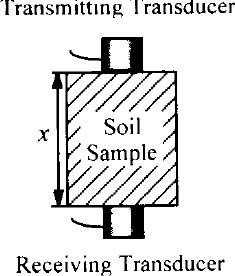
Twotransducersareusedforthemeasurements;oneemitstheultrasonicwavesandtheotherreceivesthemafterthetest sample.Thetransducersareturnedonbyapulsereceiver,whichisapartofthedata-collectingsystemfordigitizingdata.
The travel time for both test techniques is obtained by using ultrasonic measurements at the receiving transducer at the time of their initial arrival. The initial arrival time was calculated as the interval between when the transmitting transducer applied the pulse and when the waveform entered thereceiving transducer. Data collection started when the pulsewasadministeredthankstosynchronization betweenthedigital data boardandthepulse receiver.Along withtheir journey time, the waves' velocities as they go across the compacted soil from the transmitter to the receiver are also calculated.
Theinformationgatheredisusefulinassessingtheeffectsofsoilpropertiesandcompactionconditionsonvelocity.
Comparisons were made between conventional compaction plots (dry density vs. water content) and compaction plots producedvia ultrasonicmeasurements(velocityvs.watercontent).Thesoilthathas beenstabilisedwithstabilizertoan increasing proportion is compacted with different water contents using standard and modified Proctor efforts. The compactedsoilmassisusedfortheultrasonicpulsevelocitytest.Duringtestsusingthethrough-transmissiontestmethod, sampleswereusedtoevaluatedensity,watercontent,andP-wavevelocity. Thevelocityofeachsampleusedtoevaluate the compaction characteristics of the soils was calculated. Compaction plots were made using dry density vs. water contentandvelocityvs.watercontent.
4. EXPERIMENT DETAILS
Black soil, sometimes known as regular soil or just black soil, is a prevalent kind of soil in many parts of India, especially on theDeccanPlateau. Its namecomes fromits dark tint, whichistheresult ofa significant amount of organic matter and clay minerals. Black cotton soil is created by the weatheringof volcanic rocks, basaltic lava flows, and sediments left behind by rivers. Because clay minerals like montmorillonite make up the majority of its constituents, it exhibitspeculiarcharacteristics.Duetoitsabundanceinorganicmatterandnutrients,thesoiliseffectiveforfarming.
Stabilizers
1. Marbleslagworkswell asa soilstabiliser becauseofits bindingproperties. Whencoupled withsoil,it improves the mechanical properties of the soil, such as greater stability, decreased flexibility, and improved load-bearing capacity. It can therefore be utilised in a range of applications relating to construction. The alkaline nature of marble slag helps to balance acidic soils. Using marble slag as a soil stabiliser is an economicalalternative to conventional soil stabilizing methods. Byproducts like marble slag are readily available for little to no cost, loweringoverall project expenditures. Due to its ability to improve soil stability, pH levels, and load-bearing capacity, it is suitable for a range of uses in road construction, building foundations, landscaping, and land rehabilitation.
2. Thefibrous husk ofcoconuts is used tocreatecoconutcoir,whichis nowknowntobeaneffectivesoilstabilizer. Thispaperaimstoprovideacomprehensiveoverviewoftheproperties,benefits,and applicationsofcoconutcoir asasoilstabilizer.Duetoitsuniquecharacteristicsandenvironmentallyfriendlysupply,coconutcoirpresentsa moreenvironmentallyresponsibleoptionforsoilstabilisation.Coconutcoiristhetermfor the fibrous substance that is removed from the coconut husk's outer layer. Pith, lingo-cellulosic fibres, and other organic materials make up its composition. The coir fibres provide the structure strength, while the pith acts as a medium for retainingmoisture.ThepHofcoconutcoirtypicallyrangesfrom5.5to6.8,fromslightlyacidictoneutral.
Sample preparation
The soil sample collected on-site is dried outside in the open air. The clods were broken up using a wooden mallet to hasten drying. Any organic matter, such as tree roots and bark slivers, is removedfrom thesample. Shells are one more kindofnon-oilmaterialsthatareseparatedfromthemainsoilmass,muchlikeoilis.
Shells, roots, and other foreign objects are not removed when samples are taken for estimating organic content or lime content,andtheseremovalsaredocumentedalongwiththeirpercentageoftheoverallsoilsample.
Laboratory Tests to be conducted:
a. SpecificGravitytestofsoil
b. LightcompactiontodeterminetheOMC
c. UCS
d. UltrasonicPulseVelocitytest
e. DATA ACQUISITION
Thephysicalandchemicalpropertiesofthespecimen(soil)aregivenbelow,
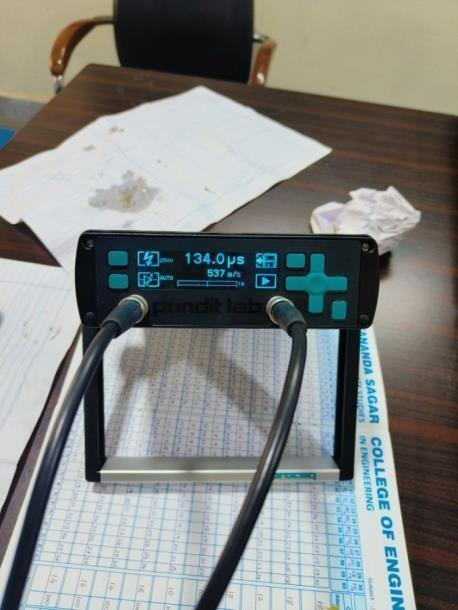
TABLE- 1 Physical properties of soil
The results of the various tests to be conducted in the laboratory were also taken into account whiledoing the analysis anddrawing out the conclusionsfor theexperiment.
f. DATA ANALYSIS
Throughvariousteststhatareconductedthroughoutthewholeproject,theeffectonthevariouspropertiesofthesoilwith theinfluenceofstabilizeratdifferentpercentagesareobtainedby evaluationandgeneratingtherelationbetweenvarious parametersofstabilizedsoil.
Theresultsaredepictedusingthenatureofthegraphsderivedfromdatafromvariousexperiments,
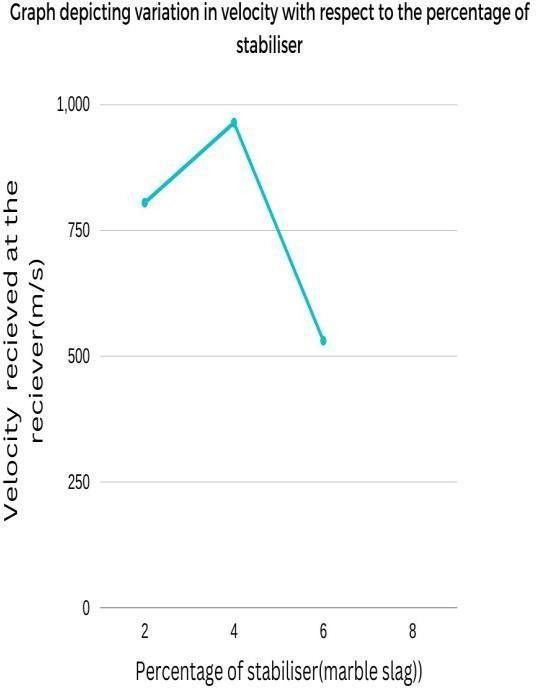
Graph-1:Variationinreadingswithpercentage
Here we can see through the graph that as the percentage of the stabilizer( here marble slag) is increased there is asubsequentincreaseinthevelocityreadingsoftheUPVtestas wellindicatingthattheincreaseinpercentageoftheslag leadtobettersoilqualityandinturnbetterstabilization.
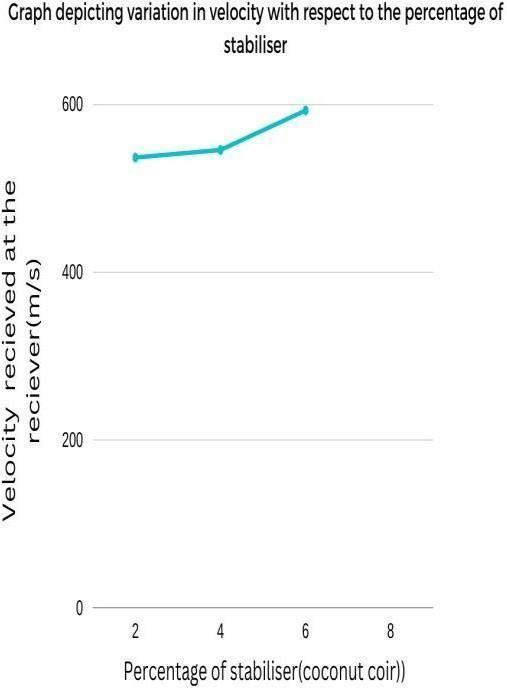
Heretoowecanseethroughthegraphthatasthe percentageof thestabilizer(herecoconutcoir)is increased thereisa subsequent increase in the velocity readings of the UPV test as well indicating that the increase in percentage of the slagleadtobettersoilqualityandinturnbetterstabilization. HereweshouldkeepinnotethattheUPVtestsconductedon thespecimenweredoneafter7daysofthespecimenbeingmade.
NowweshallseethevelocityreturnsoftheUPVtestwhenwekeepthepercentageofthestabilizerconstantandtestiton differentdays,
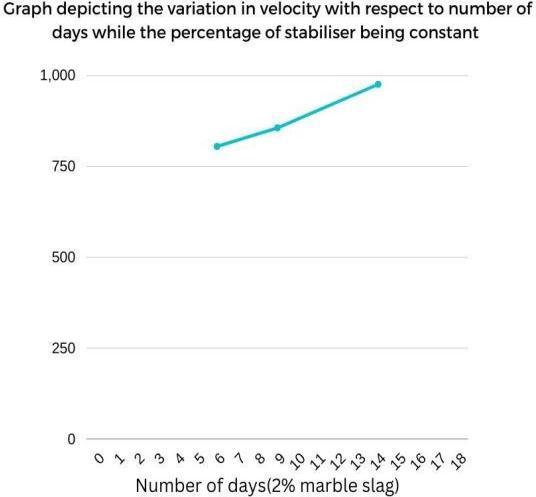
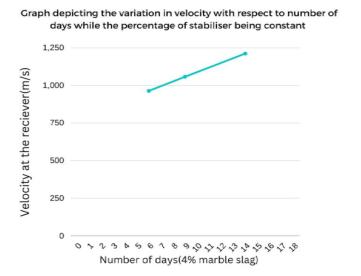
Graph-5: variationinreadingswithpassageofdays(6%MS)
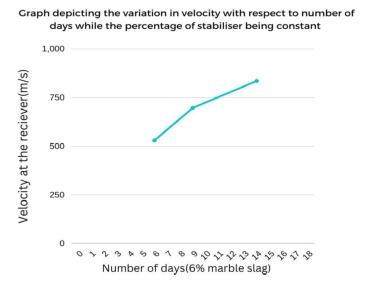
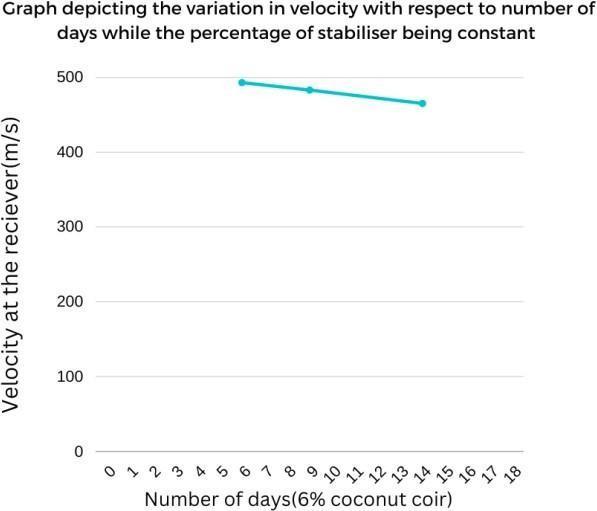
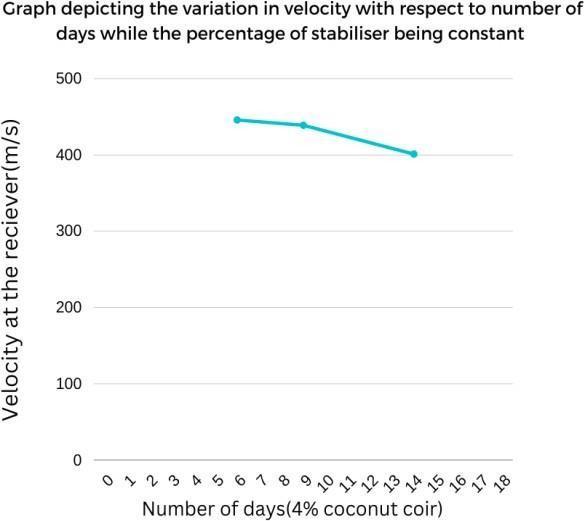
Aswecanseethroughthegraphthatthere isanincrease in the velocity of theUltrasonicPulsewavesasthespecimen mould(made up of soil and stabilizer) is kept preserved through the days. The graph is not perfectly linear but one can estimatethevaluestoacloseapproximationforthelaterdaysusingthegraph.
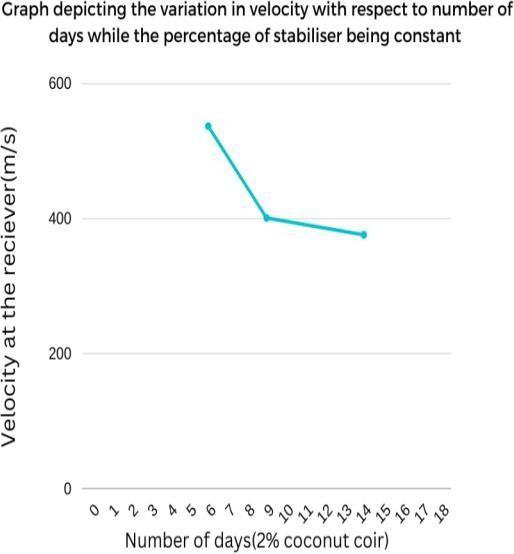
Graph-6: variationinreadingswithpassageofdays(2%CC)
Graph-7: variationinreadingswithpassageofdays(4%CC)
Graph-8: variationinreadingswithpassageofdays(6%CC)
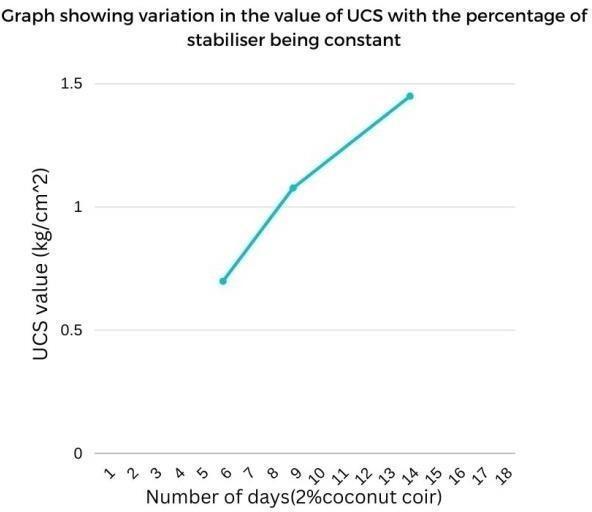
Graph-9: variationinreadingswithpassageofdays(2%CC)(UCS)
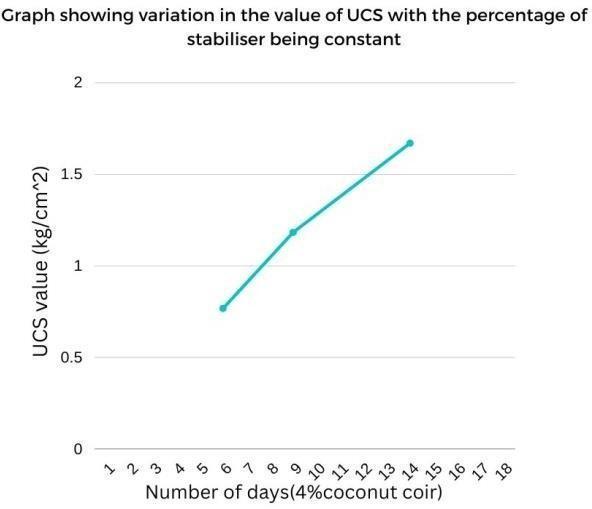
Graph-10: variationinreadingswithpassageofdays(4%CC)(UCS)
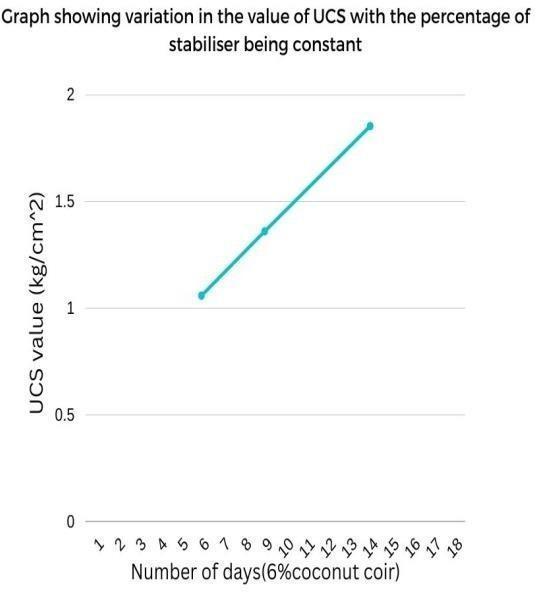
Graph-11: variationinreadingswithpassageofdays(6%CC)(UCS)
IntheabovegraphswecanseetheUCSvalueofthesamplecontainingdifferentpercentagesofcoconutcoirandtestiton differentdays.
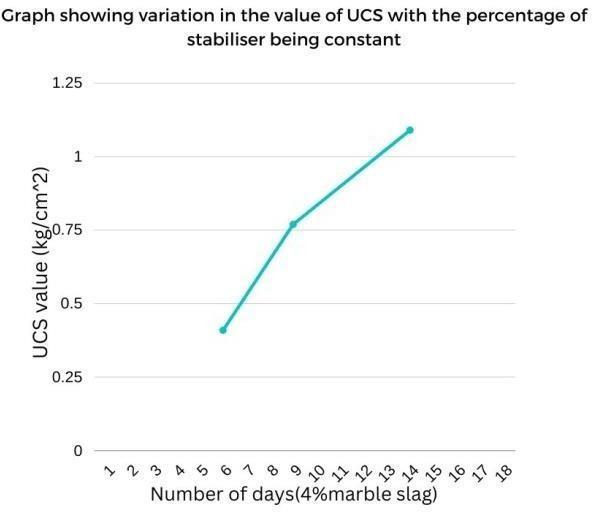
Inthe belowgraphswecan seetheUCSvalueofthesamplecontainingdifferentpercentagesofmarbleslagandtestit on differentdays.
Graph-12: variationinreadingswithpassageofdays(4%MS)(UCS)
Graph-13: variationinreadingswithpassageofdays(6%MS)(UCS)
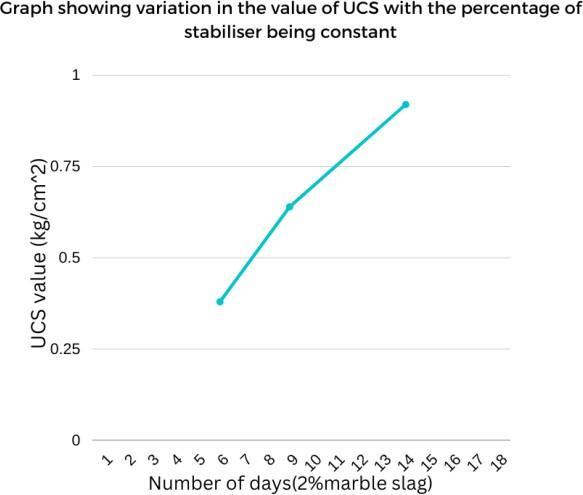
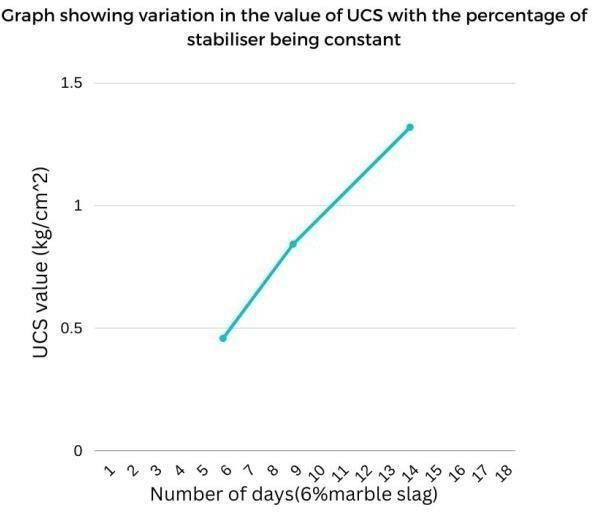
Graph-14: variationinreadingswithpassageofdays(2%MS)(UCS)
TABLE-2:Upv,UcsandtimereadingsforCoconutcoir
TABLE-4:Upv,Ucsandtimereadingsformixedstabiliser
CONCLUSION
Fromtheobtainedanalyzedresults,thefollowingconclusionsweredrawn:
Stabilisercanbeusedtostabilisethesoilbecauseithassignificantlyenhancedthegeotechnicalpropertiesofsoil.
Stabiliserenhancedsoil'smaximumdrydensitywhileloweringitsoptimalmoisturecontent.
Thesoil'spropensitytoexpandhasgreatlydiminished.
Inordertoinvestigatethecompactioncharacteristicsofsoilwithstabiliseradded,ultrasonictechnologywasused.
Plastic limit, liquid limit, and plasticity index all decrease as stabiliser percentage rises. Using ultrasonic measurements,thep-wavevelocityinthestabilisedsoilisdetermined.
Itwasdiscoveredthattherewasnodifferenceinthevariationofeithervelocityordensityforthesamewatercontent.
It was determined that high solidcontents, low water and air voids, and low solid contents andhigh water and air contents,respectively,resultinanincreaseinvelocitiesofthecompactedsoilmass.
The rate of velocity rises with density was higher for varied proportions of stabilisers suppliedtothe soil at various percentages.
ThecombinedsoilmeetsMORTH's(MinistryofRoadTransportandHighways)subgraderequirements.
REFERENCES
i. Dr.VinayA,A.V.Pradeepkumar,UltrasonicPulseVelocityassessmentofGGBSstabilizedsoil
ii. JackKatzerandJanuszKobaka,conferencepaperSeptember2006,UltrasonicPulseVelocityTestofSFRC
iii. Nitesh Ashok Bhange, Pritiradheshyamnandagawali, EngineeringCharacterization of Clayey Soil byUltrasonic Pulse VelocityTests
iv. Slavova, D. Z., Weidinger, D. M., Sevi, A. F., & Ge, L. (2010). Evaluation of compactedsiltcharacteristics byultrasonic pulsevelocitytesting.Proc.ofGeoFlorida,1284-1293.
v. Weidinger, D. M., Ge, L., & Stephenson, R. W. (2009). Ultrasonic pulse velocity testson compacted soil. Characterization, Modeling, andPerformance ofGeomaterials, Hunan,ASCE,Geotechnical SpecialPublication,(189), 150-155.
vi. Vinay. A, Dr. A. V.Pradeepkumar, Dr. M.R Rajashekhara (2018), "Alternate assessment of strength characteristics of clayey soil for compaction using ultrasonic pulse velocity method", International Journal of Engineering & Technology,7(2.1)(2018)15-19
vii. VasanthS.D,Vinay.A,A.VPradeepKumar,ShubhalakhsmiBS(2018),"AnExperimentalStudyonPhysicalProperties of Clayey Soil by Using Destructive and NonDestructive Tests", International Journal of Engineering Research & Technology(IJERT)ISSN:2278-0181
viii. Vinay M, Vinay A, A V Pradeep Kumar(2019), "Ultrasonic Pulse Velocity Assessment ofCement Stabilized Soil", InternationalJournalofScientificResearchandEngineeringDevelopment-–Volume2Issue3,May-June2019
ix. MaciejMiturski,WojciechSas,AlgirdasRadzeviˇcius,RaimondasŠadzeviˇcius,RytisSkominas,MateuszStelmaszczyk and Andrzej Głuchowski(2021), "Effect of Dispersed Reinforcement on UltrasonicPulseVelocity inStabilized Soil", Materials2021,14,6951.s.Mech.Civ.Eng.(IJERMCE),3,467-473.
x. Kondekar,V.G.,Jaiswal,O.R.,&Gupta,L. M.(2018).Ultrasonicpulsevelocitytesting ofgadhisoiladobebricks.Int.J. Eng.Re