ASSESSMENT OF THE GREEN AND ENERGY SAVING TECHNOLOGY IN THE CONSTRUCTION OF A BUILDING

Ketan ushir 1 and
Sushant Shantaram Awasare2
1Professor, Dept. of Civil Engineering Department, Sandip University, Mahiravni, Nashik, Maharashtra
2PG student, Dept. of Civil Engineering Department, Sandip University, Mahiravni, Nashik, Maharashtra *** -
Abstract – Green building, also known as sustainable building, involves the use of environmentally responsible and resource-efficient practices throughout a building's life cycle. This includes design, construction, operation, maintenance, and demolition. The integration of energysaving technology throughout the entire building process is essential for maximizing the effectiveness of green energysaving solutions. Green buildings offer benefits such as reduced energy usage and operational costs, improved air quality, and a healthier working environment. In India, green building rating methods include GRIHA, LEED, and IGBC. Green buildings save energy and water, lower CO2 emissions, and utilize rainwater harvesting and greywater reuse techniques. However, challenges such as high initial construction costs and a lack of incentives exist. Implementing green solutions in building projects is crucial for creating sustainable and healthy environments.
Keywords: Green Building, Green Technology, GreenhouseGases,Energy,Cost,SustainableMaterials, EnergyEfficientMaterials.
1.INTRODUCTION
Green building, also known as sustainable building, focuses on creating structures that are environmentally conscious and resource-efficient throughout their entire life cycle. This involves considering aspects such as site selection, design, construction, operation, maintenance, remodeling, and deconstruction. By adopting green building practices and using sustainable materials, the construction industry can reduce the environmental impact associated with the extraction, transportation, processing, fabrication, installation, reuse, recycling, and disposalofbuildingmaterials
Thegoal ofgreenbuildings istooptimizeresourceusage andminimize energyconsumption.Buildingsaccount for a significant portion of global energy consumption, and green buildings aim to minimize this energy usage by incorporating energy-efficient materials, technologies, and systems. By reducing energy consumption, green buildings contribute to lower greenhouse gas emissions andcombatclimatechange.
2.LITERATURE REVIEW
1.) ANALYSIS OF GRREN TECHNOLOGY APPLICATION IN CONSTRUCTION
Swarnkar, Singh, 2015: The most thought behind the review is to shape the green idea assessable to the averagepersonalltogetherthattheywillseethevaluein itssignificance.Theconstructionofbuildingsrequiresthe use of fossil fuels, which produce a lot of toxic gases that are harmful to humans and the environment as a whole and contribute to global warming. In addition, the construction of buildings and projects contributes significantly to global warming because these structures require power, and the majority of them are powered by conventional power plants that also make use of highly polluting fossil fuels like oil and coal. One of the many human activities that contribute to the emission of greenhouse gases, particularly carbon dioxide (CO2), is this combination of the environmental impact of the particular building's construction and its operation after construction. The point of this exploration is to investigate the project's comprehension workers might interpret green development. The entire project is centered on the subject's original idea, which was to investigate the parameters and requirements of a green building and determine the concept's relevance. Additionally, the plan is to incorporate these ideas into thedesignsolution,gainfirsthandexperiencedesigninga greenbuilding,andtakeonthechallenge.
2 ) REVIEW OF THE APPLICATION OF GREEN BUILDING AND ENERGY SAVING TECHNOLOGY
Tong, 2017: The term "green building" refers to the application of the "green" idea of protecting the environment to the planning, construction, and use of a building. This is done by incorporating the particular circumstances of the construction into the appropriate use of "green" technologies and equipment in order to achieve "green building energy conservation," which ultimatelyleadsto"peopleandNaturalcoordination"and "sustainable development." In order to achieve sustainable development, green buildings use as much energy-saving and environmental-protection technology in architectural design, construction, and demand use as possible to reduce energy consumption and natural
disturbances caused by residents, resulting in a construction that is optimal for their use. The primary emphasis here is on the necessity of reducing resource wastage.tosafeguardtheenvironment,withanemphasis onreducingcarbondioxideemissionsandenvironmental pollution.Everystepofgreenbuilding fromplanningto construction to use and maintenance to demolition requires energy and environmental conservation. In green buildings, energy-saving technologies should be usedthroughoutthedesign,construction,andusephases of the building. This will make it possible for green energy-saving technologies to be as effective in construction as possible. Suitable for people who live in green buildings, realize the sustainable development of green buildings, reduce energy consumption, and reduce people'sinterferencewiththenaturalenvironment.
3. AIM ABD OBJECIVES
3.1 AIM
Discover a quick and affordable way to develop a green building by analysing green and energy-saving building technology.
3.2 OBJECTIVES
TocomprehendtheurbanisationsituationinIndia, this study examines the rate of urbanisation, its effects on the environment and natural resources, and the severity of energy-related concerns associatedtoscarcity.
Understanding green construction principles and current practises In this dissertation, green construction ideas and methods are discussed globallywithafocusonIndia.
This thesis provides information about major organisations involved in the green building movementaswell asseveral greenbuilding rating systems and their coverage of various criteria and associatedissues.
To the perspective and status of green building implementation, awareness of, factors influencing adoption or non-adoption, and the most pressing issuesduringimplementationinIndia.
To analyse the data gathered from past surveys done in India and compile a list of several approaches and techniques that are typically used toexecutegreenbuildingprinciples.
4. METHODOLOGY
Green building construction methods will be investigated, studied, and developed as part of this project to reduce pollution and global temperature rise.
In addition, it aims to raise public awareness of the advantages and long-term cost savings of green buildings among Indians as a whole. In addition, the structureofthestructuralmethodologyisasfollows:
To meet the requirements of green technology, use the method listed below. From planning to demolition, the lifecycle of a green building involves a number of energy- and environment-saving measures. It is necessary to concentrate on the utilization of environmental factors during the design phase in order toreducethedegreeofenvironmentalharmbroughton by demolition, as well as to ensure that the building provides people with low consumption, comfort, and space during its operational phase and minimize the negative effects of the construction process on the environment. A few concepts that apply to a green environmentarelistedbelow.
5. ASSESSMENT OF THE GREEN TECHNOLOGY
Building green offers a range of motives and benefits, encompassing environmental, economic, and social aspects.Sustainabilityinitiativesemphasizetheneedfor integrated design in both new construction and retrofitting existing structures. Green building practices aim to minimize or eliminate the negative impacts of buildingsontheenvironmentandhumanhealth.
Green building encompasses a holistic approach that integrates various practices and techniques to minimize the environmental impact of buildings. By utilizing renewable resources, employing sustainable materials, and adopting energy-efficient systems, green building promotes environmental responsibility, economic savings,andimprovedqualityoflifeforoccupants.Itisa collaborative effort that requires the involvement of both the government and the community to create a sustainableandresilientbuiltenvironment.
5.1 ASPECTS OF GREEN BUILDING
Followingaretheaspectsofgreenbuilding:
Energy Efficiency: Green buildings prioritize energy efficiency by incorporating design features and technologies that minimize energy consumption. This includes efficient insulation, high-performance windows, energy-efficient lighting systems, and the use of renewable energysourceslikesolarpanels.
Water Conservation: Green buildings aim to reduce water consumption through various strategies. These include low-flow fixtures, water-efficient appliances, rainwater harvesting systems,andlandscapingdesignsthatminimize irrigationneeds.
Sustainable Materials: Green buildings promote the use of sustainable and environmentally friendly materials. This includes materials with low embodied energy, such as recycled or reclaimed materials, as well as materials that are locally sourced to reduce transportationrelatedemissions.
Indoor Environmental Quality: Green buildings prioritizethehealthandwell-beingofoccupants by ensuring high indoor air quality. This involvesusinglow-emissionmaterials,adequate ventilation systems, and controlling pollutants, such as volatile organic compounds (VOCs) and allergens.
WasteManagement:Greenbuildingsimplement waste reduction and recycling practices. This includes incorporating recycling stations, using construction techniques that minimize waste generation, and designing spaces that facilitate wasteseparationandrecycling.
Site and Landscape Design: Green buildings consider the site and its surroundings to minimize environmental impacts. This includes preserving natural habitats, using permeable surfacesto promotegroundwaterrecharge,and incorporating green spaces for improved biodiversityandheatislandreduction.
Sustainable Transportation: Green buildings encouragesustainabletransportationoptionsto reduce reliance on single-occupancy vehicles. This may include providing bicycle storage and amenities, supporting public transit accessibility, and promoting carpooling or electricvehiclecharginginfrastructure.
LifeCycleAssessment:Greenbuildingsconsider the entire life cycle of the building, including construction, operation, maintenance, and eventual deconstruction. Life cycle assessment helps identify opportunities to minimize environmental impacts and optimize the building'soverallsustainabilityperformance.
Certification and Standards: Green buildings often seek certifications from recognized green buildingratingsystems,suchasLEED,BREEAM, or Green Star. These certifications provide a framework for evaluating and recognizing the sustainabilityachievementsofabuilding.
Education and Awareness: Green buildings promote education and awareness among occupants, users, and the community. This includes providing information on sustainable
practices,energy-savingtips,andthebenefitsof greenbuildings.
6. ASSESSMENT METHOD AND DRIVERS TO GREEN BUILDING
6.1 ASSESSMENT METHOD
The assessment of green buildings is typically done through various rating systems and certification programs. These assessment methods evaluate the environmental performance and sustainability of a building based on predefined criteria. Here are some commonassessmentmethodsusedingreenbuilding:
LEED(LeadershipinEnergyandEnvironmental Design): Developed by the U.S. Green Building Council, LEED is an internationally recognized rating system that assesses building performance in areas such as energy efficiency, water conservation, materials selection, indoor environmental quality, and sustainable site development.
BREEAM (Building Research Establishment Environmental Assessment Method): Widely used in the United Kingdom and Europe, BREEAM evaluates the environmental performance of buildings based on factors like energy, water, materials, waste, pollution, and ecology.
GRIHA (Green Rating for Integrated Habitat Assessment): Developed by the Indian Green Building Council, GRIHA assesses the environmental impact of buildings in India, considering aspects such as energy efficiency, water conservation, waste management, and occupanthealth.
WELL Building Standard: Focusing on occupant health and well-being, the WELL Building Standard evaluates features such as indoor air quality, lighting quality, water quality, fitness and comfort amenities, and biophilic design elements.
LivingBuildingChallenge:Consideredoneofthe most rigorous certifications, the Living Building Challenge requires buildings to meet strict criteria related to energy, water, materials, equity, and beauty. It aims to create regenerative spaces that give back to the environment.
6.2 DRIVERS TO GREEN BUILDING
Several key drivers contribute to the growing adoption ofgreenbuildingpractices:
Environmental Concerns: Increasing awareness of climate change, resource depletion, and environmental degradation has led to a greater emphasis on sustainable building practices. Green buildings help reduce energy consumption, minimize carbon emissions, conservewater,andprotectnaturalresources.
Energy Efficiency and Cost Savings: Green buildings are designed to be energy-efficient, resulting in reduced energy consumption and lower utility costs over time. The potential for long-term financial savings is a significant driverforbuildingownersandoccupants.
Government Regulations and Incentives: Many governments around the world have implemented regulations and incentives to encourage green building practices. This includes tax benefits, grants, rebates, and mandatoryenergyefficiencystandards.
Health and Well-being: Green buildings prioritize occupant health and well-being by improving indoor air quality, providing ample naturallight,andincorporatingbiophilicdesign elements. This focus on human health and comfort is a strong driver for building occupantsandorganizations.
Market Demand and Stakeholder Expectations: There is a growing demand for sustainable buildings from tenants, investors, and consumers who prioritize environmentally responsible practices. Green buildings often attract higher market value and have a competitive advantage in the real estate industry.
Corporate Social Responsibility: Many organizations embrace green building practices as part of their corporate social responsibility initiatives.Buildingsustainablyalignswiththeir values and demonstrates a commitment to environmentalstewardship.
7. MISCONCEPTIONS AND BARRIERS TO GRREN BUILDING
Misconceptions and barriers to green building can hinder its widespread adoption and implementation. Here are some common misconceptions and barriers associatedwithgreenbuilding:
7.1 Misconceptions:
High Initial Cost: One of the primary misconceptions is that green building is more expensive compared to conventional construction. While there may be some upfront costs, studies have shown that the long-term operational savings and benefits outweigh the initialinvestment.
Limited Design Options: Some people believe thatgreenbuildingshavelimiteddesignoptions and aesthetics. However, green building practices and technologies have evolved, offeringawiderangeofdesignpossibilitiesthat can meet various architectural styles and preferences.
Lack of Performance: There is a misconception thatgreenbuildingsmaynotperformaswellor providethesamelevelofcomfortastraditional buildings. In reality, green buildings often prioritize occupant comfort, indoor air quality, andthermalperformance,resultinginhealthier andmorecomfortablespaces.
Complexity: Green building is sometimes perceived as a complex and specialized field, requiring extensive knowledge and expertise. While there are technical aspects involved, there are resources, guidelines, and professionals available to guide and support greenbuildingprojects.
7.2 BARRIERS
Lack of Awareness and Education: Limited awarenessandunderstandingofgreenbuilding concepts and benefits can be a significant barrier. Educating stakeholders about the advantages and long-term value of green buildingiscrucialforovercomingthisbarrier.
Resistance to Change: Resistance to change within the construction industry can pose a barrier to green building adoption. Traditional practices and mindsets may need to be challenged and replaced with sustainable approaches.
Regulatory and Policy Challenges: Inconsistent or inadequate regulations and policies can hindertheadoptionofgreenbuildingpractices. Governments and regulatory bodies need to develop and enforce supportive policies that incentivize and mandate sustainable construction.
MarketPerceptionandDemand:Theperception of green buildings among potential buyers, tenants, and investors can impact market demand. Demonstrating the benefits and value proposition of green buildings is essential for increasingmarketacceptanceanddemand.
Limited AccesstoFinancing:Securingfinancing for green building projects can be challenging, particularly for small-scale developments. Access to affordable green financing options andincentivescanhelpovercomethisbarrier.
Industry Fragmentation and Resistance: The construction industry is diverse, with various stakeholders involved. Fragmentation and resistance to change from industry players, including architects, contractors, and suppliers, can pose challenges to implementing green buildingpracticesuniformly.
8 RESULT AND DISCUSSION
8.1
RESULT
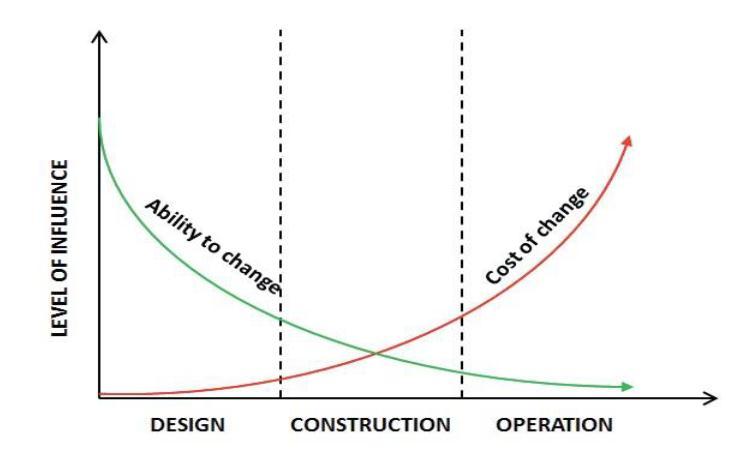
Buildings are designed and built to adhere to a set of functional and technical parameters that are outlined in building codes, regional laws and standards, and clientrequirements.Areplacementorexistingbuilding is intended or redesigned during the building design process. Because even significant design changes are frequently performed at comparatively minimal expense during this period, the extent of influence is extremely high (see figure 8.1). Therefore, it's important to increase the building's environmental performance during this stage when the potential for changeisgreatest.
8.2 DISCUSSION
Green technology is highly valued and essential for promoting sustainable principles in construction. Its application in both new and existing buildings brings significant and widespread benefits. The process of makingabuilding"green"involvesvariousstages,such as selecting an ideal location to maximize natural lighting and solar alignment, using eco-friendly materials, and incorporating sustainable design principles to address environmental concerns. Contrary to the misconception that any construction negativelyimpactstheenvironment,sustainabledesign minimizes or eliminates adverse effects. Green technology offers numerous advantages in the housing sector, despite potential higher upfront costs for materials and installation. These technologies are specifically designed to optimize resource efficiency, leading to long-term cost savings. A key benefit of implementinggreensolutionsisthereductionofwaste generated during construction. Traditional technologies like petrol generators have detrimental environmentalimpacts,makingitcrucialforbusinesses tochoosegreenalternatives.Greentechnologyreduces industrial carbon footprint by minimizing waste, conserving water, and consuming less energy compared to older technologies. As the housing industry increasingly embraces sustainable development, the use of green solutions becomes imperative and acceptable. The growing market for green energy offers diverse job opportunities in fields such as health engineering, solar utilities, and efficient lightingspecialists.
9 CONCLUSION
Green building is becoming an emerging architectural concept due to the evolving strategies of the housing industry and advancements in technology. It involves the use of environmentally friendly materials and practices throughout the entire building process. By effectively managing infrastructure processes, construction industries can increase productivity, maintain high-performance systems, and reduce operating expenses. Research has shown that poor indoor air quality in workplaces negatively affects the productivity and well-being of office workers. Incorporating green solutions in building projects can contributetoahealthierworkingenvironment.
The perspective of this project suggests that energy efficiency can be significantly improved by eliminating wasteful energyusage,resultinginpotential savingsof up to 30% in energy expenditures. Further research is needed to understand stakeholders' perceptions regarding the progressive adoption of green technologies.Greenbuildingscanbeconstructedeasily
and cost-effectively, utilizing available resources and incorporating recycling practices for sustainable construction.
In India, the integration of green technology in building projects is recognized as crucial for achieving sustainable development goals. The twenty-first century has seen a significant focus on sustainable development, and a building company that prioritizes sustainable solutions can reduce energy consumption and operational costs by approximately 30%. For instance, the installation of a solar inverter for solargenerated electricity canleadto servicecost reductionsof about30%.
REFERENCES
[1] D. K. Swarnkar & S. Singh, ―Analysis of Green Technology Application in Construction,‖ International Journal of Engineering Research & Management Technology, Vol. 2, Issue-6, pg. 147150,November-2015.
[2] 2. Z. Tong, ―Review of the Application of Green Building and Energy Saving Technology,‖ International Global on Renewable Energy and Development (IGRED 2017) IOP Conference Series: EarthandEnvironmentalScience,pg.1-4,2017.
[3] 3. D. K. Swarnkar & S. Singh, ―Investigating The Green Technology Function in Construction Perspective,‖ International Journal of Engineering Research & Management Technology, Vol. 3, Issue-1, pg.144-148,January-2016.
[4] A. Aboginije, Z. Mustapha C. Aigbavboa & D. Aghimien, ―The Application of Green Technology in the Modern Day Construction Projects-A review pp 1-10,August-2019.
[5] 5. A. Sinha, R. Gupta, & A. Kutnar, ―Sustainable Development and Green Buildings‖, DRVNA INDUSTRIJA,Vol.64Issue-1,pp.45-53,2013.
[6] 6. F. Shadram, ―Assessment and Optimization of Life Cycle Energy used in Building‖ Luleå University of Technology, Graphic Production, pg 169,2018.
[7] 7. Xiaosen Huo, Ann T. W. Yu, ―Analytical Review of Green Building Development Studies‖, Journal of GreenBuilding,Vol.12,Issue-2,pp130-148,2018.
[8] 8. Mohammed Noori Hussein Allhashimi, ―A Review of Using Green Technology in Civil Engineering,‖ International Journal of Science and Engineering Applications, Vol. 7, Issue-9, pp 284286,2018,ISSN:-2319
7560.
[9] 9. S. Yingling and L. Xinping, ―Research on the Literature of Green Building Based on the Web of Science: A Scientometric Analysis in Cite Space,‖ SchoolofEconomicsandManagement,NorthChina ElectricPowerUniversity,Beijing102200,2019.
[10] 10.K.Varma,M.Chaurasia,P.ShuklaandT.Ahmed, ―GreenBuildingArchitecture:ALiteratureReview on Designing Techniques,‖ International Journal of Scientific and Research Publications, Volume 4, Issue2,February2014,ISSN2250-3153.
[11] 11.L.J.Hunag,H.Y.WangandS.Y.Wang,―AStudy of the Durability of Recycled Green Building Materials in Lightweight Aggregate Concrete,‖ Construction and Building Materials 96 (2015) 353–359.
[12] 12. R. N. Bhandare, ―Economical Aspects of Green Building. Paripex‖- Indian Journal of Research, 2(3),pg.88–90,2013.
[13] 13. J.H. Cruywagen, 2013. The cost of ―going green‖ – A case study, In: Proceedings of 6th Annual SACQSP Research Conference on ―Green Vision 20/20‖, Cape Town, South Africa, 20 – 21 June2013,pg.79-91.
[14] 14. C. J. Kibert, Sustainable Construction: Green BuildingDesignandDelivery,3rded.,JohnWiley& SonsInc,Hoboken,NewJersey,USA,2012.
[15] 15.L.N.Dwaikat&K.N.Ali,―GreenBuildingsLife Cycle Cost Analysis and Life Cycle Budget Development: Practical Applications,‖ Journal of BuildingEngineering,July2018,pg.1-19,2018.