Analysis of Cloud Computing Security Concerns and Methodologies
Ms. Neetu1 , Mr. Varun Kumar Singh21,2Sunder Deep Engineering College, Dr. A. P. J. Abdul Kalam Technical University, Ghaziabad, India

Email: neetumaurya258@gmail.com, varunksingh07@gmail.com
Abstract - Utilizing a network of remote computers maintainedontheinternet tostore,manage,andanalysedata on demand and on a compensation, basis is the technique of cloud computing. It allows access to a common pool of resources rather thanlocalservers orindividualPCs.Asitdoes notacquiretheobjects physically, it savesbusinesses timeand money on management. Cloud computing is a connectivity technology in which client data is kept and managed in the data centre of a cloud service provider such as Google, Amazon, Microsoft, etc. Cloud computing is an emerging field that is recognisedglobally.Therearecertainsecurityconcerns while utilising cloud-based services. This research paper examines the fundamentals of cloud computing as well as the security challenges inherent to cloud computing and cloud infrastructure. In addition to analysing cryptographic algorithms with the process, this study addresses the dangers to cloud security. These cryptography algorithms are wellplanned and thoroughly examined to improve the performance of existing cryptography systems. The outcome reveals the strategies applicable to real-time encryption. All encryption techniques have proved to have benefits and disadvantages and to be suitable for various purposes.
Key Words: Cloud Storage, Cloud Performance, Cloud Scalability,CloudAvailability,CloudSecurity,CloudAccess Control,DocumentSharing
1. INTRODUCTION
Thecloudcomputingparadigmhasexpandedasatechnique thatenablesubiquitous,on-demandaccesstoasharedpool of dynamically reconfigurable computing resources, includingnetworks,servers,storagespace,applications,and services, with the goal of being rapidly deployed with minimal management effort and service provider interaction.Themostcommonandcleardefinitionofcloud is"anetworksolutionthatprovidesaffordable,trustworthy, uncomplicated,andstraightforwardaccesstoITresources" [1]. The service-oriented strategy of cloud computing not onlydecreasesinfrastructureoperatingcostsandownership costs, but also improves customer performance and flexibility[13].NISThasspecifiedthekeycharacteristicsand twokindsofcloudcomputingequipment[13].
a) DeploymentModel.
b) ServiceModel

***
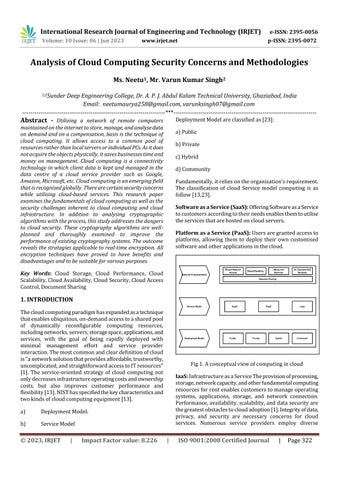
DeploymentModelareclassifiedas[23]:
a)Public
b)Private
c)Hybrid
d)Community
Fundamentally,itreliesontheorganization'srequirement. The classification of cloud Service model computing is as follow[13,23].
Software as a Service (SaaS): OfferingSoftwareasaService tocustomersaccordingtotheirneedsenablesthemtoutilise theservicesthatarehostedoncloudservers.
Platform as a Service (PaaS): Usersaregrantedaccessto platforms, allowing them to deploy their own customised softwareandotherapplicationsinthecloud.
ofcomputingin
IaaS: InfrastructureasaServiceTheprovisionofprocessing, storage,networkcapacity,andotherfundamentalcomputing resourcesforrentenablescustomerstomanageoperating systems, applications, storage, and network connection. Performance,availability,scalability,anddatasecurityare thegreatestobstaclestocloudadoption[1].Integrityofdata, privacy, and security are necessary concerns for cloud services. Numerous service providers employ diverse
policies, tactics, and procedures based on the following criteria:
•Sizeofdata.•Characteristicsofdata.•Patternsofdata.
2. LITERATURE REVIEW
Diverseresourceswereexaminedinordertoappreciatethe essential ideas ofcomputingin thecloudandkeepingsafe datainthecloud.Thissectionisdevotedtoaliteraturestudy toestablishafoundationforexaminingvariouselementsof cloudcomputing.Previousresearchrevealshowtoincrease cloudcomputingperformanceandthenumberofcriteriathat affect cloud performance. The direction of this study was determinedbythefollowingvariables[1].Diverseresources wereexaminedinordertoappreciatetheessentialideasof computinginthecloudandkeepingsafedatainthecloud. This section is devoted to a literature study to establish a foundation for examining various elements of cloud computing.Previousresearchrevealshowtoincreasecloud computingperformanceandthenumberofcriteriathataffect cloud performance. The direction of this study was determinedbythefollowingvariables[1].
a. How may Cloud Computing performance be enhanced?
b. Workload analysis and inventive management of cloudresources?
In a previous study, resource allocation wasused to boost cloud performance, and data were encrypted using a cryptographicalgorithm.Usingthesecurrenttechniqueswill lowerthetimerequiredfordownloadinganduploadingfiles tothecloud,henceimprovingperformance[1].Scalability, according to previous research, implies that, as the workstation'sloadincreases,thesystem'sperformancemust remainconsistentinallenvironmentswithoutcompromising client needs. According to a research, numerous scaling approaches exist to increase the scalability of cloud computing[1].
A. VerticalScaling.
B. Horizontalscaling.
C. Diagonalscaling.
A second definition of scalability is that several users can exchangetheirdataconcurrentlywithoutcausingacollision. The availability of the cloud is also a concern in cloud computing,accordingtopriorresearch.Itindicatesthatifa person is utilising the cloud, he should be able to obtain everything he desires. Availability and dependability are closelyproportional.Everyoneisfamiliarwiththisword;ifa systemistrustworthy,userswillutiliseitmore.Therearea variety of issues that can affect the availability of cloud computing.
a. Humanerrors
b. SoftwareFailure
c. Hardwaremalfunction
d. Machinemigrationfromoneservertoanother Accordingtopriorresearch,thefollowingconstitutetheidea of cloud computing: In cloud computing, security plays a crucial role. It implies that attackers and hackers cannot access user information. Every user was concerned about theirdata'ssecurity,privacy,andsecrecy.Ifthereisasystem that delivers this functionality robustly, which system will havethemostsuccessinthefuture?Allunauthorisedusers willbedeniedaccesstothesystem.Thesecuritycriterianeed forasuccessfulsystemisasfollow[3,24].
a. Privacy
b. Confidentiality
c. UnauthorizedAccess
d. Attacker-Safe
e. Hacker-Safeetc
Every part of cloud computing requires this researcher to have many security methods in addition to the guidelines they can implement from a security standpoint. Previous research provides a respectable introduction to the fundamentalideasofcloudcomputing.Inthisstudy,several essentialtopicspertainingtoinstancesofapplicationsthat may be produced utilising cloud computing and how they might assist the developing world in benefiting from this growingtechnologyareinvestigated.
PreviousresearchCloudcomputingenablesInternetaccess to highly scalable resources. Since the usage of cloud computing by individuals and businesses throughout the globe is increasing rapidly, why haven't data protection issuesincloudcomputingyetbeenaddressed?Usersofcloud services face a significant risk of losing sensitive data. To address user data privacy concerns, they've established a dataprotectionframework.Thesuggestedparadigmfordata protection covers difficulties across the life cycle of cloud services. Policy ranking, policy integration, and policy enforcement are the three major components of their suggestedsystem.Theyhaveprovideda varietyofmodels and studied the attributes of each component. This study examines broad recommendations for evaluating created systemsbasedonthistypeofparadigm.Thisstudyprovides accesstoseveralmodelsofdatasecurityandcost-function definitions [7]. Previous technique created a standard for securingclouddataintransit.Forthelengthofimmigration,a standard encryption mechanism has been suggested as a meansofprotectingsensitiveinformation.Otherencryption standardisessentialforrobustsecurity,althoughrequiring unnecessary processing. The metric presented in their
research provides a balance between the security and encryption overhead [14, 25, 27]. Every part of cloud computing requires this researcher to have many security methods in addition to the guidelines they can implement from a security standpoint. Previous research provides a respectableintroductiontothefundamentalideasofcloud computing.Inthisstudy,severalessentialtopicspertainingto instancesofapplicationsthatmaybeproducedutilisingcloud computingandhowtheymightassistthedevelopingworldin benefitingfromthisgrowingtechnologyareinvestigated.
3. SECURITY THREATS IN CLOUD
Cloud computing is facing a lot of security issues. Those issuesarelistedbelow[6,10,26]:
a.DataLoss.
b.Malicious.
c.InsecurityofinterfacesandAPIs.
d.Hijackingofaccountandservice.
e.Leakageofdata.
f.Denialofservice.
g.Technologysharingrisk.
h.Integrationofdataandprotection.
A. Data Loss:
Companies outsource their data to the cloud because it is inexpensiveandsecure,yetthereisariskofdataloss.There are several opportunities for data loss during data outsourcing,someofwhicharelistedbelow[4].
1.MaliciousAttack
2.Serverfailure
3.Erasureofdatabyproviders
4.Nodatabackup
5.Lossoftheencryptionkey.
There are several techniques to prevent data loss incloud computing,including:UtilizearobustAPIforaccesscontrol. Analysisofdataprotectionatbothruntimeandcompilation time. Utilize a robust key generation mechanism. Apply appropriatebackupandretentionstrategies.
B.
Contaminated insiders This might be a DBA (Data Base Administrator), an employee, a partner, etc. of the cloud business who is authorised to view cloud data. These individualscanstealandcorruptinformationifanotherfirm paysagreaterprice[27].ContaminatedinsidersThismight beaDBA(DataBaseAdministrator),anemployee,apartner,
etc. of the cloud business who is authorised to view cloud data.Theseindividualscanstealandcorruptinformationif anotherfirmpaysagreaterprice[27].
C. Insecurity of interfaces and APIs:
The relationship between cloud service providers and customersmustoccurviaapplicationprogramminginterface (APIs).Therefore,theseAPIsmustbeprotectedtoprevent unwantedaccess.
D. Hijacking of account and service
Every cloud user has an internet-based account (bank account, e-mail account or social media account). Account hackingcanresultincatastrophicdatalossforusersIntegrity andstanding.
E. Leakage of data
Thecloudserviceenablesanyusertomoveandaccessdata fromanylocationintheglobe,thereforethereisapossibility of data leakage. This demonstrates the vulnerabilities of cloudsecurityandcloud'sphysicaltransportinfrastructure.
F. Denial of service
In cloud computing, availability is a crucial factor; hence, manybusinesseswanttheirsystemstobealwaysaccessible. Anotheraspectofcloudcomputingisthesharingofresources among users. If an attacker uses up all the computational resources in the cloud, then no one else may utilise those resources; this is known as a denial of service. When this occurs,useraccess to theirresources will besluggish,and cloudavailabilitywillbeaffected.
G. Technology sharing risk.
The foundation of infrastructure as a service is shared infrastructure.Thisservicewasnotbuiltwithamulti-tenant
architecture; hence this architecture is essential for mitigatingthisrisk.
H. Integration of data and protection
Manyorganisationsmustensurethattheirdataisprotected between the end user and the cloud data centre since unprotected data is more susceptible to transmission interruptions[12].
4. REQUIREMENTS FOR SECURITY IN CLOUD COMPUTING
The ISO(International standard organisation) Information Securitystandardshouldincludeseveralsuggestedelements. Inaddition,cloudcomputingsecurityshouldbedirectedin this manner for it to be an outstanding and secure technologicalsolution.
Figure 3 depicts information security needs that are intimately coupled with cloud deployment and delivery methods. [13]. InFig. 3, thevarious cloud delivery models anddeploymentmodelsarecomparedtothesecurityneeds forinformation,where"N"denotesmandatoryrequirements and"O"denotesoptionalrequirements.
However,furtherresearchisnecessarytodeterminethebest balancerequiredtosecurecloudcomputing.Thecontextof Figure 3 should be considered when judging the security level.Thesecurityneedsofthecloudwillbediscussedinthe contextofcloudcomputing.
a.Identification


b.Authentication
c.Anonymity
d.Authorization
e.Confidentiality
f.Integrity
g.non-repudiation
h.Availability
5. SECURITY ALGORITHMS AND ITS PARAMETERS
In cloud computing, data security encompasses not just encryption but also several additional procedures. Risk of datalossiscontingentonthefollowingelements.
A) Reset of data: Clearing of data When a cloud user accessestheirdatathroughtheinternet,thisisreferredtoas the Reset of data. This procedureoperates on live data,as opposedtodatabackups.
B) Transitofdata
Thepassageofdatainandoutofthecloudisreferredtoas datatransit.Whenusersuploadtheirdatatothecloud,thisis
referredtoasdatatransit.Topreventthis,itisnowtimefor thehackertosteal userdata.Theprocedureofencryption and decryption should be adopted [18]. Encryption and decryption play a crucial part in cryptography techniques. Therearenowtwotypesofcryptographymethodsusedfor data encryption and decryption: 1. ciphering using a SymmetrickeyEncryptionwithanasymmetrickey.
comparison, the following parameters are compared to determinetheoptimalsecurityalgorithm:
1.Nameofthealgorithm

2.Keyandblocksizesutilisedinthealgorithm
3.Round
4.Structure
5.Flexibility
6.Securityfeatures
Fig5 abasiccryptographyapproach
Encryptionusinganasymmetrickey,findstheresearcher,is the best solution for data protection. In this method, both privateandpublickeyswillbeutilisedtoencryptanddecode data between sender and recipient. Various cryptography algorithms are now employed for data encryption. Using cryptography,thelevelofsecuritywillbestrengthened,along with the following critical parameters:
1. Level of data protection
2. Contents' authenticity User identification 4. Availability.Encryptionusinganasymmetrickey,findsthe researcher, is the best solution for data protection. In this method, both private and public keys will be utilised to encrypt and decode data between sender and recipient. Variouscryptographyalgorithmsarenowemployedfordata encryption.Usingcryptography,thelevelofsecuritywillbe strengthened,alongwiththefollowingcriticalparameters:1. Level of data protection
2. Contents' authenticity User identification
4.Availability.
Cryptography is the technique of concealing original informationduringthetransmissionofplaintext.TheMethod ofC.Hashalgorithm:Themathematicalfunctionisthehash function.Thehashfunctionconvertsthesuppliedtexttoan alphanumericstring.Thismethodalsoassuresthatnotwo stringsmayprovideidenticalalphanumericoutput.Thehash function is a straightforward mathematical operation, as givenin[9]below.F(x)=xmod10........(1)
All the above-mentioned approaches and techniques are frequentlyemployedforencryptingclouddatatomaintain data security. These methods maydiffer depending on the circumstances. Whatever method is employed. These strategiesarehighlyrecommendedforensuringthesecurity ofdatainbothprivateandpublicclouds.
6. COMPARISON OF CRYPTOGRAPHIC ALGORITHMS
Thetable1providesacomparisonofallpreviouslydescribed algorithms from the reference section. Based on this
A further cloud-related method is the Attribute-based EncryptionAlgorithm(ABE).Itcontainsaccesspoliciesfor theattributesettoidentifytheownerwhowantsto share their data, and encrypted data and the encryption key are kept on cloud servers, which is beneficial for security. In ordertoincreasethesecurityofthedataontheservers,the AESalgorithmisemployed.First,dataisencryptedwiththe AESalgorithm[21],thenwiththeABEalgorithm.
7. RESULT AND DISCUSSION
Thecomparisonsofthealgorithmsarebasedonthefollowing criteriontodeterminewhichsecurityalgorithmprovidesthe best cloud computing security: 1. Key size of the block 3. Round4.Structure5.Adaptability
between Symmetric and Asymmetric algorithms demonstratesthatSymmetricalgorithmsaremoreefficient. Based on prior research and a comparison of potential results, researchers conclude that AES is the most dependablealgorithmintermsofencryptionspeed,decoding difficulty, key length, structure, and adaptability. If the researcher will combine AES and ABE (Attribute based encryption).Itwillyieldthefinestresultsintermsofsecurity forcloudcomputingparadigms.
REFERENCES
[1] Shoaib Hassan, Asim Abbas kamboh, Farooque Azam, (2014). "Analysis of Cloud Computing Performance, Scalability,Availability&Security".IntheProceedingsof the 2014 International Conference on Information Science & Computing Basics", International Journal of Advanced Research in Computer and Communication Engineering,Vol.1,Issue.5,pp.3-22.
[2] M.A.Vouk,(2008)."Cloudcomputing-Issues,research andimplementations",InProceedingofthe200830th International Conference. On Information Technology Interfaces(ITI),Cavtat,Croatia,pp.31-40.
Fig:6EncryptionprocessoffileswithuseofAESandABE algorithm

So, the researcher concludes his survey based on the aforementioned criteria. The algorithm [18] that has been appliedtoDES,EDES,RSA,Blowfish,DSA,RC6,AES,andABE hasthequickestencryptiontime,speed,andflexibility.The resultsalsodemonstratethattheAESalgorithmprovidesthe highest levels of security, flexibility, and encryption performance.Itisthemosteffectiveincomparisontoothers. ResearchersconcludethatAESwithABEAlgorithmsismost appropriate for future work [13] since this approach provides double encryption to give the highest level of securityincloudcomputingparadigms.Figure6depictsthe fullencryptionprocedureusingAESandABE[18].
8. CONCLUSION
Thispaperprovidesaquickintroductiontothemostmajor cryptographic algorithms used in the process, as well as a description of the dangers to cloud security. These cryptography algorithms are well-planned and thoroughly examined inorder toimprove the performance of existing cryptography systems. The outcome demonstrates the relevantstrategiesforreal-timeencryption.All encryption techniqueshaveprovedtohavebenefitsanddisadvantages and to be suitable for various purposes. The comparison
[3] P.S. Wooley, (2011). "Identifying Cloud Computing SecurityRisks,"UniversityofOregon,pp.1-88February, 2011. [3]. P.S. Wooley, (2011). "Identifying Cloud ComputingSecurityRisks,"UniversityofOregon,pp.188February,2011.
[4] F.B.ShaikhandS.Haider,(2011)."SecurityThreatsin Cloud Computing", In Proceeding of the 2011 International Conferenceon Internet Technology and SecuredTransactions,AbuDhabi,pp.11-14.
[5] Abdulrahman, Alharthi, Fara Yahya, Robert J. Walters and Gary B. Wills, (2015). "An Overview of Cloud Services Adoption Challenges in Higher Education Institutions", In Proceedings of the 2nd International Workshop on Emerging Software as a Service and Analytics(ESaaSA-2015),pp.102-109.
[6] DanLinandAnnaSquicciarini,(2010)."DataProtection Models for Service Provisioning in the Cloud", In Proceedings of ACM Symposium on Access Control ModelsandTechnologies(SACMAT,2010),Pittsburgh, Pennsylvania,USA.
[7] J.HuandA.Klein,(2009)."Abenchmarkoftransparent dataencryptionformigrationofwebapplicationsinthe cloud,". In Proceeding of 2009 8th International conference on Dependable, Autonomic and Secure Computing,Chengdu,China,pp.735-740.
[8] J. Srinivas, K. Reddy and A. Qyser, (2012). "Cloud ComputingBasics",.InternationalJournalofAdvanced
ResearchinComputerandCommunicationEngineering, Vol.1,Issue5,pp.3-22.
[9] S.B. Bele, (2018). “An Empirical Study on ‘Cloud Computing”.InternationalJournalofComputerScience andMobileComputing,Vol.7Issue2,pg.33-41.
[10] B.SriVarshaetal.(2014).“DataPrivacyandProtection SchemesinCloudComputing”.InternationalJournalof Computer Science and Information Technologies, Vol. 5(5):6395-6399.
[11] Cyber Investigation Challenges Faced by Future Technology Trends. Cloud Security and Forensics.https://raymondleo.wordpress.com/2018/10 /17/cyberrisks-in-the-near-future/(fig.2)
[12] Issa M. Khalil, Abdallah Khreishah and Muhammad Azeem (2014). Cloud Computing Security: A Survey. Computers,3(1):1-35.
[13] Jitendra Kumar Seth and Satish Chandra, (2013). A NovelDesigntoIncreaseTrustinCloud.International JournalofComputerScienceIssues,Vol.10,Issue4,No 1,329-336.
[14] H.Suo,J.Wan,C.Zou,andJ.Liu,(2012).“Securityinthe internet of things: a review,” In Proceedings of the International Conference on Computer Science and ElectronicsEngineering(ICCSEE),pp.648–651.
[15] Securityforcloudcomputingtenstepstoensuresuccess version.Availablefrom:http://www.cloudcouncil.org.
[16] M. Zhou (2010).“Security and Privacy in Cloud Computing: A Survey,” Proceedings of the 2010 Sixth InternationalConferenceonSemantics,Knowledgeand Grids-2010,Pages105-112.
[17] FirasA.Abdulatif,Maanzuhiar(2017).“CloudSecurity Issues and Challenges:” Important Points to Move towardsCloudStorage.InternationalJournalofScience andResearch,6(8):6-391.
[18] Monjur Ahmed, Mohammad Ashraf Hossain. (2014). "Cloud Computing and Security Issues in the Cloud". International Journal of Network Security & Its Applications(IJNSA),Vol.6,No.1,25-36.
[19] RohiniH.Joshi,DivyaP.Rathi,AsmaKhan,MedhaJain (2018). "A Survey on Various Security Issues and Challenges to Secure Cloud Computing". International JournalofInnovativeResearchinComputerScience& Technology,Vol.6,Issue3,31-35.
[20] PushpalathaV.,SudeepaK.B.,MahendraH.N.,(2018)."A Survey on Security Issues in Cloud Computing",
International Journal of Engineering & Technology, 7(3.34):758-761.
[21] Nisha, Nasseb Dillon, (2016). “A Novel Approach to Enhance the Security in Cloud Computing using AES Algorithm”, International Journal on Emerging Technologies (Special Issue on RTIESTM-2016) 7(1): 76-79(2016).
[22] Parmar, Sapna and Mangane, Gangambika (2016). “Security Issues in Cloud Computing: A Review". InternationalJournalonEmergingTechnologies(Special IssueonICRIET-2016)7(2):269-274.
[23] Jain, Sweta and Richhariya, Vineet (2017). “Strong AuthenticationPolicyforCloudComputingEnvironment Using Modified Kerberos Authentication Protocol. InternationalJournalofTheoretical&AppliedSciences, 9(2):227-231.
[24] Thakur, Priyanka and Thakur, Pawan (2016). “Cloud Computing: A Comprehensive View”. International Journal of Electrical, Electronics and Computer Engineering,5(2):11-15.
[25] Adeppa, Sudarshan (2015). Data Sharing in Cloud Storage using Identity Encryption Technique. InternationalJournalonEmergingTechnologies,6(1): 115-117.
[26] Thakur, Pawan and Awasthi, Sachin (2017). Infrastructure as a Service (Iaas) Security Issues in Cloud Computing. International Journal on Emerging Technologies,8(2):01-06.
[27] Pandey,AkankshaandSharma,Sanjeev(2017).Hybrid Encryption Technique for Security of Cloud Data. InternationalJournalofTheoretical&AppliedSciences, 9(2):283-287.