CLOUD STORAGE AND RETRIEVAL USING BLOCKCHAIN
1Assistant Professor, Dept. of CSE, NIE, Mysore, Karnataka, India

2Student, Dept. of CSE, NIE, Mysore, Karnataka, India
3Student, Dept. of CSE, NIE, Mysore, Karnataka, India
4Student, Dept. of CSE, NIE, Mysore, Karnataka, India ***
Abstract - Decentralized storage systems leverage distributed architectures and peer-to-peer networks to store data across multiple nodes rather than relying on a single centralized server. This distribution eliminates the vulnerabilitiesassociated withasinglepointoffailure,aswell as the risks of data loss or unauthorized access. By dividing data into smaller encrypted chunks and dispersing them acrossthenetwork,decentralizedstoragesystemsensuredata integrityandconfidentiality.Oneoftheprimaryadvantagesof decentralizedstoragesystemsistheirenhancedsecurity.With databeingencrypted,sharded,anddistributedacrossmultiple nodes, it becomes significantly harder for malicious actors to compromise or manipulate the stored information. Furthermore, the absence of a central authority or governing body reduces the risk of data breaches and unauthorized access, empowering individuals, and organizations to have greatercontrolovertheirdata.Decentralizedstoragesystems also offer improved accessibility. Traditional centralized systemsoftensuffer frombottlenecks,limitedbandwidth,and geographical restrictions. In contrast, decentralized storage systems allow users to access their data from any node on the network, ensuring faster and more efficient retrieval. Moreover, as these systems rely on distributed networks of volunteers or participants, they can leverage idle storage resources, reducing the costs associated with dedicated infrastructure.
Key Words: Decentralized storage, centralized storage, peer-to-peer networks, security, encryption, distributed network, node etc.
1.INTRODUCTION
Decentralized storage systems are a type of data storage infrastructurethatdistributesdataacrossmultiplenodesor devicesratherthanrelyingonacentralizedserverordata center.Thisapproachoffersseveraladvantagesintermsof data security, privacy, availability, and scalability. In a decentralized storage system, data is divided into smaller pieces and encrypted before being distributed across a network of participating nodes.Eachnode inthe network stores a fragment of the data, and multiple copies of each fragment may be stored across different nodes to ensure redundancy and fault tolerance. One key advantage of decentralizedstorageisenhanceddatasecurity.Sincedatais encryptedanddistributedacrossmultiplenodes,itbecomes
much more difficult for unauthorized parties to access or manipulatethedata.Additionally,theuseofencryptionand fragmentationensuresthatevenifonenodeorfragmentis compromised, the data remains secure. Decentralized storagesystemsalsoofferimproveddataavailability.With traditional centralized storage, if the central server goes downorexperiencestechnicalissues,accesstothestored datamaybelost.Inadecentralizedsystem,however,evenif somenodesgooffline,thedataremainsaccessibleaslongas enoughnodesarestilloperational.Privacyisanotherbenefit of decentralized storage. Since data is fragmented and encrypted,onlytheuserwhopossessestheencryptionkeys canaccessanddecryptthedata.Thismeansthateventhe storageprovidersthemselveshavelimitedvisibilityintothe actual contents of the stored data. Furthermore, decentralizedstoragesystemsarehighlyscalable.Additional storage capacity can be easily added to the network by simply connecting new nodes, allowing the system to accommodate growing data demands without requiring significantinfrastructureupgrades.Somepopularexamples ofdecentralizedstoragesystemsincludeInterPlanetaryFile System (IPFS),Storj, andFilecoin. Thesesystemsleverage distributed ledger technologies, such as blockchain, to maintain data integrity, incentivize participation, and facilitate decentralized governance. In summary, decentralizedstoragesystemsofferimproveddatasecurity, privacy,availability,andscalabilitycomparedtotraditional centralizedstorage.Bydistributingdataacrossanetworkof nodes, these systems provide a robust and resilient approach to storing and accessing data in a decentralized manner.
2.PROBLEM IDENTIFICATION
Data privacy and security are concerns when data resides third party storage. Storage can be created from the underutilized resources of peers. Data security, privacy, availability,andresourceutilizationaretheareashandledby theproposedsystem.
3.SYSTEM DESIGN AND LIMITATIONS
Zhe,Diao,etal[2],discussestheincreasingdemandforcloud storage with associated security and privacy issues in centralizedcloudstorage.Asperthediscussionbyencrypting thedataandscatteringthedataacrossmultiplenodes,ahigh
levelofdatasecuritycanbeachieved.Leeetal[3],hasshown encryption enhances the security of user’s data stored in cloud storage. Authors have used the AES encryption algorithmtoenhancesecuritywithspeedwithoutimpacting the system’s performance.Nakamoto, Satoshi [4], uses the concept of bitcoin in blockchain technology to show transactionrecords.Thetransactiondetailsarestoredinthe blocks and are chained to each other serially, using the conceptofhashing.Everypeerinvolvedinthenetworkhasa copy of the blockchain to verify the credibility of the blockchain.Theauthorclaimsthatthetransactionsstoredin thepeer-to-peernetworkaretamperproof,cannotbealtered byanattackerandtheidentityofallthepartiesinvolvedin transactionsissecure.Thepeerto-peernetworkusesproofof-worktorecordapublichistoryoftransactionsthatquickly becomes computationally impractical for an attacker to change if honest nodes control most of the CPU power. Zyskind[5],raisestheproblemsrelatedtocentralizedcloud storage and suggest blockchain to solve the issues. The proposed system allows two transactions viz, Taccess and Tdata,Taccessforaccesscontrolpermissionwhichwillbeset bytherespectiveuserwhoownsthedata,andTdataareused fordatastoragepurposes.Thesharedencryptionkeysecures the data from third parties. Cachin, Christian et al [6], discussesthearchitectureofhyperledgerblockchainfabric, limitationsofelectroniccoins,workingofhyperledgerfabric, andproofofworkconsensusalgorithm.HyperledgerFabricis apermissionedblockchainnetworkthatallowsonlylimited nodes that have permission to add new blocks in the blockchain.Inpaper[7],theauthorexplainsthearchitecture ofEthereumandtheworkingofsmartcontracts.Bitcoinwas used only for sending and receiving cryptocurrency but lacked to add business logic. Ethereum applications like decentralized file storage and decentralized autonomous systems are discussed. Ruj, Sushmita [8], proposes BlockStore, a decentralized framework using blockchain technologytoenhancesecurity,transparencyintransactions betweenpeers(HostandRenters).Thesystemusesproofof storageandproofofworktoverifythathostsdonotmeddle with data in Blockchain. The proposed system does not encryptordecryptsdatabeforeuploadingittopeerswhich createsathreattoconfidentialityandprivacyofuser’sdata. Juan Benet et al. [9], introduces a new peer to peer file transfer protocol called IPFS (InterPlanetary File System). IPFS uses a content-based addressing scheme. As per the author,IPFSprovidesahighthroughputcontent-addressed block storage model along with content-addressed hyperlinks. Li, Dagang [10], discusses how data sharing in blockchainbased applications differs from traditional applications. The author identifies that data-sharing in decentralized architecture is cumbersome. The author proposesMeta-keyforsecuredatasharinginadecentralized storage system based on blockchain also focuses on the collusion-free property of the proposed cryptographic protocolandproveditstrictly.Wohreretal.[11],explainsthe solidityusedforcreatingsmartcontractsinblockchainand itsdifficulty.Allthesecurityissueswhichhavebeenresolved
are1.Checks-EffectsInteraction,2.Emergencystop,3.Speed bump, 4. Rate limit, 5. Mutex and 6. Balance limit. The knowledge related to these issues can be found in grey literatureandmanyblogarticles.In[12],blockchainprovides scalability, security, and sustainability, it is also helpful to transformthewayofdoingbusiness.Inthispaper,theauthor istryingtoconductacomprehensivesurveyonthetechnical and application of blockchain technology by discussing its structuretodifferentconsensusalgorithms.Theauthorhas alsoexplained,thestructureofblockchainconsistsofdata, timestamp,andaddressofthepreviousblockinhashform. The timestamp is recording the time when the block was created.Ahashfunctionistheonethattakesaninputofany lengthandgeneratestheoutputwithauniquefixedlength. Each block contains a hash value of the previous block. therefore,securityisincreasedinBlockchain.Itusesproofof stack(POS),proofofwork(POW)consensusalgorithmasa measuretodiscouragetheattacksofDenialofServiceand minercanvalidatetransactionsinablockdependingonthe amount the user holds respectively. Therefore, blockchain technologyisexceedingrecognizedandappraisedduetoits decentralized infrastructure and peer-to-peer nature. In paper [13] D. Sivaganesan has suggested the use of blockchaintoimprovesecurityandprovidetransparencyin IoT applications. The use of smart contract avoids third personinterventionaswellasprovidesimprovedsecurity andtransparencyinthetransaction.
Fig1.DifferencebetweenCentralizedandDecentralized
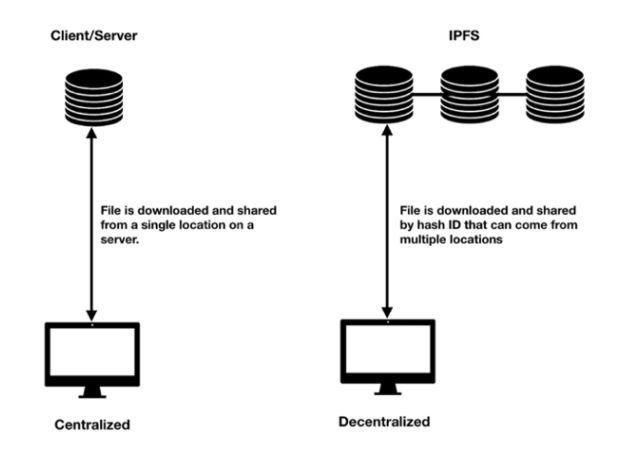
Intheproposedsystem,smartcontractsareusedtostorefile details in the blockchain and transfer the cryptocurrency from theuser’s walletto the peer’s wallet.AESencryption algorithmforenhancingthesecurityofuser’sdatastoredin cloudstorage.Theproposedsystemmapstheuser’swallet addresswiththeuser’sfilesothatonlythelegitimateowner can access the file’s data. Users' information is stored in Ethereum blockchain. The Ethereum blockchain network allowstheuseofsmartcontractsthroughwhichinformation offileuploadedbytheuserisstoredintheblockchain.The proposed system encrypts and decrypts data every single timeforuploadanddownloadoperation.Thesystemusesthe IPFS Protocol to distribute files efficiently across several peersinthenetwork.
4. METHODOLOGY
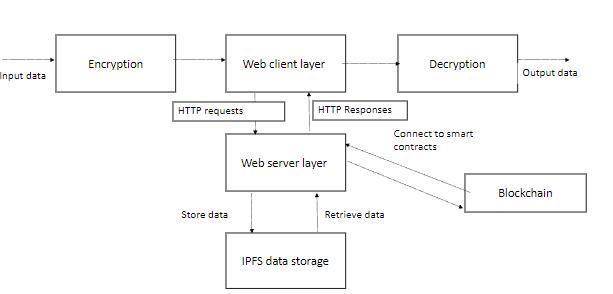
Theproposedsystemworksinfourmodules.Theuserfirst creates an account on the metamask. The user’s account addressandwallet balanceare fetchedin theappthrough web3.jsfromthemetamask.Usersselectthefiletoupload throughfilepicker.Systemchecksforthenumberofavailable peers. Further, the AES algorithm uses the user’s wallet addressasakeyandencryptstheuploadedfile.Apayment dialogueseeksfortheuser’sconfirmation.Onconfirmingthe payment,theuser’sfileisstoredacrossavailablepeersusing IPFSprotocol.IPFSthenreturnsahashvalueconsistingofthe path of the file. This path is then mapped with the user’s addressusingasmartcontractandgetsstoredsecurelyinthe blockchain.Toachievehighavailabilityandreliabilityofdata, the uploaded data is replicated on three peers. For better performance system blacklists peers every time they are unavailablefordataretrieval.
B.Encryptionoffile:TheuploadedfileisencryptedusingAES 256-bitalgorithm.Theencryptionkeyisgeneratedusingthe user’swalletaddressandrandomlygeneratedsaltvalue.This encryptionkeyalongwithanIVisusedtoencryptuser’sdata. Thismaintainstheconfidentialityoftheuser’sdata.
C.Storingoffileacrossmultiplepeers:Theencryptedfileis thendividedintoblocksof64KBandsendstodifferentpeers acrossthenetworkwiththehelpoftheIPFSprotocol.The proposed system uses a private IPFS network to allow registeredpeerstostorethefileinthenetwork.Thefileblock isreplicatedonmultiplepeer’sstoragesforhighavailability usingtheIPFScluster.
D.Storingoffileacrossmultiplepeers:IPFSreturnsahash value which indicates the path of the file. The hash value alongwithmetadataismappedwiththeuser’swalletaddress andisstoredintheblockchainusingasmartcontract.Smart contractsarelikeagreementandareusedtoeradicatethe needforathirdparty.Theycontrolthetransactionbetween nodes or assets between parties under certain conditions. Thisislinesofcodestoredonablockchainnetworkandare automatically executed when predetermined terms and conditionsaremet.Inourproposedsystempreconditionsfor the smart contract to execute are: 1) Enough Space is available in the network to store files. 2) The user has sufficientwalletbalancetopaythepeers.
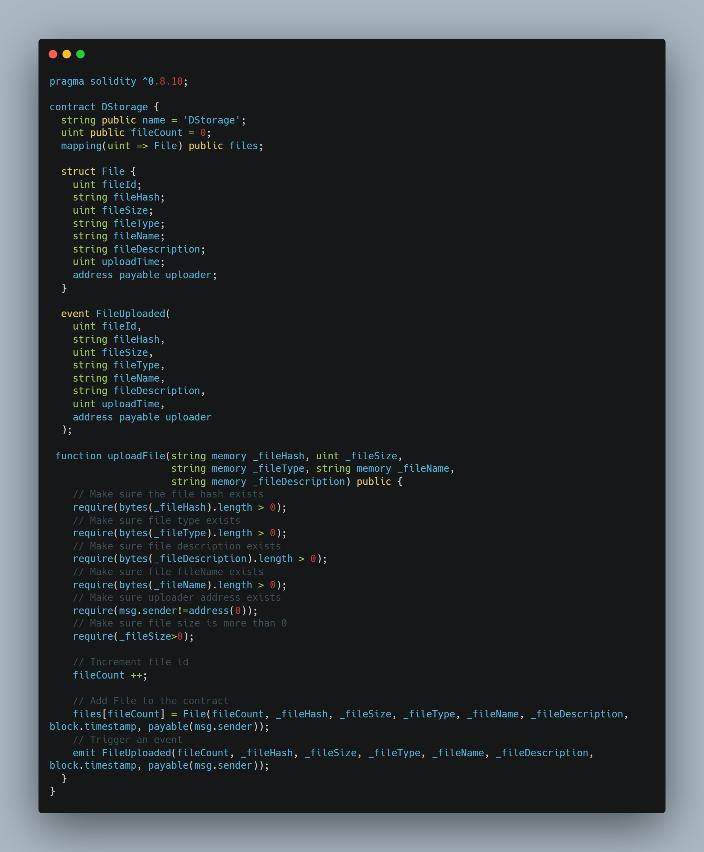
Thesmartcontractstoresallthefilesdetailsinthestructure namedFileandmapsthisstructurewiththeuser’saddress.It consistsoftwofunctions,onetoaddanewfileandanotherto getthedetailsoftheuploadedfile.
Fig2.SystemDesignforCloudStorage&Retrieval
Theterminologyisbrieflydiscussedbelow:
1. Metamask: Browser extension whichactsasa bridge to connectwiththeethereumnetwork.
2.Ethereumnetwork:Itisanopen-source,publicblockchain baseddistributedcomputingplatform.Ethereumusessmart contracts where one can add business logic to make decentralizedapplicationsasperthebusinessrequirements.
3.Peers:Thesearetheusersofthesystemwhohavepledged torenttheirfreestorageforotheruserstostorefiles.
4.AES:AdvanceEncryptionStandard(AES)isasymmetric keyalgorithmthatsupportsblocklengthof128bitandcan haveakeysizeof128,192,and256bits.
5. IPFS protocol: IPFS is an open-source peer to peer file transferprotocol.
A.Uploadingoffile:Useruploadsfileusingthefilepicker.The systemchecksthefilesizeandensuresstorageavailabilityin the network. The file is uploaded when enough storage is available.ThensystemperformsstepB.Usersarenotifiedto tryagainwhenenoughstorageisunavailable.
E. Paying the peers for file storage: Once the file is stored across peers, total cryptocurrency is calculated and is deductedfromtheuser’swallet.Thiscryptocurrencyisfirst transmittedtothesmartcontractfromtheuser’swallet.With the smartcontract, thisamount isdistributed to the peers whohavestoredtheuser’sfile.
The above smart contract stores all the files details in the structurenamedFileandmapsthisstructurewiththeuser’s address.Itconsistsoftwofunctions,onetoaddanewfileand anothertogetthedetailsoftheuploadedfile.
5. RESULTS
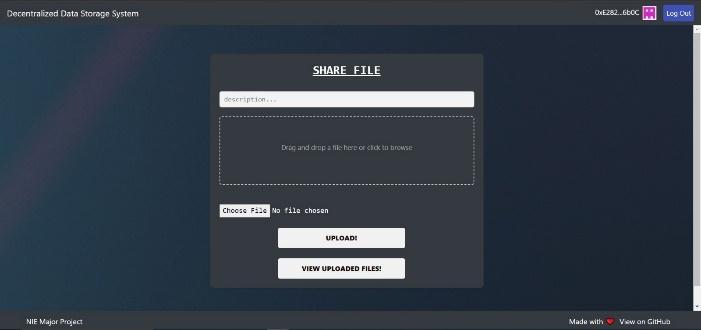
Toaccessthesystem,usersfirstsignuponmetamaskand loginwiththeregisteredcredentials.Successfullogintakes userstothehomescreenforselectingthefiletoupload.
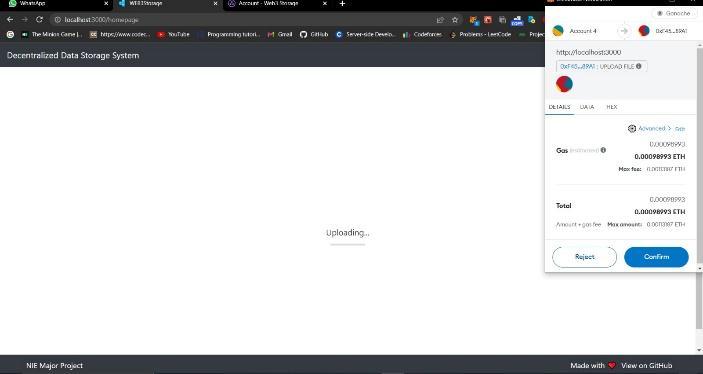
Afterasuccessfulpaymentfileissplitintoblocksandstore acrosspeersusingIPFSprotocolandthecorrespondinghash valueisstoredintheblockchain.
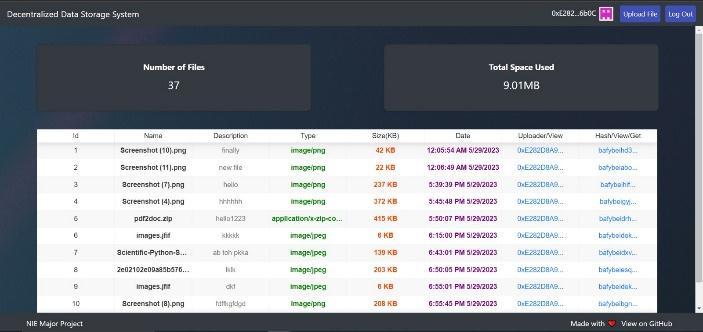
Fig.6representssuccessfullyuploadedfiledetails.Oncethe file is successfully uploaded ipfs returns a hash value indicatingthepathofthefile.Thiswillbemappedwiththe user’s wallet address and will be stored in the blockchain withthehelpofasmartcontract.
Systemchecksforstorageavailabilitybasedonselectedfile size. The selected file is encrypted using AES 256-bit algorithm when sufficient storage is available. The system willcomputethetotalcostofstoringthefile.Oncethecostis thecalculatedsystemwillcheckiftheuser’swalletbalanceis more than the calculated cost. If the user has sufficient balance,thenhe/sheisprompttopaythecryptocurrencyto storethefile.
6. CONCLUSIONS
The proposed system enhances the security of data by encryptinganddistributingthedataacrossmultiplepeersin the system. Implemented system uses the AES 256bit encryption algorithm to encrypt the data ensuring the confidentiality of the user’s data. Encrypted data is then distributedandstoredacrosspeersinthenetworkusingthe IPFSprotocol.Oursystem notonly solvestheprivacyand security concerns of centralized cloud storage but also providesamediumforthepeertorenttheirunderutilized storage and earn cryptocurrency in return thereby, maximizingthestorageresourceutilization.Inthefuture,an adaptive scheduling algorithm can be incorporated with which files can be accessed multiple times by the user as comparedtotheonewhichisaccessedrarely.Thiswillhelp toensurethatfrequentlyaccessedfilesareavailableeasilyto the user whenever required. Also, a credit system can be addedwithwhicheachpeerwillbeassignedadefault100 credit, based on their system uptime, and several successfullyservedfileaccessthatrequeststheircreditswill
beeitherdeductedoradded.Peerswithmorecreditswillbe givenhigherpriorityfordatastorage.
REFERENCES
[1] Bernard Marr,” How Much Data Do We Create Every Day?TheMind-BlowingStatsEveryoneShouldRead.” Forbes, 2018 M. Young, The Technical Writer’s Handbook.MillValley,CA:UniversityScience,1989.
[2] Zhe,Diao,”StudyonDataSecurityPolicyBasedOnCloud Storage”2017ieee3rdinternationalconferenceonbig data security on cloud (bigdatasecurity), ieee international conference on high performance and smart computing (hpsc), and ieee international conferenceonintelligentdataandsecurity(ids)IEEE, 2017.
[3] Lee,Bih-Hwang,ErvinKusumaDewi,andMuhammad Farid Wajdi. ” Data security in cloud computing using AES under HEROKU cloud.” 2018 27th Wireless and OpticalCommunicationConference(WOCC).IEEE,2018.
[4] Nakamoto, Satoshi,”Bitcoin: A peer-to-peer electronic cashsystem”,(2008).
[5] Zyskind,Guy,andOzNathan,”privacy:Usingblockchain to protect personal data”,IEEE Security and Privacy Workshops.IEEE,2015
[6] Cachin, Christian,” Architecture of the hyperledger blockchain fabric”, Workshop on distributed cryptocurrenciesandconsensusledgers.Vol.310.2016.
[7] Buterin,Vitalik,”Anext-generationsmartcontractand decentralizedapplicationplatform”,whitepaper(2014).
[8] Ruj,Sushmita,etal,”BlockStore:ASecureDecentralized Storage Framework on Blockchain” 2018 IEEE 32nd International Conference on Advanced Information NetworkingandApplications(AINA).IEEE,2018.
[9] Benet,Juan,“IPFS-ContentAddressed,Versioned,P2P FileSystem.”2014.
[10] Li, Dagang, et al. Meta-Key:” A Secure Data-Sharing ProtocolUnderBlockchain-BasedDecentralizedStorage Architecture”,IEEENetworkingLetters1.1(2019):3033.
[11] Wohrer,Maximilian,andUweZdun,”aSmartcontracts: security patterns in the ethereum ecosystem and solidity”, International Workshop on Blockchain OrientedSoftwareEngineering(IWBOSE).IEEE,2018.
[12] Sum,V.“SECURITYANDPRIVACYMECHANISMUSING BLOCKCHAIN.” Journal of Ubiquitous Computing and CommunicationTechnologies(UCCT)1.01(2019):4554
[13] Sivaganesan,D.“BLOCKCHAINENABLEDINTERNETOF THINGS.” Journal of Information Technology 1.01 (2019):1-8.