
Implementation of Computer Vision Applications usingOpenCV in C++
Adwait Bhave, Vaishnavi Jadhav, Punit Bhandari, Vaishnavi PatilDepartment of Electronics and Telecommunication Engineering, Pune Vidyarthi Griha’s College of Engineering Technology Project Guide: Prof. Anand Najan
Sponsored by NSM Solutions Pvt. Ltd.Industry guide: Mr. Nishad Mande -----------------------------------------------------------------------
Abstract Computer Vision (CV) has emerged as a critical field in various domains, ranging from autonomous vehicles to medical imaging. OpenCV, an open-source computer vision library, provides a rich set of functions and algorithms for image processing, feature detection, object recognition, and more. This paper presents a comprehensive study of integrating OpenCV with C++, aiming to explore its potential for developing robust and efficient CV applications. We present practical examples that demonstrate the seamless integration ofOpenCV with C++. We showcase real-world applications such as facial recognition, motion detection, and augmented reality, highlighting the versatility and extensibility of the OpenCV library whenutilizedalongsidetheC++programming language
Keywords – Computer Vision, OpenCV, C++, Text Recognition, colour detection, barcode decoding, Text on
Computer vision systems can recognise and categorise objects in pictures or video streams by extracting features, matching patterns, and using machine learning methods. Image processing enables applications like object tracking, surveillance, and autonomous navigation by helping to distinguish things based on colour, shape, texture, or other visual properties. Tools for picture analysis and interpretation are provided by image processing in order toget useful data from images. This involves activities like measuring, motion analysis, scene comprehension, andObject and Text Recognition, for the following given usecases
1. ColourDetection
2. BarcodeDecoding
3. TextRecognition

4. TextonImage
OpenCV (Open-Source Computer Vision Library) is a widely-used open-source computer vision and machine learningsoftwarelibrary.Itprovidesdeveloperswitharich set of tools and algorithms for image and video processing, objectdetectionandrecognition,andothercomputervision tasks. OpenCVis written in C++, which makes it a powerful and efficient library for real-time computer vision applications.
C++ provides a powerful and flexible environment for implementing CV algorithms, leveraging features like operatoroverloading,templates,andmemorymanagement. WeexplorehowC++enhancestheperformanceof OpenCVbased applications through its low-level control and efficientresourceutilization.
We will be using various OpenCV and image processing functions and algorithms like Grey-scaling, edge-detection, morphology,contours,thresholdingetc.
Computer vision tasks such as object detection and recognition benefit from image processing techniques.
The field of computer vision in C++ is active and quickly developing,withmanynewscientificdiscoveriesanduseful applications.InourProjectweusedfourdifferentusecases of computer-vision which we implemented using the programminglanguageC++.
Therearelargenumberofstudiesandresearchinthefield ofcomputer-vision but it is all done in the programming languageofpython.ImplementingitinC++wasachallenge in itself as not many researches were there regarding our usecases.Hereisasummaryoftheimportantstudies.
1. "Learning OpenCV 3: Computer Vision in C++ with the OpenCV Library" by Adrian Kaehler and Gary Bradski-Thisbookisacomprehensiveguidetothe OpenCV library and is ideal for beginners who want to learn computer vision using C++ and OpenCV.
2. “Recognizing one-dimensional barcode using OpenCV” by Junhao Liangand Tianqi Wang give a depthviewinhowbarcodedecodingworks.
3. “Process of Detecting Barcodes Using Image Processing” by Kopila Pariyar explained the processofbarcodedetection

4. “OCR Service Platform Based on OpenCV” by Jianjun Cai, Erxin Sun, Zongjuan Chen. The study found that the OCR technique achieved high accuracyintextrecognitionanddetection.

5. "Mastering OpenCV 4 with Python: A Practical Guide Covering Topics from Image Processing, AugmentedRealitytoDeepLearningwithOpenCV 4 and Python 3.7" by Alberto Fernandez and PrateekJoshi-Thisbookcoversthelatestversion of OpenCV and provides hands-on examples of how to use OpenCV with Python to solve realworldproblems.
III. METHODOLOGY/EXPERIMENTAL
While working on this project we had to take a different approach whilecomingupwiththecodeforeachusecase asthere was not enough study materials related to the topic.
This led us to build the code and decide the method from scratch. With different permutation and combinations used as well as taking useful functions from programing language python and converting and tweaking the function/algorithmasperourneedhelpedustogainmore insightabouttheexpectedoutcome.
A. Block Diagram

a) ColourDetection
b) TextRecognition
c) BarcodeDecoding
d) TextonImage
B. Synthesis/Algorithm/Design/Method
1) ColourDetectionRGBColourModel-
Red, green, and blue colours are combined in varying ratios to create a variety of colours in the RGB colour model, which is an additive colour scheme. A colour modelisamethodformultiplyingafewcorecoloursto produce many hues. Model light is used to display colour in additive colour. Colour mixing is additive in the RGB colour model [7]. It is the technique of combining the red, green, and blue primary colours in various ratios to create other colours. HSV colour gamut The Hue (H), the colour type (such as red, green), and the saturation (S) of the colour are the threeelementsthatmakeup theHSV(Hue, Saturation, Value) model, sometimes known as HSB (Hue, Saturation, Brightness). It has a red angle of 0 to 360 degrees.

2) TextRecognition–TesseractLibrary:
Text extraction from photographs or scanned documents is made possible via text recognition in OpenCV using the Tesseract package, which is a reliable and popular method. Tesseract, a Googledeveloped open-source OCR engine, for precise and effectivetextrecognition.
Tesseract analyses and recognises the text within the specified regions using cutting-edge OCR algorithms. Text recognition in OpenCV utilising the Tesseract library enables the extraction of textual information from photos or scanned documents with high accuracyandefficiency by combining OpenCV's image processing skills with Tesseract's potent OCR techniques.
3) BarcodeDecoding–
In order to extract information from digital images, computer vision must first modify and analyse the images. This process is known as image processing and detection. Several important methods and processesthatarefrequentlyusedinimageprocessing anddetection.
● Grey scaling and the Sobel Function: Greyscale photos can be used with the Sobel function [3], a well-known edge detection technique, to locate andhighlight edges based on the gradient of pixel intensity.
● Blurring and Thresholding: Blurring, commonly referred to as smoothing, is a technique for removing small features from an image and reducingnoiseandthresholdingentailsseparating a picture into binary sections according to a predeterminedthresholdvalue.
● Morphology Operations: A set of operations used toexamine and modify the shapes and structures found in an image are referred to as morphology operations.
● Contours: The borders or outlines of items in a pictureareknownas contours. They areessential in the detection, identification, and study of objects'shapes.
● ZBar Library: Zbar is an open-source software librarythatofferstheabilitytoscanbarcodesand QRcodes.
● RegionofInterest:Inimageprocessing,ROIstands forregionofinterest.Itdescribesaparticulararea or region inside an image that is picked out for additional examination, processing, or information extraction.
● Decoding Algorithm: it is the algorithm based on OtsuModel.
4) TextonImage–
• Put Text: This function is used to write text on an image.Ittakesthefollowingparameters:
• Image: The input image on which the text will be written.
• Text:Theactualtextstringtobewritten.
• Position:Thecoordinates(x,y)ofthestartingpoint ofthetext.
• Font type and size: The font type and size of the text.
• Color:Thecolorofthetext.
• Thickness:Thethicknessofthetext.
• Line type: The type of line used for drawing the text.
• Text Size: This function calculates the size of the textstring.
• Scalar:ThisclassrepresentsacolorinOpenCV.You can specify the color using the BGR (Blue,Green, Red)format.
• These are pre-defined font types available in OpenCV for writing text. FONT_HERSHEY_SIMPLEX, FONT_HERSHEY_PLAIN, FONT_HERSHEY_DUPLEX, etc.
C. Expected Outcome
1) ColourDetection:
We were able to successfully isolate the objects of which colour code we had given in the HSV tracker. Thus Object detectionwassuccessful.
2) TextRecognition:
We were able to successfully Detect the text using OpenCVfunctionsinC++

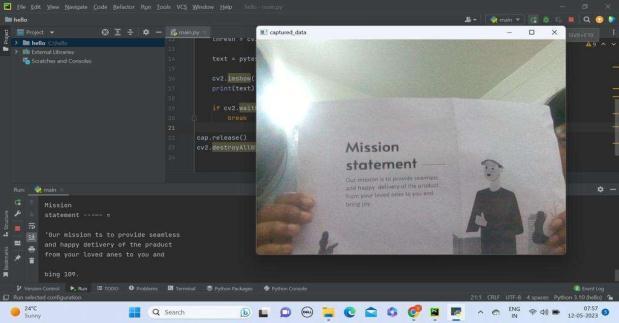


3) BarcodeDecoding:
We faced the same problem like in [2] above, where the original Zbar (barcode decoding library) was in the OpenCV package, but it was discontinued for C++ programming language. So after many Permutations and Combinations wewere able to achieve a Near Perfection barcodeDetection

But the tesseract library which was initially a part of OpenCV module for C++ was mot working giving errors. Hence to prove our methodology and algorithm is precise and correct we tried the same algorithm in programming languagePython.
WewereabletosuccessfullyDecodeUPC-Abarcodesusing basicOpenCVFunctionsandalgorithmsinC++withoutthe Pre-trainedlibraryZbar.
4) TextonImage:
Wegotthedesiredoutcomeforourtextonimageusecase

example project to understand how image processing functions,itssignificanceinthefieldofcomputervision,and thefundamentalstepsthatmustbetakenintoconsideration. It acts as a significant demo project.Except for the phases wherethePre-trainedlibrariessuchasTesseractand ZBar[] werewithdrawn,thefundamentalsofimageprocessingand computer vision are easy to understand. This led us to employing different method forthoseuse-cases.
We were able to complete our project's primary objective—the implementation of all computervision apps in C++, despite a few smalldifficulties. Testing a variety of other C++ andPython programming language may help this project advance. Applications for computer vision in C++ may be used to set up automation plants or automate conveyer belt systemoperations for a particular project or productline.
More OpenCV advancements and applications are expectedinthefollowingareas:
1) Industrial Automation: Computer vision is increasingly being used in industrial automation to increase quality control, inspection,andprocessoptimization
2) Security and Surveillance: Computer vision is extremely important in security and surveillance systems. The object detection, tracking, and behavior analysis capabilities ofOpenCVhelptoconstructintelligentvideo surveillancesystems.
3) Real-time and Embedded Systems: As smart devices and the Internet of Things (IoT) proliferate, there is an increasing demand for real-time computer vision applications that can run efficiently on resourceconstraineddevices.
IV. CONCLUSION AND FUTURESCOPE
Theproject“ImplementationofComputerVisionapplications using OpenCV in C++"is an innovative project that can be seenasa demonstrationprojectforunderstanding thebasic concepts of computer vision, machine learning, and image processingbyusingdifferentalgorithms.

It also provides information on Object Detection models, Artificial Intelligence, and Computer Vision Algorithms for researchers who are really interested in the topic. This project can be used byresearchers as an overview or an
4) Integration with other Technologies: Deep learning techniques, specifically convolutional neural networks(CNNs), have transformed computer vision. TensorFlow andPyTorch are two popular libraries that have been integrated. In augmented reality (AR) and virtual reality (VR) applications, computervisioniscritical.

Finally, with its broad features, cross-platform compatibility, active community support, and integration capabilities, the future of OpenCV implemented in C++ appears excellent. While it has a steep learning curve and only limitedsupportfor advanced approaches, its excellent performance and versatility make it a powerful tool for a widerangeofcomputervisionapplications.
V. REFERENCES
[1] https://pyimagesearch.com/2014/12/15/real-timebarcode-detection-video-python-opencv/
[2] https://www.ijser.org/researchpaper/Naive-BayesApproached-in-Color-Detection-using-PandasOpenCV.pdf
[3] https://laconicml.com/barcode-detection-opencv/
[4] https://pyimagesearch.com/2018/05/21/an-opencvbarcode-and-qr-code-scanner-with-zbar/
[5] https://link.springer.com/chapter/10.1007/978-3030-20904-9_9
[6] papers.ssrn.com/sol3/Delivery.cfm/SSRN_ID38799 81_code3665699.pdf?abstractid=3879981