EXPERIMENTAL STUDIES ON FOAM AND SILICA FUMEBASED CELLULAR LIGHT WEIGHT CONCRETE
APOORV AGARWAL1, ABHISHEK PATHAK2, SHIVAM SINGH3
1APOORV AGARWAL, B.TECH. STUDENT, SRMCEM LUCKNOW
2ABHISHEK PATHAK, B.TECH. STUDENT, SRMCEM LUCKNOW
3SHIVAM SINGH, B.TECH. STUDENT, SRMCEM LUCKNOW ***
Abstract
This research paper examines the use of foam and silica fume in the production of lightweight concrete. Foam-based lightweight concrete is created by introducing air or gas bubbles into a cement mixture, while silica fume-based lightweight concrete is made by mixing silica fume with cement, sand, water, and other additives. Both types of lightweight concrete haveadvantagesanddisadvantages,dependingon the specific application anddesiredproperties.Foam-basedlightweight concrete has good insulation properties and iseasy to produce, but is not as strong as silica fume-based lightweight concrete.Silicafume-basedlightweightconcreteisstrongerandmoredurable,butmay require specializedequipmentandis moredifficulttoproduce.Thispaperreviewsthecurrentresearchonthepropertiesandapplicationsoffoamandsilicafumebasedlightweightconcrete,andprovidesinsightintothepotentialusesandlimitationsofeachtypeoflightweightconcrete.
Keywords: Foam-based lightweight concrete, Silica fume-based lightweight concrete, lightweight concrete production, ConcretestrengthConcretedurability,Foamagent,Silicafume.

1. INTRODUCTION
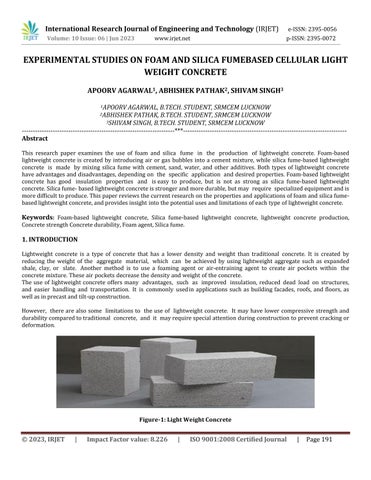
Lightweight concrete is a type of concrete that has a lower density and weight than traditional concrete. It is created by reducing the weight of the aggregate material, which can be achieved by using lightweight aggregate such as expanded shale, clay, or slate. Another method is to use a foaming agent or air-entraining agent to create air pockets within the concretemixture.Theseairpocketsdecreasethedensityandweightoftheconcrete. The use of lightweight concrete offers many advantages, such as improved insulation, reduced dead load on structures, and easier handling and transportation. It is commonly usedin applications such as building facades, roofs, and floors, as wellasinprecastandtilt-upconstruction.
However, there are also some limitations to the use of lightweight concrete. It may have lower compressive strength and durabilitycomparedtotraditional concrete, and it mayrequirespecialattentionduringconstructiontopreventcrackingor deformation.
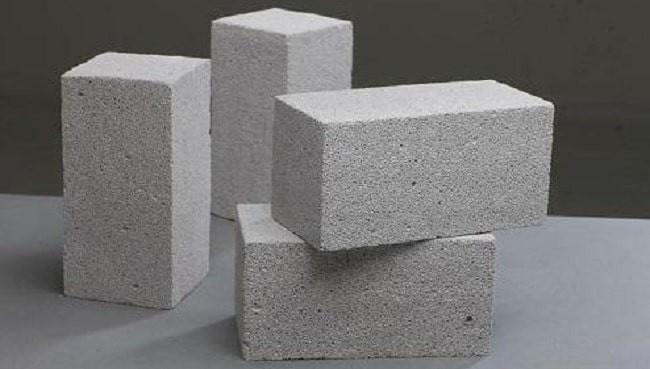
Lightweight concrete can provide several benefits over traditional concrete. For example, it reduces the dead load of a structure, which can lead to cost savings in the design and construction of the building. It also improves the insulation propertiesofthestructure,whichcanresultinincreasedenergyefficiencyandcostsavingsonheatingandcooling.
In addition, lightweight concrete is easier to handle and transport, which can reduce labor costs and make construction more efficient. It can also be used in situations where heavy equipment cannot be used, such as in retrofitting or repair projects.
Whilelightweightconcreteoffersmanyadvantages,italso has some disadvantages thatshouldbeconsideredbeforeitsuse inaconstructionproject.Herearesomeofthepotentialdisadvantagesoflightweightconcrete:
A. Lowerstrength:Lightweightconcretetypicallyhaslowercompressivestrengththan traditionalconcrete,which canlimit itsuseincertainapplications.
B. Durabilityissues:Theuseoflightweightaggregateand/orair-entrainingagentsintheproductionoflightweightconcrete canleadtolowerdurabilityandresistancetofreeze-thawcycles,whichcanresultincrackingandreducedservicelife.
C. Cost: The cost of lightweight concrete can be higher than traditional concrete, due tothe use of specialized aggregate, additives,orproductionprocesses.
D. Shrinkage:Lightweightconcretemayexperiencehighershrinkagethantraditionalconcrete, which canresult incracking ordeformationovertime.
E. Limited availability: Lightweight aggregate and/or air-entraining agents may not be readily available in certain regions, whichcanlimittheuseoflightweightconcreteinthoseareas.
F. Thechoicetouselightweight concreteshould bebasedon acarefulconsiderationof itsadvantagesanddisadvantages, and the specific needs of the project. In some cases, the advantages of lightweight concrete may outweigh its disadvantages,whileinothercases;traditionalconcretemaybethebetteroption.
2. FOAM IN LIGHT WEIGHT CONCRETE
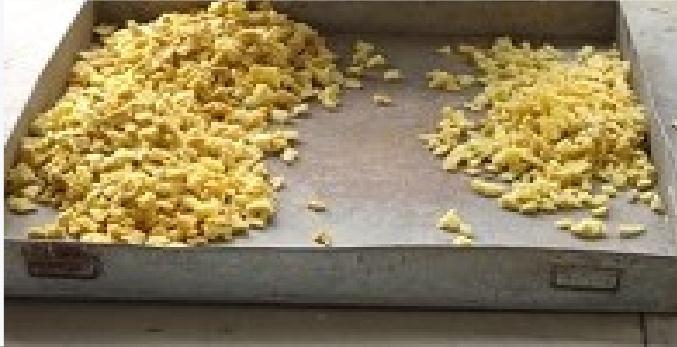
Foam is a commonly used additive in the production of lightweight concrete. The foam is created by introducing air into a solution of water and a surfactant, which is then mixed withthe concrete to create air pockets within the mixture. These air pockets reduce the weight oftheconcrete,whilealsoprovidinginsulationandacousticproperties.
Foam-based lightweight concrete has several advantages over other types of lightweight concrete. It is easy to produce and canbemadeonsiteusingsimpleequipment,whichcanreducethecostandtimeof construction. Italso has goodinsulation properties, whichcanleadtoimprovedenergyefficiencyandcostsavingsonheatingandcooling.
However, foam-based lightweight concrete also has some limitations. It typically has lower strength and durability than traditional concrete, which can limit its use in certain applications. It may also require special handling and curing techniques to prevent crackingordeformation.
3. SILICA FOAM IN LIGHT WEIGHT CONCRETE
Silicafumeisanothercommonlyusedadditive intheproductionof lightweightconcrete. Itisaby-productoftheproduction of silicon and ferrosilicon alloys, and is composed of very fine particles that can fill the gaps between the cement particles, leadingtoadenserandstrongerconcrete.
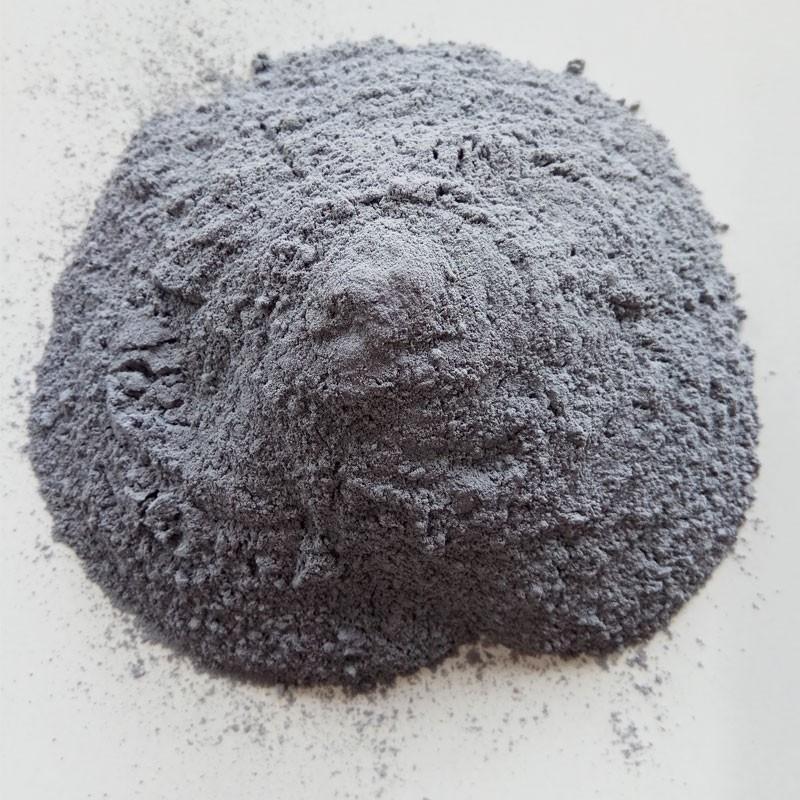
When silica fume is added to lightweight concrete, it can increase its compressive strengthand durability, while also reducing its permeability and improving its resistance to chemical attacks. It can also improve the workability of the concrete, whichcanmakeit easiertohandleandplace.
However, the use ofsilica fume in lightweight concrete alsohas some limitations. It is typicallymoreexpensivethanother lightweightconcrete additives, whichcanincrease thecostoftheconstructionproject.Itmayalsorequireadditional curing timetoachieveitsfullstrength,whichcandelaytheconstructionschedule.
The use of silica fume in lightweight concrete can provide many benefits in terms of strength, durability, and resistance to chemical attacks, but it may also have some limitations thatshould be considered before its use in a construction project. The choice to use silica fume in lightweight concrete should be based on a careful consideration of its advantages and disadvantages,andthespecificneedsoftheproject.
4. COMPRESSIVE STRENGTH OF FOAM AND SILICA FOAM IN LIGHT WEIGHT CONCRETE
Thecompressivestrengthoffoamandsilicafume-basedlightweightconcretedependsonvariousfactorssuchasthetypeand qualityoftheaggregate,theratiooftheingredients,thecuringprocess,andthedensityoftheconcrete.
Generally,foam-basedlightweightconcretehaslowercompressive strengththan traditional concrete, butit still canprovide sufficient strength for many construction applications. The compressive strength of foam-based lightweight concrete can rangefrom1,500to5,000psi(10.3to34.5MPa),dependingonthefactorsmentionedabove.
On the other hand, silica fume-based lightweight concrete typically has higher compressive strength than foam-based lightweightconcrete.Theadditionofsilicafumecanincreasethecompressive strength of lightweight concrete by up to 20-
30%. The compressive strength ofsilica fume-basedlightweightconcretecanrange from4,000to12,000 psi(27.6 to 82.7 MPa),againdependingonvariousfactors.
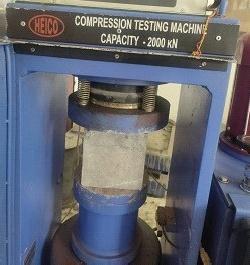










Itisimportanttonotethatthecompressivestrengthoflightweightconcreteisnotthe only factortoconsiderinitsuse.The durability,workability,andotherpropertiesoftheconcreteshould also betakenintoaccounttoensure its suitability forthe intendedapplication.


5. FLEXURAL STRENGTH OF FOAM AND SILICA FOAM IN LIGHT WEIGHTCONCRETE
The flexural strength of foam and silica fume-based lightweight concrete depends on various factors, such as the type and qualityoftheaggregate,theratiooftheingredients,thecuringprocess,andthedensityoftheconcrete.
Foam-based lightweight concrete typically has lower flexural strength than traditional concrete. The flexural strength of foam-basedlightweightconcretecanrangefrom200to700psi(1.4to4.8MPa),dependingonthefactorsmentionedabove.
Silica fume-based lightweight concrete typically has higher flexural strength than foam-based lightweight concrete. The addition of silica fume can increase the flexural strength of lightweight concrete by up to 40-50%. The flexural strength of silicafume-basedlightweightconcretecanrangefrom600to1,800psi(4.1to12.4MPa),dependingonvarious factors.
Flexure strength chart


6. CONCLUSION
Open lightweight aggregates, fly faeces, silica smoke, and foam as air entraining preparations for make cellular lightweight cement. Compressive strength, flexibility, creep, heartiness, fire resistance, ease of installation, and management are clever. Reduce material consumption, burden on an arrangement, simplify establishing, managing, and speeding new development, andincreasecompressivestrength.Compressivestrengthisachieved by mixing concrete,sand,silicasmoke,aggregates,and flydebris. Itlowerscrucial componentdeadheap, boosts fireandstrength resistance, and is cheaperthanstandardcement. Properaggregates,proportioning,mixing,assembly,transportation,andsettingstrengthenconcrete.Water-significantdegree impacts critical blend, strength, setting time, and concrete value. Cell Lightweight Concrete weighs less. Mixing 10%–20% silica smoke with fly trash froths it. Silica smoke and fly rubbish freely provide 10% and 20% of considerable weight, makingMix2'stotaladmixtures10%andMix3's20%.Mix2offersa smallerinitialsetuptime,quickercompressivestrength development, more visible weakness, and greater comfort than Mix 3.Cellular lightweight cement may inspire innovative buildingmaterials.
The future scope for foam and silica fume-based cellular lightweight concrete is promising,as there are several ongoing researchanddevelopmentactivitiesinthisfield.Somepotentialareasoffutureresearchanddevelopmentinclude:
1. Optimization of foam and silica fume-based lightweight concrete mixtures to improve their mechanical properties, durability,andworkability.
2. Development of new types of foam and silica fume-based lightweight concrete mixtures that can provide enhanced insulation, fire resistance, and acoustic properties.
3. Investigationofthe potentialuse of foamandsilicafume-basedlightweight concreteinstructuralandnon-structural applications,includingwalls,roofs,and flooringsystems.
4. Exploration of new production techniques for foam and silica fume-based lightweight concrete, such as using 3D printingandotheradvancedmanufacturingprocesses.
5. Studyofthe environmental impactandsustainabilityof foamandsilica fume-based lightweightconcrete,includingits carbonfootprint,energyconsumption,andwastegeneration.
6. Development of cost-effective and scalable production methods for foam and silica fume-based lightweight concrete, whichcanmake it moreaccessible andaffordableforawiderrangeofconstructionprojects.
REFERENCES
1. Puttappa C.G “Mechanical Properties of Foamed Concrete - ICCBT 2008
A
(43)
pp491-500”.
2. Mohd. Zairul Affindy Abdul Rahman “Analysis of Comparison between Unconfined and Confined Condition of Foamed Concrete Under Uni-Axial Compressive Load - American J. of Engineering and Applied Sciences 3 (1): 68-72, 2010 ISSN 1941-7020© 2010Science Publications”.
3. Alia. Akhtaruzzaman “Behavior of Foamed Slag Concrete at High Temperatures – JKAU Eng. Sci. Vol. 2, pp. 119-131 (1410A.H./1990A.D.)”.
4. Narayanan N., Ramamurthy K. “Structure and properties of aerated concrete - Cement& Concrete Composites 22 (2000)321±329”.
5. Mohamad N., Omar N., Abdullah R., Lee Y. L. , Abdul Samad A. A. “Axially loaded pre-cast foamed concrete sandwich panel-EleventhEastAsia-PacificConferenceonStructuralEngineering&Construction(EASEC-11),Taipei,Taiwan”.
6. JonesM. R.andMcCarthyA.“Preliminaryviewsonthepotentialoffoamedconcreteasastructuralmaterial-Magazine ofConcreteResearch,2005,57,No.1,February,21–31”.
7. Tommy Y. Lo“Structural LightweightConcretein HongKong: Now, New,Next”.
8. ByunK.J.,SongH.W.andParkS.S.“Developmentofstructurallightweightfoamedconcreteusingpolymerfoamagent”.
9. Nuruddin MF., Bayuaji R., Application of Taguchi’s approach in the optimization of mix proportion for Microwave IncineratedRiceHuskAshFoamedConcrete-International Journal of Civil & Environmental Engineering IJCEE Vol: 9 No:9”.
10. Abd S.M., Mohd. Zain M.F., Abdul Hamid R. “Modeling the Prediction of Compressive Strength for Cement and Foam Concrete”.
11. NuruddinMF,BayuajiR.“Non-EvaporableWaterAnalysisonMirhaFoamedConcrete”.
12. 16.“Lightweight Concrete” Expanded ShaleClayand Slate Institute’s Publication.