A Comparative Analysis of Variation in Vitamin C Content Of Kinnow
Mandarin (Citrus Reticulata) and Guava (Psidium Guajava) as a Function Of Days Of Storage at Room Temperature
Laveena Gulabchandani1, Taruna Sethi21Lecturer, Department of Chemistry, Sophia Girls’ College (Autonomous), Ajmer, Rajasthan, India

2Associate Professor, Department of Chemistry, Sophia Girls’ College (Autonomous), Ajmer, Rajasthan, India ***
Abstract - This study depicts an analysis of Vitamin C content of two fruits, namely a citrus fruit Kinnow Mandarin and a non-citrus fruit Guava grown at Sophia Girls’ College (Autonomous), Ajmer. Vitamin C or ascorbic acid is a very essential nutrient for human body which cannot be synthesized but can be obtained only from the food we eat. Thus, estimation of Vitamin C content and the effect of storage duration becomes significant. In this investigation, ascorbic acid content was estimated in juices extracted from freshly plucked fruits and in the stored fruits after an interval of 7 and 14 days. The analysis of the data shows that kinnow fruits show a decrease in Vitamin C content from 36.45 mg/100mL to 34.87 mg/100 mL after storage of 7 days which reduces to 24.83 mg/100 mL after 14 days of storage while guava on the other hand shows an increase in Vitamin C content from 100.91 mg/100 mL in fresh fruit sample to 127.86 mg/100 mL in after 7 days followed by a decrease to 119.40 mg/100 mL after 14 days of storage due to ripening effect, but it reached near the point of rottening decreasing its shelf life. Thus, it can be concluded that consuming fruits when fresh is best.
Key Words: Vitamin C, Guava, Kinnow, Redox titration, Ascorbicacid
1.INTRODUCTION
Fruits and Vegetables constitute a very important part of humandiet.Theyarerichsourcesofdietaryfiber,vitamins andmineralsincludingVitaminC,AandE,Mg,Zn,Folicacid aswellasphytochemicalsespeciallytheantioxidants.Adiet containingahighnumberoffruitsandvegetableshelpsin loweringbloodpressure,minimizestheriskofheartdisease and stroke, assists in prevention of some types of cancer, decreasestheriskofvariousproblemsconcerningwitheyes anddigestivesystemandshowapositiveeffectontheblood sugarlevel[1].
Vitaminsareoneofthemostimportantconstituentsoffruits and vegetables that are vital for humans to maintain a healthy diet and form a necessary part of various biochemicalandphysiologicalprocessestakingplaceinthe body.SomeofthevitaminslikeVitaminD,K,Niacin,Biotin canbesynthesizedwithinhumanbodywhilesomeothers cannot be synthesized, one of which is Vitamin C. This is because of the mutation in the gene which codes for the
enzyme L- gulono lactone oxidase required for the biosynthesisofVitaminC[2].Asaresultofthis,humancells cannot perform the laststepof synthesisof VitaminC i.e., formation of ascorbic acid from L- gulono g- lactone catalyzedbyenzymeL-gulonolactoneoxidase[3]. Thus,the only source of Vitamin C in humans is the food we eat. According to Office of Dietary Supplements, the RecommendedDailyIntake(RDI)ofvitaminCisaround90 mg/day for an adult male and 75 mg/day for an adult womanwhichincreasesto85mg/dayforapregnantwoman and to 120 mg/day for a woman during lactation [4]. The dailyintakeofVitaminCincreasesbyaround35mg/dayfor smokers as vitamin C gets oxidized by free radicals and oxygenspeciesproducedbycigarettesmoking[5,6].
VitaminC,chemicallyknownasL-AscorbicAcid(C6H8O6)is a white or slightly yellow odourless crystalline powder which is highly soluble in water and performs numerous biochemicalandphysiologicalfunctionsinhumanbody.It functionsasanantioxidantbyscavengingandneutralizing themostofthebiologicallyactiveandharmfulradicalssuch assuperoxide,hydroperoxyl,aqueousperoxylradicals,NO2, nitroxide radicals etc. [7] thus preventing humans from a conditionknownasoxidativestress[8]whichiscausedby increasednumberoffreeradicals. Moreover,ascorbicacidis a cofactor involved in the synthesis of Carnitine, Collagen and Neurotransmitters catalysed by hydroxylases and monooxygenase enzymes [8 -11]. It also behaves as a catalyst in amidation reactions of peptide hormones [12] oxytocin,cholecystokinin,α-melanotropinandvasopressin attheirmaximumefficiency[11].
Recently many Investigations have proved that Vitamin C reduces the risk of breast, lungs, rectum, colon as well as mouthcancers[2,13-14].Inadditiontothis,ascorbicacid helpspreventionofHypercholesterolemia,enhancesdietary absorption of non-heme iron [10-12, 15-17], improves immunity during cold infections, advantageous in cardiovasculardiseases[12,18]andcataracts[12].
DeficiencyofVitaminCcausesanaemia,bleedinggums,poor wound healing, capillary haemorrhage, atherosclerotic plagues,muscledegeneration,andneuroticdisturbances[8], toothloss,jointpains,boneandconnectivetissuedisorders, fatigueandlethargy,depressionandmoodchanges[9].Its
deficiency can also cause a pathologically fatal disease known as Scurvy, [19] the symptoms of which include fatigue, weakening of connective tissues and capillary fragility [10, 20] thus it is also known as “Anti- scorbutic factor”,asithelpstopreventthediseaseknownasscurvy [21].
VitaminCcontentoffruitsandvegetablescanbeusedasan indicatorofnutrientqualitysinceitishighlysusceptibleto degradation. Various factors such as climatic conditions, culturepractices,pH,Temperatureanddaysofstorageaffect theamountofVitaminC.
Due to its importance for the various biochemical and physiological functions of human body, the effects of its deficiencyandthedegradationfactorswhichinfluencesthe nutrient quality of fruits and vegetables, the quantitative estimationofVitaminCandthefactorsaffectingitassumes significance.
Thisstudyinvolvesthedeterminationandanalysisofeffect ofdurationofstorageonVitaminCcontentoftwofruitsviz. Kinnow (Citrus reticulata) and Guava (Psidium guajava) grown at Sophia Girls’ College (Autonomous), Ajmer by redoxtitrationusingpotassiumiodateasthetitrant.
Kinnow(Citrusreticulata)isacitrusfruitwhichisahybrid of Citrus nobilis (King) and Citrus deliciosa (Willow Leaf) mandarins. It contains a large amount of ascorbic acid, provitamin A, Folate, Limonoids, Phenolics, Carotenoids, FlavonesandFlavonoids[22].Thesemetabolitesboostthe immunesystemagainstvariousinfections,heartdiseasesas wellascancer[23].ItalsocontainsmineralssuchasNa,K, Ca,Mg,P,Fe,Zn,CuandMnwhicharenecessaryforhealthy bones and proper functioning of mitochondrial enzymes [22].
Guava(Psidiumguajava)isahighlynutritiveandadelicious fruit containing proteins, carbohydrates, lipids, minerals (calcium,iron,phosphorus,potassium),water,vitamins(A, B1&C)[24-25].Itcanalsobeusedtotreatvariousdiseases bybeingapartofdrugs[25].
2.RESEARCH METHODOLOGY
2.1 Sample Collection
FreshFruitsofKinnowMandarin(Citrusreticulata)and Guava(Psidiumguajava)werepluckedfromthetreesgrown inSophia Girls’College(Autonomous),Ajmer campusand wereanalysedforVitaminCcontentonthedayofplucking and consecutively after 7 days and 14 days of storage at roomtemperature.
2.2 Sample Preparation
The Collected fruit samples were washed with distilled watertoremoveanyadheringdustparticlesandimpurities.
100gofboththefruitsampleswereweighedandblended withaminimalamountofdistilledwater.Afterblending,the pulpwasfilteredusingasieveandamuslinclothandthen washed using few 10 mL portions of distilled water to extractthejuice.Theextractedjuicewastakenina100mL volumetricflaskandtheflaskwasfilleduptothemarkusing distilled water. Similarly, the sample were prepared from fruitsafterstorageof7and14Days.
2.3 Preparation of Reagents
0.002 M Potassium Iodate
0.428gofPotassiumiodatewasweighedanddissolved in minimum amount of distilled water in a one-liter volumetricflaskandthentheflaskwasfilleduptothemark usingdistilledwater.
0.6 M Potassium
Iodide
0.6 M solution of Potassium Iodide was prepared by dissolving 9.96 g of KI in distilled water in a 100 mL volumetricflask.
1 M Hydrochloric Acid
8.33mLofHClwastakenin100mLvolumetricflaskand thesolutionwasmadeuptothemarkbydistilledwater.
0.5%
Starch Indicator
0.25gofstarchwasdissolvedin50mLofboilingdistilled waterbystirring.Thesolutionwascooledbeforeusing.
2.4 Procedure
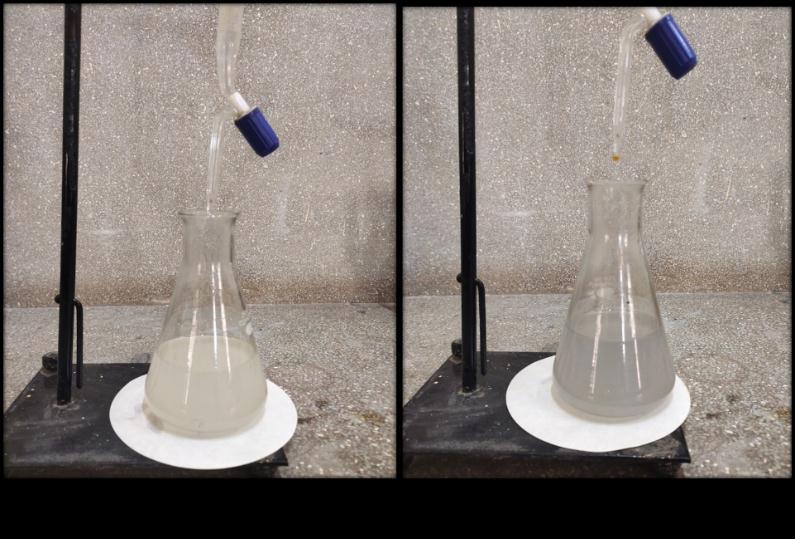
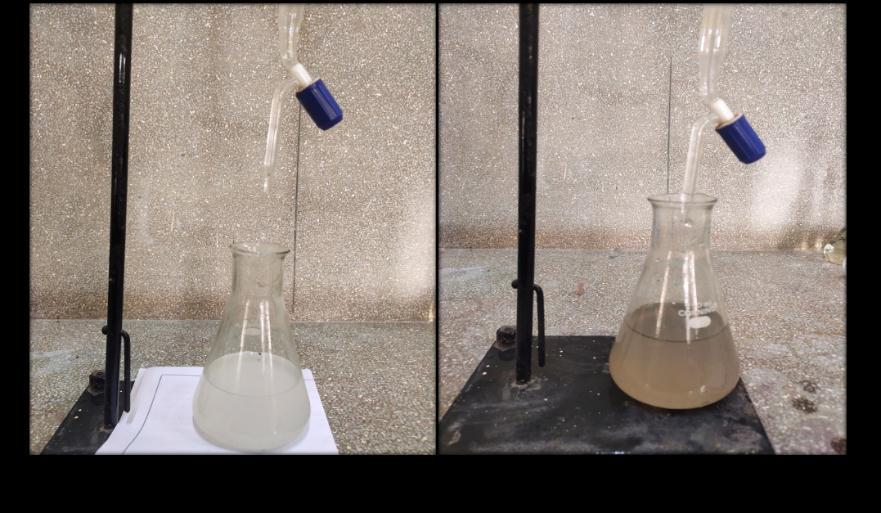
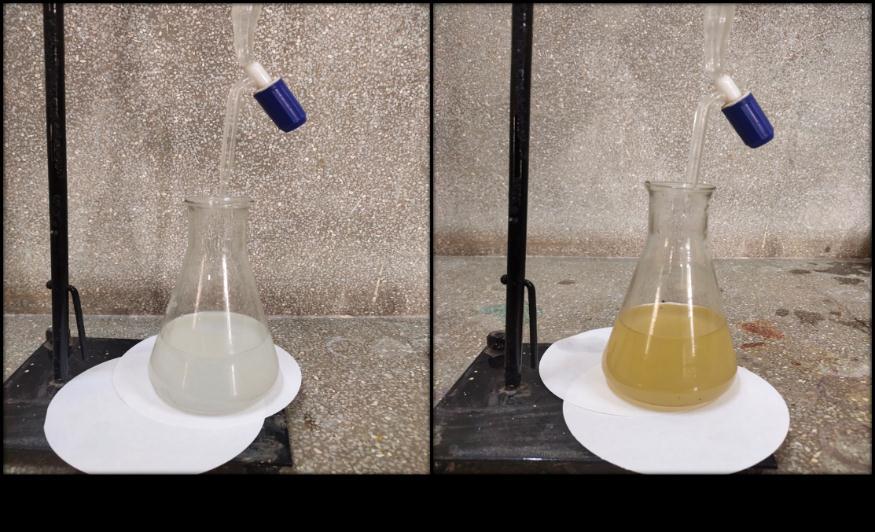
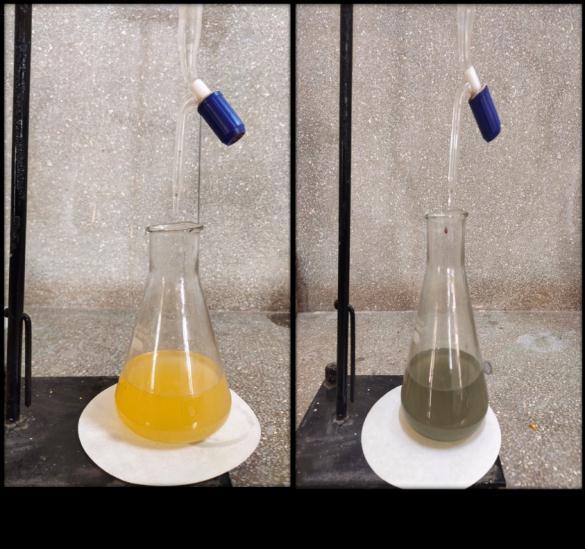
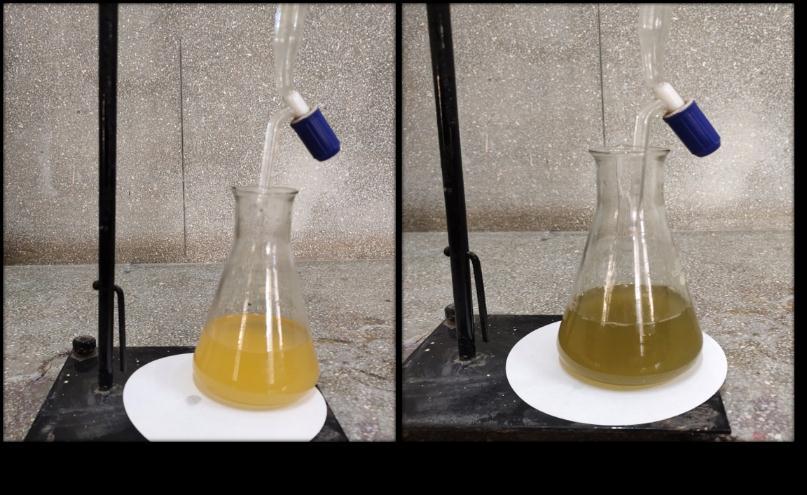
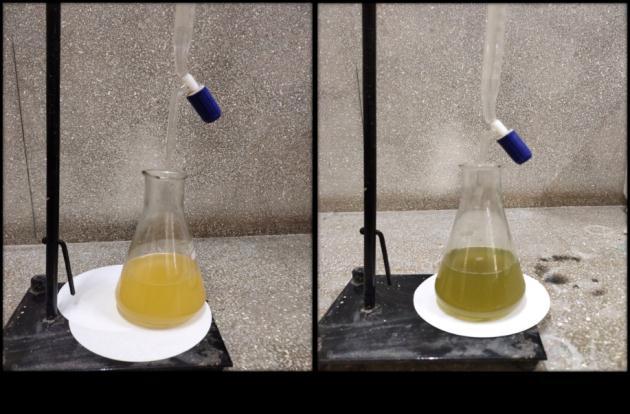
In this study, Vitamin C content in fruit juices was determinedbyoxidation-reductiontitrationusingpotassium iodate as the titrant in presence of KI and starch as the indicator[26].20mLoffreshfruitjuicewastakenusinga pipetteandpouredina250mLconicalflasktowhich150 mLofdistilledwater,5mLeachof0.6MKIand1MHCland 1 mL starch indicator was added. Then the sample was titrated with 0.002 M Potassium iodate solution till a permanent blue black colour appears due to formation of starchiodinecomplexattheequivalenceortheendpointof titration.Acolourvariationmaybeobservedduetocolourof fruit juice sample. The final volume of the iodate solution usedto neutralizetheascorbicacidpresentinthesample was recorded and the titration was repeated at least two more times to get the concordant readings. An identical processwasrepeatedtoanalyzetheAscorbicacid(Vit. C) contentinjuicesextractedfromstoredfruits.Thechangein colourobservedduetotitrationforthevariousfruitjuicesof bothguavaandkinnowareshownfromfigure1to6.
Duringthistitration,iodateionsarereducedandtheiodide ionsareoxidizedtoformiodinewhichoxidizestheascorbic acid present in the sample to dehydroascorbic acid and is itselfreducedbacktoiodine.Theexcessiodineaftertheend point reacts with starch to form a blue black coloured complex. The vitamin C content of the fruit juices was calculatedonthebasisofthestoichiometryofthefollowing reactions-
Ascorbic

Accordingtotheabovereactions,
No. of moles of iodate used = 3 x No. of moles of Iodine formed = 3 x No. of moles of ascorbic acid
Thisshowsthat, 1 mole of iodate used = 3 moles of ascorbic acid present


Thatis,themolarratioofiodateandascorbicacidis 1:3

Massofascorbicacid(mg)canbecomputedby-
Mass of Ascorbic acid present (in mg) =Molesof ascorbicacidxMolecularweightofascorbicacidx1000





Thisgivestheconcentrationinmg/20mLofsampleasthe initialvolumeofsampletakenwas20ml.Multiplyingthis valueby5givestheconcentrationinmg/100mLofsample.



Percentage (%) loss in concentration of Vitamin C is estimatedbytheformula:
Table
VitaminCinVariousFruitJuiceSamples ofKinnowMandarin (Citrus reticulata)
% loss = X100
2. RESULT AND DISCUSSION
This investigation involves the estimation of Vitamin C or AscorbicacidcontentoffreshlypluckedfruitsofGuavaand KinnowMandarinbyredoxtitrationusingpotassiumiodate as the titrant and its variation due to storage at ambient temperature.AveragevolumeofPotassiumiodaterequired bythejuicesextractedfromfreshlypluckedandstoredfruits of Guava and Kinnow Mandarin and the corresponding concentrationofascorbicacidinsamplesisgivenin table1 and2.ThegraphshowingthevariationofVitaminCcontent asafunctionofdaysofstorageisshowninfigure7
Table 2 -AverageVolumeofTitrantusedandthe concentrationofVitaminCinVariousFruitJuiceSamples ofGuava (Psidium guajava)
Theobtainedresultsshowthatfreshaswellasstoredguava fruitshaveahigherVitaminCascomparedtokinnowfruits. Moreover, it shows that kinnow fruits show a gradual decreaseintheascorbicacidcontentfrom36.45mg/100mL to34.87mg/100mLafterastorageperiodof7dayswhich reducesto24.83mg/100mLafter14daysofstorage.Thisis consistentwiththevariousinvestigationswhichrevealthat fruits and vegetables show a gradual decrease in the concentrationofVitaminCasthetimeofstorageincreases [27-29].PercentagelossintheconcentrationofVitaminCas computedfromequation1isillustratedinFigure8.
After storageof 7 Days After astoragefor 14Days
Durationof Storage
Figure 8 – Percentage(%)lossinconcentrationof VitaminCasafunctiondurationofStorageinKinnow



Figure8demonstratesthat kinnowfruitdisplays a 4.33% lossinVitaminCcontentafteraperiodofstorageof7days andonsubsequentstoragefor7moredaysasharplossin VitaminCcontentof31.87%wasobserved.
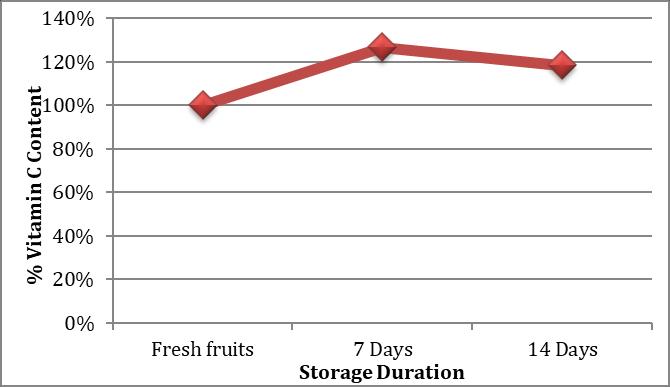

Guava(Psidiumguajava),howeverfollowsadifferenttrend ofvariationinascorbicacidcontentasafunctionofstorage period.ItshowsaninitialincreaseinVitaminCcontentfrom 100.91mg/100mLinfreshfruitsampleto127.86mg/100 mLinjuiceextractedfromfruitsstoredforaperiodof7days followedbyadecreaseto119.40mg/100mLasdetermined after14daysofstorage.
This may be because the guavas were plucked when they were not completely riped and storage at ambient temperature brought about the ripening of fruits which increasestheamount of VitaminCas proved in an earlier investigation[30].
Percentage variation in the concentration of Vitamin C in guavaisrepresentedinfigure9.
Thefigureshowsthatguavasdonotexhibitany%lossin VitaminCcontentovertime,elseitshows26.70%gaininthe amountofVitaminCwhenstoredfor7dayswhichthenshow 8.38%lossinVitaminCcontentascomparedtotheamount ofVitaminCinfruitsstoredfor7daysbutstillithas18.32% moreVitaminCincomparisontothefreshlypluckedfruits whichwerenotcompletelyriped.
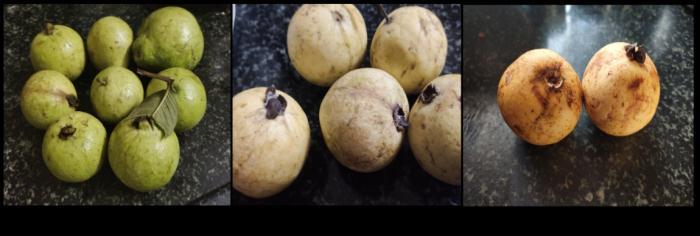
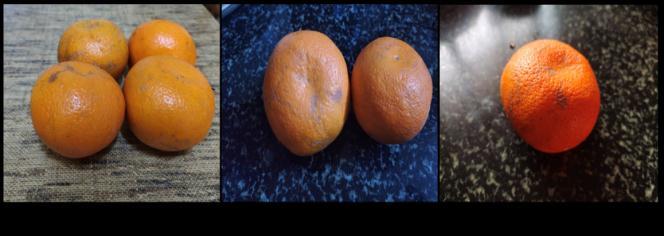
It was also observed that storage of fruits at room temperaturebroughtaboutcolourandtexturalchangesas showninfigure10and11.
The figures above display that softness of peels of both kinnowaswellasguavafruitsdecreasedwithtime.Although GuavashowedagainintheamountofvitaminConstorage butinaperiodoftwoweeksthefruitreachedverynearto thepointofrottening.Thismaybebecauseofitsperishable nature[31].
Alongwiththis,itwasobservedthatguavashowsbrowning oftheskinasthetimeofstorageincreases.Thisisbecauseof theenzymaticbrowningreactionscarriedoutbypolyphenol oxidaseandpolyphenylammonialyase[32].
Thus,thisstudyshowsthateventhoughguavahasahigher VitaminCcontentbutitsshelflifeislessthanthatofkinnow fruitsasitripesveryrapidlyafterharvestanditsstoragefor alongertimeisdifficulttochancesofitsspoilage.
REFERENCES
[1] D. Kornack and P. Rakic, “Cell Proliferation without NeurogenesisinAdultPrimateNeocortex,”Science,vol. 294, Dec. 2001, pp. 2127-2130, doi:10.1126/science.1065467.
[2] M.Young,TheTechnicalWriter’sHandbook.MillValley, CA:UniversityScience,1989.
[3] R. Nicole, “Title of paper with only first word capitalized,”J.NameStand.Abbrev.,inpress.
[4] K.Elissa,“Titleofpaperifknown,”unpublished.
[1] VegetablesandFruits.
https://www.hsph.harvard.edu/nutritionsource/wha t-should-you-eat/vegetables-and-fruits/
[2] M.M.RKhan,M.M.Rahman,M.S.IslamandS.A.Begum, “A Simple UV – spectrophotometric Method for the Determination of Vitamin C Content in Various Fruits andVegetablesatSylhetAreainBangladesh,”J.Biol.Sci., 6(2),2006,pp.388-392.
[3] V.T. Reddy and P.P. Naga, “Comparative Studies on AscorbicacidcontentinVariousFruits,Vegetablesand LeafyVegetables,”Int.J.ofLifeSci.,5(4),2017,pp.667671.
[4] WhatarethebestfoodsforvitaminC?
https://www.medicalnewstoday.com/articles/32506 7#best-foods
[5] E.J. Bruno, T.N. Ziegenfuss and J. Landis, “Vitamin C: ResearchUpdate,”Curr.SportsMed.Rep., 5(4),2006, pp.177-181
[6] VitaminC, https://lpi.oregonstate.edu/mic/vitamins/vitamin-C
[7] K. Pathy, “Process for Preparation of Vitamin C and Method for Determination of Vitamin C in Tablets,” SurCasStudOpAccJ.,1(3),2018,pp.52-65.
[8] S. Chambial, S. Dwivedi, K.K. Shukla, P.J. John and P. Sharma,“VitaminCinDiseasePreventionandCure:
AnOverview,”IndianJ.Clin.Biochem.,28(4),2013, pp.314-328.
[9] A.C. Carr and B. Frei, “Toward a new recommended dietaryallowanceforvitaminCbasedonantioxidant andhealtheffectsinhumans,”Am.J.Clin.Nutr.,69(6), 1999,pp.1086-1107.
[10] S. Abdulrazak, Y.A. Oniwapele, D. Otie and Y.I. Sulyman, “Comparative Determination of Ascorbic Acid in Some Selected Fruits and Vegetables CommonlyConsumedinNorthernNigeria,”J.Global Biosci.,4(1),2015,1867-1870.
[11] K.A.Naidu,“VitaminCinHumanHealthandDiseaseis stillamystery?Anoverview.”Nutr.J.,2(7)2003.
[12] E.S. Wintergerst, S. Maggini and D.H. Hornig, “Immune-EnhancingRoleofVitaminCandZincand EffectonClinicalConditions,”Ann.Nutr.Metab.,50, 2006,pp.85–94.
[13] M.I. Hassan, A. L. Majidi and H.Y. ALQubury, “DeterminationofVitaminC(ascorbicacid)Contents in various fruit and vegetable by UVspectrophotometry and titration methods,” J. chem. pharm.,9(4),2016,pp.2972-2974.
[14] G.Block,“EpidemiologicevidenceregardingvitaminC andcancer,”Am.J.Clin.Nutr.,54(6),1991,pp.1310S1314S
[15] G.V. Kumar, A. Kumar, R. Patel and S. Manjappa, “Determination of vitamin C in some fruits and vegetables in Davanagere city, (Karanataka). India,” Int.J. Pharm.&LifeSci.,4(3),pp.2489-2491.
[16] N.Martí,P.Mena,J.A.Canovas,V.Micol,andD.Saura, “VitaminCandtheRoleofCitrusJuicesasFunctional Food,”Nat.Prod.Commun.,4(5),2009,pp.677-700.
[17] L.HallbergandL.Hulthen,“Predictionofdietaryiron absorption: an algorithm for calculating absorption andbioavailabilityofdietaryiron,”Am.J.Clin.Nutr., 71(5),2000,pp.1147–1160.
[18] K.F. Gey, “Vitamins E plus C and interacting conutrientsrequiredforoptimalhealth.Acriticaland constructive review of epidemiology and supplementation data regarding cardiovascular diseaseandcancer,”Biofactors,7,1998
[19] A.E.IshaqandS.Obirinakem,“EffectofTemperature andStorageonVitaminCContentinFruitsJuice,”Int. J.Chem.Biomol.Sci.,1(2),2015,pp.17-21.
[20] R.A.JacobandG.Sotoudeh,“VitaminCFunctionand StatusinChronicDisease,”Nutr.Clin.Care,5(2),2002, 66-74.
[21] A.I. Simion, L. Rusu, I. Ştefanescu and L. Gavrila, “Influence of Various Thermal Treatments Over Vitamin CConcentration in Lemons,”Sci. Stud.Res., 9(4),2008,pp.519-530.
[22] S.S.PurewalandK.S.Sandhu,“NutritionalProfileand HealthBenefitsofKinnow:AnUpdatedReview,”Int.J. Fruit Sci., 20: sup3, 2020, pp. S1385-S1405. DOI: 10.1080/15538362.2020.1792390.
[23] S.W.A. Shah, M. Jahangir, M. Qaisar, S.A. Khan, T. Mahmood,M.Saeed,A.FaridandM.Liaquat,“Storage StabilityofKinnowFruit(Citrusreticulata)asaffected by CMC and Guar Gum-Based Silver Nanoparticle Coatings,”Molecules,20,2015,pp.22645–22661,doi: 10.3390/molecules201219870
[24] A.Guntarti,M.Ahda,H.Nabilla andH.Susanti,“The Storage Effect against Vitamin C Content in crystal guava(PsidiumguajavaL.)Juice,”J.Sci.Islam,32(1), 2021,pp.39–42.
[25] N. Lubis, R, Prasetiawati and W. Septiani, “Determination of Vitamin C Red Guava (Psidium GuajavaLinn)FruitJuice,withVariationofBeverage Packaging,”Int.J.Adv.Aci.Eng.Technol.,5(4),2017, pp.51-55.
[26] Determination of Vitamin C Concentration by Titration (Redox Titration using Iodate Solution), College of Science, University of Canterbury. https://www.canterbury.ac.nz/media/documents/sci ence-outreach/vitaminc_iodate.pdf
[27] V.A.Adisa,“Theinfluenceofmoldsandsomestorage factors on the ascorbic acid content of orange and pineapplefruits,”FoodChem.,22(2),1986,pp.139146.
[28] M. Bieniasz, E. Dziedzic and E. Kaczmarczyk, “The effectofstorageandprocessingonvitaminCcontent inJapanesequincefruit,”FoliaHort.29(1),2017,pp. 83-93.
[29] S.R.AhmadandM.U.H.Sarbini,“TheEffectofStorage on Vitamin C Stability of Locally Grown Fruits in BruneiDarussalam,”InnovareJ. FoodSci.,7(2),2019, pp.1-5.
[30] J.Gull,B.Sultana,F.Anwar,R.Naseer,M.Ashrafand M. Ashrafuzzaman, “Variation in Antioxidant AttributesatThreeRipeningStagesofGuava(Psidium
guajavaL.)FruitfromDifferentGeographicalRegions ofPakistan,”Molecules, 17(3),2012,pp.3165–3180.
[31] M.A.R. Sarker, M.M. Haque, R.A. Rifa,F.A.Ema,M.A. IslamandM.Khatun,“Isolationandidentificationof bacteriafromfreshguava(Psidiumguajava)soldat localmarketsinMymensinghandtheirantibiogram profile,”Vet.World, 11(8),2018,pp.1145–1149.
[32] D.M. Barrett, J.C. Beaulieu and R. Shewfelt, “Color, Flavor,Texture,andNutritionalQualityofFresh-Cut FruitsandVegetables:DesirableLevels,Instrumental and Sensory Measurement and the Effects of Processing,” Crit. Rev. Food Sci. Nutr., 50, 2010, pp. 369–389.