Experimental study of beam with replacement cement with polyster fiber and using ceramic waste replacement with aggregate
Parth Dudharejia1 , Aakash Rajeshkumar Suthar 2

1 Student Civil Engineering Department, L.J.I.E.T. Ahmadabad, Gujarat, India

2 Professor Civil Engineering Department, L.J.I.E.T. Ahmadabad, Gujarat, India ***
Abstract - Recent structures are using more and more ceramic materials, such as tiles, sanitary fittings, and electricalinsulators.Therefore,reusingthesewastesduring the creation of concrete may be an excellent strategy to protect the environment while simultaneously enhancing the concrete's qualities. The ceramic tiles are added to concrete cubes in crushed form at a weight of 20% and a dimensionof10to20mm.About75%ofalltrashproduced worldwide come from construction and demolition (C&D) wastes. Additionally, ceramic materials contribute a maximumof54%ofthe wastesintheC&Dwastes.Brick wall (debris), ceramic tiles, and utensil garbage are all examplesofceramicwaste.Thesolemethodcurrentlyused todisposeoftheseceramicwastesislandfill.Inthecurrent investigation,ceramictilewastewassubstitutedfornatural coarseaggregateinconcretetovaryingdegrees(0,10, 20, and 30%), and M20 grade concrete was used. Although concrete structures often have poor tensile strength, they typically have significant compressive strength. The qualitiesofconcrete,suchascompressivestrength,tensile strength, impact strength, and abrasion resistance, are improved by the introduction of polyester fibre. For this study,25MPaofcompressivestrengthconcretewasused. For the purpose of determining the samples' compressive strength, split tensile strength, and flexural strength, sampleswithvaryingfibreconcentrationsrangingfrom0to 6%weremanufacturedwithanincrementof0.5%.
Key Words: Ceramic, Waste, And Concrete, Polyester Fibers, Workability, Compressive Strength, Flexural Strength.
1.INTRODUCTION
Waste from floor tiles used in concrete applications can significantlylessentheharmdonetotheenvironmentand the depletion of natural resources. It is feasible to use ceramicwastegeneratedduringtheproductionofceramic asaggregatesinthecreationofconcreteinordertorecycle itandsoreduce the amount oftrash generated. Thisstudy
lookedintothecompressivestrengthofconcretemadefrom wastefloortileaggregates.
India is classified as a developing nation; numerous new innovationsmaybeobservedintheconstructionindustry. As the population has grown, so have the advancements, resulting in more buildings being built to meet our personalneeds.Cement,sand,andaggregates(coarseand fine)are among the manyconstruction materialsthatare in high demand in the construction sector. Around the world, rapid industrial expansion contributes to major issuesincludingthedepletionofnaturalaggregatesandthe production of vast quantities of debris from construction and demolition activities. Utilising the garbage is one strategy to lessen this issue. Because of its extremely low tensilestrength,planeconcretecancrackbothunderstress andwhenitisnot.Lowstrain,brittle,andlessductileare some characteristics of it. concrete reinforced with polyester fibres can be used to solve these issues. These fibres are dispersed at random and are necessary for Portland cement concrete reinforcing. The compressive and flexural strength of a concrete is increased when polyester is added to regular concrete. Because concrete has so many uses, it has become the most important component in the development of infrastructure worldwide. Cement, fine and coarse aggregate, and water make up the constituents of concrete. Many studies have beenconductedoverthepastfewdecadestofindwaysto strengthen concrete without using its traditional constituents.
2. LITRATURE REWIEW
“Experimental Study on Concrete by incorporating Waste Broken Tiles” @2021 International Journal for Research TrendsandInnovationAllrightsreserved.
Recent structures are using more and more ceramic materials, such as tiles, sanitary fittings, and electrical insulators. However, because ceramic is so fragile, a substantial amount of it is lost during production, shipping, and installation. Therefore, reusing these wastes during the production of concrete may be a good strategy to protect the environment and enhance the concrete's properties. The study focuses on an experimental investigation of broken ceramic tile mixed with concrete. 20%byweightoftheweightoftheconcretecube'scrushed ceramic tiles, measuring 10 to 20 mm, are added.The findings indicate that waste ceramic tiles were utilised in concrete in place of coarse natural aggregates. The best amount of leftover ceramic tile to use in After examining thefindings,aconcretemixturewithawater/cementratio of0.3waschosen.
Concrete using waste tile has a 5.5% higher compressive strengththanregularconcreteofthesamegrade.roughly 75%. Additionally, 54% of the C&D wastes come from ceramicmaterials,whichconstitutethehighestamountof wastes overall. Around 11,166 million square metres of ceramictileswereproducedworldwidein2011–12alone. China produces the most ceramic tiles worldwide (5,200 million square metres). This is 38.9% of global consumptionand4,250millionsquaremetres,or46.6%of global output. India comes in third place after China in termsofproductionoftiles,accountingforjust691million square metres, or 6.2% of global production, and consumption, with681 millionsquare metres, or 6.2% of globalconsumption.
Experimental results
Theresultofdesign-mixisbeenrepresented
“UTILIZATIONOFCERAMICWASTEASA REPLACEMENTOFAGGREGATESANDITS EFFECTONVARIATIONOF EXPENDITURE”@2017InternationalJournalof EngineeringResearch-OnlineAllrightsreserved.

India is classified as a developing nation; numerous new innovationsmaybeobservedintheconstructionindustry. As the population has grown, so have the advancements, resulting in more buildings being built to meet our personalneeds.Cement,sand,andaggregates(coarseand fine)areamongthemanyconstructionmaterialsthatare in high demand in the construction sector. Environment andclimaticconditionsforcementandaggregates(coarse andfine).Themostimportantcomponentsforconserving thesenaturalresources,suchasaggregates,areemployed in the manufacturing of concrete, which is needed for society'swelfareandcanbeusedinconstruction.
reported using ceramic waste powder as a partial replacement for cement in M-25 grade concrete in the rangeof0%,10%,20%,30%,40%,&50%byweight.The wastesusedwerefromtheceramicindustryandhadbeen declared unfit for sale for a number of reasons, such as dimensional or mechanical flaws, flaws in the firing process,orothercauses.Thefindingsshowedthatadding ceramic masonry debris actively endows cement with beneficial properties, including significant mechanical strengthandfinancialbenefits.
Experimental results



Thecompressivestrengthofconventionalconcreteaswell asceramicwasteconcreteat7,14,28daysaregivenin table1.

Workability: The replacement concrete is equally as workableastheconcreteusedasareference.Workability is unaffected by replacing coarse aggregate with ceramic waste.Thevaluesaregivenintable2.
Table2:workabilityofthereplacedconcrete
COST ANALYSIS:
In the present study the cost of 10 m3 referral concrete (M15 with PPC). The cost of material is calculated below according to market rate (march April 2017). CEMENT CONCRETEOF1:2:4(for10cum)Dryvolumeof10cum= 1.52*10=15.2cumThereforethepercentagereductionin costforthepercentagereplacementoftheceramicwaste concreteisshowninthetable5.
Table3:Costanalysedforthepercentagereplacements
“Reuse of Ceramic Waste as Aggregate in Concrete“@2016InternationalResearchJournalof EngineeringandTechnology(IRJET)Allrights reserved.
In the current investigation, ceramic tile waste was substituted for natural coarse aggregate in concrete to varying degrees (0, 10, 20, and 30%), and M20 grade concrete was used. After 3, 7, and 28 days of cure, the concrete moulds were cast and tested for Compressive StrengthandSplitTensileStrength.Thefindingsshowthat a 30% substitution of natural coarse aggregate with ceramic tile aggregate yields the highest compressive strength. In this investigation, ceramic tile aggregate with a maximum coarseness of 20 mm will be used. Sand and regular Portland cement (OPC) 53 grade were used. Compressive testing were run, and the findings show that, with the exceptionofM30mix,thereisn'tmuchofanimpactonM20 andM25Mixes.Butafterthat,strengthprogressivelybegan to decline as the percentage of tile aggregate in concrete increased.[7]Crushedtilewasusedasthecoarseaggregate in concrete, and its substitution with 0%, 50%, and 100% natural aggregate was studied. Physical and mechanical testswereconducted.
Experimental results


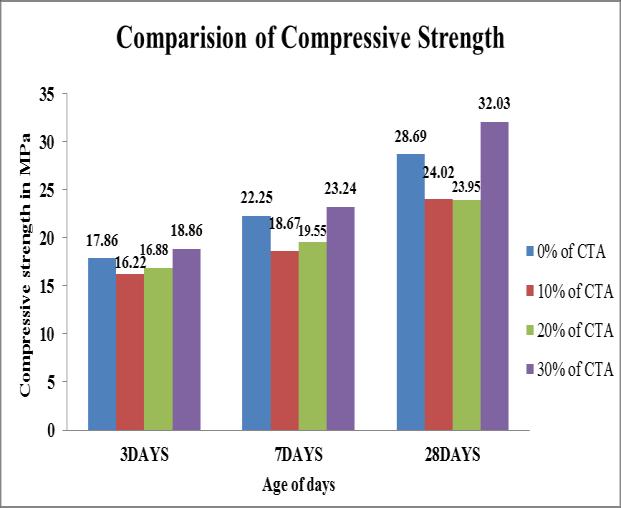
shows the process flowchart, which includes choosing materials like cement, fine aggregate, coarse aggregate, andceramictileaggregate.ForM20mixintendedforplain concrete,concreteisprepared.Coarseaggregateisusedin placeofceramictileaggregateinsomecases.Materialsare combined by taking the proportions into account according to the mix design. The mould has three layers with dimensions of 150x150x150 mm and a height of about 50 mm for each layer. Each layer's compaction is carried out using a shake table and tamping rod. Moulds are created for various ratios in accordance with the Graph - M20concretegradewith0%,10%,20%and30% replacementofCTAandtheircompressivestrengthat3,7 and28days
“Strength Characteristic Study of Polyester Fiber Reinforced Concrete”@2018 International Journal of Engineering Research & Technology (IJERT)Allrightsreserved.
inconcretebyreplacingit.Italsoreducescarbondioxide emission in environment by all possible ways. Although concretestructuresoftenhavepoortensilestrength,they typically have significant compressive strength. The qualities of concrete, such as compressive strength, tensilestrength,impactstrength,andabrasionresistance, areimprovedbytheintroductionofpolyesterfibre.Fibres support concrete by being evenly dispersed throughout the matrix and acting as a support in all directions. In addition, rusting is avoided. The most popular and widely used pozzolan is fly ash. It is a coal byproduct trash. It is based on the thermal power produced by electricity. Because of their spherical shape, fly ash may freely flow and mingle with other ingredients. The durability of concrete is significantly increased by these components. One can see that fly ash is used both affordablyandsafely.Aspartofsustainabledevelopment, effortsweremadeto
Experimental results
Flexuraltestonconcrete:
Concrete's tensile strength is determined by flexural strength. It resists bending failures. Tests are conductedinbeamswithspanlengthsthatareatleast three times deeper. When a certain point isloaded, a crackformsandapointismarked.
Compression test on concrete: The entire strength of concretecubescanbeseenintheircompressivestrength. Thespecimenis150mmX150mmX150mm.Ontopofthe sampleisputthetestspecimen.140kilogrammepercubic centimetreperminuteofstressisapplied.Itmentionsthe maximumload.
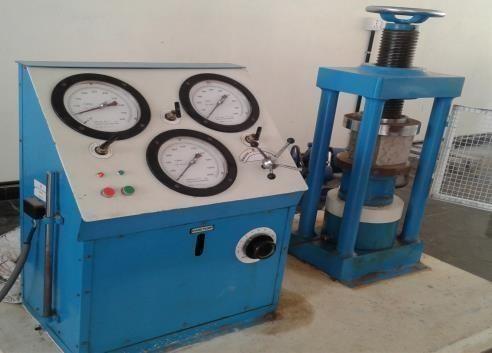
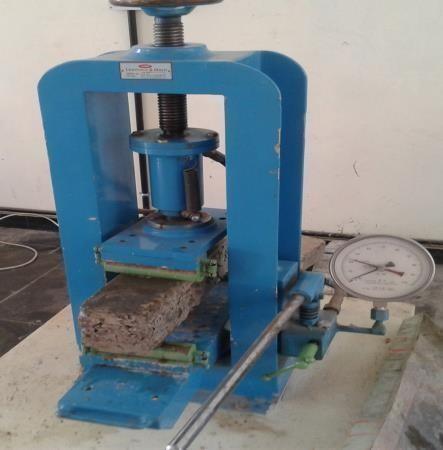
TABLE2:COMPRESSIVESTRENGTHOFDIFFERENT MIXES
reinforcedconcrete'ssplittingtensilestrengthandrupture modulus both increased as the volume fraction increased, reaching values of 98.3% and 126.6% at 2.0% volume percent,respectively.
Experimental results
Slumptesthadbeenconductedforfindingtheworkability oftheconcrete.Inthistestslumpisgraduallyincreasing. At 2% fiber maximum slump of 82mm attained for polyesterfiber.
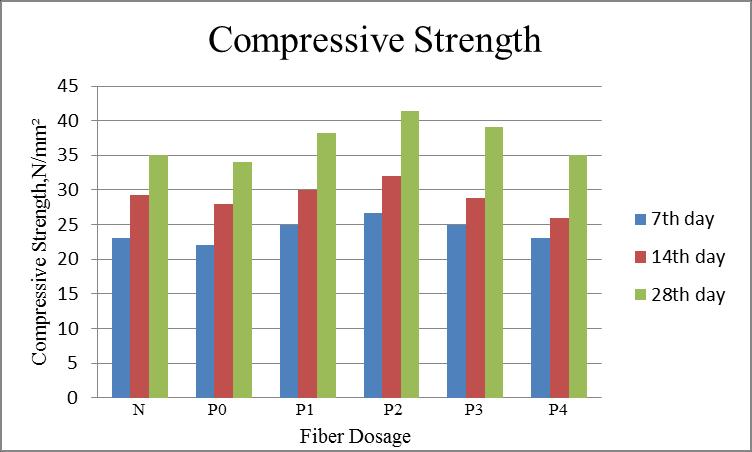
CHART1:COMPRESSIVESTRENGTH
5. VenuMalagavelli,NeelakanteswaraRaoPaturu
“Polyester Fibers in the Concrete an Experimental Investigation”@2020 researchgate All rights reserved
Forthisstudy,25MPaofcompressivestrengthconcretewas used. For the purpose of determining the samples' compressive strength, split tensile strength, and flexural strength,sampleswithvaryingfibreconcentrationsranging from 0 to 6% were manufactured with an increment of 0.5%.Compressivestrengthofconcretesisobservedtorise asfibrecontentrisestoacertainpoint.
[1]. Vasudevan et al [2] have looked into the use of waste materialsinflexiblepavements.Themoltenwasteplastics areappliedtothestoneaggregate.Theydiscovereda100% boostintheroad'sstrength.SongandHwang[3]studythe mechanical characteristics of high strength steel fibre reinforced concrete. At volume fractions of 0.5%, 1.0%, 1.5%, and 2.0%, steel fibres were introduced. They discovered that fiber-reinforced concrete's compressive strength peaked at 1.5% volume fraction, representing a 15.3%gainabovehighstrengthconcrete(HSC).Thefiber-
3.MATERIAL

Cement: Cement is the primary ingredient for making concrete. cementisordinaryPortlandcementof53 grade confirmingtoIS:12269.
Fine Aggregate: Locally available silt-free river sandas perIS383-1970withaspecificgravityof2.65isused
Coarse Aggregate: The ceramic tile aggregates as per IS 383-1970theceramictileswithpercentsof0and20were substitutedfornaturalcoarseaggregates
Super plasticizer: The hyper plasticizer must be ADDMIX 389, a highly water-reducing polycarboxylic ether super plasticizer. The product must have a specific weight 1.1 andasolidscontentofnotlessthan40%byweight.
Mineral additives: Polyster fiber , ceramic waste, Super plasticizers.
4. METHODOLOGY
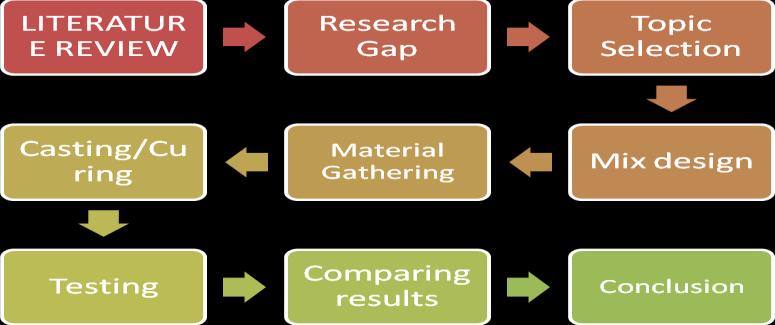
• Collection of Material like Pozzolana Portland Cement,Coarseaggregate,Fineaggregate,polyster fiber&ceramicwaste,Admixture.
• Laboratorytestonbasicingredientsofconcretelike Cement,Coarseaggregate,Fineaggregate.
• FinalizeMixdesignforconcrete.
• Partial replacement of cement with polyster , aggregatewithceramicwastepercentages.
• Checkworkabilityofconcrete.
• Castingofcubespecimen
• DetermineCompressivestrengthofconcrete.
3) The compressive strength of ceramic wastereplaced concrete increases in comparison to ordinary concrete up to a replacement level of 40% as the proportion of replacement rises. Strength nearly stays the same (increases by 0.87%)with50%replacement.
4)Uptoacertainextent,or20%foraw/cratioof 0.3, adding coarse waste ceramic tile aggregate gradually boosted concrete's compressive strength.Thestrongestcompressivestrength was foundinconcrete.
5) It is also evident that using leftover ceramic tiles during the manufacturing of concrete does not significantly alter its properties. It has been found that using used ceramic tiles as coarse aggregatesataratioof10to30percentisoptimal. Compressive strength rises in these measurements, and unit weight falls as well.The maximum split tensile strength is obtained when 30% of Ceramic tile aggregate was replaced with coarseaggregate.
REFERENCES:
5. CONCLUSIONS
1) In this investigation, ceramic tile aggregate withamaximumcoarsenessof20mmwillbe used.SandandregularPortlandcement(OPC) 53gradewereused.Compressivetestingwere run, and the findings show that, with the exception of M30 mix, there isn't much of an impactonM20andM25Mixes.Butafterthat, strengthprogressivelybegantodeclineasthe percentage of tile aggregate in concrete increased. [7] Crushed tile was used as the coarse aggregate in concrete, and its substitutionwith0%,50%,and100%natural aggregate was studied. Physical and mechanicaltestswereconducted.
2) It is also clear that the characteristics of concrete are not noticeably harmed by the use of leftoverceramictilesintheproduction ofconcrete.
It is discovered that 10 to 30 percent is the ideal situation for employing used ceramic tiles as coarse aggregates. In these metrics, compressive strengthincreaseswhileunitweightdecreasesas well.
[1]Khaloo,A.R.,“Crushedtilecoarseaggregateconcrete”, Cement and Concrete Aggregate, Vol.17, pp.119-125, 1995. Lopez, V., Llamas, B., Juan, A., Moran, J.M. and Guerra, I., “Eco-efficient concretes: Impact of the use of white ceramic powder on the mechanical properties of concrete”, Biosystems Engineering, Vol.96, pp.559-564, 2007. Torgal, F.P. and Jalali, S., “Reusing ceramic wastes in concrete”, Construction and Building Materials, Vol.24, pp.832–838, 2010. Medina, C., Sanchez, M.I, and Frias, M., “Reuse of sanitary ceramic wastes as coarse aggregate in ecoefficientconcretes”,CementandConcreteComposites, Vol.34, pp.48-54, 2012. Tavakolia,D., Heidari, A. and Karimian, M., “Properties of concretesproduced with wasteceramictileaggregate”,AsianJournalofCivil
[2]AbdullahM.M.A.B.,HussinK.,RuzaidiC.M.,BharinS.,
RamlyR.andNisaN.K.,(2006),“ConcreteCeramicwaste slab”, Journal of engineering research and education, Volume3 139-145. Birdie. G.S (2015),Estimation and Costing,Dhanpat Rai Publishing Company. Binici H. (2006), “Effect of crushed ceramic and basaltic pumice as fine aggregates on concrete mortar properties”. Elsevier Ltd., construction and building materials21(2007)1191-1197.
[3] IS: 456-2000, Indian Standard “Plain and reinforced concrete”-code of practice. IS: 10262-2009, Indian Standards “Recommended guidelines for concrete mix design proportioning”code of practice.IS: 383-1970, “Specificationsforcoarseand fineaggregatefromnatural source for concrete”, (Second revision), Bureau of Indian Standards,NewDelhi,India.“Concretetechnology”Theory ofpractice,AtextbookofM.S Shetty, 2005.
[4] Indrayit Patel, C D Modhera, “study effect of polyesterfibresonengineeringpropertiesofhighvolume fly ash concrete” march 2011 [2] U.Bhavitha, Mohammed Safiuddin,Syedmoshin,“studyofstrengthofpropertiesof polyester fiber reinforced corcrete,Hyderabad,October 2016[3]NV.Rachcch,UjeniyaandR.KMisara,“Mechanical characteristics of ratten fiber polyester composite” 2014
[4] Dr S.L Patil, J.N Kale, S .Sumen, “fly ash concrete : A technical analysis for compressive strength”, December 2012 [5] M Matsudaira, H.Qin, Y.Kimura, “compressional propertiesofpolyester–fibershingosenfabrics”April-2009

[6] Marcela Ondova, Nadezda Stevulova,Ludmila Meciarova, “The potential of higher share of fly ash as cementreplacementintheconcretepavement”,2013[7]E. Arunakanthi,J.D.ChaitanyaKumar,“Experimentalstudies on fiberreinforced concrete (FRC)”,October 2016 [8] Athira Das, Priya Grace IttiEipe, “Experimental investigation on properties of synthetic fibre reinforced concrete pavements”,September2016
[5]WenjunQu,XiaoliangZhangandHaiqunHuang,Journal of Composites for Construction, ASCE (2009), Vol. 13(5), pp. 350
359, Oct. 2009. Vasudevan, R., S.K. Nigam, R. Velkennedy, A. R. Chandra Sekar and B. Sundarakannan, Proceedings of the International Conference on Sustainable Solid Waste Management (2007), Chennai, India,pp.105-111. P. S. Song and S. Hwang, Construction and Building Materials, ELSEVIER, Vol 18-9(2004), pp.669-673.
[6] Sergio F. Brena, Regan M. Bramblett, Sharon L. Wood, and Michael E. Kreger, ACI Structural Journal (2003), Vol. 100-1, pp. 36-46. Tavakkolizadeh, M. and Saadatmanesh,S.,JournalofStructuralengineering,ASCE, Vol.129,No. 1(2003),pp.30-40.
[7] Venu Malagavelli and Neelakanteswara Rao Paturu, Proceedings of International Conference on Current Trends in Technology (2010), Ahmedabad, India. VenuMalagavelliandRaoP.N.,InternationalJournalofCivil andStructuralEngineering,Vol.1(3),pp.449-457,2010.IS 383 – 1970: Specification for Coarse and fine Aggregates fromNaturalSourcesforConcrete(Secondrevision)
BIOGRAPHIES
MR. DUDHAREJIA PARTH Student,Structuralengineeringdepartment, L.J.I.E.T.Ahmadabad,Gujarat,India
Mr. Aakash Rajeshkumar Suthar iscurrentlyworkingasanAssistantProfessoratLJInstitutes of Engineering and Technology. He graduated with a Bachelor of Civil Engineering from LJ Institute of EngineeringandTechnology.HehasalsocompletedMasters of Technology in Forensic Structural Engineering from GujaratForensicSciencesUniversity.