Comparative Study of Pre-Trained Neural Network Models in Detection of Glaucoma
Pranay Jain1 , Sachin Mourya2 , Dr. Dhananjay Theckedath31-2Dept. of Biomedical Engineering, Thadomal Shahani Engineering College, Mumbai, India
3Associate Professor, Dept. of Electronics and Telecommunication Engineering, Thadomal Shahani Engineering College, Mumbai, India

***
Abstract - Glaucoma is one of the major causes of blindness in people all over the globe. If detected quickly, its progression can be slowed, stopped & even permanent blindness can be prevented [1,2] Several automated methods have come up for the early detection of glaucoma using various artificial neural networking models. In this paper, we present a comparative study of various pre-trained neural network models for the early detection of glaucoma. Six pre-trained models were built and analyzed with the help of several parameters for their comparison
Key Words: Glaucoma, Neural Network, Convolutional Neural Network, Transfer Learning, Deep Learning, PreTrained Model.
1.INTRODUCTION
Glaucoma is considered one of the leading causes of blindnessallovertheglobe.AccordingtoastudybyWHO (WorldHealthOrganisation),morethan65millionpeople havebeenaffectedbyglaucomathroughouttheglobe.The characteristicfeatureofglaucomaisadamagedopticnerve due to a rise in intraocular pressure. It is an irreversible neurodegenerativedisease.However,itsearlydetectioncan helpintreatmenttosloworstopitsprogression[3]
Glaucoma is generally detected by an ophthalmologist using a set of eye-test known as comprehensive eye test whichincludes–Tonometry,Pachymetry,Perimetry,Dilated Eye Test, and Gonioscopy. These tests must be done on a regular basis & can be tedious for the ophthalmologist conducting it. A skilled ophthalmologist usually takes an average of about 8 minutes for conducting the test & therefore a computer-aided system is a necessity. Various automated techniques are being developed nowadays for quick&accurateexaminationswhichuseneuralnetworking modelsfortheidentificationofthedisease.Fundusscansof an eye can be used to feed the neural network model to detectwhethertheeyeunderconsiderationisglaucomatous ornon-glaucomatous.
As there are many neural network models for image classification, it may be difficult to compare each one and choosethebetteroneforglaucomadetection.Inthispaper, wehaveclassifiedsixpre-trainedneuralnetworkingmodels
viz. Inception, Xception, ResNet50, MobileNetV3, DenseNet121, and DenseNet169. The Accuracy and Loss Graphofeachmodel wasanalyzedandalongwithseveral otherparametersobtainedwiththehelpofconfusionmatrix valueswereusedfortheclassificationofmodels.
2. Requirements
A labelled database that contains 9690 fundus images from both eyes classified into two classes namely glaucomatous(3422 images) and non-glaucomatous(6268 images), Google Cloud Platform (GCP) – for Cloud Computing,Jupyternotebook-InteractivePythonNotebook, Tensorflow – Open source machine learning library for creatingandtrainingthemodels,Keras–DeeplearningAPI for the artificial neural network which runs on top of Tensorflow, NumPy – Python library for high-level mathematicalcalculationsonarrays,Pandas- toolfordata manipulationandanalysis,Matplotlib–pythonlibrarythat can create animated, static and interactive data visualizations,Seaborn–libraryforDataVisualization.
3. METHODOLOGY
The steps for building the classification model are mentionedbelow.
1.1 Data Pre-Processing
Theinitialsetupisthelocalizationoftheopticnervehead (ONH) including locating other anatomical structures like bloodvessels,tracking,andregisteringchangeswithinthe optic disc region, etc. The input images were first preprocessed for the removal of outliners. Initially, the unnecessary part of the image was cropped. Then several filterswereappliedtothecroppedimagetoextractuseful information[4]
A given dataset may contain images of different dimensions and parameters which may hamper the performance of the neural networking model. Hence, an imagedatageneratorwhichisalibraryofKerasisusedto removethedifferencesbetweentheindividualimagesina dataset.Itsetsthedimensionsofimagestothegivenvalue so that the differences are removed. We have set the resolution to 224 x 224 which is generally used for pre-
trainedmodelsastheycanbememoryintensive.Also,batch sizecanbesetaccordingtothehardwareused.Wekeptthe batchsizeof32imageswhichwasoptimumaccordingtothe pre-trainedmodelused.
Data Augmentation is the way of creating new data by performingseveraloperationssuchasflipping,rotating,etc ontheoriginaldataset.Datasetsizehaveahugeimpacton the accuracy of the neural network model and hence data augmentation is a powerful method for the same. In our study, we have implemented data augmentation by performingzooming,shearing,horizontalflip,verticalflip, and validation split on the training dataset. Data Augmentationplaysamajorroleinbalancingthe2classesof datasets[5]viz.GlaucomatousandNon-Glaucomatous.The totalnumberofdatapointsinadatasetgetsincreasedwith thehelpofaugmentation.
1.2 Model Creation
Aneuralnetworkmodelisacollectionofvariousnodes or neurons, and each node consists of a set of inputs, weights,andabiasedvalue.Wheneverinputdataentersthe node,theweightismultipliedbytheinputandtheoutput generatediseitherfeedtothenextlayerorisobserved.We havesettheweighttoImageNetasitisabletocategorizethe images into 22,000 categories based on a defined set of parameters.ThetoplayerissettoFalseaswemustclassify thedatasetinto2classes.
Thepoolinglayerhelpstoreducetheresolutionofthe features.Thefeaturesobtainedarethenrobustagainstnoise anddistortions.WehaveusedGlobalAveragePooling2Dfor building the model. The Global Average Pooling 2D layer makesthemodelmore robusttospatialtranslationsinan imageasitsumsoutthespatialinformationintheimage[6] Further,thedenselayeriscreatedbysettingtheactivation function as SoftMax and keeping the number of training classesas2.
Dense layer along with the pooling layer of the specified model is used to predict the output by giving them as the second parameter to the Model function. The input to the Modelfunctionisprovidedbythebaseclassofthespecified modelsuchasResNet50,VGG16,DenseNet169,etc[7] In thisway,wehavebuiltatransferredlearningmodelusing6 pre-trainedImageNetmodels[8]
1.3 Model Implementation
Once the model is built, it is compiled using Adam optimizing algorithm and the loss is set to categorical crossentropy. The categorical crossentropy measures the model’sperformanceandgeneratesresultswhoseoutputis a biasedvalue between0 or 1.The metricto measurethe model’sperformanceisaccuracyasitisgenerallyusedinall themodels.Finally,themodelisrunfor20epochcyclesand
thevalidationdatasetisusedtovalidatethetrainedmodel bycomparingtheresults.
4. RESULTS
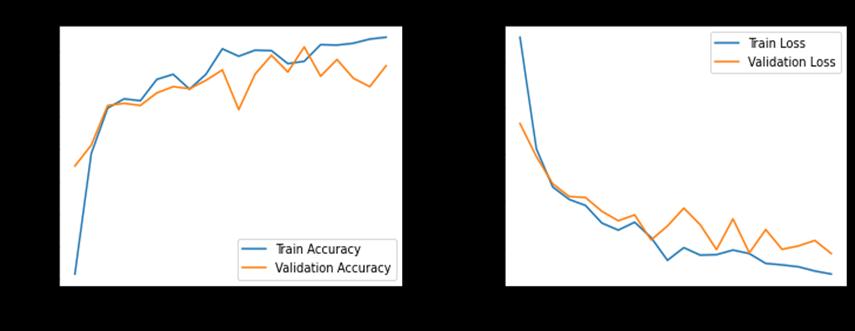
After completing all 20 epoch cycles, the accuracy and loss of all the models were found. To show the basic CNN performance, the accuracy graph and loss graph were plottedwiththeaccuracygraphhavingepochcyclesalong the x-axis and accuracy value on the y-axis and the loss graphhavingepochcyclesandlossvalueonthex-axisandyaxisrespectively.TheMatplotlibandNumPylibrarieswere usedtoplotthegraph.Anexampleofa graphisshown in Chart1.
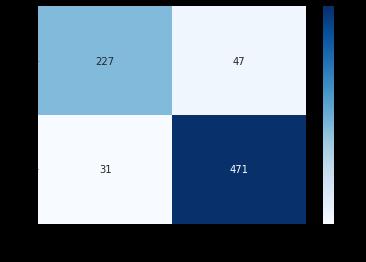
Calculatingaccuracyalonecansometimesbemisleading whenyouhaveanunequalnumberofobservationclasses. So, we decided to plot a confusion matrix that shows the statisticalclassificationofthealgorithm’sperformance.The testdatawastestedwithallthemodelsandtheconfusion matrixshowingActualClassVsPredictedClasswasplotted. YoucanseetheconfusionmatrixoftheDenseNet169model in Fig 1 which shows True Positive, True Negative, False Positive,andFalseNegativeimagesfromthetestresults[9]
Chart -1:AccuracyandLossGraphforDenseNet169
The confusion matrix was plotted with the help of SeabornandPandaslibrary.Withthehelpoftheconfusion matrix, several parameters can be compared such as Precision,Recall,Specificity,F1Score,etc.
The parameters are calculated based on the values acquired from the confusion matrix with the help of the formulaementionedbelow.
Precision=TP/(TP+FP)
Recall=TP/(TP+FN)
F1 Score = (2 × Precision × Accuracy) / (Precision+ Accuracy)
Accuracy=(TP+TN)/(TP+TN+FP+FN)
Specificity=TN/(TN+FP)
Using the mentioned formulae, all the parameters for eachmodelwascalculated[10] Adetailedanalysisofallthe models can be done more accurately by including more parameters.
Table -1: ParameterValuesforPre-TrainedModels
networkingmodels.Thisstudywasdoneonapreliminary basis and the models can be fine-tuned for better results. Also, the epoch cycles were kept 20 due to hardware limitationsbutcanbeincreasedalongwithanincreaseinthe sizeofthedatasetformakingamuchmorerobustmodel.
REFERENCES
[1] Lei Wang, Juan Gu, Yize Chen, Yuanbo Liang, Weijie Zhang,JiantaoPu,HaoChen."Automatedsegmentation of the optic disc from fundus images using an asymmetric deep learning network", Pattern Recognition,2021.
[2] M.Wu,T.Leng,L.deSisternes,D.L.Rubin,andQ.Chen, “Automatedsegmentationofopticdiscinsd-octimages andcup-to-discratiosquantificationbypatchsearchingbasedneuralcanalopeningdetection,”Opt.Express,vol. 23,no.24,pp.31216–31229,Nov2015.
[3] Opticdiscandcupsegmentationmethodsforglaucoma detection with modification of U-Net convolutional neural network, Pattern Recognition and Image Analysis,vol.27,no.3,pp.618–624,2017.
[4] H.Fu,"JointOpticDiscandCupSegmentationBasedon Multi-label DeepNetwork andPolarTransformation," IEEETRANSACTIONSONMEDICALIMAGING,2017
[5] Alomar, K.; Aysel, H.I.; Cai, X. Data Augmentation in Classification and Segmentation: A Survey and New Strategies.J.Imaging2023,9,46.
[6] ManishaSaini,SebaSusan."Deeptransferwithminority data augmentation for imbalanced breast cancer dataset",AppliedSoftComputing,2020
5. CONCLUSIONS
Basedontheparameter’stablefor20epochcycles,the model’s performance can be concluded for each of them. ResNet50givesthemostpromisingresultswiththehighest valueinPrecisioni.e.,0.910, Accuracyi.e.,0.918,F1Score i.e., 0.879 & Specificity i.e., 0.954 as compared to other models.DenseNet169canalsobetakenintoconsideration after ResNet50 as its Precision, Accuracy & F1 Score are better than the other pre-trained models excluding ResNet50. Xception & DenseNet121 models give average resultsandmustbefine-tunedifwewanttousethemfor classification. MobileNetV2 & Inception give the least promising results among all the models. MobileNetV2 has the highest Recall value however when comparing other parameters, it lags almost every model. This classification also proves that the pre-Trained model can be used for classificationwithalmostperfectaccuracy,muchlesstime andlimitedresourcescomparedtotheconventionalneural
[7] X. Chen, Y. Xu, S. Yan, D. Wing, T. Wong, and J. Liu, “Automatic Feature Learning for Glaucoma Detection Based on Deep Learning,” in Proc. MICCAI, 2015, pp. 669–677
[8] Krizhevsky, A., Sutskever, I., Hinton, G.E.: Imagenet classificationwithdeepconvolutionalneuralnetworks. In:NIPS,pp.1106–1114(2012)
[9] AkterN,FletcherJ,PerryS,SimunovicMP,BriggsN,Roy M.Glaucomadiagnosisusingmulti-featureanalysisand a deep learning technique. Sci Rep. 2022 May 16;12(1):8064. doi: 10.1038/s41598-022-12147-y. PMID:35577876;PMCID:PMC9110703.
[10] Abhishek,D.andBandyopadhyay,S.(2016)‘Automated Glaucoma Detection Using Support Vector Machine Classification Method’, British Journal of Medicine MedicalResearch,Vol.11,No.12,pp.1368-1372.