VOX – A Desktop Voice Assistant
Aniket Murkutkar1, Aradhya Bobade2, Naina Kaushik3
1,2SE Student, Computer Engineering, Rajiv Gandhi College of Engineering, Andheri, Maharashtra, India

Abstract - Voice assistants are programs on digital devices that listen and respond to verbal commands. This voice assistant will gather the audio from the microphone and then convert that into text, later it is sent through an API . The API will then convert text into audio file in digital language(binary) which is then converted to English language. Voice assistant is a technology which allows us two basic operations that are speech to text conversion in which we will have the user give a voice command and after getting an input the assistant will display what the command user gave and then implement it and text to speech conversion in which we will have the user write a text command which the assistant will interpret and give us a speech translationofthe writtencommand.
Keywords API, speech to text, text to speech, verbal commands, voice assistant.
1. INTRODUCTION
Voiceassistantisanapplicationprogramthatunderstands natural language and voice commands to complete tasks for the user. The users can even ask their assistant questions and also interact with them. Voice assistant is usedtorunmachinelikelaptoporPC’soramobilephone on your own voice command. For this software it uses a microphoneasinputdevicetoreceivevoicerequestsfrom userandspeakerasoutputdevicetogivetheoutputvoice.
1.1. Advantages of using Voice Assistant
1. Hands-free operation: Users can interact with the assistantusingtheirvoice,eliminatingtheneedtouse akeyboardormouse.
2. Multitaskingandseamless integration:Desktopvoice assistants often integrate with various applications and services, allowing users to seamlessly switch between tasks or access information from different sources.
3. Accessibility and inclusivity: Voice assistants make technology more accessible to individuals with disabilities or those who have difficulty using keyboard and mouse. People with mobility issues, visualimpairments,orcertainmedicalconditionscan benefitfromvoiceassistants.
4. Efficiency and productivity: Users can simply speak commands or ask questions, and the assistant will
***
respond with the relevant information or perform the requestedaction.
5. Expanded functionality and integration: Increasing compatibility withvariousapplications, platforms,and devices allows for a more seamless user experience. For example, integrating with popular productivity tools, smart home devices, or third-party services can provideuserswithawiderarrayofcapabilities.
6. Customization and user control: Providing users with options to customize the voice assistant's behavior, voice, or interface can enhance the overall user experience. Allowing users to define preferences, choose different voices, or customize settings empowers them to tailor the assistant to their individualneedsandpreferences
1.2. Drawbacks of current system
1. Privacy concerns: Users may feel uneasy about having a device that is always listening to their conversations, as it may lead to unintended data collectionorpotentialbreachesofprivacy.
2. Limited functionality and compatibility: Compared to their mobile counterparts, desktop voice assistants typically have limited functionality. They may not support certain features or integrations available on mobile devices,whichcanlimittheirusefulness.
3. Misinterpretation and errors: Variations in accents,speechpatterns,orbackgroundnoisecan affecttheaccuracyofvoicerecognition.
4. Dependency on internet connectivity: Without a stableinternetconnection,thefunctionalityofthe voice assistant may be limited or even rendered unusable.
5. Difficulty in Multitasking: In a shared office environment or a quiet library, users may prefer traditional input methods to avoid disturbing others.
6. Limited Use Cases: Voice assistants have limitationsincertaindomains.Theyexcelattasks like setting reminders, answering general knowledge questions, or controlling smart home
devices. However, they may struggle with complex tasks that require deeper domain expertise or lack integration with specific applications.
2. SUGGESTED IMPROVEMENTS
• Language interpretation should be improved as Indian speakers have a thick accent. Adding support for additional languages allows users who are more comfortable communicating in their native language to interactwiththeassistanteffectively.
• For the purpose privacy and information protection a system supporting personal voice commandsonthedesktopassistant.
• Offline functionality of Operating System commands will let us perform operations even without internetconnection.
• An android based voice assistant can have increased range of operations for wide usage of voice assistant.
Introducing multimodal interfaces that combine voice with visual and touch inputs can enhance the user experience. Adding support for screens or displays allows voice assistants to provide visual feedback, display information, or enable users to interact using traditionaltouchormouseinputswhenappropriate.
Voice assistants can be improved by enlarging their knowledge base and domain expertise. Integrating with more external services, APIs, and databases can enablevoiceassistanttoprovideaccurateandup-to-date information across a broader range of topics and domains.
1) SpeechRecognition
In this module the system receives user commands and converts spoken words or phrases into text. The text is thentranscribedintoaformthatcanbeunderstoodbythe system.
2) NaturalLanguageUnderstanding
The text which is converted to a form understood by the system is analyzed to understand the user’s intent and interpretthecommands,queriesandinstructionsgivenby theuser.
3) TaskExecution
This module is responsible for carrying out specific tasks or actions requested by the user. It interacts with other software components or services to perform functions such as setting reminders, sending emails, playing music, providing weather updates, or any other supported actions.
4) SpeechSynthesis
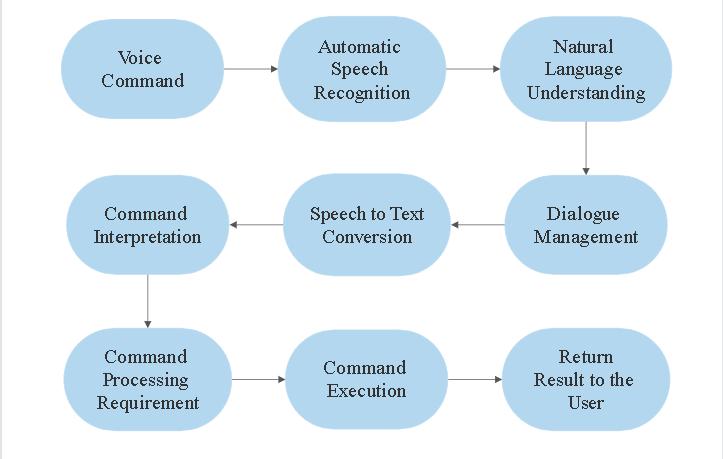
The speech synthesis module, also known as text-tospeech (TTS). It converts the system-generated text responses into spoken words and transforms the text into an audible output that the user can hear through the speakers or headphones. It can also convert a text input intospeech.
5) UserInterface
The user interface module provides the visual representation of the voice assistant on the desktop screen. It includes elements like graphical user interface (GUI), settings, help option for user, command list for betteruserexperience,clearscreen,etc.
4. USER INTERFACE
• MainPage
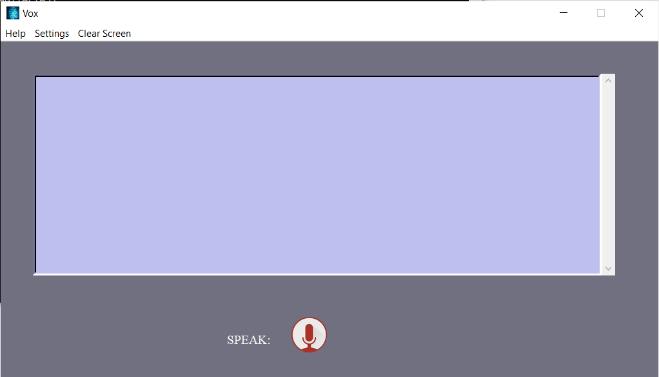
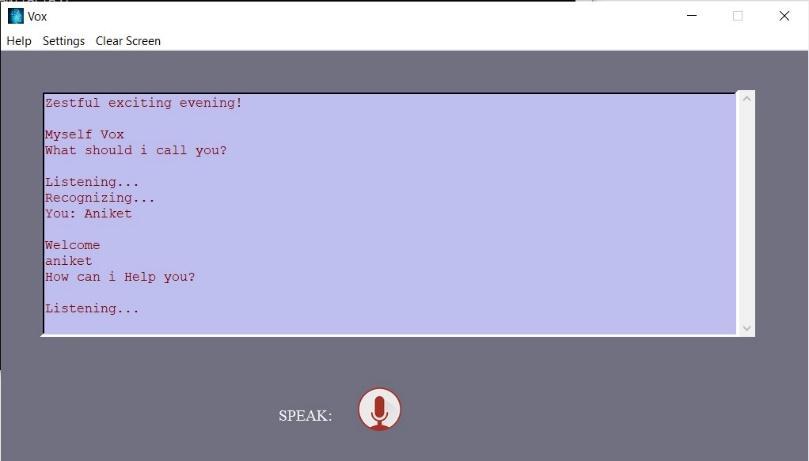
GUI for the desktop voice assistant. When the speak button is activated, the system starts to take the user’s voice commands.
• WelcomePage
The system greets the user, asks his/her name for future referenceandsignalstheusertogivethecommand.
5.FUTURE SCOPE
As per the project perspective, it can be improved to an android application which can increase the mobility of the voice assistant from accessing it just from the laptop/PCs. Design work will include the improvement in the design of theGUI.For bettermentof user,theAI botcan beupgraded intoapersonalizedvoiceassistant.Thismeansthattheuser willgettoaddtheirownvoicebywhichonlytheirvoicewill berecognizedbytheartificialintelligenceandworkonlyon theuser’svoicecommand.Thiswillresultanupgradeinthe securityaspectoftheapplication.
6.CONCLUSION
• RunningCommands
After taking the user desired input, it executes the command.
VoiceAssistantistheapplicationofartificialintelligenceand Software development where we are creating a voice assistant which helps us to remotely access our hardware through voice commands. This project will benefit all the people bysaving thetime totypeand rather justspeak and controlthedevice.Voiceassistantcanprovetobebeneficial onbothindustryandpersonallevelfortheusers.
REFERENCES
[1] “Research Paper onDesktop Voice Assistant”, InternationalJournalofResearchinEngineeringandScience (IJRES),vol.no.10,pagenos.15-20,year2022.
Vishal Kumar Dhanraj (076) Lokeshkriplani (403) Semal Mahajan (427), “Gradient-based learning applied to document recognition,‖ Proceedings of the IEEE, vol.10, pp.15-20,2022.
[2] “Donna – A web based AI Personal Assistant”, International Journal of Computer Applications, vol.175no.8 , page nos.07-12 , year 2017. Ami Doshi, Ria Shah,DrastiBhimani,BhoomiPatel,SwatiMali,IJCRT,ISSN: 2320-2882
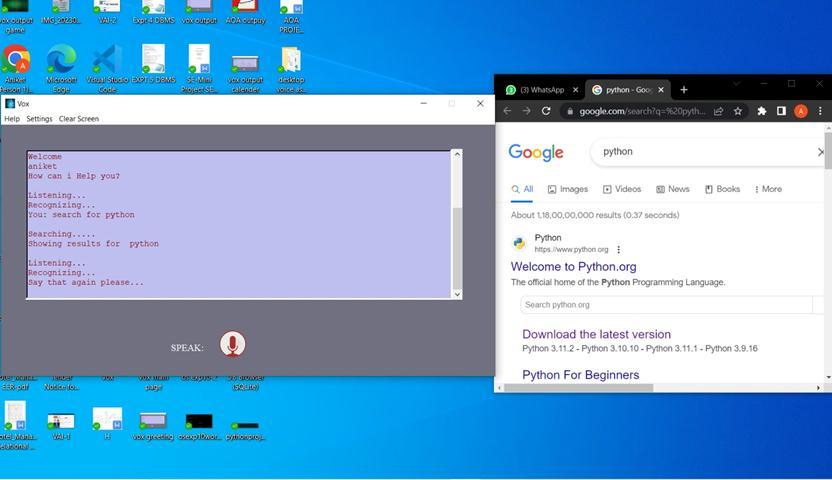
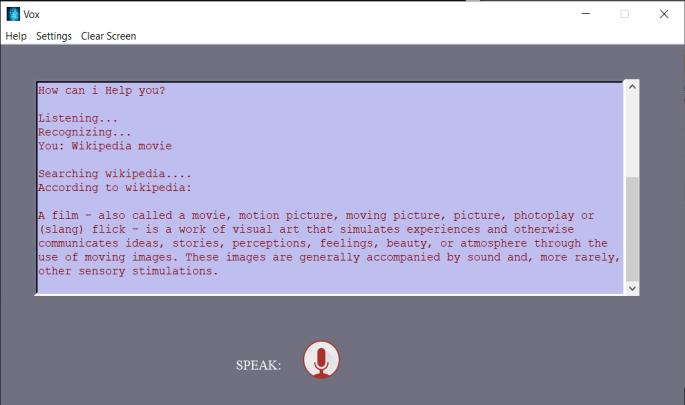
Intheabovefigure,theusersays‘Wikipediamovie’which impliestodescribethewordmoviethroughWikipedia.
[3] “Desktop Assistant Theory Explained,” https://www.geeksforgeeks.org/Desktop Assistanttheoryexplained/,
[4] “Desktop Voice Assistant”, International Research Journal of Modernization in Engineering Technology and Science, Volume:02/Issue:05/May-2020