Real Time Driver Drowsiness Detection Hybrid Approach

1,2,4,5 Undergraduate Student, B.M.S. College of Engineering, Bengaluru, India
3Assistant Professor, B.M.S. College of Engineering, Bengaluru, India ***
Abstract - Driver drowsiness detection is an important safety feature in modern vehicles, as it can help prevent accidents occurred by fatigue or falling sleep while driving. A hybrid approach to detecting driver drowsiness combines multiple methods to improve accuracy and reliability. One common method for detecting drowsiness is through the use of visual tracking systems, which use cameras to track the driver's eyes and facial expressions. Another method is through the use of physiological sensors, such as electrocardiography (ECG) or using pulse sensor, which will measure heart rate to detect changes indicative of drowsiness. A hybrid approach combines these methods, using the strengths of each to give a more reliable results of the driver's alertness. The visual tracking system can detect signs of drowsiness such as eye closure or nodding, while the physiological sensors can measure changes in brain activity or heart rate that may indicate drowsiness. This hybrid approach has the potential to improve the accuracy and reliability of drowsiness detection systems, helping to keep drivers and passengers safe on the road.
I. INTRODUCTION
Driverfatigueisamajorcontributortoroadaccidentsand trafficfatalities,withestimatessuggestingthatitmaybea factor in up to 20% of all crashes. As a result, there has been a increase interest in developing drowsiness detection systems to detect when a driver is becoming drowsyandalertthemtotheneedtorestorpullover.
One approach to driver drowsiness detection is using sensorstotrackphysiologicalsignssuchaseyemovement, blinking rate, and facial muscle activity. For instance, a system may use a camera to track the position and movement of the driver's eyes, or employ sensors to measure changes in skin conductance or heart rate. By analyzing these indicators, the system can identify when thedriverisabouttogoindrowsystateandissueanalert.
Another strategy is to use machine learning algorithms to analyze patterns of vehicle movement, such as lane deviations, abrupt braking, or extended periods of time
without steering input. The technology can detect these patterns,thesystemcaninferwhenthedriverisbecoming drowsyandissueanalarm.
Ahybridapproachincorporatesmultiplemethods,suchas using both physiological sensors and machine learning algorithms, to improve precision and reliability of the drowsiness detection system. This can be particularly useful in instances where one method may be less successful on its own, such as when a driver is wearing sunglassesorhasamedicalconditionthataffectstheireye movement.
Real-time driver drowsiness detection systems can be integratedintoavehicle'sexistingmonitoringandwarning systems, or they can be installed as standalone devices. Theycanbeusedtoalertthedrivertotheneedforabreak ortopulloverandrest,ortheycantriggeralarmsoralerts for other drivers on the road. In some cases, the system mayevenbeabletoautomaticallysloworstopthevehicle ifthedriverdoesnotrespondtothealert.
Overall,real-timedrowsinessrelatedautomobileaccidents have the potential to significantly reduce the number of accidents and fatalities caused by driver fatigue. By alertingdriverstotheneedtorestandtakeabreak,these systemscanhelpkeepeveryoneontheroadsafer.
II. PROBLEM STATEMENT
Since drowsy driving can be particularly dangerous because it can affect a driver's response time, judgment, and decision-making ability, making it more difficult for them to respond to changing road conditions or avoid potentialrisks.Itcanalsoraisetheriskoflanedeviations, suddenbraking,andotherunpredictabledrivingbehaviors thatcanputotherdriversatrisk.
Thegoalofdriverdrowsinessdetectionhybridapproachis to seek to identify when a driver is becoming drowsy or exhasuted and alert them to the need to rest or pull over, in order to reduce the risk of accidents caused by driver fatigue. By combining multiple methods, such as using both physiological sensors and machine learning algorithms, the system can improve the precision and
reliability of the drowsiness detection process, helping to ensure that drivers are informned to rest before they becometooexhaustedtocontinuedrivingsafely.
TheuseofDeep neural networks will makeit possible for identification of the detection of the drowsiness to have knowledge of anomalies by considering multiple domain specificartifactsasinput.
III. LITERATURE SURVEY
A. Key Terminologies
1. Driver drowsiness: The state of being tired or fatigued while driving, which can impair a driver's reactiontime,judgment,anddecision-makingability.
2. Alert: Awarningornotificationissuedtothedriverto alertthemtotheneedtorestorpullover.
3. Physiological sensors: Sensors that measure indicators such as eye movement, blinking rate, skin conductance,orheartratetodetectdrowsydriving.
4. Machine learning algorithms: Algorithms that analyze patterns of vehicle movement, such as lane deviations, sudden braking, or prolonged periods of time without steering input, to infer when the driver isbecomingdrowsy.
5. Hybrid system: A system that combines multiple methods, such as using both physiological sensors and deep learning algorithms, to improve the precision and reliability of the drowsiness identificationprocess.
6. Real-time: A system that operates in real-time, meaning that it can detect and respond to drowsy drivinginthemoment,ratherthanafterthefact.
7. Standalone device: A device that is not integrated into a vehicle's existing systems, but is instead installedseparately.
8. Automatic slowing or stopping: The ability of a systemtoautomaticallysloworstopthevehicleifthe driverdoesnotrespondtoanalert.
B. Existing Systems
There are several existing systems for detecting driver drowsiness in real-time. These systems can be split into different categories: the one that physiological sensors to
measure eye movement and blinking rate, and those that use machine learning algorithms to analyze patterns of vehicle movement. Physiological sensor-based systems often use cameras or sensors to track the position and movement of the driver's eyes, or to measure changes in skin conductance, heart rate, or other physiological indicators. By analyzing the system will be able to detect when the driver will be going into the drowsy state and issueannotifications Machinelearning-basedsystemsuse algorithms to analyze patterns of vehicle movement, such as lane deviations, sudden braking, or prolonged periods oftimewithoutsteeringinput.Bydetectingthesepatterns, the system can infer when the driver is becoming drowsy and issue an alert. Hybrid systems use many multiple methods to increase the precison of sleepiness detection, such as use of both physiological sensors and machine learning algorithms, to improve the accuracy and reliabilityofthedrowsinessdetectionprocess.
Some examples of existing driver drowsiness detection systemsinclude:
1. Nissan's "Fatigue Detection System," which employs a camera to monitor the driver's eye movements and facial expressions to detect drowsiness.
2. Volvo's "Driver Alert Control," which uses machine learning algorithms to analyze the vehicle'smovementsandissueanalertifitdetects patternsindicativeofdrowsydriving.
3. Drowsy Drive, a standalone device that uses a combinationofphysiologicalsensorsandmachine learning algorithms to detect drowsy driving and issueanalert.
These systems can be integrated into a vehicle's existing monitoring and warning systems, or they can be installed asstandalonedevices.Theycanbeusedtoalertthedriver totheneedforabreakortopulloverandrest,ortheycan trigger alarms or alerts for other drivers on the road. In some cases, the system may even be able to automatically slow or stop the vehicle if the driver does not respond to thealert.
IV. PROPOSED SOLUTION
A. High Level Design
V. IMPLEMENTATION
A. Behavioral features
The main aim is to first combine all three facial features like Eyes, Yawning & Head Posture to predict the drowsinessforlivecamera. Tobesimpleitisa regression issue, hence the model should be predicting 136 scalar as an outcome. The problem is in the performance. Since the willbehundredsoffacesinaphoto,Realtimepredictionis goingtobeverydifficultunlessoutmodelisfastandquick enough
Analyzing all these, We used CNN architecture called Xception Net. The geometry of a filter in a typical CNN layer is (output channels, input channels, k, k), where k stands for the filter size. The filter may take into account spatial correlations concurrently across many channels and within a single channel thanks to this convolution process.
The XceptionNet work, "Xception: Deep Learning with Depth wise Separable Convolutions," however, presents a new strategy by disentangling channel correlations and spatialcorrelationsintoindependentoperations.Sincethe InceptionNet also conducts a comparable decoupling, this idea is not entirely novel. The main distinction is the strongerdecouplingassumptionmadebytheXceptionNet, which gave it the nickname "Xception" ("Extreme Inception").

ThecreationoftheInceptionmodulewasprimarilydriven bytheneedtomoreeffectivelyseparatespatialandcrosschannel correlations. The fact that the Inception module accomplishesthisbyexplicitlydividingthechannelsintoa series of operations that independently take into account
spatial and cross-channel correlations justifies the use of theword"efficient".
Cross-channel correlations are handled by the standard Inceptionmoduleintwosteps.Multiple1x1convolutional neural networks (CNNs), also known as pointwise operations, are used in the initial processing of these correlations. The 1x1 CNNs interpret the cross-channel correlations by operating on parts of the input channels. The module then interprets the correlations inside these smaller 3D channel segments by employing standard CNN layers.

A 1x1 CNN is used in the initial operation of the original Inception module to record cross-channel correlations. Then, conventional CNN layers with kernel height and breadth greater than 1 are applied separately to each segmentintheensuingprocesses.
The extreme form of the Inception module, on the other hand, makes a greater assumption and presupposes that cross-channelcorrelationsandspatialcorrelationsmaybe totally dissociated. To do this, an extreme Inception module first maps the cross-channel correlations using a 1x1 CNN. The spatial correlations of each output channel arethenindividuallymapped.Sinceeachkernelisapplied to a channel individually in the second operation, the kernel'sformwouldbe(outputchannels,1,k,k).
Depth wise Separable Convolutions do a pointwise convolution first, then a channel-wise spatial convolution.

By isolating spatial and cross-channel correlations, this techniqueincreasescomputingefficiency.
The Inception module, on the other hand, starts with a pointwise convolution and then performs following operations. In this module, a rectified linear unit (ReLU) non-linearity is frequently present during both the pointwise convolution and the following operations. The network's expressive capacity is increased by the introduction of non-linear transformations brought about bytheintegrationofReLUnon-linearities.
Thoughtherearenonon-linearitiesbetweenthepointwise and channel-wise spatial convolutions when depth wise separable convolutions are used to carry out the operations.Adistinguishingfeatureofthistechniqueisthe depth wise separable convolutions, which further minimizecomputingcostsbyremovingnon-linearities.
Efficiency with depth wise Separable Convolution. We needtocheck many timesa vanilla CNN layerneedsto be multiplied to get an output shape of Co x Ho x Wo using kernels of size Ci x Kh x Kw, where Co is the number of kernels.CixKhxKw(whichistheformofasinglekernel) gives the number of multiplications for a single CNN operation using a single kernel. The total number of multiplications by a single kernel following the CNN procedureis(CixKhxKw)x(HoxWo).Thisoperationis carriedoutHoxWotimesforeachkernel.
Ahypotheticalinputlayermighthavethefollowingshape: Ci x H x W, where Ci stands for the quantity of input channels and H and W are the height and breadth, respectively. Using kernels of size 1 x Kh x Kw, where Ci specifies the number of such kernels, our objective is to createanoutputlayer with theform ofCix Hox Wo. Lets note that the height and breadth of the input layer are unaffectedbypointwiseconvolution.Asaresult,thedepth wise convolution ought to provide results with the appropriate end form. The number of multiplications needed in a single depth wise convolution by a single kernel is (1 x Kh x Kw), illustrating the fact that each kernel isapplied individuallyto eachinputchannel.Given that there are Ci total kernels, we can compute the total numberofmultiplicationsperformedbyallthekernelsina depthwiseconvolutionlayeras(1xKhxKw)x(CixHox Wo).WemayfurtherreducetheequationwhenHoequals Wo (both equal O) and Kh equals Kw (both equal K): The total number of multiplications in a depth wise convolution layer is represented by the expression (K2) x (Ci x O2). The number of multiplications in a depth wise separable convolution operation is now calculated using the formula Ci * O2 * (K2 + Co), and the result is
2,117,477,376. This figure is around nine times less than what a typical CNN layer would be. Furthermore, this depth wise separable convolution only has 134,144 parameters,whichisaroundninetimesfewer.
Each kernel is applied to each input channel separately in this case. In order to express the form of a single kernel, the quantity of multiplications needed for a single pointwise convolution operation by a single kernel is (1 x Kh x Kw). The total number of multiplications by a single kernelfollowingthepointwiseconvolutionprocedureis(1 xKhx Kw)x(Hox Wo), witheachkernel undergoing this operation Ho x Wo times. The total number of multiplications performed by all the kernels in this pointwiseconvolutionlayermaybeestimatedas(1xKhx Kw)x(CoxHoxWo)giventhatwehaveCototalkernels.
The sum of the multiplications in a depth-wise separable convolutionlayerisprovidedby(CixK2xO2)+(CixO2x Co), which is abbreviated to Ci * O2 * (K2 + Co) based on the aforementioned formulas. Let's look at an example where we want to run a standard CNN operation with a 3x3kernelsize,producing512outputchannels.Theinput layer has 256 channels, a height and width of 128, and these parameters. Accordingly, the output height and width, represented as O, may be calculated using the convolution formula, which results in 126. This suggests thatCi= 256, H= W= 128, K= 3,andCo =512. The total number of multiplications in a CNN operation is 18,728,091,648 when these numbers are substituted into the formula (Ci x K2) x (Co x O2), which calculates the number of multiplications in a CNN operation. Additionally, there are 1,180,160 trainable parameters in this layer. In depth wise separable convolutions, the number of multiplications and parameter size are significantly reduced, which not only makes them quicker butalsosignificantlymorememory-efficient.
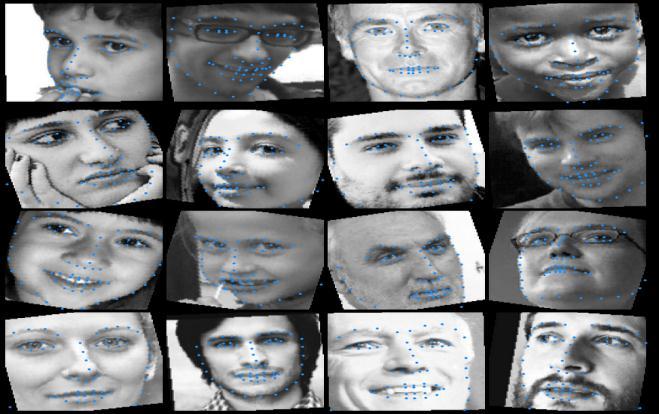
The ibug 300W Large Face Landmark Dataset, which is roughly1.7GBinsizeandcomprisesover7,000faceswith 68 landmark coordinate values per face, is a fantastic datasetforourproject.
Fig.4: 68pointsmark-up
Let's dissect the augmentation procedure into its component pieces. We will read, preprocess, and add augmentationtothefacesinthefirstsectionbeforeadding augmentation to the landmarks. The dataset is currently being enhanced using a variety of augmentations. With some additional border padding, the offset crop function randomlyselectsafacepicturefromthetrainingdata.The randomfacecropfunctionthenchoosesacroppedarea at random from the padded face picture. Random rotation is appliedtothefaceandtherelatedlandmarksforlandmark augmentation. The preprocessing function then scans the image, preprocesses it, and adds enhancements to the landmarks and face. After completing all of the augmentation stages, this yields a series of updated photos.
The author's recommended architecture, which we are executing exactly, is as follows: The model is not only a substitute for Inception modules in an Inception Net with depth wise separable convolutions. The Xception design, on the other hand, is made up of a linear stack of depthwise separable convolution layers that incorporate residualconnections.Thesuppliedcodesnippetillustrates how depthwise separable convolutions are implemented in PyTorch. The input layer is divided into sections using the "groups" option. In this instance, we set it to the numberofinputchannels,causingakernelofform(1xkx k)tobeconvolvedwitheachinputchannel. Itiscrucialto note that this method uses depth wise separable convolutions with residual connections, which is consistentwiththeXceptionarchitecture'soriginaldesign.


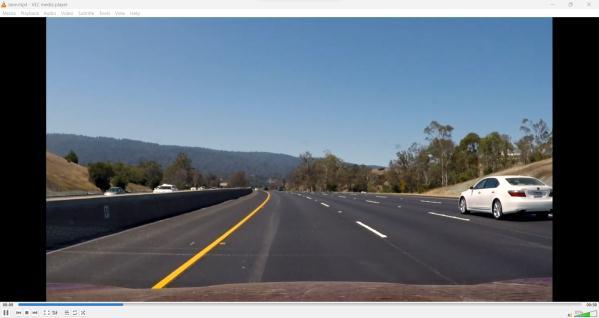
B. Lane Detection
The main goal of the Hough transform is to find lines in a picture. It is a method for figuring out a shape's parameters based on its border points. The Hough transform has been developed throughout time to locate variousforms,especiallycirclesorellipses.Theequationy = mx + c is changed in the original Hough transform for straight lines and represented as x cos(e) + y sin(e) = r in its parametric version. As a result, lines may be representedintermsoftheirangle(e)andlength(r)from the origin. Each point in an image corresponds to a sinusoidal wave in the parameter space in the context of the Hough transform. The lines in the picture are represented by each point in the parameter space. When two locations in the picture are collinear, the sinusoids that correspond to those points in the parameter space meet at that specific location. A similar process may be used to detect circles using the Hough transform. When several sitesaroundthecircle'scircumferenceareknown, it enables the estimate of circle parameters. The parametricequations
The Arduino Uno microcontroller is used to interconnect all the sensors together and the data is collected from the sensorsitisanalyzedandthenecessaryalertsaregivento the driver. The infrared sensor consists of IR emitter and IRphotodiode Theemitterproductiontheradiation,ifthe eye is open the radiation is not reflected back and if the eye is closed the radiation is reflected back to the IR photodiode. The IR photodiode will capture the radiation and the eye closeness is detected This will be used to detectwhenthedrivertendstofallasleep.

can be used to describe a circle with radius R and centers (a,b).Thepoints(x,y)tracethecircumferenceofthecircle astheanglechangesfrom0to360degrees.

Thefollowingmethodisusedtofindthelanemarkings:
For the parameters p and e, the parameter space isdiscretizedacrossanappropriaterange.

The members of an accumulator array are all initializedto0.
The accumulator array is filled with each point in the gradient picture that exceeds a set threshold. These points are recognized, incremented, and saved.
Thevalueintheaccumulatorarrayrepresentsthe numberofpoints on theassociatedline, and local maxima in the accumulator array correspond to collinearpointsintheimage.
C. Sensor Based Approach
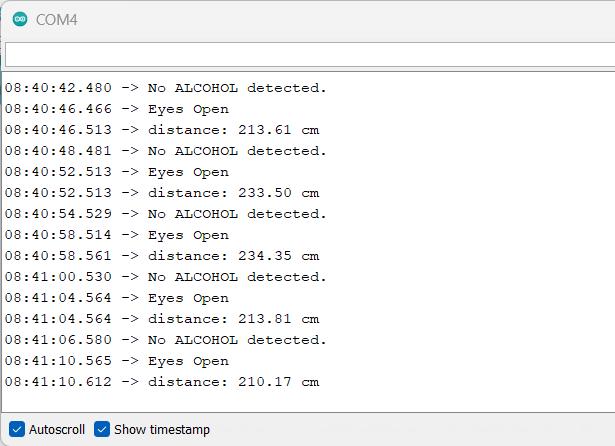
The sensor based approach consists of 4 sensors to providenecessaryalertstothedriverwhenheisdrivingin the drowsy state. The sensors used are InfraRed Sensor, UltrasonicSensor,GasSenorMQ-3andPulsesensor.
The Ultrasonic sensor works by transferring the sound wavesandreceivingitthroughtransducer.Thetimetaken to detect the sound waves by transducer determines the distancebetweenthesensorandtheobject.Thisisusedto avoidcrasheswhenthedriverisinthedrowsystate.
A semiconductor gas sensor called the MQ3 smoke sensor is used to find when the driver is alcoholic . The sensor measures how a sensing material's resistance changes in the presence of alchohol. Tin dioxide (SnO2), which has a decreasedelectricalconductivityincleanair,servesasthe detecting component of the MQ3 sensor. The SnO2 conductivity rises when smoke is present. The amount of smoke in the air directly relates to the change in resistance. Between 25 and 500 ppm of alchohol may be detected with the MQ3 sensor. A specific temperature is reached on the sensor. The sensor is open to the atmosphere.TheconductivityofSnO2risesinalcohol The concentration of alcohol is calculated and the driver is warnedfordrivinginthealcoholicstate.

By flashing a light through the skin and measuring the quantity of light reflected, a pulse sensor operates. With every heartbeat, the blood flow alters, which affects how muchlightisreflected.Thesensorcanthendeterminethe heart rate using this data. A light is projected through the skin by the sensor. The sensor counts how much light is reflected. Based on variations in the amount of light reflected, the sensor determines the heart rate. When the driver is in the drowsy state the pulse rate reduces drastically, we capture the pulse rate from the driver and thealertisprovidewhenheisinthedrowsystate.

All theabovementionedsensorareintegratedtogether to providethenecessaryalertstothedriverinrealtime.


VI. RESULTS
A. BehavioralApproach
In conclusion, real-time driver drowsiness detection is a important technology for reducing traffic fatalities occurred bydriverexhaustion.Bydetectingwhenadriver is becoming drowsy or fatigued and alerting them to the need to rest or pull over, these systems can help keep everyoneontheroadsafer.
Real-time driver drowsiness detection systems can be integratedintoavehicle'sexistingmonitoringandwarning systems, or they can be installed as standalone devices. Theycanbeusedtoalertthedrivertotheneedforabreak ortopulloverandrest,ortheycantriggeralarmsoralerts for other drivers on the road. In some cases, the system mayevenbeabletoautomaticallysloworstopthevehicle if the driver does not respond to the alert. Overall, these systems have the potential to significantly reduce the number of car accidents and fatalities caused by driver fatigue.
REFERENCES
[1] M. Ramzan, H. U. Khan, S. M. Awan, A. Ismail, M. Ilyas andA.Mahmood,"ASurveyonState-of-theArtDrowsiness Detection Techniques," in IEEE Access, vol. 7, pp. 6190461919,2019,doi:10.1109/ACCESS.2019.2914373.
[2] R. Ahmad and J. N. Borole, ‘‘Drowsy driver identificationusingeyeblinkdetection,’’Int.J.Comput.Sci. Inf.Technol.,vol.6,no.1,pp.270–274,Jan.2015.

[3] C. Yan et al., ‘‘Video-based classification of driving behavior using a hierarchical classification system with multiplefeatures,’’Int.J.PatternRecognit.Artif.Intell.,vol. 30,no.5,2016,Art.no.1650010.

[4] I. Teyeb, O. Jemai, M. Zaied, and C. B. Amar, ‘‘A novel approach for drowsy driver detection using Head posture estimation and eyes recognition system based on wavelet network,’’ in Proc. 5th Int. Conf. Inf., Intell., Syst. Appl. (IISA),Jul.2014,pp.379
384.
[5] O. Khunpisuth, T. Chotchinasri, V. Koschakosai and N. Hnoohom, "Driver Drowsiness Detection Using EyeCloseness Detection," 2016 12th International Conference on Signal- Image Technology & Internet-Based Systems (SITIS),2016,pp.661-668,doi:10.1109/SITIS.2016.110.
[6] Y. Katyal, S. Alur and S. Dwivedi, "Safe driving by detecting lane discipline and driver drowsiness," 2014 IEEE International Conference on Advanced Communications, Control and Computing Technologies, 2014, pp. 1008-1012, doi:10.1109/ICACCCT.2014.7019248.
[7] G. Zhenhai, L. DinhDat, H. Hongyu, Y. Ziwen and W. Xinyu,"DriverDrowsinessDetectionBasedonTimeSeries Analysis of Steering Wheel Angular Velocity," 2017 9th International Conference on Measuring Technology and Mechatronics Automation (ICMTMA), 2017, pp. 99-101, doi:10.1109/ICMTMA.2017.0031.
[8]Z.Li,S.E.Li,R.Li,B.Cheng,andJ.Shi,‘‘Onlinedetection of driver fatigue using steering wheel angles for real driving conditions,’’ Sensors, vol. 17, no. 3, p. 495, Mar. 2017.
[9]H.A.Rahim,A.Dalimi,andH.Jaafar,‘‘Detectingdrowsy driverusingpulsesensor,’’J.Technol.,vol.73,no.3,pp.5–8,Mar.2015.
[10] B. Warwick, N. Symons, X. Chen, and K. Xiong, ‘‘Detectingdriverdrowsinessusingwirelesswearables,’’in Proc. 12th Int. Conf. Mobile Ad Hoc Sensor Syst. (MASS), Oct.2015,pp.585–588.
[11] H. S. AlZu’bi, W. Al-Nuaimy, and N. S. Al-Zubi, ‘‘EEGbased driver fatigue detection,’’ in Proc. 6th Int. Conf. Develop.Syst.Eng.(DESE),Dec.2013,pp.111–114
[12] M. Awais, N. Badruddin, and M. Drieberg, ‘‘A hybrid approach to detect driver drowsiness utilizing physiological signals to improve system performance and wearability,’’Sensors,vol.17,no.9,p.1991,Aug.2017.
[13] Gustavo A. Peláez C., Fernando García, Arturo de la Escalera, and José María Armingol,” Driver Monitoring BasedonLow-Cost3-DSensors.”IEEETRANSACTIONSON INTELLIGENT TRANSPORTATION SYSTEMS, VOL. 15, NO. 4,Page(s):1855–1860AUGUST2014.
[14] A. Picot, S. Charbonnier, and A. Caplier, "On-line automatic detection of driver drowsiness using a single electroencephalographic channel," in Engineering in Medicine and Biology Society, 2008. EMBS 2008. 30th Annual International Conference of the IEEE, 2008, pp. 3864-3867.
[15] G. Borghini, L. Astolfi, G. Vecchiato, D. Mattia, and F. Babiloni,"Measuring neurophysiologicalsignalsinaircraft pilots and car drivers for the assessment of mental workload, fatigue and drowsiness," Neuroscience & BiobehavioralReviews,2012.