Hot and Cold Storage using Waste Heat Recovery System
Vedant Borawake1 , Tanmay Dixit2 , Ojas Chitale3
1Student of B.E., Department of Mechanical Engineering, PVG’s COET & GKPWIOM, Pune 411009, Maharashtra, India

2Student of B.E., Department of Mechanical Engineering, PVG’s COET & GKPWIOM, Pune 411009, Maharashtra, India
3Student of B.E., Department of Mechanical Engineering, PVG’s COET & GKPWIOM, Pune 411009, Maharashtra, India
***
Abstract -In the present era, the world is grappling with a significant energy crisis, necessitating the adoption of energy-efficient practices in all areas of life. Given that heat is a form of energy, it becomes crucial to prioritize energy conservation, especially concerning the use of refrigerants, to safeguard the global environment. The dissipation of waste heat contributes to adverse environmentalconditions, such as global warming and ozone layer depletion. Therefore, it becomes imperative to make substantial and tangible efforts toward conserving energy through waste heat recovery. In this regard, an endeavor has been undertaken to harness the waste heat emitted from refrigerator condensers. This captured heat holds potential for various domestic and industrial applications. With low construction, maintenance, and operational costs, this system proves highly beneficial for domestic purposes. It serves as a valuable alternative approach to enhance overall efficiency and repurpose waste heat. The feasibility study indicates the technical and economic viability of this system, wherein a simple refrigerator is equipped with a compartment, positioned beneath the freezer, designed to capture heat emitted by the condenser coils. This compartment can be utilized for hot storage, while the refrigerator continues to function conventionally. Moreover, there is room for further improvement in the coefficient of performance (COP). Preliminary calculations indicate that a hot box temperature of approximately 35°C-40°C can be generated without consuming additional electric power by harnessingthe recoveredheatfromadomesticrefrigerator.
Key Words: Waste heat, Overall efficiency, Refrigerator, Energyconservation,Condenser
1.INTRODUCTION
Energy efficiency and sustainability have emerged as crucial considerations in today's society, given the increasing demand for cooling and heating systems. In order to maximize energyutilizationandminimize waste, it has become essential to explore innovative approaches. One promising avenue is the utilization of waste heat generated by domestic refrigerators, which typically goes unusedanddissipatesintotheenvironment.Thisresearch paper focuses on the concept of utilizing waste heat for hot and cold storage, presenting a unique method to
harness and utilize this energy for sustainable applications. By harnessing the waste heat produced by refrigerationsystems,ourobjectiveistocontributetothe development of more energy-efficient and environmentally friendly cooling and heating solutions. Thispaperexaminestheunderlyingprinciples,challenges, and potential benefits associated with this innovative approach, shedding light on its viability and broader implicationsforagreenerfuture.
1.1 Principle of VCC in household refrigerator
The Vapor Compression Cycle (VCC) is commonly used in household refrigerators to transfer heat from a low temperature to a high temperature environment. The primarypurposeofarefrigeratoristoremoveheatfroma low-temperature medium. During the operation of a householdrefrigerator,heatisrejectedtothesurrounding environment from the condenser. Unfortunately, in warm climates,thisheatistypicallywasted.Thispaperexplores the feasibility of a new system that utilizes the rejected heat from the refrigerator's condenser to create hot storage. The objective is to investigate the utilization of waste heat from the condenser within the same system wheretherefrigerationprocesstakesplace.
The thermodynamic cycle of the refrigeration system involves controlling heating and cooling in storage. The cycle begins with the compressor, which receives vaporized refrigerant and compresses it. The compressed vapor exits the compressor as superheated vapor, which then passes through the condenser. In the condenser, the superheated vapor cools down and releases heat, causing ittocondenseintoa liquid.Additional heat,pressure,and temperatureare removedfromtheliquid refrigerant by a fanblowingacrossthecondensercoil.
The warm air in the hot room passes through the condenser coil, becoming heated in the process. This heat isabsorbedbytheproductsstoredinthehotroom.
The liquid refrigerant then flows through the expansion valve, where a sudden pressure drop leads to flash evaporation. The resulting cold liquid-vapor mixture travelsthroughtheevaporationcoil,whereitisvaporized by the warm air cooled by a fan across the evaporation
coil. The refrigerant vapor returns to the condenser inlet, thus completing the cycle. The temperature of the hot roomismaintainedwiththehelpofexhaustfansandfresh airfans.
2. CONSTRUCTIN OF HOT STORAGE
InthispaperwehaveconstructedaHOT&COLDSTORAGE in a same household refrigerator of 2 doors and having capacity of 230 litre. We had to remove the lower door insulation from side condenser coil so that heat which is transferred to the surrounding from radiation and conduction can be transferred to the lower hot box with the help of holes created on the inner side of the Hot storage. Insulation between the two compartments is the mostimportantelementandforthatthePUFsprayisused. Polyurethaneisatypeofsealantusedforvariouspurposes likesealingand isolation.Fortemperaturecontrol exhaust fanisattachedtothebackofthehotstoragecompartment whichiscontrolledbyanArduinocircuitwiththehelpofa motor driver and exhaust fan. The temperature sensors sense the temperature in each of the compartments and sendthedatatotheArduinouno.Thisisthendisplayedon theLCDdisplay.Nowfortemperatureregulation,whenthe valueinthehotstoragereachesacertainupperthreshold, thefanturnsonwhichhelpstoregulateorremovetheheat from the lower compartment. the fan is mounted on the backsideofthelowercompartmentabovethecompressor. After it has been running for some time, the fan turns off when the temperature reading from the LM35 reads a certainpre-setlowertemperaturevalue.
3. METHODOLOGY
Method for controlling heating and cooling in a room comprises the steps of circulating refrigerant in the compressor
(1) As the said vapor is compressed and then exists the compressor superheated vapor that passes through the condenser
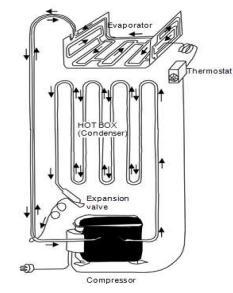
(2)whichfirstcoolsandremovesthesuperheat,thevapor is condensed into a liquid by removing additional heat pressureandtemperaturebyusingafan
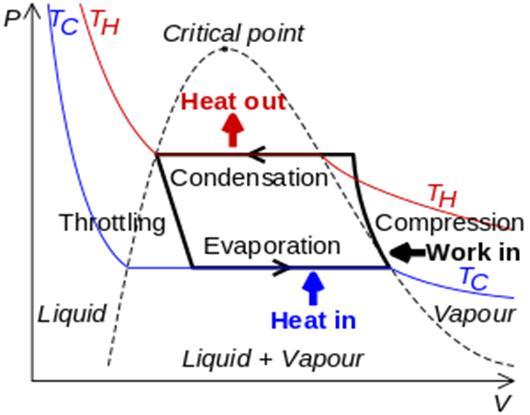
(3) Across the condenser coil, the warm air in hot room passesthroughthecondensercoilandgetsheatedup,this heatisabsorbedbytheproductskeptinhotroom,thesaid liquidrefrigerantgoesthroughtheexpansionvalve
(4) When pressure suddenly drops down, flash evaporations take place, the cold liquid vapor mixture thentravelsthroughtheevaporationcoil
(5) and is vaporized by the cooling of the warm air by a fan
(6) Across the evaporation coil, the refrigerant vapor returns to the condenser inlet to repeat the cycle. In one specific example of system in accordance with the inventiona constant volumethermodynamic machinehas hot and cold level working rooms with hot and cold displacerscyclingworkingfluid.
International Research Journal of Engineering and Technology (IRJET) e-ISSN:2395-0056
Volume: 10 Issue: 05 | May 2023 www.irjet.net p-ISSN:2395-0072
4. APPLICATIONS
4.1 Advantages of System
Effective utilization of waste heat recovery due to whichglobalwarmingcanbereduced.
Increase in overall effectiveness of domestic refrigeratorandsavinginenergy.
Increase in Coefficient of performance of domestic refrigerator.
Efficient and economical combination of refrigerator andfood/waterwarmer.
Simulated for medium to large system or multiple domesticrefrigerators.
Heat load in kitchen due to heat rejected in room is also reduced which indirectly reduces energy requiredtocooltheroom.
4.2 Applications of System
Todrygrainsanddry-fruitsetc.
Maintaining temperature of substances up to 35oC40oC.
Keepsnacksandfoodwarm.
Grocery stores for storing cold and warm items simultaneously.
Usedinhealthcarecentres,schools,etc.
Anyotherapplicationrequiringwarmair.
Servingbothcoolingandheatingpurposei.e.,Machine ismultipurpose.
5. CALCULATIONS
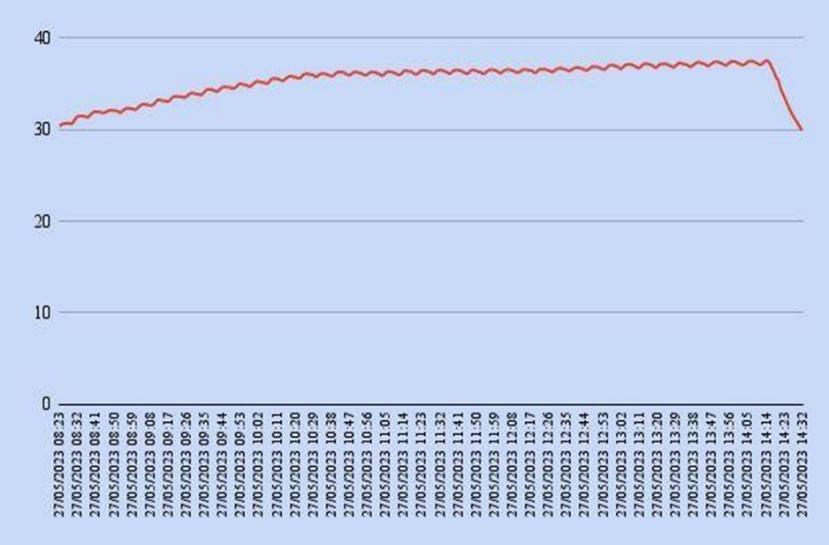
The observations for the following graph were recorded usingDataLoggers.
5.1 COP CALCULATIONS
Timerequiredforreading,Δt=100min
InitialtemperatureofwaterT1 =30 0C
FinaltemperatureofwaterT2 =35 0C
TemperaturedifferenceΔT= 5 0C
Massofwaterinthebox,m=1300gm
Specificheatofwater,Cp=4.184KJ/KgK
HeatAbsorbedByWater,Q =mxCpxΔT/Δt =4.53J/s
Heatrecoveryachieved,Q=HeatAbsorbedbyWater =4.53W
Refrigeratorcoolingcapacity=160.00W
Power required for running the compressor = Work doneonrefrigerant =130W
COPactual= Heatextracted
Workdonebycompressor = 160.00
130.00 =1.23
Waste heat of condenser is utilized to heating hot box which is the part of System work. HenceCOPofsystemwillimprove.
COPimproved= Heatextractedinrefrigeration
Workdonebycompressor-Heatrecoveryachieved 160 = 130-4.53 =1.28
Improvement(%)inCOP= (COPimproved–COPactual)×100
COPactual
= (1.28-1.23) ×100 1.23
=4.1%
6. CONCLUSIONS
Thisinnovativeapproachhasthepotentialtoimprove the overall efficiency of domestic refrigeration systems and contribute to energy conservation by harnessingotherwisewastedheatenergy.
The experimental analysis conducted in this study revealed that the proposed system could generate temperaturesofaround35°C-40°Cinthehotbox.
The graph illustrating temperature variations over time provided valuable insights into the system's performance.
Calculations to determine the coefficient of performance (COP) of the system indicated an approximate 4.1% increase in efficiency. This improvement in COP implies reduced energy consumptionandenhancedenergyutilization.
The findings of this research support the notion that utilizing waste heat from domestic refrigerators for hot and cold storage is a promising approach with potential benefits for energy efficiency and conservation.
DRAWBACK OF THE SYSTEM:
•The temperature insidethehot boxisdependent on the operation of the refrigerator, which can limit the control andstabilityofthehotstorageenvironment.
7. RESULTS
Thus, we have experimentally proved that the COP or the efficiency of the domestic refrigerator is increased by incorporating a waste heat recoverysystem.
An increase of 4.1% is obtained in the COP of the refrigerator corresponding to a 5o rise in the temperatureofwater.
REFERENCES
[1] Mr. Sachin Narnavre, Mr. Shyam Gupta, Mr. Ashwin Jakhaniya, “Waste Heat Recovery System for Refrigerator”
[2] B.J. Lokhande , DR. S. B. Barve ,’’Design &Analysis of Waste Heat Recovery System for Domestic Refrigerator”
[3] Lakshya Soni, Mr. Pawan Kumar, Mr. Rahul Goyal, “A review on Waste Heat Recovery from Domestic Refrigerator”


BIOGRAPHIES
Mr. Vedant H. Borawake

B.E.MechanicalEngineering, Pune Vidyarthi Griha’s COET&GKPWIOM,Pune (Emailvedant.borawake1810@gmail.co m)
Mr. Tanmay S. Dixit
B.E MechanicalEngineering, Pune Vidyarthi Griha’s COET&GKPWIOM,Pune (Emailtanmay100801@gmail.com)
Mr. Ojas A. Chitale
B.E.MechanicalEngineering, Pune Vidyarthi Griha’s COET&GKPWIOM,Pune (Emailojaschitale1717@gmail.com)