Understanding Work-Life Balance: An Analysis of Quiet Quitting and Age Dynamics using Deep Learning
Devang Shah1 , Masumee Parekh21Student, Department of Computer Engineering, NMIMS University, Maharashtra, India

2Student, Department of Computer Engineering, NMIMS University, Maharashtra, India
Abstract - In today's fast-paced society, achievingwork-life balance is increasingly becoming a challenge for individuals across various age groups. To gain a comprehensive understanding of this phenomenon, we leverage the power of Deep Learning (DL) and Machine Learning(ML)techniquesin this research study. We explore howMLcanbeinstrumental in understanding the determinants of work-life balance, with a particular focus on the concept of "quiet quitting" and how different attributes possess varying degrees of importance in establishing work-life balanceacrossdifferentagegroups.Our study is based on a comprehensive dataset of 15,977 survey responses encompassing 25 attributes related to work and personal life. To extract meaningful insights from the dataset, we have implemented Artificial Neural Network (ANN) algorithm. Our model's performance showcases promising results, with a test accuracy of 73.91%. This underscores the efficacy of the ANN implementation in capturing the complexity of work-life balance dynamics. Additionally, we discuss various potential solutions and recommendations derived from our findings, enabling organizations and individuals to proactivelyaddresswork-lifebalancechallenges and foster healthier, more sustainable work environments.
Key Words: Deep Learning, Quiet Quitting, Work Life Balance, Artificial Neural Networks, Data Analysis.
1.INTRODUCTION
Intoday'sfast-pacedandever-evolvingworld,theinfluence ofmachinelearning(ML)anddeeplearning(DL)algorithms is ubiquitous. These advanced computational techniques have significantly impacted various aspects of our lives, including the workplace. As industries undergo rapid transformations and individuals face increasing personal and work-related challenges, the concept of work-life balancehasbecomecrucialformaintainingwell-beingand productivity.
Thechanginglandscapeofindustrieshasintroducednovel demands and complexities, often leading to personal and work-related problems for individuals. The relentless pursuitofprofessionalsuccessandthepressuresofmodernday work environments can take a toll on employees, affecting their physical and mental well-being [1]. Consequently, organisations have started recognizing the importance of work-life balance as a means to foster a healthierandmoreproductiveworkforce.
Onenotablephenomenonthathasemergedinrecentyears isQuietQuitting. Thistermreferstoemployeeswho,donot openly resign but disengage from their work and become less committed to their organisations. Quiet Quitting can have detrimental effects on both the individual and the organisation,resultinginreducedjobsatisfaction,decreased productivity,andincreasedturnoverrates[8].Exploringthe factorscontributingtoquietquittingandunderstandingits implications is crucial for organisations to create an environmentthatpromotesengagementandjobsatisfaction.
As individuals progress in age, their priorities, responsibilities,andoveralllifecircumstanceschange.The factorsinfluencingwork-lifebalancecanvarysignificantly based on age, as different life stages bring forth distinct priorities and responsibilities [12]. Understanding how variousattributesholddifferentweightageindetermining work-life balance for different age groups is crucial for organisationstotailortheirstrategiesandsupportsystems effectively. For instance, younger employees may place greater importance on career advancement, achievement, and social networking. These individuals may strive for recognitionandengageextensivelyinprofessionalnetworks to expand their opportunities. Consequently, work-life balanceforthisagegroupmaybeinfluencedbytheinterplay between their ambition, social connections, and the time dedicatedtopersonalpursuits.
Ontheotherhand,asindividualsentermid-careerstages, theirwork-lifebalanceconsiderationsmayshift.Theability to maintain financial stability, allocate time for personal interests and hobbies, and strike a healthy equilibrium between work and personal life becomes increasingly significant. Mid-career professionals often seek fulfilment beyond material success and strive for a more holistic approachtotheirwell-being.
TheLifestyleandWellbeingdatasetfromKaggleconsisting of survey responses from authentic-happiness website, includesfactorssuchasfruitsandvegetablesconsumption, stresslevels,socialnetworksize,achievementorientation, physical health indicators like BMI range and daily steps, demographicvariableslikeageandgenderandvariousother parameters.
In this paper, we have used the Artificial Neural Network (ANN) algorithm which captures complex patterns and
correlations to derive valuable insights from the data. By assigningappropriateweightstodifferentfactors,wegained a deeper understanding of their relative importance in influencing work-lifebalanceoutcomes. Bythe endof our analysis,weaimtoprovideacomprehensivesolutionforthe identifiedproblems.TheANN-basedapproachenablesusto generatepredictionsandrecommendationsthatcanassist organisationsinpromotingahealthierwork-lifebalance.By understanding the factors contributing to quiet quitting, organisationscanimplementstrategiestofosterengagement and job satisfaction, ultimately reducing turnover rates. Furthermore,byunderstandingthevaryingsignificanceof different factors in work-life balance across age groups empowers individuals to optimize their work-life equilibrium.
2. LITERATURE SURVEY
Work-lifebalancehasbecomeacrucialaspectofemployees' well-being and overall quality of life. Researchers, such as Pawlicka et al [1] have explored the potential of artificial intelligence and machine learning to improve work-life balance.Intheirstudy,theyutilizedamachinelearningtool toanalyseasubstantialdatasetcomprising800employees. By employing an artificial neural network, they identified significantfactorsaffectingwork-lifebalance,includingthe relationbetweenthefeelingofbalanceandactualworking hours, availability of free time, weekend work, selfemployment,andsubjectivefinancialstatus.Similarly,Radha andRohith[2]conductedananalysisusingmachinelearning classifiersonadatasetof12,756individuals.Theirfindings revealedcorrelationsbetweenvariousfactorsandwork-life balance, providing insights into improving employee wellbeing.

Inadditiontounderstandingthefactorsinfluencingwork-life balance,itisessentialtoaddresstheissueof"QuietQuitting," whichreferstoemployeeslimitingtheircommitmenttotheir jobs. Mahand and Caldwell [8] discuss how the decline in employeecommitmentstemsfromthefailureofmanagers and supervisors to fulfil their leadership responsibilities effectively. They emphasize the significance of engaging, empowering, and inspiring employees to increase commitment.Additionally,consideringtheimpactofageon work-lifebalance,Richert-KaźmierskaandStankiewicz[12] examinedtherelationshipbetweenageandtheassessment ofwork-lifebalance.Theirstudyfoundthatolderworkers weremorelikelytoprioritizework-lifebalanceandindicated a need for equal opportunities for flexible solutions. The resultsprovidevaluableinsightsforemployersinmanaging personnel and creating workplace conditions that support work-lifebalance,particularlyforseniorworkers.
Broadeningthescopeofpriorfindings,thisstudyanalysesa comprehensive dataset and provides age-specific recommendations for enhancing work-life balance, thus offering practical solutions for individuals experiencing
work-life imbalance and addressing the underexplored aspectof"quietquitting."
3. METHODOLGY
Thedatasetusedinthisresearchpaperwascollectedfrom Kaggle consisting of survey responses from authentichappiness website. This dataset was chosen due to its comprehensive coverage of attributes related to work-life balance,providingaholisticviewofindividuals'experiences. The study includes attributes such as fruits and veggies consumption,dailystresslevels,placesvisited,corecircleof friends and family, social network usage, achievement orientation, donation habits, BMI range, completed tasks, experience of flow, daily steps, vision for their lives, sleep duration,unusedvacationdays,instancesofdailyshouting, perceivedincomesufficiency,personalawardsreceived,time allocated to passions, weekly meditation practice, age, gender,andwork-lifebalancescore.Forresearchpurposes, the target attribute –“lifestatus” was introduced, which consistsof3categories-poor,good,andexcellentworklife balance.Fig-1illustratesthemodelbuildingprocessusedto extractmeaningfulinsights.
First, the dataset was checked for missing values, outliers, and inconsistencies. Missing values were either imputed usingappropriatetechniquesor,ifthepercentageofmissing values for a particular attribute was significant, the corresponding instances were removed. Outliers were identifiedusingstatisticalmethodsandtreatedaccordingly. Min-Maxnormalizationwasusedtobringalltheattributeson thesamescale,between0and1.
Theutilizationoffeatureengineeringtechniquesallowedfor theextractionofsupplementaryvaluableinsightsfromthe availableattributes.Forinstance,theagewastransformed intoacategoricalvariableindicatingwhetheranindividual fallsunderthecategoriesof<20,21to35,36to50,or>50. Similarly,theattribute“lifestatus”wascategorizedintolevels such as poor, good, and excellent work-life balance. These transformationsaimedto enhance the interpretabilityand predictivepowerofthedata.
Further, the ANN algorithm was chosen for its ability to effectivelycapturecomplexpatternsandrelationshipswithin the data, making it well-suited to understand the intricate dynamics of work-life balance. The ANN architecture consisted of multiple layers, including an input layer, four hiddenlayers,andanoutputlayer.Theinputlayerutilized the rectified linear activation function, which helps to preservethepositivevaluesandimprovetheconvergenceof thenetwork.Therectifiedlinearactivationfunctionisknown foritsabilitytohandlenon-linearrelationshipseffectively. The four hidden layers provided depth to the network, allowing for the extraction of abstract features from the dataset.Thespecificnumberofnodesineachhiddenlayer was determined through experimentation and hyperparametertuning,aimingtostrikeabalancebetween modelcomplexityandoverfitting.Theoutputlayeremploys thesoft-maxactivationfunction,whichiscommonlyusedin multi-classclassificationproblems.Thisactivationfunction assignsprobabilitiestoeachclass,enablingthepredictionof themostlikely“lifestatus”categoryforagivensetofinput features. During the model training process, various hyperparametersandparametersweretunedtooptimizethe performanceoftheANN.Theseincludedparameterssuchas batchsize,regularizationtechniques(e.g.,dropout),andthe numberofepochs.
Inthemodelfittingoutput,achievingalossvalueofzeroand an accuracy ofapproximately 74.08% onthe training data maysuggestthatthemodelhaslearntthepatternspresentin the training set quite well. The model evaluation output reveals a test loss of zero and a test accuracy of approximately 73.91%. These metrics indicate that the trainedmodelperformswellonunseendata,achievingahigh accuracyinpredictingthetargetvariable.Thisimpliesthat themodelhassuccessfullygeneralizedfromthetrainingdata tomakeaccuratepredictionsonnew,unseeninstances.
3.1 Quiet Quitting
The problem of "Quiet Quitting" refers to a phenomenon where individuals silently disengage from their work or careerduetoissuesrelatedtowork-lifebalance.Itsignifiesa situation where employees may not explicitly resign from theirpositionsbutbecomeincreasinglydisengaged,leading toreducedproductivityandsatisfaction.
Quietquittingismoreprevalentamongindividualsaged2135.Thisperiodoflifeofteninvolvessignificanttransitions and challenges, such as starting a career, building relationships,andmanagingpersonalresponsibilities.This agegroupmaybemorepronetosilentlyquittingastheymay feel pressured to prove themselves, face high workloads, experiencedifficultyinsettingboundariesbetweenworkand personallife,andhaveagreaterdesireforwork-lifebalance andfulfilment.
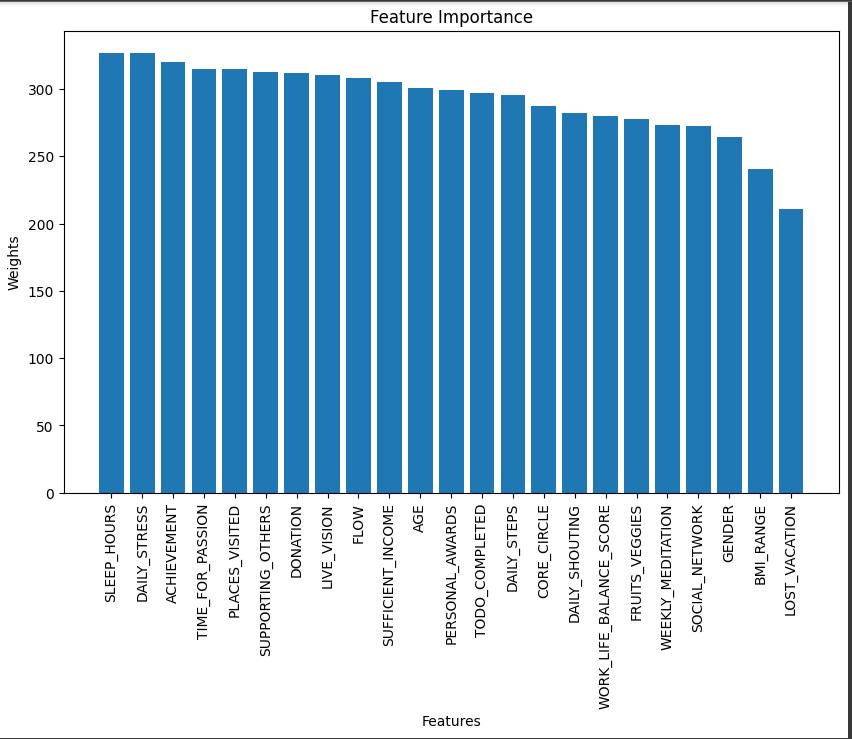
Fig - 2: ImportantfeaturesofANNmodel
From Fig -2, it can be inferred that the most important features which can help individuals and organizations preventquietquittingareasfollows:
Sleep Hours - Sufficient sleep is crucial for physical and mental well-being. Inadequate sleep can lead to fatigue, reducedcognitivefunctioning,anddecreasedproductivity, makingindividualsmoresusceptibletodisengagementand theinclinationtoquietlyquit.
DailyStressLevels-Highdailystresslevelscancontributeto increased burnout, reduced job satisfaction, and a higher likelihood of disengagement from work. When individuals experienceexcessivestressonadailybasis,itcannegatively impacttheirwell-beingandmotivationtocontinueintheir currentrole.
Achievement - When individuals feel their efforts and accomplishmentsareacknowledgedandvalued,itenhances theirmotivationandcommitmenttotheirwork.Conversely, alackofrecognitionandopportunitiesforachievementcan lead to feelings of stagnation and disengagement, making individualsmoresusceptibletoQuietQuitting
3.2 Dynamics of Age and Work-Life Balance
3.2.1 Age Category: <20 years
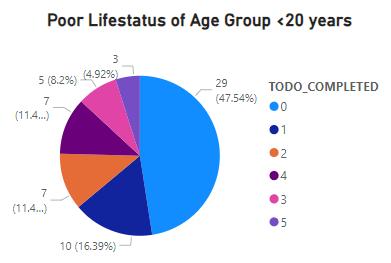
Amongthetotalpeoplepresentintheagegroupbelow20, withapoorworklifebalance(“lifestatus”=0),theattribute "TODO Completed" was analyzed. Approximately 63.84% (Fig-3)ofindividualsinthisagegroup,whoreportedhaving a less than satisfactory work-life balance, scored 0 or 1 indicating the challenges they face in accomplishing their tasks. This suggests that a substantial portion of this age group, who struggle with maintaining a good work-life balance,encounterdifficultiesinmanagingandcompleting theirdailyactivities.Thiscanbeattributedtofactorssuchas
timeconstraints,lackofprioritizationskills,oroverwhelming workloads.
Toaddressthisissueandmitigatetheimpactofhighdaily stress levels, several solutions can be proposed. Offering flexibilityandautonomyinworkcanempowerindividuals and enable better work-life integration and reduce stress associatedwithrigidworkstructures. Equippingindividuals witheffectivestrategiesforhandlingconflictsandfostering positive relationships can also reduce workplace stress. Participating in activities that foster relaxation and stress reduction,suchasexercising,meditating,pursuinghobbies, or enjoying with loved ones, enhances your ability to effectivelyhandlepersonalandprofessionalresponsibilities.
Age Category: 36-50 years
Severalstrategiescanbeadoptedtoenhancecompletionof dailyactivitiesandoverall productivity. Prioritizetasksby identifyingthemostimportantonesandorganizingtheminto a to-dolistor usingtask management tools.Effectivetime managementtechniques,suchasthePomodoroTechniqueor time blocking, can be employed to break tasks into manageable chunks and allocate dedicated time slots for focusedwork.Settingrealisticandachievablegoalsforeach day, breaking down large tasks into smaller steps, and eliminatingdistractionsisalsocrucial.
3.2.2 Age Category: 21-35 years
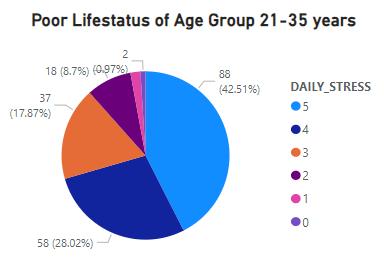
Similarly, the attribute “DAILY_STRESS” was examined amongtheagegroup21-35,witha poorwork lifebalance (“lifestatus”=0).70.5%ofindividualsscored4or5(Fig-4) forthisattribute,indicatinghighstresslevelsonadailybasis. Thisrevealsanotablecorrelationbetweenwork-lifebalance and daily stress levels among individuals who fall in this category. Heavy workloads, long working hours, and difficulties in managing personal and professional commitments are some of the main causes of high stress levels.
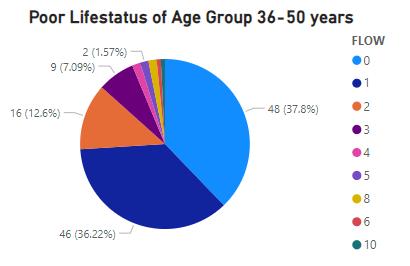
Among individuals aged 36 to 50 with a poor work life balance(“lifestatus”=0),atotalof74%ofindividualsinthis age group scored 0 or 1 (Fig -5) for the attribute "FLOW" This indicates that individuals, who reported having an unsatisfactorywork-lifebalance,barelyexperienceanystate offlowduringtheirdailyactivities.Flowreferstoastateof complete absorption and enjoyment in the work one is engagedin.
This can be attributed to various factors, such as job dissatisfaction due to mismatch between skills and responsibilities.Itisessentialtopromotejobsatisfactionby aligningjobresponsibilitieswithindividuals'skills,interests, and values. Helping individuals identifyand leverage their uniqueskillsandstrengthsintheirworkandpromotingthe importanceofregularbreaksthroughouttheworkdaytohelp individualsrechargeandregainfocuscanincreasetheability toexperienceflow.
3.2.4 Age Category: >50 years
A total of 69.7% of this age group with a poor work-life balance who scored 0,1 or 2 (Fig -6) for the attribute “CORE_CIRCLE” This suggests that individuals in this category have a small core circle. These findings highlight potentialchallengesrelatedtoloneliness,astubbornnature, and face difficulty in adapting to a changing environment amongindividualsinthisagegroup.Thelackofasignificant support network or close relationships can contribute to
feelings of isolationand canimpact overall well-being and mentalhealth.
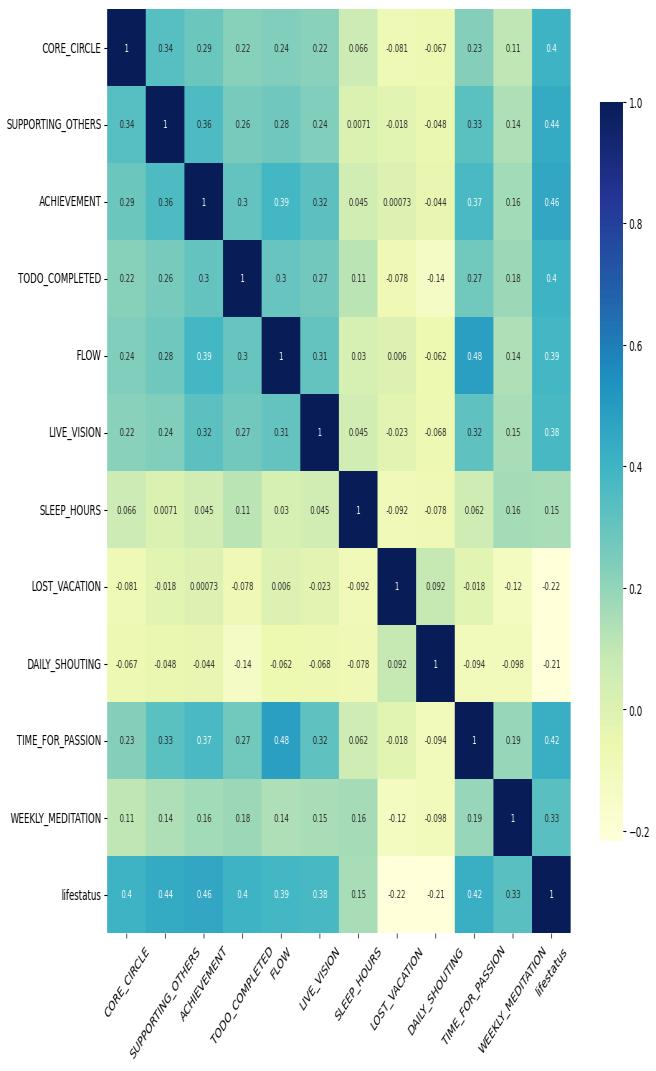
TheresultsoftheresearchpaperindicatethattheANNtest model achieved an accuracy of 73.91%, demonstrating its effectiveness in predicting work-life balance based on the dataset attributes. Additionally, the analysis revealed a correlation between certain variables (Fig -7), namely “FLOW” and “TIME FOR PASSION” , “CORE CIRCLE” and “SUPPORTING OTHERS”, as well as “LIFE VISION” and “ACHIEVEMENT” These findings highlight the interconnectednessofthesefactorsininfluencingindividuals' work-lifebalanceandsuggesttheimportanceofconsidering themcollectivelywhendesigninginterventionsorstrategies toenhanceoverallwell-being.
Fromouranalysis,thefollowingarethestrategiesthatcanbe implementedbyindividualstoimprovetheiroverallworklife balance.
To promote a more fulfilling and socially connected life, individuals can actively seek opportunities for social engagementandconnectionbyjoiningcommunitygroups, clubs, or organizations that align with their interests, participatinginsocialevents,orvolunteeringforcausesthey care about. Encouraging a growth mindset and providing supportduringtransitionscanenhancetheirabilitytoadapt and thrive in changing environments. Encouraging connections between older individuals and younger generationscanfostermutuallearning,understanding,anda senseofpurpose.
4. RESULTS

1. Prioritizing self-care by setting boundaries, allocating timeforrelaxation,hobbies,andactivitiesthatbringjoy
2. Practicingeffectivetimemanagementtechniquessuchas prioritizingtasks,delegatingwhenpossible,andavoiding multitasking.
3. Establishingclearcommunicationwithsupervisorsand colleaguesregardingworkloadandexpectations.
4. Leveraging technology and automation tools to streamlineandoptimizetasks
5. Maintaining a support network of friends, family, or mentors who can provide guidance and emotional support
The proposed solutions can contribute to creating a more balancedandfulfillingwork-lifeharmonyforindividuals.
5. CONCLUSION
Thesignificanceofwork-lifebalancecannotbeemphasized enough,asithasadirectinfluenceonourholisticwell-being andthequalityofourlives.Itenablesindividualstouphold theirphysicalandmentalhealth,diminishstresslevels,and safeguard against burnout. A healthy work-life balance fostersbetterproductivity,engagement,andjobsatisfaction, leading to improved performance and career success. Moreover,itenablesindividualstoallocatetimeandenergy topersonalrelationships,hobbies,andself-care,promotinga fulfillingandmeaningfullifebeyondwork.
TheutilizationofArtificialNeuralNetworks(ANN)proved instrumentalinourresearchforaddressingtheissueofquiet quitting and understanding how different attributes hold varying weightage in determining work-life balance for distinct age groups, providing insights into age-specific challenges. ANN's ability to capture complex patterns and relationships within the dataset enabled us to identify significant factors contributing to Quiet Quitting, such as
inadequate sleep, high daily stress levels, and lack of recognition.Thishelpeddeveloppersonalizedstrategiesto tackle quiet quitting and enhance work-life balance by considering the unique needs and dynamics of each age group.
REFERENCES
[1] A. Pawlicka, M. Pawlicki, R. Tomaszewska, M. Choraś, andR.Gerlach,“Innovativemachinelearningapproach andevaluationcampaignforpredictingthesubjective feeling of work-life balance among employees,” PLOS ONE,vol.15,no.5,p.e0232771,May2020.
[2] K.Radha,M.Rohith,"AnExperimentalAnalysisofWorkLife Balance Among the Employees using Machine LearningClassifiers,"InternationalJournalofComputer TrendsandTechnology,vol.69,no.4,pp.39-48,2021.
[3] Gautam, Indu & Jain, Sameeksha. (2018). A Study of Work-LifeBalance:ChallengesandSolutions.
[4] Paigude, Supriya & Shikalgar, Sajeeda. (2022) Deep Learning Model for Work Life Balance Prediction for WorkingWomeninITIndustry.
[5] Formica,Sandro&Sfodera,Fabiola.(2022).TheGreat Resignation and Quiet Quitting paradigm shifts: An overview of current situation and future research directions. Journal of Hospitality Marketing & Management.
[6] O.I.Abiodun,A.Jantan,A.E.Omolara,K.V.Dada,N.A. Mohamed,andH.Arshad,“State-of-the-artinartificial neuralnetworkapplications:Asurvey,”Heliyon,vol.4, no.11,p.e00938,Nov.2018.
[7] SusantoP,HoqueME,JannatT,EmelyB,ZonaMAand Islam MA (2022) Work-Life Balance, Job Satisfaction, and Job Performance of SMEs Employees: The Moderating Role of Family-Supportive Supervisor Behaviors.Front.Psychol.13:906876.
[8] Mahand, Thalmus & Caldwell, Cam. (2023). Quiet Quitting -Causes and Opportunities. Business and ManagementResearch.12.10.5430/bmr.v12n1p9.
[9] HatcherRyanHwangYo-Sung(ServiceN)International ConvergenceManagementSocietyJournalofEconomics, MarketingandManagementVol.7No.12019.03
[10] E. S. Kassim et al., "Work life balance and job satisfaction:Howrelevantarethey?"2013International Conference on Technology, Informatics, Management, Engineering and Environment, Bandung, Indonesia, 2013,pp.62-66,doi:10.1109/TIME-E.2013.6611965.
[11] Hamouche, S., Koritos, C. and Papastathopoulos, A. (2023),"Quietquitting:relationshipwithotherconcepts
and implications for tourism and hospitality", International Journal of Contemporary Hospitality Management
[12] Richert-Kaźmierska,AnitaandStankiewicz,Katarzyna. ‘Work–lifeBalance:DoesAgeMatter?’1Jan.2016:679
688.
[13] Dhas, Mr D. Babin, and Dr P. Karthikeyan. "Work-life balance challenges and solutions: overview." International Journal of Research in Humanities and SocialStudies12.2(2015).
[14] Gribben, Louise, and Cherith Jane Semple. "Factors contributingtoburnoutandwork-lifebalanceinadult oncology nursing: an integrative review." European JournalofOncologyNursing50(2021)
[15] Birimisa,Nikolina,"InfluenceofFlexibilityonWorkLife Balance" (2016). Thesis. Rochester Institute of Technology.