
An Organized Review of Public Attitudes, Technologies, and Renewable Energy Sources: Towards Sustainable Energy
Shubham Kadam1***
Abstract - Renewable energy sources like solar, wind, and biomass won't become less accessible as a result of use. The ever-increasing need for energy is met by using sunlight, a reliable source of energy. This assessment addresses global energy requirements, domestic renewable energy technology, and popular perceptions of renewable energy. From 2009 to 2018, a thorough assessment of the literature was done. More than 300 articles were categorized during thisprocess, and42 papers were filtered for critical review. The review of the literature revealed that in spite of significant efforts at all levels to promote renewable energy as a viable alternative to fossil fuels and reduce dependency on them, in2017fossil fuels still made up 73.5% of the world's electricity output. On the other hand, renewable energy sources only made up 26.5%. This study also shows that one of the biggest obstacles to the adoption of renewable energy technology is a lack of public knowledge. The findings of this study demonstrate that incorporating renewable energy sources into power generation can help to handle the current global energycrisis. Additionally, this systematic research has emphasized the significance of public opinion and carried out a real-time analysis of public tweets in order to aid the development of renewable energy technology.
Key Words: Energy policies, public opinion, renewable energysources(RES),renewableenergytechnology(RET), solarenergy,windenergy.
1.INTRODUCTION
Experts and the general public are becoming more concerned about the topic of renewable energy (RE). In absoluteandrelativeterms,researchonrenewableenergy sources(RES)hasincreasedinrecentyears[1].Bytackling the problems of fossil fuel depletion and global warming, REScanplayasignificantrole[2].Thethreeprimarysources ofenergyarenuclearpower,renewableenergy,andfossil fuels. similar RES Liandong Zhu served as the assistant editorwhooversawtheevaluationofthismanuscriptand gave final approval for publication. Since solar, wind, biomass, geothermal, and hydropower are all used to generateenergy,theyareallextremelyhelpfulinthefight againstenergyshortages[3]–[5].Theattitudeofthegeneral people and their readiness to pay for electricity from renewable electricity sources were the topic of a recent research[6]ofvillagesinWesternGreece.Becausetheyare beneficialtotheenvironment,renewableenergysourcesare regardedascleanenergysources[7]andarecrucial[8],[9]. Traditional reliance on fossil fuels is thought to have
contributedtocarbondioxide(CO2)emissions,greenhouse gas (GHG) issues, and environmental damage as environmentalconsciousnesshasgrown[10],[11].Withthe ability to supply energy services with zero or almost zero emissionofairpollutantsandGHGs,REScanmeetdomestic energyneeds.WiththegrowthofRE,crucialissuesincluding thesustainabledevelopmentofisolateddesertandmountain regionsaswellasthefulfilmentoftherequirementstofulfil international agreements relating to environmental protectionareanticipatedtoberesolved.Thereiscurrently a global trend to replace conventional fuels with RES in ordertomeettheexcessiveenergydemand.TheneedforRE isexpandinginthecurrentenvironmentduetoavarietyof issues, including GHG emissions, CO2 emissions, climate change,andenergysecurity.Incontrasttofossilfuels,RES offerseconomicadvantages,environmentalbenefits,anda pollution-freeenvironment.Therefore,itiscrucialforboth thepresentandfuturegenerationstorelyonRESinorderto meettheenergyneed.Todothis,policy-makingandpublic opinionresearchareneededtoencouragetheadoptionof RE.TheimpactthatpublicopiniononREmayhaveonthe formulation of policy makes analysis of that opinion essential. Through computer-mediated environments like Web 2.0, public attitudes, a hot area of research, are intensifying.Theseallowagrowingnumberofindividualsto interactandcommunicatewithoneanotherviasocialmedia siteslikeTwitter,Amazon,theblogosphere,etc.Byanalysing public opinion on social media, this survey hopes to gain insightful information about the use of RE, the difficulties encountered therein, awareness of utilising RES, and acceptanceofrenewableenergytechnology(RET)forhome use. The purpose of this survey paper is to examine the global demand for RE, the many types of RES used domestically,andtodrawpracticalconclusionsontheuse andacceptanceofRETandRESbythegeneralpublic.
1.1 Planning the review
The review is organized by putting out the research questionspertinenttoourstudygoal.Wealsodetermined the search technique, the search terms, and the inclusion/exclusionstandards.
1) ResearchQuestions
The primary goal of this effort is to increase understandingoftheimportanceofRE,RES,andRET.To accomplish the research goals, we have created the followingresearchquestions(RQs).

RQ1: WhyisRenewableenergyneededworldwide?
RQ2: Whatkindsofrenewableenergysourcesareused fordomesticpurposes?
RQ3: What are people's opinions about renewable energytechnologies,accordingto?

2) SearchStrategy
For this SLR, the study followed Kitchenham’s recommendations. In order to investigate the papers pertinent to our study purpose and the research questions,wefirstusedtheformalsearchmethod. The search field is set up to encompass the well-known databasesprovidedinTable1inordertofindrelevant articles. The papers were initially collected, and then further studies were looked at for significance (snowballing). Table
3) SearchString
The essential terms used in the issue area and the review'sgoalwereusedtocreatethesearchterms.Using trialanderror,anumberofpilotsearcheswerecarried out to improve the search string's keywords. The following search string was used: (‘‘renewable energy‘‘ OR‘‘publicopinions’’OR‘‘useofrenewableenergy’’OR ‘‘solarsystemsfordomesticuse’’OR‘‘solarheaters’’OR ‘‘solar cooker’’ OR ‘‘solar cooler’’ OR ‘‘biomass’’ OR ‘‘hydropower’’, OR ’’wind’’) AND (‘‘energy sources’’ OR ‘‘energy demand’’ OR ‘‘public opinions’’ OR ‘‘domestic products’’ OR ‘‘home systems’’ OR ‘‘acceptance’’ OR ‘‘attitude’’OR‘‘effects‘‘OR‘‘motivation’’)AND(‘‘energy crises’’ OR ‘‘ energy demand’’ OR “clean energy’’ OR ‘‘electricityneed’’OR‘‘greenhousegasemission’’).
2. RESULTS

A. Overview of Studies
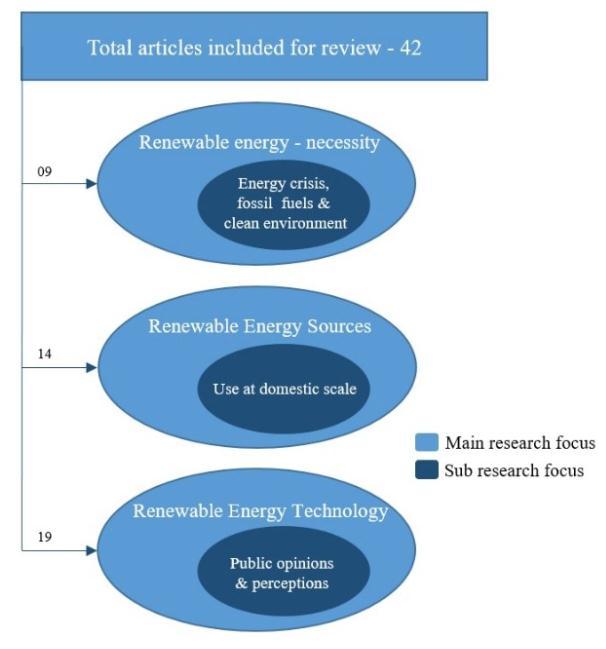
Thestagesofthestudyselectionprocedureforthesystematic reviewprovidedinthisarticleareshowninFigure1.These studiesconcentratedonthreemaintopics:theneedforRES (9 of the 42 research); RES on a home scale (14 of the 42 studies);andpublic opiniononRES(19ofthe42studies).
The findings are then further addressed in relation to the threeresearchquestions(RQ1,RQ2,andRQ3).
1) WhyisRenewableenergyneededworldwide?
In order to fulfil the demands of the expanding global population and prevent energy crises, it is imperative to introducemethodstomeettherisingneedforenergy.
By 2030, the demand is anticipated to rise by 65% at the current pace of energy use, considering 2004 as the base year. Most of the energy utilized now in the world comes from non-renewable sources like coal-fired power plants. Thesearerecognizedtoproducesignificantissues,suchas GHGemissions(CO2,NOx,andSox),aswellascontributeto globalwarming.
In contrast to industrialized nations, energy crises, particularly those involving electricity, are severe in developingnations.Shakeeletal.'sstudylaidoutaplanfor overcomingPakistan'senergychallengesbyincorporating RESintopowergenerating.Accordingtoaresearchstudy, Iran's rural areas are heavily dependent on fossil fuels to supply their energy needs. The report states that a significant portion of the world's electrical production in 2017camefromfossilfuels.
2) Whatkindsofrenewableenergysourcesareused fordomesticpurposes?

Reliableenergysources,likeRES,cansignificantlyimprove qualityoflife.ThemostprevalentkindofRE,solarthermal energycanbeobtainedbothdirectlyandindirectly.Thermal applicationsofsolarenergyincludesolarwaterheaters,air conditioners,solarhomesystems,cookers,andrefrigeration. Thesecanprovideforafamily'srequirementsandprovidea sustainablefuture.Numerousnationsemploysolarthermalbasedtechnologiesextensivelytogeneratehotwater.Botha closedloopandanopenlooparebuiltintothem.Extremely coldregionsaresuitedfortheclosedloopsolarsystem.RES applications (solar and biomass) are utilized to reduce a household'selectricityusageandmeettheenergyneedsofa single-familydetachedhome.Aninvestigationofhousehold energy use revealed that the installation of a solar water heater might cut overall household energy use by about 13%. The study investigated the possibilities of a hybrid solarPhotovoltaic/Thermal(PV/T)collectorlinkedwitha thermochemicalsorptionthermalstoragesystemforahot water heater in order to enhance the utilization of solar energyonahomescale.Examplesofinventionsthataddress domesticenergypovertyindevelopingnationsincludeLED lightingandenergy-efficient multi-cookers.Anotherstudy revealed that household energy management systems
(HEMS)batteriescanberechargedusingasolarphotovoltaic systemasasecondarysource.
3) Whatarepeople'sopinionsaboutrenewableenergy technologies,accordingto?
Accordingtoouranalysisoftheliterature,usingREwillbe necessarytoaddressupcomingenergy-relatedconcerns.To dothis,itisessentialtoraisepublicacceptabilityofRETand RES and enhance public awareness of them. In order to increasepublicacceptabilityofRESandpreventtheserious issueofglobalwarming(causedbytheenergyproducedby fossil fuels), it is essential to analyze popular attitudes towardsRES.Inthiscase,REservesasagoodsubstitutefor environmental protection. In order to gauge secondary school students' interest in RE-based systems, a poll was undertakeninTurkey.The vastmajorityofstudentswere aware of RES that use solar and wind power to generate electricity.Thesepupilswereawareoftheproblemofglobal warming, and they believed that using RE would help to mitigateit.Portuguesepeoplehavebeenshowntogenerally support the growth of new RE projects in their nation, howevertheyarenotwell-versedinallRES,suchasbiomass. Malaysiaisoneofthedevelopingnationsthatismakingabig contribution to attaining a sustainable environment and slowing down climate change. According to a case study conductedinJapan,thelocalrespondentsareunwillingto permit wind farms in their back yards. Being the greatest GHGemitterintheworld,Chinaisconsciousthatitspolicies have a significant impact on international efforts to halt climatechange.2086Chineseinternetusersparticipatedina poll,anditwasverywellreceived.
5: Opinions & Renewable Energy Sources
ThesourcesofpublicopinionandthesourcesofREon whichpublicopinioninthisreviewstudyisbasedare explainedinFigure5.
3. OPINION RESEARCH ON RENEWABLE ENERGY POSTED ON SOCIAL MEDIA


AnexaminationofcommentsmadeonREthatwerereceived viaTwitterisdoneinordertogiveageneralpictureofhow
socialmediaisusedtodayforRE.ResearchonREhasfound a great potential to build a sustainable environment and providetoday'senergyneeds,drivenbytheneedforclean energyandtheglobalneedforenergy.Resultsforahybrid renewable energy integration system showed that, due to highupfrontexpenditures,agrid-connected-onlysystemis notaseconomicallyviableasalarge-scalerenewableenergy integration system (wind/PV/connected to the grid). For DenmarkandFinland,theGrangernon-causalitytestshows a one-way causal relationship between RE and CO2 emissions, while Sweden and Norway show a two-way relationship between these variables. Interestingly, the findingsfailedtosupportanylinkbetweenREandgrowth. The study found that costs for renewable energy, nuclear energy,andfossilfuelsareaboutthesameintermsofcosts, emissions,andenergysecurity,althoughenergysecurityof upto60%ofvariablerenewablecapacityisattainablewith littlecostincrease.Itisclaimedthattheexistingenergymix is heavily weighted towards thermal energy, with hydrocarbons making approximately 87% of the overall primaryenergysupplyandultimatelyleadingtohigherGHG emissions. Pakistan must transition to RES in order to address these concerns as it has abundant land reserves totaling800,000km2withseveralprospectsforsolar,wind, bio,andhydroenergy.Adifferentstudy showsthenecessity ofREStoaddressIran'sruralareas'energydifficulties.Iran isthought to receive between 1800and2200kWh/m2 of solarradiationannually,whichismorethantheaveragefor theworld.Despitehavingproductiveland,theinstallationof REShassomeinfrastructural,managerial,socio-cultural,and economic hurdles. In terms of RET for home use, the productionofhotwaterwasoneoftheaspectstakeninto account while determining the needs of the general population. With a requirement for 277 kWh of thermal energy to produce residential hot water at a rate of 80 L/min, the direct solar with thermal storage integration (DSTSI) configuration demonstrated great efficiency. The primaryfactorspreventingthewidespreadadoptionofsolar waterheaters(SWH)forhomesarecost,householdsize,and housedesign,whichaffectswhereaSWHcanbeinstalled. The solar cooker is considered to be one of the most significant and practical appliances among RES-powered household products. Solar cookers come in three basic varieties: solar panel cookers, solar box cookers, and parabolicsolarcookers.Abox-stylehybridsolarcookerthat islightweight(weighingonly4.8kg)andcompactinsizehas beencreatedwithasmallfamilyinmind.
3.1 EXAMPLE FROM TWITTER
Twitteroffershelpful,up-to-dateinformationonarangeof subjects,includingserious,funny,andsocialissues.Basedon theopiniondataresultsforREthatweremadeaccessibleon social media (Twitter), it was found that consumers' perceptionsofREareexpressedthroughsignificantopinion categories.Wehavediscoveredthattherearealotoftweets availableaboutrenewableandsustainableenergysources.
Thisgivesageneralideaofhoweffectivesocialmediaisat raising knowledge about various events that could aid in promoting RE. As was covered in the sections above, understandingpublicopinionisanessentialqualityforthe successfuloutcomeofREacceptance.Itwasdeterminedthat theefficiencyis38%greaterwhenthermalandphotovoltaic energyarecombinedthanwhencomparedtothebaseline model.Ithasappealingpropertiessuchbeinguser-friendly, convenient (unattended cooking is allowed at any time), quicktocook,economical,andabletoprepare4-5mealsper day.
3. CONCLUSIONS
The goal of this post was to draw attention to the significanceofRESandtheRET.ThemajorityofRES,suchas solar,wind,and biomass,are utilizedinthe production of domestic goods, such as water pumps, heat and power generation, and windmills that produce electricity. Solar energy is the most widely accessible renewable energy source worldwide. This is why solar energy is the best replacementforfossil fuels andwhy most everydayitems use solar energy in RET. It is crucial to spread awareness aboutRESinordertoguaranteesustainabledevelopmentfor futuregenerations.Numerousitemsthatareuseddaily,such solar dryers, coolers, and cookers, can be made using RE. RES, like solar, are used all over the world. In addition to helpingtoabsorbharmfulgaseslikeCO2,biomasscanalso be utilized as a fuel and a source of electricity. Another effective RES resource that may be exploited to generate electricity is wind. Our research confirms that raising the public's awareness of RES and RET can contribute to the success of RE. The introduction of RE-related educational programsthroughdomesticandinternationalplatformscan help achieve this. This SLR was conducted in an effort to concentrateonRES&RETinlightofpublicattitudes,which are crucial for promoting the development of RES & RET. Eventhough
the results evidently contribute to the RE literature, the study has certain some limitations. First, included articles discussed the need of RE, RE at domestic level and public opinions about the use of RET through the use of wellestablished keywords. However, the current SLR may not have taken into account all essential terms. Second, nonEnglishpapershavebeenremovedinordertoensurethat thestudyremainedfocusedandqualityconscious.Overall, ourstudyprovidesanaggregatedsummaryoftheresearch andaqualitativeassessmentofRES&RETpracticesamong the public, enabling us to systematically identify new researchdirections.
REFERENCES
[1] F.Rizzi,N.J.vanEck,andM.Frey,‘‘Theproductionof scientificknowledgeonrenewableenergies:Worldwide trends, dynamics and challenges and implications for
management,’’Renew.Energy,vol.62,pp.657–671,Feb. 2014.
[2] D.C.Momete,‘‘Analysisofthepotentialofcleanenergy deploymentintheEuropeanUnion,’’IEEEAccess,vol.6, pp.54811–54822,2018.
[3] A. Raheem et al., ‘‘Renewable energy deployment to combatenergycrisisinPakistan,’’Energy,Sustainable Soc.,vol.6,no.1,p.16,2016.
[4] A.AshfaqandA.Ianakiev,‘‘Featuresoffullyintegrated renewable energy atlas for Pakistan; wind, solar and cooling,’’Renew.Sustain.EnergyRev.,vol.97,pp.14–27, Dec.2018.
[5] N.A.Ludinetal.,‘‘Prospectsoflifecycleassessmentof renewableenergyfromsolarphotovoltaictechnologies: Areview,’’Renew.Sustain.EnergyRev.,vol.96,pp.11–28,Nov.2018.J.A.Paravantis,E.Stigka,G.Mihalakakou, E. Michalena, J. M. Hills, and V. Dourmas, ‘‘Social acceptanceofrenewableenergyprojects:Acontingent valuation investigation in Western Greece,’’ Renew. Energy,vol.123,pp.639–651,Aug.2018.
[6] Q. Xu, P. Lan, B. Zhang, Z. Ren, and Y. Yan, ‘‘Energy sources,partA:Recovery,utilization,andenvironmental effects,’’ Energy Sources, vol. 35, pp. 848–858, Mar. 2013.
[7] A.M.Saleh,A.BinHaris,andN.B.Ahmad,‘‘Towardsa UTAUT-basedmodelfortheintentiontousesolarwater heaters by Libyan households,’’ Int. J. Energy Econ. Policy,vol.4,no.1,pp.26–31,Dec.2014.
[8] M.Qu,P.Ahponen,L.Tahvanainen,D.Gritten,B.MolaYudego,andP.Pelkonen,‘‘Chineseuniversitystudents’ knowledge and attitudes regarding forest bioenergy,’’ Renew. Sustain. Energy Rev., vol. 15, pp. 3649–3657, Oct.2011.
[9] H.Lucas,S.Pinnington,andL.F.Cabeza,‘‘Educationand training gaps in the renewable energy sector,’’ Sol. Energy,vol.173,pp.449
455,Oct.2018.
[10] P.TropandD.Goricanec,‘‘Comparisonsbetweenenergy carriers’ productions for exploiting renewable energy sources,’’Energy,vol.108,pp.155–161,Aug.2015.
[11] F. Fornara, P. Pattitoni, M. Mura, and E. Strazzera, ‘‘Predicting intention to improve household energy efficiency: The role of value-belief-norm theory, normative and informational influence, and specific attitude,’’ J. Environ. Psychol., vol. 45, pp. 1–10, Mar. 2016.