Angina Pectoris Predicting System using Embedded Systems and Big Data
Dangeti Sai Chaithrik, Chiluka Harshith ReddyDangeti Sai Chaithrik, Dept. of Electronics and communication Engineering, VIT university, Tamil Nadu, India Chiluka Harshith Reddy Dept. of Electronics and communication Engineering, VIT university, Tamil Nadu, India
Abstract - The proposed system paves a way to predict the disease with the seamless integration of both hardware and Machine learning. The embedded System consists of components like heart rate sensor, SpO2 sensor, ESP8266 WIFI-module and ECG sensor for collecting the patient data modules that includes patient heart rate, rest ECG, temperature and SpO2 and are visualized using Thing Speak cloud. The heart rate ranges from 20BPM to 150BPM where BPM above 82 is considered as high or abnormal heart rate and BPM below 60 is considered as low heart rate. After collection this data is fed into the five machine learning algorithms which includes 1. logistic regression 2. Random Forest 3. K-NN 4. Linear SVM 5. Naive bayes for training and testingthedata. TheefficiencyishighestforK-NNwith0.8703 and Random Forest with 0.9640 test accuracy respectively so the proposed system uses these two models for the prediction. In the web page both K-NN and Random Forest are incorporated to predict if the patient is suffering from disease or not from various field ID’s which are inputted by the end user.
Key Words: Anaconda, BeatsPerMinute (BPM), Classifier, Electrocardiography (ECG), prediction rate, Thingspeak.
1.INTRODUCTION
IoTreferstothenetworkofphysicaldevices,sensors,and connectivity that enable these objects to connect and exchangedata.Inthehealthcareindustry,IoTdevicescanbe usedtomonitorpatientsinreal-time,collecthealthdata,and provide remote care. ML, on the other hand, that enables machinestolearnfromdataandmakepredictionsbasedon that data. In the healthcare industry, ML can be used to analyse vast amounts of patient data to identify patterns, predict outcomes, and make personalized treatment recommendations.
The combination of IoT and ML has the potential to revolutionizethehealthcareindustryandimprovethelives ofpatientsandhealthcareproviders.Theliteraturereported in[1-17]dealswithvariouswaystocollectvarioushealth parameters like heart rate, NodeMCU, ECG of the patients andtheapplicationofvariousmachinelearningmodelsin training and testing the acquired data. Health monitoring usingsensorsandpredictingframeworkusingIOTportrays the intercorrelation and assortment of the patient health
information [1]. Establishing IOT environment with wearablesensordeviceslikeHeartratesenor,ECGforthe datacollectionandthecollecteddataissenttotheArduino forprocessingofdata[2].Theprocesseddataissentintothe cloudlikeThingspeakforcontinuousvisualizationandtoget a true picture of the patient’s heart rate and temperature variations however this paper does not propose a way to integratetheECGgraphintotheThingspeak[3].Thepulse rateisdividedintothreecategoriesnamelylowheartrate whereBPM<60,NormalheartratewhereBPMliesbetween 60 to 100 and high pulse rate where BPM>100 these variations can better help to visualize the data and these classificationscanbedoneintheArduinoinitialization[4].It iscrucialtocreateportableheartdetectionsystemsthatcan processsignalsinrealtimeandanalyseanECGinorderto keep track of high-risk patients and help doctors make judgements [5]. Unlike the unsupervised learning the supervisedlearningthealgorithmistrainedonlabelleddata thatincludesbothinputandoutputfeaturesandinturngive better test accuracy [6]. logistic regression predicts heart diseasebycalculatingthelikelihoodoftheoutcomevariable (heart disease) based on a collection of predictor factors using a logistic function (sigmoid curve) [7]. The Random Foresttechniquebuildsmanydecisiontrees,eachofwhichis trained using a different random subset of the data. Each treeintheforestpredictswhetheracertainpatienthasheart diseaseornot,andthecombinedprojectionsofallthetrees intheforestyieldthefinal result[8].The K-NN algorithm looksforthe"k"closestpatientsinthetrainingdatabased on the similarity of their features to the new patient's featuresandthe"k"closestpatientsarethenusedtomakea predictionaboutwhetherthenewpatientislikelytohave heart disease or chest pain [9]. The linear SVM algorithm worksbyfindingthebesthyperplanethatseparatesthedata intodifferentclasses.Inthecaseofheartdiseaseprediction, thealgorithmtriestofindthebesthyperplanethatseparates thepatientswhohaveheartdiseasefromthosewhodon't [10].NaiveBayesworksbyusingBayes'theorem,whichisa statisticalformulathatcalculatestheprobabilityofanevent occurringbasedonpriorknowledgeofconditionsthatmight be related to the event. In the case of heart disease prediction, the algorithm tries to calculate the probability that a patient has heart disease [11]. K-NN is a nonparametric algorithm, which means that it does not make any assumptions about the underlying distribution of the data. This allows the algorithm to be highly flexible and adapt well to different types of data [12]. To lessen

overfittingandincreasealgorithmicaccuracy,eachdecision tree in the Random Forest is trained using a random selection of features and a subset of the data [13]. After trainingandtestingthedata,thebestalgorithmsareselected andthemodelissavedusingpythonpickling[14].
1.1 Technical Specifications
TheAnginaPectorisPredictionSystemgathersmetricson the patient's heart rate, blood pressure, and other vitals usingIoTsensorslikeheart ratesensorsandECGsensors connectedtoArduinoUnoanddeliverstheinformationover wifitotheThingspeakapiplatform.Fivemachinelearning algorithms are used to process and analyze the acquired data.Pre-trainedmachinelearningmodelsarestoredonthe websiteaspicklefilesandareusedtomakepredictions.The systemisintendedtobepreciseandeffective,givingmedical practitionersaccesstoresultsrightaway.
Hardware specifications:
Arduino Uno: TheArduinoUNOisamicrocontrollerboard basedontheATmega328P.Itcontains6analogueinputs,a 16MHzceramicresonator,14digitalinput/outputpins(six ofwhichmaybeusedasPWMoutputs),aUSBport,apower connector,anICSPheader,andaresetbutton.Itcomeswith everything needed to support the microcontroller; to get started,justpluginaUSBcable,anAC-to-DCconverter,ora battery.

ESP8266 WiFi module: ESP8266isasystemonchip(SoC) modulethatsupportsWi-Fi.Itmakesembeddedapplications internet-connected.Forconnectionwiththeserver/client,it interactsusingtheTCP/UDPprotocol.ItcapableofAnalogto-digital conversion (10-bit ADC), Serial Peripheral Interface(SPI)serialcommunicationprotocol,2.4GHzWi-Fi (802.11 b/g/n, supporting WPA/WPA2), general-purpose input/output(16GPIO),Inter-IntegratedCircuit(I2C)serial communication protocol, I2S (Inter-IC Sound) interfaces withDMA(DirectMemoryAccess)(sharingpinswithGPIO), andUART(ondedicatedpins,plusatransmit-onlyUARTcan beenabledonGPIO2).

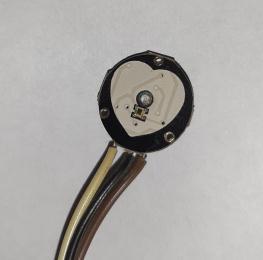
Heart rate Sensor: A heart-rate sensor for Arduino, the Pulse Sensor, is plug-and-play. Students, artists, athletes, makers,gamedevelopers,andmobileappdevelopersmay alluseittoquicklyincorporatereal-timeheartratedatainto their works. An integrated optical amplifier and noisereduction circuit sensor is the key component. Attach the PulseSensortoyourfingertiporearlobe.Thenyoumayread heartratebypluggingitintoyourArduino.
LCD Display:
AsortofdisplaythatmakesuseofliquidcrystalsistheLCD (LiquidCrystalDisplay).Thereisa16-pininterfaceonthe LCDpanel.Thefollowingisadiscussionofthe16pinsonthe LCDdisplay:
1. ThememoryoftheLCDthatwesendthedatatois controlledbytheRegisterSelect(RS)pin.Eitherthe dataregisterortheinstructionregisterisoptions. The future instruction, which is stored in the instructionregister,issoughtafterbytheLCD.
2. The reading or writing mode is chosen by the Read/Writepin.
3. Thewritingtotheregisterscanbeenabledbyusing the Enable (E) mode. When the mode is HIGH, it transmitsthedatatothedatapins.
4. D0to D7these eight data pinshave the following designations:D0,D1,D3,D3,D4,D5,D6,andD7.We have the option of setting the data pin's status to HIGHorLOW.
5. The LCD's Ground pin is pin 1, and the Vcc, or voltage supply, pin, is pin 2. The VEE, or contrast pin,islocatedonLCDpin3.
6. Backlightpins(Bklt+andBklt-)areanothername fortheAandKpins.
1.2 Software Specifications
1. Visual Studio: Microsoft'sVisualStudioisanintegrated developmentenvironment(IDE).Softwareapplications,such aswebsites,webapplications,onlineservices, and mobile applications, are developed using it. Microsoft's software developmentplatforms,includingWindowsStore,Windows Presentation Foundation, Windows API, and Windows Forms,areusedbyVisualStudio.Bothnativeandmanaged codecanbegeneratedbyit.
2. Anaconda prompt: With more than 720 open-source programmes, Anaconda Distribution is a free, simple-toinstall package management, environment manager, and Python distribution. The command line interface for AnacondaDistributioniscalledAnacondaPrompt.Linuxand macOSbothhaveacommandlineinterfacecalledTerminal.

Block Diagram:
Working Prototype:
Description:
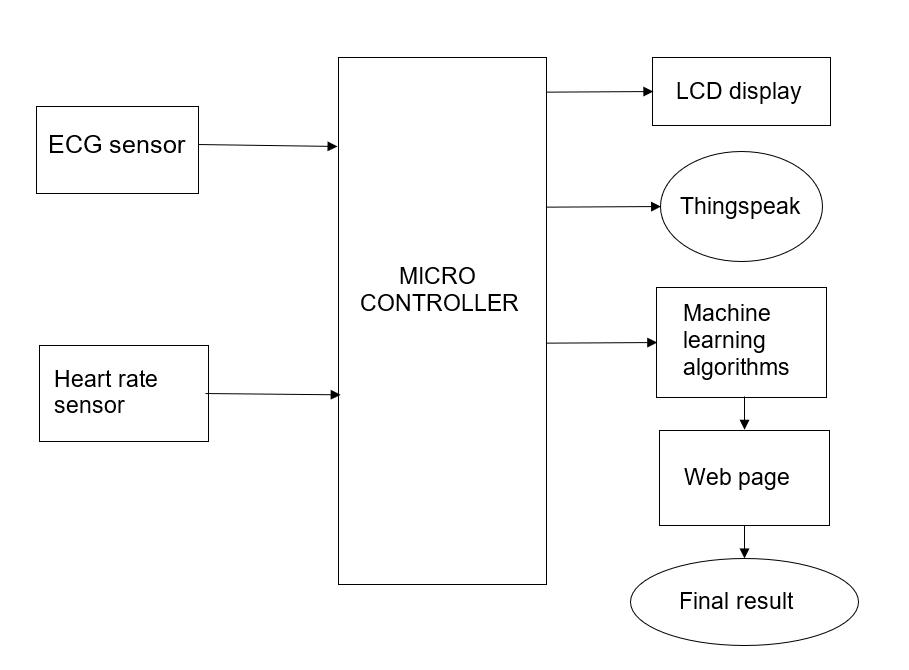
TheEcgsensorhasbeenconnectedtothedigitalReadpinsof 10 and 11 for the LO+ and LO- detections. The heart rate sensor has been connected to the analog pin 0. The serial communicationbaudrateisfixedtobe9600.Thebeatsper minute has been set in between 20 to 150 in the myBPM functioncallwherethereadingsarerecorded.Theoutputis displayedintheLCDconnectedtothepins7,6,5,4,3,2,1. Thepins8and9aregiventothereceiverandtransmitter module. The IP address of the thingspeak cloud is set to “184.106.153.149”.Thechangesinthedatacanbeviewedin thethingspeakopensourcewithadelayof500ms.
LCD Interfacing:

The initialization of the LCD has been given a delay of 1000msandthevariationsintheheartratevalueshasbeen givenadelayof500ms.
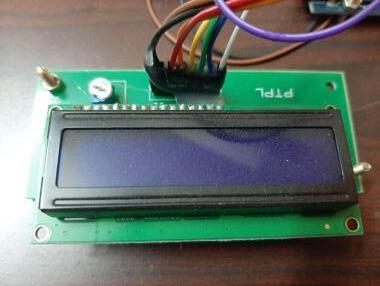
Table -1: PindescriptionforLCD
Step-2: ReadingtheBPMwithadelayof500ms
Step-3: ReadingtheECGvalueswithadelayof500ms
Design Flow: Design flow consists of four parts Datacollection, Data-preprocessing, Efficient model, prediction part.
Table-2: Design flow
Data-Collection Data-Preprocessing
Steps Involved in the working prototype:

Step-1: Initialization


Step-4: Visualizinganddownloadingthefieldid’sintheCSV format
ECG graph:

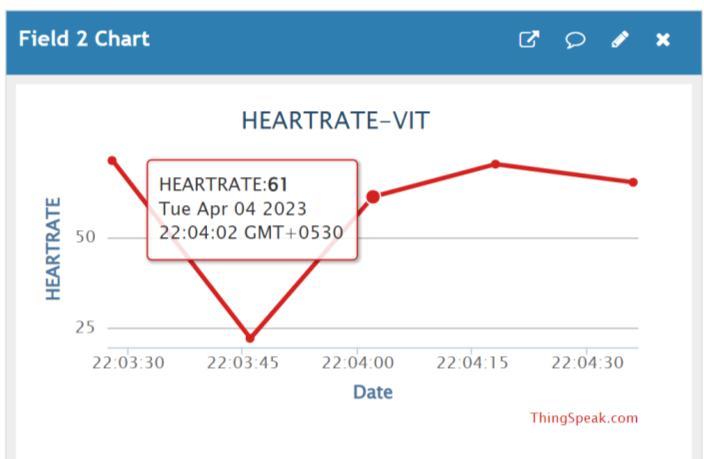
Heart Rate:
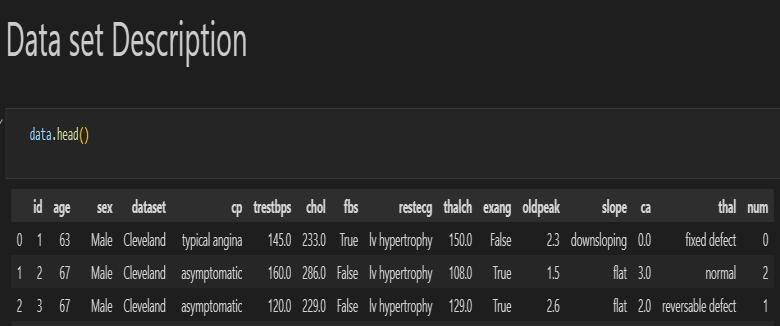
Avarieddatasetcanhelpensurethatthemodelisnotbiased towardsspecificgroupsofpeopleorspecificdiseasetypes. This could enhance the model's general fairness and accuracy.Insummary,alargeandvarieddatasetisessential forpredictingdiseasesbecauseithelpstoimproveaccuracy, generalization,robustness,andrepresentation.
Acorrelationmapcanassistuncoversignificantfactorsand correlations between variables that may be related to the disease, which can be utilized to construct more precise predictivemodels.
Algorithms Used:
Logistic Regression: In the context of heart disease prediction, logistic regression can be used to estimate the probability that an individual will develop heart disease based on various risk factors such as age, gender, blood pressure, cholesterol levels, and family history of heart disease. These risk factors are typically used as predictor variables in the logistic regression model. The logistic regression model estimates the probability of developing heartdiseasebasedonthevaluesofthepredictorvariables. Theoutputofthemodelisaprobabilityvaluebetween0and 1,where0indicatesnoriskofdevelopingheartdiseaseand 1 indicates a high risk of developing heart disease. The model uses a threshold value (typically 0.5) to classify individualsaseitherhavingahighorlowriskofdeveloping heartdisease.
Random Forest: Random Forest is a machine learning algorithm that can be used for classification tasks such as heart disease prediction. It works by constructing a multitudeofdecisiontreesandthencombiningtheirresults tomakeafinalprediction.ByusingmulticlassROCanalysis, the performance of the random forest model can be evaluatedacrossallclasses,whichcanprovideinsightinto the model's ability to correctly classify individuals with different levelsofheartdiseaseseverity. Thisinformation canbeusedtorefinethemodelandimproveitsperformance forheartdiseaseprediction.


K-NN: K-NN (K-Nearest Neighbors) is a machine learning algorithmthatcanalsobeusedforclassificationtaskssuch asheartdiseaseprediction. TheK-NNalgorithmworksby identifyingtheKnearestneighborstoanewdatapointand using their labels to make a prediction. To evaluate the performanceofaK-NNmodelforheartdiseaseprediction, multiclassROCanalysiscanalsobeused.ThemulticlassROC curveisagraphicalrepresentationofthetrade-offbetween thetruepositiverate(sensitivity)andfalsepositiverate(1specificity)foreachclassatdifferentthresholdvalues.

Naive Bayes: Naive Bayes is a probabilistic machine learningalgorithmthatcanbeusedforclassificationtasks, includingthepredictionofheartdisease.Inordertomake predictions, the Naive Bayes algorithm requires a set of training data that includes information about individuals whohaveandhavenotbeendiagnosedwithheartdisease. Oncethetrainingdatahasbeenprocessed,theNaiveBayes algorithm can be used to predict the probability of an individual having heart disease based on their attributes. The algorithm calculates the probability of each attribute given the presence or absence of heart disease, and combines these probabilities using Bayes' theorem to calculatetheoverallprobabilityofheartdiseasegiventhe person'sattributes.
Linear SVM: In the context of heart disease prediction, linear SVM can be used to classify individuals into one of several classes based on their risk factors. The SVM algorithmfindstheoptimal hyperplanethatseparatesthe differentclassesinthedatasetbasedonthesupportvectors TobuildalinearSVMmodelforheartdiseaseprediction,a labeled dataset is typically used to train the model. The model learns the relationships between the predictor variablesandtheoutcomevariable(heartdisease)fromthe training data and then uses this knowledge to predict the likelihoodofheartdiseaseinnewindividuals.


Disease Prediction:
ChoosingtheMostEfficientalgorithm:
CONCLUSION
Inconclusion,ourheartmonitoringsystem,comprisingboth hardwareandsoftwarecomponents,representsasignificant advancement in predicting the risk of heart disease. By utilizingarangeofsensorsfordatacollection,followedby thorough preprocessing and training of machine learning models,wehavedevelopedahighlyaccuratepredictiontool. Deployingthistrainedmodelonawebsiteenablesusersto conveniently input their health information and obtain personalized risk assessments. The accuracy of the classifierswhichwehaveusedK-NNandRandomForestis 0.8703 and 0.9640 so by this we can conclude that the diseasepredictionisveryaccurateandthereisaverylittle roomforerroranditspotentialtofeedmoredatacanonly increase its efficiency furthermore and holds promise for improvingoverallcardiovascularhealthoutcomes.
REFERENCES
BothK-NNandRandomForestcanbeeffectiveinpredicting heart disease because they can handle complex and nonlinear relationships between the features and the target variable. Additionally, they can handle missing data and outlierseffectively.
[1]RiyazullaRahman.J,ShridharSanshiandN.Nasurudeen Ahamed, “Health Monitoring and Predicting System using InternetofThings&MachineLearning”7thICACCS,2021.
[2]Dr.YogeshKumarSharma,KhatalSunilS,“HealthCare PatientMonitoringusingIoTandMachineLearning”,IOSR JournalofEngineering,2019.
[3]Dr.JayantShekhar,DesalegnAbebaw,“Temperatureand Heart Attack Detection using IOT( Arduino and ThingSpeak)”,IJACSTVolume7No.11,November2018.
[4]SahanaSKhamitkar,“IoTbasedSystemforHeartRate Monitoring”,IJERTVol.9Issue07,July-2020.
[5]HeltonHugodeCarvalhoJunior,RobsonLuizMoreno,“ A heart disease recognition embedded system with fuzzy clusteralgorithm”,Elsevierhealth,2013.
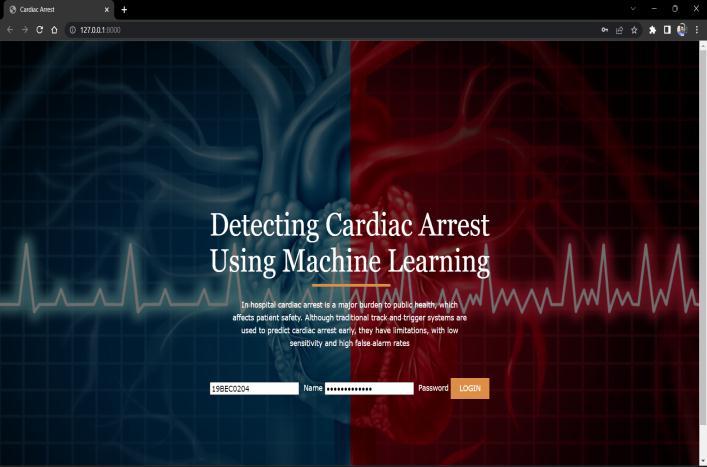
Predictingifthepatientissufferingfromdiseaseornot
[6]ReetuSingh,“AReviewonHeartDiseasePredictionusing UnsupervisedandSupervisedLearning”,IJARESMVolume8, Issue7,July-2020.
[7] A. S. Thanuja Nishadi, “Predicting Heart Diseases In Logistic Regression Of Machine Learning Algorithms By PythonJupyterlab”,IJARPVolume3Issue8,August2019.
[8] Madhumita Pal, Smita Parija, “Prediction of Heart DiseasesusingRandomForest”,ICCIEA2020.
[9] Harshit Jindal, Sarthak Agrawal, “Heart disease prediction using machine learning Algorithms”, ICCRDA 2020.

[10] B. Manoj Kumar, P S.Uma Priyadarsini, “Efficient Prediction of Heart Disease using SVM Classification Algorithm and Compare its Performance with Linear

RegressioninTermsofAccuracy”,JournalofPharmaceutical NegativeResults,Volume13,SpecialIssue42022.
[11]M.Marimuthu,M.AbinayaandM.Abinaya,“AReview on Heart Disease Prediction using Machine Learning and DataAnalyticsApproach”,InternationalJournalofComputer ApplicationsVolume181,No.18,September2018.


[12]Arun.R,N.Deepa,“Heartdiseasepredictionsystemusing naive bayes”, International Journal of Pure and Applied Mathematics,Volume119No.16,2018,
[13] Kompella Sri Charan, Kolluru S S N S Mahendranath, “HeartDiseasePredictionUsingRandomForestAlgorithm”, IRJET,Volume:09Issue:03Mar2022.
[14] Akkem Yaganteeswarudu, “Multi Disease Prediction Model by using Machine Learning and Flask API”, ICCES 2020.
BIOGRAPHIES
DangetiSaiChaithrik dsaichaithrik@gmail.com
ChilukaHarshithReddy harshithreddy382@gmail.com