SUSTAINABLE DESIGN OF PERVIOUS PAVER BLOCKS USING CEMENT KILN DUST (CKD) AND RECYCLED ASPHALT PAVEMENT (RAP)
·Abhyanshu Singh Rajawat1 , Manoj Kumar Trivedi21Post Graduation Student, Department of Civil Engineering, MITS Gwalior, Madhya Pradesh, India
2Professor, Department of Civil Engineering, MITS Gwalior, Madhya Pradesh, India ***

Abstract
The main aim of the study is to make Sustainable and cost-effective development of pervious paver blocks made with CKD (Cement kiln dust) and RAP (Recycled asphalt pavement). In the present study, two different types of aggregates (CKD and RAP) were used: RAP aggregates and fresh aggregates (FA) that were procured from a nearby quarry. RAP was acquired through the uncontrolled milling of bituminous concrete (BC) pavement that was 8 years old and from a Gokul warehouse in Gwalior (M.P.). CKD was acquired as a cementitious replacement for the usage of industrial wastage for sustainability from the Rashi Prism factory in Satna (M.P.) A total of 70 specimens (14 types) + 5 replicas were made for testing in the lab. Two of the five replicates were tested for porosity, density, infiltration rate, and clogging impact; three were tested for strength properties (Compressive strength, Cantabro abrasion). According to the findings of the study paver blocks made from CKD are reliable as well as cost-effective. The finding concludes that paver blocks made by the replacement of CKD and RAP are sustainable, durable and affordable.
Keywords
Pervious, Paver block, CKD, RAP, Sustainable, Costeffective
1. Introduction
Theconstructionofa reliableroadsystemiscrucial toa country's economic growth and social progress. Typically, the quantity of building supplies needed is quite large. Man makes use of soil for a wide range of construction-related tasks because it is the most inexpensive material at his disposal. Construction sites often lack access to graded soil, forcing engineers and scientiststomakedowithindustrialwastethatdegrades the environment or presents disposal challenges. Use of waste materials in construction, such as fly ash, granulated blast furnace slag, cement kiln dust, etc., requires specific consideration in this setting (1). The granular material layer is an essential part of a flexible pavement structure since it affects the stresses and
strains everywhere else. Fatigue and rutting in asphalt concrete are two major causes of failure in flexible pavement (2). Materials from asphalt and aggregate pavements that have been previously used and subsequently reclaimed are known as reclaimed asphalt pavement (RAP). High-quality, well-graded aggregates coated with asphalt cement can be found in RAP after it has been crushed and screened, and this material is mostly produced during pavement restoration and reconstruction(3).RAPqualitymightvarydependingon thesourceoftheoldpavementitwasrecycledfromand the qualities of the constituent materials and asphalt concrete type utilized in the original pavement. Sometimesnewgranularmaterial,soils,orevengarbage is added to heaps of recycled pavement. A variety of factors, including the frequency with which the pavementhasbeenresurfaced,theextenttowhichithas beenpatchedand/orcrackedsealed,andthepresenceor absence of previous seal coat treatments, will affect the makeup of RAP. Specific gravity measurements of RAP indicatethatithasahighsilicacontentandlowlevelsof CaO, falling within the range of 1.94 to 2.30. It is necessary to monitor the quality of recycled asphalt pavement (RAP) to ensure that it is suitable for its intended purpose after processing, since RAP may originate from a variety of sources. One prominent example is "in-place" recycling of asphalt roads. The usual particle size distribution and other physical, chemical,technical,andmechanicalfeaturesofRAPhave beendeterminedviaextensiveresearch(4).
The mining and heavy industrial industries, which includecement,power,steel,andothers,areresponsible foranincreasingamountofwaste.Theexpenseofwaste removal is rising as well. Without the creation and implementation of new and beneficial use choices that are both commercially viable and environmentally friendly, the accumulation of by-product materials is unavoidable. Cement kiln dust (CKD) is a solid waste product of Portland cement kilns' pre-heater by-pass systems caused by the presence of trace amounts of volatile components in the kiln's feed and fuel. The raw feedstock is only partially calcined, and the result is a fine, grey powder that resembles Portland cement. The main chemical components of CKD are lime, silica, alumina, and iron. The raw materials and collection
technique employed by the cement mill have an impact onthechemicalandphysicalpropertiesofCKD.Patients with chronic kidney disease (CKD) may be eligible for free lime. It's possible that coarser CKD particles collectedclosertothekiln contain more freelime. More sulfatesandalkalisareconcentratedinsmallerparticles in CKD. The cementitious qualities of cement kiln dust makeita desirablecommodity.Becauseto theinclusion of lime (CaO), CKD may have a high cementitiousness. Cement kiln dust (CKD) may thus be used as an alternative to Portland cement, blast furnace slag cement,Portlandpozzolancement,andmixedcement.It may be pelletized or agglomerated for more particular applications. Stabilizing municipal sludge, red mud, miningtailings,anddredgematerialsareallmadeeasier by CKD's high alkalinity. It is an excellent match for the alkaline environments in which these organisms may develop due to its alkaline qualities and its ability to absorb moisture. Highway construction also makes use ofCKD(5).

Recent years have seen a rise in awareness of environmental issues and the importance of sustainable development. As society's trash and byproducts accumulate, more and more people and organizations arelookingforwaystocutback,repurpose,andrecycle. Concrete is the most commonly used construction materialintheworld-itconstitutestoasmuchastwice the total of all the other building materials combined, due to its versatility, economy and workability. An astounding 12 billion metric tonnes of concrete is produced every year which uses approximately 1.6 billion metric tonnes of cement annually. In fact, it is often said that modern civilization is literally built on concrete. The research and development of Controlled Low Strength Materials (CLSM) has recently attracted a lotofattention.Portlandcementandothercementitious materials are essential to the creation of CLSM. Cement kilndust(CKD)isasubstantialby-productofthecement manufacturingprocessthatmightpotentiallybeusedas a
substituteforPortlandcementintheproductionofCLSM with the desired properties. Reduced environmental risks from CLSM's usage of CKD point toward a future when this byproduct is put to good use in the service of sustainable development. Cement manufacturers dump over12.9millionmetrictonsofCKDeveryyear,thevast majority of which is unrecyclable. The cement productionprocessgeneratesabyproductcalledclinker, afinepowderthatlooksexactlylikePortlandcement.
Themethodusedinthekilnandtheefficiencyofthedust collection system typically yield four distinct types of dust from the cement manufacturing process. There are two common kiln techniques: the wet process and the dry process. The feed materials might be either a slurry to be processed in the wet process kilns or dried and ground to be processed in the dry process kilns. There are potentially two ways to collect CKD for either procedure.Thefirstisthedust,whichcanberecycledby the kiln's dust collection system. The second procedure either recycles or disposes of all CKD. Free lime, one of CKD's chemical characteristics, is often concentrated in the coarser particles collected near the kiln. Concentrations of sulfates and alkalis tend to be higher in finer particles. Similarly, the calcium content of CKD from wetprocesskilnsisoftensmallerthanthatof dust fromdryprocesskilns.CKDhasbeenincludedinasphalt concrete as a mineral filler. It has been estimated that between 15 and 25 percent less asphalt cement is required if CKD is combined with the asphalt binder before the hot mix aggregate is added. Factory-made CKD aggregates may be either agglomerated or palletized, depending on the application. Roads paved with asphalt and concrete might benefit from an oilabsorbingartificialaggregatemadefromCKDduringthe warmer months. As a cement modifier for low-ductility mastic asphalt, CKD shows potential when used with asphaltbinder.CKDhasthepotentialtoreplacePortland cement in the production of cement-like silicate materials (CLSM) due to its dual activity as a cementitiousmaterialandpozzolanactivator(6)
2. Aim
Sustainable and cost-effective development of pervious paver block made with CKD (Cement kilndust)andRPA(Recycledasphaltpavement)
3. Objectives
Thedevelopmentofperviouspaverblocksusing (RAP)recycled asphalt pavement in three weight ratios of 0%, 50%, and 100% that are environmentally friendly as well as financially feasible.
Sustainable and affordable development of permeable paver blocks constructed with industrial waste CKD (Cement kiln dust), which has cementious ratioin 10% and 20% by weight.
4. Literature Review
(Ahmed et al., 2023)(7)This research looks into how theengineeringqualitiesofpozzolanicconcrete,whichis usedin block production,changewhen Portlandcement is partially replaced by cement kiln dust. The end result may be less cement used and fewer greenhouse gas emissions.Cylindricalconcretesamplesweremadefrom five different combinations of 71.13% pozzolan and 14.16% water, with either zero, five, ten, fifteen, or twenty percent of the OPC fraction (14.71 wt.%) substituted by CKD. Density, compressive strength (UCS),voids,andwaterabsorptionweremeasuredafter 28 days of curing, and these measurements were taken at 7, 14, 28, 56, and 91 days of curing for each sample. The numberof voidsperdaydecreasedandtheamount of water absorbed increased with worsening CKD. The UCSwaslargestinthe15%CKDgroup,regardlessofage at cure. X-ray diffraction analysis reveals a much larger concentration of the hydrated calcium silicate phase in theCKD15%samplecomparedtothecontrol.
(Radhakrishnan&Vignesh,2023)(8)
Bituminous materials are used for the majority of road surfacesaroundtheworld.Massivequantitiesofnatural virginaggregatesarerequiredforroadconstructionand maintenance. The cost and the environment are both affected by the depletion of resources used in building the road. Therefore, it is important to cut back on the amount of virgin aggregate used to build bituminous pavements. Recycling asphalt pavement (RAP) and marbledebrisaretwoexamplesofeco-friendlymaterials that may be used in road construction. Sustainable DevelopmentGoal(SDG)12isthetopicofthisstudy,and morespecificallytarget12.5,whichisallaboutrecycling and reusing resources. However, no studies on the combined use of RAP and sustainable materials in bituminouspaverblockswerefound.Inthisexperiment, the bituminous mixtures were tested for durability and compared to a standard mixture. After casting bituminouspaverblocksusingeco-friendlycomponents, their performance was evaluated with standard
laboratory testslike thecompression test,Cantabroloss test,andwheelruttest.Thebituminousblockspassedall of the tests with flying colors, therefore they may be used for servicing the pavement constructions. According to the research, combining RAP with sustainable materials in pavement blocks can create a low-impact, low-maintenance system, making it an importantstrategyforachievingSDG9.
(Chiara et al., 2022)(9)Astudywasdoneusingsamples gatheredfromfivedifferentlocationsinItalytoevaluate the performance of RAP as aggregate in concrete. Physical properties (particle size distribution, water absorption, porosity, wettability), microstructure (using microscopy), dimensional stability (drying shrinkage of mortar and concrete with 100% of RAP as aggregates), and durability (using freezing-thawing cycles) are just some of the aspects of RAP that have been studied. The differences between RAP and regular concrete aggregates were discussed at length. The use of RAP as recycled aggregate for concrete might be beneficial, but it would need to be well characterized to ensure performanceanddurability.
(Sumit Nandi&Ransinchung,2021)(10)Over the last several years, recycling concrete paver blocks has surpassed any other kind of concrete recycling in popularity. The environmental effect of waste management is reduced, and the manufacture of heirloom-quality objects is aided as a result. Concrete paverblockscontainingeithercoarseorfinefractionsof unprocessed recovered asphalt pavement (RAP) were analysed to see how their performance varied from one another. As a byproduct of asphalt recycling, RAP (reclaimed asphalt pavement) is created. The effect of RAP% and wet curing age was evaluated using an ANOVAwithmultiplecomparisonsforthisinvestigation. All performance tests, with varying loads, showed that concrete blocks infused with RAP were durable and reliable. The dose of RAP used as a natural aggregate replacement and the durability of RAP concrete may be enhanced by the use of staged mixing and timecontrolled dual-source compaction, which combines synchronizedimpactpressureandvibratorycompaction energy.Aneconomicandenvironmentalimpactanalysis suggests that precast concrete paver blocks built from recycledRAPfractionsmaybesuccessfulinthelongrun.
(Bittencourt et al., 2021)(11)Recently,therehasbeena rise in academic interest in using recycled asphalt pavement (RAP) aggregate into cementitious material. This curiosity stems mostly from the fact that flexible pavement maintenance results in the buildup of a great dealofunusedRAPaggregates,whichcanleadtoserious environmental difficulties due to the paucity of landfillingspaceforthiswaste.Therefore,thegoalofthis
study is to help find a solution by advancing the use of RAP pervious concretes. There were five mixtures examined for their physical, mechanical, and hydraulic (as determined by an infiltration and clogging test) properties, all of which included natural and/or RAP aggregates. Both an experimental mixture (in which up to100%RAPwassubstitutedfornaturalaggregate)and acontrolmixture(inwhichonlynaturalaggregate)were created. While the use of RAP aggregate improved the infiltration performance of pervious concretes (infiltrationratemorethan 2.9103m/s),itsignificantly degraded the mechanical behavior of the resulting materials. Although the strength of the tested combinations was lower than what would be required forstructural perviousconcrete, they were nevertheless adequate for use in non-structural applications like as bikelanes,sidewalks,andsoon.
(Saleh et al., 2020)(12)The research team behind this project hopes to find out whether cement kiln dust (CKD) and poly(styrene) (PS), two troublesome waste products, may be used to create lightweight bricks with physico-mechanical characterizations acceptable for future building applications. Portland cement, iron slag, and crushed waste glass make up the two basic components (CKD and PS), and their relative amounts were modified to enhance the mechanical properties of the final product. Compressive strength, density, porosity, and water absorption were among the mechanical and physical properties investigated on the samples. Scanning electron microscopy (SEM), energy dispersive X-ray spectroscopy (EDX), and Fourier transform infrared fluorescence (XRF) were used to investigate the microstructure. PS does not improve survival in CKD, as shown by experimental research usingmechanicalresistance.Thestrongestcomposite,in comparison to CKD, was made of iron slag, Portland cement,groundwasteglass,andshreddedPSwaste.The modified cementitious product has been evaluated and found to be of sufficient quality for use in outside shielding and interior non-load-bearing walls in construction projects in accordance with national and internationalregulations.
(Suchorab et al., 2018)(13)In this chapter, we explore thepossibilitiesofcementkilndust(CKD)inthebuilding industry,namelyinconcretemanufacturing.Cementkiln dust(CKD)orbypassdustisasolidparticlethatmustbe filtered out by pollution control machinery due to the high alkalinity of the exhaust gases. Cement factories using rotary kilns release CKD as a byproduct of the manufacturing process. The strength and durability of CKD concrete was studied through a combination of literaturereviewandoriginalresearch.Concretetreated with CKD has been hydrophobized, therefore the scientists have also looked into the material's resilience
tofrostandsalt.OurresearchshowsthatCKDutilization is a promising field of study; however, it is essential to keep in mind that adding no more than 5% CKD to concretecompositionsisreasonableandhasnonegative effects on concrete parameters; adding 10% CKD is acceptable up to the point where all final product parameters begin to decrease; and adding 20% should beavoidedatallcosts.
(Gorman et al., 2016)(14)Recycled asphalt pavement (RAP) has seen a lot of experimental study up until this point. In order to optimize the ratio of new to recycled components and to determine how long it will take for the drum to completely melt, finite-element techniques have recently been shown to be an effective modeling tool. The thermal conductivities of RAP and its components must be precisely known before the modelingcanbegin.Thisrequirementdrovethecurrent experimental effort, which included recycled asphalt pavement(RAP)particles,RAPparticlesstrippedoftheir asphalt binder, and pure asphalt binder of varying ages. Sand, as well as the waste rock left behind from processingtaconite,wasanalyzed. Ithasbeensuggested that the tailings could make a good aggregate. Three factors were found to be connected to the solid media conductivity results: “(a) the size distributions of the solids, (b) the overall density of the sample, and (c) the porosity of the sample. The solid media tested had conductivitiesthatrangedfromaround17to30W/m°C. The binder's thermal conductivity was found to be between0.17and0.19W/m°C”.
(Modarres & Hosseini, 2014)(15)Thispaperlookedat the effects of incorporating rice husk ash (RHA) into roller compacted concrete (RCC) made from virgin and RAP. Cement was replaced with RHA in the RCC combinations at a rate of 3-5%. Several options, including RAP in its entirety, RAP mixed with fine original aggregate, and RAP mixed with coarse original aggregate,wereevaluated.Compressiontestsandthreepoint bending setups were the most common experimental methods. RCC composites have their modulus of rupture, energy absorption, and fatigue response determined by flexural testing. Only samples that had been cured for 120 days were subjected to the fatiguetest;theothertestsandanalyseswereconducted at 7, 28, and 120 days. Using RHA improved both maximum dry density and optimal moisture content (OMC). Using RAP of varied sizes also reduced the OMC and the maximum dry density. Substituting 3% RHA for cement increased the material's adaptability. However, raising the RHA level to 5% decreased the energy absorption. RAP-containing RCC blends had a shorter fatigue life than the standard mix. Additionally, fatigue life was increased when RAP was used to replace the coarse material. The energy-absorbing capacity and
fatigue response of RCC mixtures were found to be highly correlated (R2 > 0.90). The more energyabsorbent mixture performed better under repeated loadingsatstressratiosof0.72.Furthermore,thefatigue life was discovered to be inversely proportional to the porosity of the material. Improvements in fatigue resistance and reduced porosity, notably after 120 days of curing, were attributed to the use of 3% RHA. In contrast, increasing the RHA content to 5% increased porositiesanddecreasedfatiguelives.
(Isaac et al., 2013)(16)HMAandWMAnowaccountfor close to 85% of all RAP usage due to the genre's recent surgeinpopularity.Severalstudieshavebeenconducted throughout this time period, however they have all concentrated on RAP concentrations of 50% or below. This report details laboratory research on the effects of RAP contents between 50 and 100% on WMA's rutting, moisture damage, durability, cracking, and mixing homogeneity. For most uses on today's roads, mixtures containing more than 50 percent RAP are not beneficial due to the lack of a RAP surplus and the performance statistics reported in this research. When tested for its effectiveness as a base pavement layer, WMA blended with 50% RAP met or exceeded expectations in all categories,includingdurabilityandcracking.
5. Methodology
In the present study, two different types of aggregates (CKD and RAP) were used: RAP aggregates and fresh aggregates (FA) that were procured from a nearby quarry. RAP was acquired through the uncontrolled millingofbituminousconcrete(BC)pavementthatwas8 years old and from a Gokul warehouse Gwalior (M.P.) with an expected maximum particle size of 13 millimeters. The substance was composed of large RAP aggregate particles that stuck together because to the liquefaction of asphalt. This content had to be disentangled from its aggregated condition before it could be used. Once the RAP aggregates were equally
5.1 Material used - Cement,Coarseaggregateandwater
baked for 30–40 minutes at 80 C, they were broken up into smaller pieces using a wooden hammer. To make good use of RAP aggregates in pervious paver blocks (PPB), this technique was consistently employed. Furthermore,10%to20%byweightofindustrial waste cement kiln dust (CKD) is used as a replacement for cement. The current study opted for a c/a ratio of 0.25 and a w/c ratio of 0.30. Table 1 displays the results of producing pervious paver blocks with two different gradations. “These grades are G1 and G2, respectively. G2 was chosen to have a finer texture than G1, whereas G1 was picked from a prior study by (34). Virgin aggregates and RAP were combined in three different ways: 100% VA, 50% VA + 50% RAP, and 100% RAP.” “TheweightoftheaggregateswasusedtoreplaceRAP”. “The mix ratios for the various aggregates and gradationsaredenotedasG10,G150,G1100,andG20, G2 50, and G2 100.” RAP usage has been denoted in the mix by the numbers 0, 50, and 100. Table 4 provides information on the mix proportion as well as the fundamental characteristics of FA and RAP. Specific gravity, density, and cantabro abrasion values of RAP aggregates are reduced when an asphalt binder coating is present on their surface. Material abrasion during milling operations increases water absorption. Additionally, the RAP aggregates are contaminated by fines and dust, which is another factor in the water absorption.
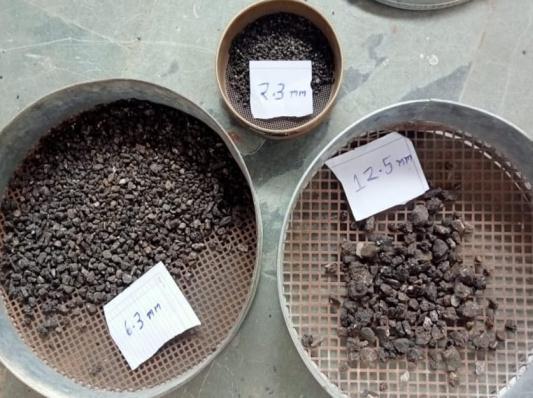
“The aggregates were sieved into various sizes to facilitatethedevelopmentofaporous,opennetworkfor thepurposeofevaluatingperviouspaverblocks”.“Table 1 and Figure 2 show that two different aggregate gradationswereutilized.“Thesegradationswere6.3mm passing 2.36 mm retained and 12.5 mm passing 6.3 mm retained”. “When the aggregates were batched in the saturated surface dry state, no super plasticizer was applied”. “The binding material used was ordinary Portland cement (OPC), often known as OPC 43. This study opted for a c/a ratio of 0.25 and a w/c ratio of 0.30”.
Wastematerialusedforreplacingaggregateandcementmakingiteconomicalandsustainable.
Coarse aggregate replaced by RAP (Recycled asphalt pavement) in three percent 0%, 50% and 100% ratio by weight.
Cement replaced by industrial waste CKD (Cement kiln dust) which have cementious properties in two percent 10%and20%ratiobyweight.
CoarseaggregatedividedintotwogradesG1andG2.
ProjectwascompletedusingRashiprismfactory,Satna-producedCKDandOrdinaryPortlandCement(OPC),aconsistent standard was identified. The w/c ratio for the OPC was set at 0.30. Both a 10% and a 20% cement weight replacement ratio for making paver blocks were studied. various chemical compositions of CKD, OPC, and CKD, with OPC and CKD serving as replacements in varying amounts. Both the OPC mortar (OPCM) and the CKD mortar (CKDM) were tested for theirphysicalproperties,suchastheirflow,density,UltrasonicPulseVelocity(UPV),andporosity(apparentporosityand 2D image analysis). In addition to employing image analysis methodology to assess whether or not the strength of the examinedsamplescorrelateswiththeircolorfeatures,wealsomeasuredtheircompressivestrength.


5.3. PREPARATION OF PCPB
“The production of PCPB has been standardized. Cement paste encapsulating aggregate blending method best characterizes this technique”. “After adding all of the aggregate and 20–25% of the total calculated water content,theconcretemixerwasrunfor15-20secondsin thisprocedure”.Theaggregatewasboundtogetherwith the appropriate amount of cement. Once the remaining water was added, the mixture was mixed for about 2 minutes before being poured into the molds. The PCPB samples were compacted using a vibrating table. In the manufacturing, paver bricks are typically vibrated for 15-20 seconds to get them ready for use. Overnight, we let the prepared samples to dry in the mold. The dry samples were demolded following a 29-day cure period inwater.KeepinmindthattherearefourdifferentPCPB preparation shapes. Measurements of different PCPBs' diametersandareasweretakenforthisstudy.
A total of 70 specimens (14 types) + 5 replicas were made for testing in the lab. Two of the five replicates were tested for porosity, density, infiltration rate, and clogging impact; three were tested for strengthproperties. The averages are presented in the text that has been released. The coefficient of variation fortheallmeasurementisunder10%.
6. Tests
1. DensityandPorosity
2. Cantabroabrasionloss(%)
3. Infiltrationrate(mm/sec.)
4. Compressivestrength
6.1. HARDENED DENSITY AND POROSITY
The structural and functional activities of PCPB are best characterized by its density and porosity, two essential pore properties. “Hardened concrete samples were tested for density and porosity using the ASTM C1754/C1754M-12, Standard Test Method for Density and Void Content of Hardened Pervious Concrete (Withdrawn 2021)”. The pore parameters were determined after the dry weight of each sample was determined. After taking the necessary measurements, the volume was recorded. “A hardened sample's density is defined as its dry weight per unit volume”. Researchers were able to determine porosity by immersing samples for 30 minutes. Tapping the outside of the PCPB samples helped release the trapped air. Whentheconditioningtimewasover,wemeasuredhow muchthesampleweighedwhenimmersed,andweused the method given in ASTM C1754 to determine the porosityvalue.(35)
6.2. CANTABRO ABRASION TEST
PPB's longevity is an important quality. The aggregates are held together by the cement paste in a honeycomb pattern. Maintaining a low rate of material loss due to abrasion is crucial to preserving the stability of this structure. One simple technique for testing the stability of a finished mixture is the Cantabro loss (CL) method. The Los Angeles (LA) test protocol calls for placing the ready PPB samples into an abrasion machine without utilizing steel balls. The mass lost by the PPB after 300 revolutionsat30revolutionsperminutearerepresented asapercentageoftheCantabroattritionloss.(36)
6.3. FAILURE LOAD AND COMPRESSIVE STRENGTH
For this study, we made every PCPB sample through a compression test under controlled displacement. Every minute, one millimeter of pressure was added. To determine the PCPBs' compressive strengths, we calculated their surface areas and recorded the failure loads. Indian Standard (IS) 15658:2006, also known as the CED 5: Flooring, Wall Finishing, and Roofing, was used to conduct the evaluation of the precast concrete blocks.(37)
6.4. INFILTRATION RATE
The density and porosity of the hardened specimens of each test were initially determined. Steel ring of 50 mm inheightand75mmininnerdiameterwasusedforthe measurement.TheringissecuredtothePCPBsamplein Figure 5A before plumber's putty is applied to the underside of the rim to seal it from water leakage. A 15 mmhead wasattempted to be maintained while 250 ml of water was added to the ring. After the water was pouredintoPCPBforthefirsttime,wetimedhowlongit tooktoevaporatefromthesurface.“Theinfiltrationrate of PCPB was determined using C1701/C1701M-17a, Standard Test Method for Infiltration Rate of In Place Pervious Concrete, which took into account the ring's diameterandtheamountof time requiredforthewater topermeatethePCPB”.(38)
6.5. COMPRESSIVE STRENGTH TEST
“The compressive strength (CS) of the PPB was measured using a displacement-controlled compressive testingdevice.Theroughedgesofthepaverstoneswere smoothed with gypsum paste to produce a flat loading zone”. The rate of force application was 1 mm per minute. PPB samples' CS were determined using both their failure loads and their overall surface areas. According to IS 15658: 2006, the observed compressive
strength is multiplied by 1.18 to account for the PPB's skewed aspect ratio.(39)
7.1. Density and porosity


0%
50%RAP20%CKD
100%RAP10%CKD
100%RAP20%CKD Ideal(100%RAP100%FA)
Gradation G2

0%RAP10%CKD
0%RAP20%CKD
50%RAP10%CKD
50%RAP20%CKD
100%RAP10%CKD
100%RAP20%CKD
Ideal(100%RAP100%FA)
Shows the density and Porosity of G2 gradation
TheabovetabledescribesthedensityandporosityofG1pavingstoneblocks.Twooftheblockshadaporosityof13.88% and 14.68%, respectively, which is below the PC requirement. However, water percolation was seen in these blocks, pointingtothepresenceofaconnectedvoidsystemaswillbeshownbytheinfiltrationrateresults.Resultsweresimilar when using the coarser aggregates of the G2 grading rather than the finer ones of G1. “The density of G2 and G1 graded blocks were found to be nearly identical for the same combination composition (w/c and c/a)”. In addition, G2 graded mixtures were shown to have higher porosity than G1 graded mixtures. Because of the blocked bottoms of the blocks containing the G2 graded mixtures with different c/a and w/c ratios, only the mixture with these specific ratios was dispensed.
7.2. Cantabro abrasion loss%
CantabroabrasiontestresultsinnormalPPB,ascanbeobservedinFig.Cantabroloss(CL)resultsareshowninastacked areamap(Figure)toillustratetheeffectofvaryingthemixparameters.CLvalueswerefoundtobelowestforw-cratiosof 0.30, as evidenced by the center depression. “This occurrence can be explained by the fact that the cement paste at this water-to-cement ratio is strong enough to hold the aggregate particles together”. If the water-to-cement ratio is too low, themixturewillbetoodry,whileifitistoohigh,thecementpastewillbeeasilyspreadablebutwillnotadherewell.The CLvaluewaslowestforG2,whichused100%VA,andhighestforG1,whichused50%RAP.TheseresultsenhancethePPB densityinformationthatwaspreviouslygathered.
“The rateof invasionby PCPBs wasevaluated usinga 3-inchring.Although there wasa smallerrangein infiltration rate withrespecttoc/aandw/casafunctionofPCPBformthantherewaswithrespecttostrengthorfailureload,arangewas stillpresent”.
7.4.
Gradation G2
8. Conclusion
Sustainable and cost-effective construction of pervious paver blocks utilizing CKD (Cement kiln dust) and RPA (Recycled asphalt pavement) is the focus of this research. The investigation and analysis performed in the lab for this study led to the following findings: “The porosity of G2 graded mixtures was measured to be greater thanthatofG1gradedmixtures.CL valueswere found to be lowest for w-c ratios of 0.30”. In contrast to c/a and w/c, the infiltration rate was not significantly affected by shape, but rather by the quality of the mixture or the pore design; this led us to conclude that paverblocksmadefromCKDarereliableaswellascosteffective.
Author, funding and data statement
Author contributions
Abhyanshu Singh Rajawat and Manoj Kumar Trivedi both conducted the research work together and wrote themanuscript.
Funding
The authors received no financial support for the research,authorshipand/orpublicationofthisarticle.
Data availability statement
Someoralldata,models,orcodethatsupportthefinding ofthisstudyareavailablefromthecorrespondingauthor markedinreferences
Disclosure statement
Conflict of interest
Authors report no potential conflict of interest with any person and organization. The required copyright permissionsweredulyobtainedbyauthorstoreproduce FiguresandTables
References
1. Singh SP, Tripathy DP, Ranjith PG. Performance evaluation of cement stabilized fly ash-GBFS mixes as a highwayconstructionmaterial.WasteManag.2008;
https://www.sciencedirect.com/science/article/abs/pii /S0956053X07003261
2. Heath AC, Pestana JM, Harvey JT, Bejerano MO. Normalizing Behavior of Unsaturated Granular Pavement Materials. J Geotech Geoenvironmental Eng. 2004;
https://www.researchgate.net/publication/246974678_ Normalizing_Behavior_of_Unsaturated_Granular_Paveme nt_Materials
3. Osinubi KJ, Edeh JE. Reconstituted Coal Ash StabilizationofReclaimedAsphaltPavement.In2011.
https://trid.trb.org/view/1108958
4. FHWA. User guidelines for by-products and secondary use materials in pavement construction. 2008;
https://rosap.ntl.bts.g
5. Robert, L. P., Elizabeth, K. and Justin PM. Use of CementKilnDustforSubgradeStabilization.2008;
6. Thaha W. DEVELOPMENT OF CONTROLLED LOW STRENGTH MATERIALS USING CEMENT KILN DUST. 2003; Available from: https://www.collectionscanada.gc.ca/
7. Ahmed HM, Hefni MA, Ahmed HAM, Saleem HA. Cement Kiln Dust (CKD) as a Partial Substitute for CementinPozzolanicConcreteBlocks.Buildings.2023;
8. Radhakrishnan P, Dhurai V. Development and Evaluation of Sustainable Bituminous Paver Blocks. Recycling.2023;
9. Masi G, Michelacci A, Manzi S, Bignozzi MC. Assessment of reclaimed asphalt pavement (RAP) as recycled aggregate for concrete. Constr Build Mater. 2022;
10. Nandi S, Ransinchung GDRN. Performance evaluation and sustainability assessment of precast concrete paver blocks containing coarse and fine RAP fractions: A comprehensive comparative study. Constr BuildMater.2021;
11. Bittencourt SV, da Silva Magalhães M, da Nóbrega Tavares ME. Mechanical behavior and water infiltration of pervious concrete incorporating recycled asphalt pavement aggregate. Case Stud Constr Mater. 2021;
12. Saleh HM, Salman AA, Faheim AA, El-Sayed AM. Sustainable composite of improved lightweight concrete fromcementkilndustwithgratedpoly(styrene).JClean Prod.2020;
13. Barnat-Hunek D, Góra J, Suchorab Z, Łagód G. Cement kiln dust. In: Waste and Supplementary Cementitious Materials in Concrete [Internet]. Elsevier; 2018. p. 149–80. Available from: https://linkinghub.elsevier.com/retrieve/pii/B9780081 021569000055
14. DeDene CD, Gorman JM, Marasteanu MO, Sparrow EM. Thermal conductivity of reclaimed asphalt
pavement(RAP)anditsconstituents.IntJPavementEng. 2016;
15. Modarres A, Hosseini Z. Mechanical properties of roller compacted concrete containing rice husk ash with original and recycled asphalt pavement material. MaterDes.2014;
16. HowardIL,DoyleJD,CoxBC.Meritsofreclaimed asphalt pavement-dominated warm mixed flexible pavementbaselayers.RoadMaterPavementDes.2013;
17. Chandrappa AK, Biligiri KP. Methodology to Develop Pervious Concrete Mixtures for Target Properties Emphasizing the Selection of Mixture Variables.JTranspEngPartBPavements.2018;
18. ASTM. Standard Test Method for Density and Void Content of Hardened Pervious Concrete. ASTM Int. 2021;
19. Tex-245-F.Cantabroloss.2014;3(5).
20. Flooring WF andR.Precast ConcreteBlocksfor Paving.(NewDelhi,IndiaBurIndianStand.2006;
21. Debnath B, Sarkar PP. Clogging in Pervious Concrete Pavement Made with Non-conventional Aggregates: Performance Evaluation and Rehabilitation Technique.ArabJSciEng.2021;
22. Lin W, Cho YH, Kim IT. Development of Deflection Prediction Model for Concrete Block Pavement Considering the Block Shapes and ConstructionPatterns.AdvMaterSciEng.2016;