Analysis of Wind Load Effects on R.C Structure Resting on Flat and Sloping Ground by Using E-tabs
Ms. Khan Shaima Khan Iftekhar Khan1 , Mr. Aakash Suthar 21Student, Master’s in Structural Engineering, L.J.I.E.T, Gujarat, India
2Assistant Professor, Structural Engineering Department, L.J.I.E.T, Gujarat, India ***

Abstract - In this study, 36 models are prepared the interaction between tall buildings and wind on flat and sloping ground, specifically focusing on the northern part of India with high wind flow. Reinforced concrete structures of different heights (G+5, G+10, and G+15) are analysed on both flat terrain and slopes (0°,10°,20°, and 30°) for various wind zones. Wind load analyses using the e-tabs software are performed in this paper there are 3 types of models has been done for the different zones. The story displacement, story drift, mode period has been also checked and result is satisfactory. Results from software and manual calculations are compared, and design considerations are based on maximum obtained values.
Key Words: Wind analysis, building tower, Sloping Ground, wind load, wind analysis, high-rise structure, deflections, wind pressure.

1. INTRODUCTION
Windloadisacriticalfactorinthedesignofstructuresand requiresthoroughinvestigationtounderstanditseffectson buildings.Particularly,buildingsconstructedonhillslopes often possess unsymmetrical characteristics. This project focusesonconductingacomprehensivestudyofwindload behavior on building frames, analysing the structural responsetowind,andassessingtheimpactofslopeonthe structures.Structuraldesignsaimtowithstandearthquakes, andwindloads,maintainstability,andpreventdamage.
Wind load acts as a lateral force on buildings, exerting pressurealongandacrossthewinddirection.In[IS875 –(Part 3) – 2015], the basic wind speeds are specified and categorized by zones on a map. The shape and size of a building play a crucial role in wind analysis since wind pressure depends primarily on the exposed area of the buildingfacingthewindspeed.
Theanalysisofstructuresbecomesparticularlycriticalwhen locatedonsteeporslopingground,especiallyinareaswith higher wind flow intensity and hilly regions. Buildings constructed on hills using masonry with mud mortar or cement mortar, without conforming to seismic codal
provisions,haveproventobeunsafeandresultedintheloss oflifeandpropertyduringearthquakegroundmotions.
1.1 A Building Resting on A Flat Surface
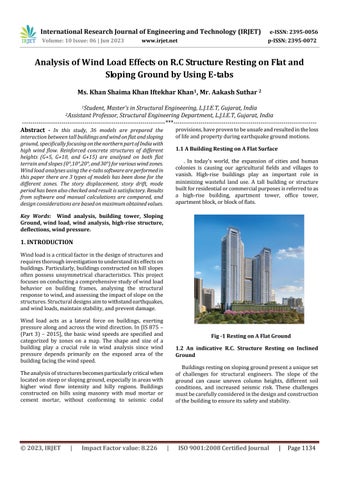
. In today's world, the expansion of cities and human colonies is causing our agricultural fields and villages to vanish. High-rise buildings play an important role in minimizing wasteful land use. A tall building or structure builtforresidentialorcommercialpurposesisreferredtoas a high-rise building, apartment tower, office tower, apartmentblock,orblockofflats.
-1 Resting on A Flat Ground
1.2 An indicative R.C. Structure Resting on Inclined Ground
Buildingsrestingonslopinggroundpresentauniqueset of challenges for structural engineers. The slope of the ground can cause uneven column heights, different soil conditions, and increased seismic risk. These challenges mustbecarefullyconsideredinthedesignandconstruction ofthebuildingtoensureitssafetyandstability.
1.3 Objectives
Theobjectivesoftheanalysisofwindloadeffectsonan R.C.structurerestingonflatandslopinggroundusingE-tabs areasfollows:
Evaluate wind load distribution: Determine the distributionofwindloadsonthestructureconsideringboth flatandslopinggroundconditions.
Compare effects on the flat and sloping ground: Analyse andcomparetheeffectsofwindloadsonthestructurewhen itisrestingonflatgroundversusslopingground.
Study structural behaviour: Investigate the structural behaviouroftheR.C.structureunderwindloads,including deflections, bending moments, shear forces, and support reactions
Assess structural stability: Evaluate the stability of the structure under wind loads, considering both overall stabilityandindividualmemberstability.
Optimize design: Identify areas of improvement in the structural design to enhance the resistance against wind loads.
Validate design codes: Comparetheresultsobtainedfrom theanalysiswiththeprovisionsspecifiedinrelevantdesign codesandstandards
Provide recommendations: Basedontheanalysisresults, offerrecommendationsforimprovingthestructuraldesign, construction techniques, or site selection to enhance the windresistanceoftheR.C.structureonbothflatandsloping ground.

Overall,thestudyaimstoprovidevaluableinsightsintothe analysisofwindloadeffectsonbuildingsrestingonbothflat andslopingground,withafocusonwindzonesandtheuse ofETABSsoftwarefordesignpurposes.
2. LITERATURE REVIEW
BD Yadav1*,Nilesh Choudhary1,JaydevKumarMahato2 and Nitin Kumar2, “study the effects of various wind loadingsinhighriserc-framedstructuresinzone–v ”Inbrief itisfoundthat:Windloading,andseismicloadingaretwo crucialfactorsinthedesignofhigh-risebuildingstoensure their stability and structural integrity. Let us deeper into eachaspectanddiscusstherelevantprovisionssuggestedin theIndianStandards(IS).
Prof. D.N. Kakde1, Shaikh Mohd. Kasheef, “influence of slope angle variation on the structures resting on sloping ground subjected to heavy winds.” The research study focused on evaluating the structural performance of highrise structures in the northern part of India, where wind flow is significantly higher. These structures were further complicated by being constructed on inclined portions of hilly regions. The study aimed to specifically examine the effectsofheavywindloadsonsuchstructures.
Naveen Suthar, Pradeep K. Goyal, “comparison of the responseofbuildingagainstwindloadasperwindcodes[is 875 – (part 3) – 1987] and [is 875 – (part 3) – 2015].” In brief it is found that: The research paper presented a comparison of wind loads for a G+11 building using two differentwindloadingcodes:theoldcode[IS:875–(Part3) –1987]andthenewcode[IS:875 –(Part3)–2015].The comparisonfocusedonthewindloadscalculatedusingthe static method for zone 4 with terrain category 3. This comparison allowed them to assess the differences in the windloadcalculationsandunderstandhowthechangesin thecodeprovisionsaffectedthestructuralresponse.
B. Shobha1, Dr.H. SudarsanaRao2, Dr. Vaishali.G. Ghorpade, “effect of windloadon low, medium, high-rise buildingsindifferentterraincategories.”Inthisstudy,the focusisonassessingtheresponseoftallbuildingstowind loads,specificallyconsideringboth"alongwind"and"across wind" vibrations caused by wind flow. While modern tall buildings are designed to meet lateral drift requirements, excessive oscillations can still occur during windstorms, whichcanposethreatstothestructure'sintegrityandcause discomforttooccupants.Therefore,accuratelyassessingthe motionoftallbuildingsunderwindloadsiscrucialtoensure theirserviceability.
K. Surender Kumar a, N. Lingeshwaran b Syed Hamim Jeelani, “ANALYSIS OF RESIDENTIAL BUILDING WITH STAAD.PRO&ETABS.”Thispaperfocusesonthedesignand analysisofamulti-storybuildingwiththeaimofachieving efficiency and long-term durability. Multi-story buildings offertheadvantageofincreasedfloorareawithouttheneed for expanding the land area, resulting in cost savings and optimized land utilization. The primary objective of the studyistodevelopaneffectivedesignanalysismethodology thatencompassesvariousaspectssuchasloadcases,load
combinations,supportreactions,andthereinforcementof columnsandbeams.
3. METHODOLOGY
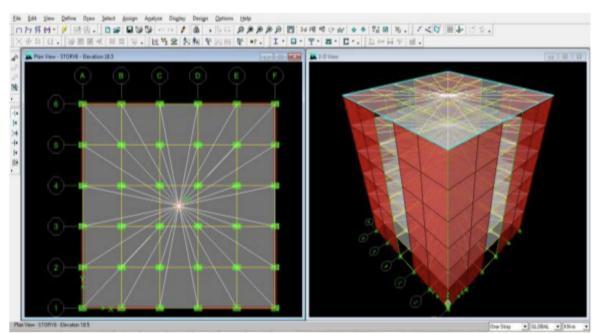
TheanalysisanddesignofanRCCstructurerestingonflator slopinggroundusingETABSsoftwaretypicallyinvolvethe3 differenttypesofstorybuildingispossibleforAnalysisof Wind Load Effects on R.C Structure Resting on at 0°,10°,20°,30°SlopingGround.Thesestepsrequireagood understanding of IS codes (Indian Standard codes) and fundamentalstructuralconcepts.Tovalidateandcompare theresults,atotalof36modelswerecreated.
• Generate a variety of reports that can be used to documentwindloadcalculations.
ETABSisacommercialsoftware,sothereisacost associatedwithusingit.
Thesoftwarecanbecomplextolearnanduse,soit isimportanttohavesometrainingbeforeusingit forwindloadanalysis.
3.2 Modelling
To study the seismic behavior of RCC structure, different caseshavebeendefinedandtheircomparativegraphsfor thesecaseshavebeenplotted.AtypicalRCCbuildingwillbe designedandanalysedfordeadload,liveload,windload.
i. Seismiczone,Z(IS1893:2002,clause6.4.2,table2)
ii. Responsereductionfactor,R(IS1893:2002,clause 6.4.2,table7)
iii. Importance factor, I (IS 1893: 2002, clause 6.4.2, table6)
iv. Soiltype(IS1893:2002,clause6.4.5,page16)
Table -1: Modelling Details for RCC Structure
PARAMETERS
Numberofstories (G+5),(G+10),(G+15)
Typeofstructure
StorytoStoryheight
Groundstoryheight
Gradeofconcrete
Structure
forColumnandSlab& M30forBeam
3.1 Software of analysis
ETABSisapowerfulandversatilesoftwarethatcanbeused toaccuratelycalculatewindloadsonbuildingsaccordingto Indianstandards.Thesoftware'sfeaturesmakeitwell-suited foravarietyofwindloadanalysisapplications,includingthe design of new buildings and the evaluation of existing buildingsforwindsafety.
Thesefeaturesincludetheabilityto:
• Calculatewindloadsbasedontheterraincategory andheightofthebuilding.
• Account for the effects of wind gusts and vortex shedding.
• Calculatewind-inducedupliftforces.
Thicknessofslab
Thicknessofslab 230mm
Beamsize 400mmX400mm
Columnsize 450mmX600mm
Density Forconcrete 25KN/m ForBrickwall19KN/m
BasicwindSpeedZone Zone3,Zone4, Zone5
DegreeofSlope 0°,10°,20°,30°


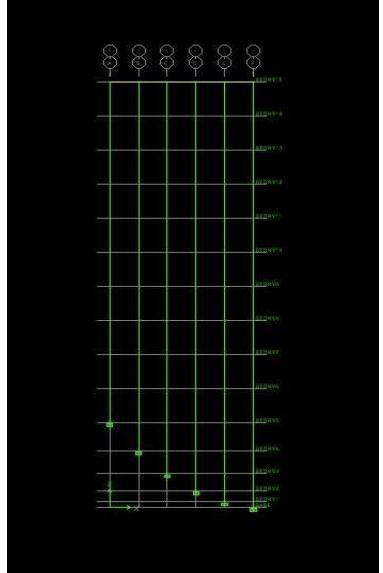
4. OBSERVATIONS
Thereare3majortypesofmodelsisanalysedofdifferent heights (G+5, G+10, and G+15) on both flat terrain and slopes(0°,10°,20°,and30°)withdifferentwindzones.
4.1 Story Displacement: - Thepermissiblelimitforstory displacementis0.004timesthestoryheight.Therefore,the story displacement values in the table are within the permissiblelimit.
The X and Y direction values are the same in the table becausethebuildingisassumedtobesymmetricalinboth directions.Thismeansthatthewindloadisappliedequally
in both directions, and the stiffness of the building is the sameinbothdirections.
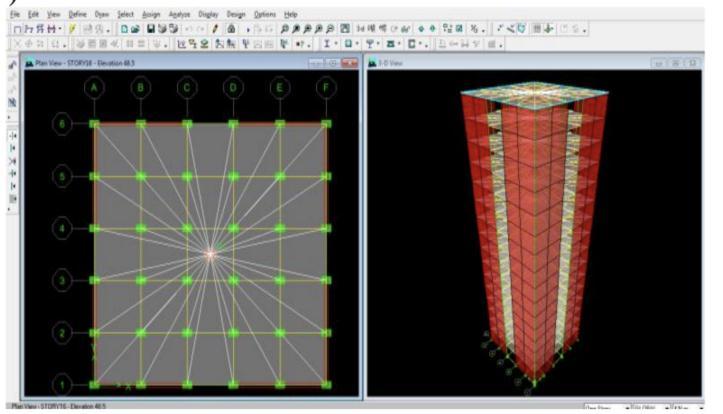
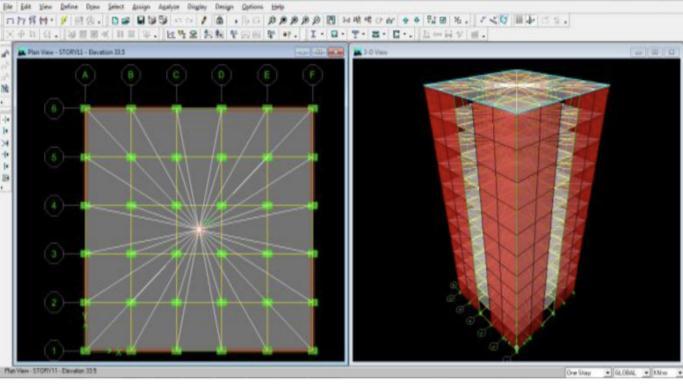
4.1 Story Displacement: - The permissible limitforstory displacement is 0.004 times the story height.

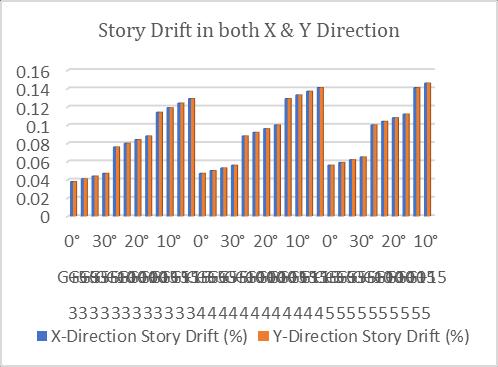
4.2 Story Drift: - The permissible limit of story drift depends on the type of structure and the applicable building code. In India, the permissible limit of story drift for RC structures is 0.004 times the story height. The values given in the table are within the permissible limit.
4.3 Mode Period: - The permissible limit of mode period depends on the type of structure and the applicable building code. In India, the permissible limit of mode period for RC structures is 0.15 seconds. The values given in the table are within the permissible limit.
ThevaluesinbothXandYdirectionsarethesamebecause thebuildingisassumedtobesymmetricalinbothdirections. This means that the wind load is applied equally in both directions, and the stiffness of the building is the same in bothdirections.
5. CONCLUSIONS
Table -2: A table that summarizes wind characteristics in various zones: -
Inallthreewindzones,storydriftandstory displacement increase with the number of stories and slope. This is becausethetallerthebuilding,themoreitwillswayinthe windorunderseismicloading.Theslopeofthegroundalso hasaneffect,asaslopinggroundwillcausethebuildingto swaymorethanalevelground.
In Zone 3 and Zone 4, mode period increases with the numberofstoriesandslope.Thisisbecauseatallerbuilding has more mass, which will tend to dampen the swaying motion.However,inZone5,modeperioddecreaseswiththe numberofstories.Thisisbecausethehigherwindspeedsin Zone5requireashortermodeperiodtopreventthebuilding fromoscillatingtoomuch.
1. Thestructureonslopinggroundexhibitsahigher maximumdisplacement,whichcanleadtocritical situationscomparedtostructuresonflatground.
2. Themodeshapeanalysisrevealsthatthe15-storey structurehasthelongestperiodatboththetopand bottomstories.
Wind
Zone Table 1 Table 2
Zone 3 Storydriftincreases with number of stories and slope.
Story displacement increases with number of stories and slope. Mode period increases with number of storiesandslope.
Zone 4 Storydriftincreases with number of stories and slope.
Story displacement increases with number of stories and slope. Mode period increases with number of storiesandslope.
Zone 5 Storydriftincreases with number of stories and slope.
Story displacement increases with number of stories and slope. Mode period increases with number of storiesandslope.
Story drift increases withnumberofstories.
Story displacement increaseswithnumber ofstories.Modeperiod decreaseswithnumber ofstories.
3. Thetablesshowthatstorydrift,storydisplacement, and mode period all increase with the number of storiesandslope.However,modeperioddecreases withthenumberofstories.Thisisbecauseataller buildinghasmoremass,whichwilltendtodampen theswayingmotion.
4. ThebaseshearisgreaterintheX-directionthanin theY-directionforstructuresonslopingground.
5. The mode period decreases as the slope angle increases.

Story drift increases withnumberofstories.
Story displacement increaseswithnumber ofstories.Modeperiod decreaseswithnumber ofstories.
6. Themaximumstorydisplacementisobservedinthe structurewitha10ºslope.
7. The displacement is higher at the top story comparedtothebottomstoryinallothermodels, bothintheX-directionandY-direction.
8. The maximum story drift occurs in the structure witha10ºslopeinallmodels.
REFERENCES
Story drift increases withnumberofstories.
Story displacement increaseswithnumber ofstories.Modeperiod decreaseswithnumber ofstories.
[1] Yadav,B.D.,Choudhary,N.,Mahato,J.K.,&Kumar, N. (2023). Study The Effects of Various Wind Loadings in High Rise Rc-Framed Structures In Zone–V. Journal of Civil Engineering Research & Technology. SRC/JCERT-140. DOI: org/10.47363/JCERT/2023(5),139,2-6.
[2] Kakde,D.N.,&Kasheef,S.M.(2020).INFLUENCEOF SLOPE ANGLE VARIATION ON THE STRUCTURES RESTING ON SLOPING GROUND SUBJECTED TO
HEAVY WINDS. Solid State Technology, 63(1s), 2352-2364.
[3] Suthar,N.,&Goyal,P.K.(2021,June).Comparison of response of building against wind load as per wind codes [IS 875– (Part 3)–1987] and [IS 875–(Part3)
2015].InIOPConferenceSeries:Earthand EnvironmentalScience(Vol.796,No.1,p.012007). IOPPublishing.
[4] Shobha,B.,Rao,D.H.S.,Vaishali,D.,&Ghorpade,G. (2018). Effect of wind load on low, medium, high rise buildings in different terrain category. International Journal Of Technical Innovation In ModernEngineering&Science(IJTIMES).
[5] Kumar, K. S., Lingeshwaran, N., & Jeelani, S. H. (2020).AnalysisofresidentialbuildingwithSTAAD. Pro & ETABS. Materials Today: Proceedings, 33, 1221-1228.
[6] S. Yogeshwaran, L. Natrayan, G. Udhayakumar, G. Godwin, L. Yuvraj, Effect of waste tyre particles reinforcementonmechanicalpropertiesofjuteand abaca fiber-epoxy hybrid composites with pretreatment,Mater.Today:Proc.(2020),
[7] IS: 875(Part 1, Part 2, Part 3)- 2015, bureau of Indianstandardcodeoftrainingforconfiguration loads.
[8] B.Shobha,HSudarshanRao,VaishaliGGhorpade (2018) Effect of wind load on low, medium, High risebuildingsindifferentterraincategoryIJTIMES2018.
[9] Al Agha W, Umamaheswari N (2021) Analytical studyofirregularreinforcedconcretebuildingwith shearwallanddualFramed-Shearwallsystemby using Equivalent Static and Response Spectrum Method. Mater. Today Proc., International ConferenceonAdvancedMaterialsBehaviourand Characterization(ICAMBC2020)43:2232-2241.
[10] A.S.Patil,P.D.Kumbhar.Timehistoryexamination of multistorey RCC structures for various seismic powers,Int.J.AuxiliaryStruct.DesigningExplore. (IJSCER),Vol.2(3),2013.