“Extract the Audio from Video by using python”
Digvijay Kambale4Abstract - A video to audio converter is a programme that converts video to audio and video to mp3. In this application, you must first select a file and then press the convert button once you have finished selecting your video file. This video to audio converter tool will then begin converting video to audio, and your audio file will be saved in the same folder. Let's create a Python Video to Audio Converter project.
Key Words: Python-
1 INTRODUCTION
SincetheemergenceofsocialmediasiteslikeYouTubeand Instagram,videocontenthasgrowninpopularity.However, there are times when we prefer to just listen to a video's audio rather than watch it. A video to audio converter is usefulinthissituation.Asoftwareprogrammeknownasa "videotoaudioconverter"mayextractaudiofromavideo fileandstoreitinanaudiofileformatlikeMP3orWAV.By doing this, users can listen to their favourite podcasts or musicwithouthavingtoseetheaccompanyingvideo.There areseveralpopularmultimediaformatsavailabletoday,and eachoneisfortunatetohavea specificapplication(Video HomeSystem,InternetVideoStreaming,VideoEditing,etc.) orwasinventedspecificallyforportablemultimediadevices. Someprogrammesandgadgetscanonlyacceptformatsthat were specifically designed for them. It is well known that there are numerous multimedia devices (such as DVD players,mobilephones,iPods,PSPs,Zune,PlayStations, etc.) and various audio/video data carriers (such as DVDs, the Internet,BlueRay,HDDs,andFlashUSBstorage),makingit relatively simple for even seasoned users to encounter difficultieswhenselectingthebestone.Becausevirtuallyall devices are produced by universal brands like Microsoft, Apple, and Sony, which can be considered competitors, it appears to be extremely complicated. Additionally, the productsthatthesecompaniesarepromotingoccasionally appeartobeincompatiblenotonlywithPCbutalsowithone another. These limitations are brought about by the development of unique video formats for specific devices. The main difference between the video and audio is The videoisavailableinanumberoffileformats,includingMp4, MOV, and WEBM. The audio and video in these files are synced.Mp3files,ontheotherhand,justhaveaudioandno visuals. As a result, mp3 files consume far less space on storagedeviceslikesmartphones,onlinestorageplatforms, andharddiscs.Additionally,certaindevicescan onlyplay
andstoreMP3files.Theinternetisrifewithvideosthatwe mightenjoywatchingwhileworkingout,exercising,ordoing housework.Musicwithmusicvideos, podcastswithvideo segments,interviews,andmotivationalspeechesarejusta fewexamples.Wedon'tknowaboutyou,butatleastoneof ourfriendshasaphonethatisoverflowingonanygivenday. Aswasalreadymentioned,mp3filestakeuplessspace,soif youremoveanysuperfluousvideos,youcanfitmoresongs, images,orfilmsonyourdevices.You'dbeshockedathow much space a few videos downloaded to your phone, computer,orexternalstoragedevicewilluse.Videofilescan growratherlarge.
Usingbasicoperations(suchcuts,concatenations,andtitle insertions), video compositing (also known as non-linear editing),videoprocessing,orcomplexeffects,MoviePyisa Python module for video editing. The majority of popular videoformats,includingGIF,canbereadandwritten.
1.1 Problem Statement
Thereareseveralsystemsouttherethatonlytranslateaudio or video into text. There are numerous live transcribing programmesforvarioustranscribingtasksthatwesee,use, andarepresentinourregularjobandprofessionalprofiles. Since this system only uses audio transcription, there is a chancethatoccasionallythepronunciationwillbeincorrect. The accuracy issue arises throughout the video to text conversion process when we attempt to obtain audio accuracyinordertoprovidethedesiredoutput.Incontrast, avideoplaysframebyframe,whichtakestimeandresultsin aslowoutput.
1.2 Objective
Using this application, we may get notes from audio and videosourcesandsolvetheproblem ofdocumentation.In order to extractthetext that ispresent in eachframeand add it to the output textbox, we are utilising the open CV programme with the provided input video as a source to determine the frame rate. The audio file's speech recognitiontechnology.
2 Literature Survey
Inthisstudy,wepresentanoveltechniqueforautomatically aligning and evaluating audio-visual text for music video summarization.Themusicvideoseparatesthevideotrack

from the music track. The chorus can be located in the musical track, according to an analysis of the music's structure.Weinitiallydividethephotosandgrouptheminto close-upfaceshotsandnon-facialshotsbeforeextractingthe phrasesanddeterminingthemostoftenrepeatedlyricsfrom the shots for the video track. The phrases from the music videothataremostfrequentlyrepeated,theshottype,and thealignmentofchorusboundariesareusedtocreatethe synopsis.Studiesforchorusdetection,shotcategorization, and lyrics detection using 20 English music videos are provided. individual user research. Studies for chorus detection,shotcategorization,andlyricsdetectionusing20 English music videos are provided. The effectiveness and calibre of summary have been assessed by a series of subjectiveuserstudies.
Videoandaudiodataaregatheredacrossabroadrangeof issue disciplines in order to document processes, procedures,orencounters.Thesevideoandaudiodataare afterwardsinvestigatedusinganumberofapproachestotry tounderstandwhatwashappeningatthetimeofrecording; sometimesinrelationtoinitialhypothesesandothertimes intermsofa"posthoc"analysisutilisingamoregrounded approach.Thispaperintroducesthetoolsandmethodology for analysing video data and explores prospective innovations in discourse analysis that can be inspired by learninganalytics.
Inthisthirdpapervoicecloningtechniqueshavebeenused in a range of applications, such as video games and customised speech interfaces for marketing. The most sophisticated voice cloning technology may produce perceptually unidentifiable speech by learning speech featuresfromasmallsampleofspeech.Thesesystemspose new security and privacy risks to voice-driven interfaces. Sincefakeaudiohasbeenusedwithmaliciousintent,itcan bedifficulttotellthedifferencebetweenrealandfakeaudio during a digital forensic analysis. This paper looks at the issue of deep-fake audio categorization and evaluates the usefulnessofforensicdeep-fakeaudiodetectionmethods.
Intherealworld,wherethemainworkplacechallengesare solved, there is a need for a video and audio to text converter.Thisconvertercanbeusedfordocumentationby manysoftwarebusinesses,academicinstitutions,andother organisations.Thisisgenerallyusedbysoftwarebusinesses toaccessnotes,projectdata,projectpresentationmaterials, etc. We chose to use Google Speech Recognition for our system'sUIbecauseitissoreliableanduser-friendly.Python isevenourchoicedueofhoweasyitistolearn.Ifthereis onlyoneaudiofileonthesystem,theaudiototextconverter shouldbeusedtomakeiteasierfortheusertoconvertthe audiototext.
3 Process of video to audio converter

Video Converter is a multipurpose program specially createdforworkingwithvideofiles.Theprogramallowsyou toperformpracticallyalltheoperationswithvideo.
1) Enhanced system of managing the conversion process gives you an opportunity very quickly and qualitatively to convertvideofromoneformatintotheother;itisimportant tomentionthatthereareagreatvarietyofsupportedvideo formats and multimedia devices. By means of our Video Converter, a user can easily save DVD film from a disc on his/herPC,mobilephoneoranymultimediadevice(iPhone, iPod, PSP, Zune, Creative…), or on the contrary, write the video on a DVD disc. The innovative "2pass encoding" technology enables you to save DVD movies on your computer,havingdrasticallyshrunktheirsizeby5–10times. What'samazing,though,isthatthevideoqualityofthefinal product isstill veryhigh; ithas excellent colour rendering withverybrightandrichcolours,anddefinitelydrownsout smalldetailseveninthemostdynamicscenes.
2)Youcaneditvideosbyaddingorremovingdifferentpieces (such as titles or commercials), save audio tracks from moviesinMP3formats,anddoavarietyofothertaskswith theaidofaprofessional"VideoEditor."
3)The"Downloader"applicationallowsyoutobrowseorjust download your favorite video clips from the most widely usedvideohostingsitesontheInternet,includingYouTube, MySpace,andAOL.
4) The built-in "Disc Writer" will assist you in saving the video clips to a disc for later viewing, such as on a DVD player.
5)Apanelcalled"ProfileEditor"thatwasbuiltspecificallyfor professionalusersallowsyoutomanuallyselectthedesired featuresofthefinishedvideo.(Useingoogleimage)
3.1 Ways of video to audio converter:
Avideofilecanbeturnedintoanaudiofileina varietyof ways.Herearesometechniquesyoucanuse:
1. Online video to audio converters: These services are available on a wide variety of websites. You can find a varietyofsolutionsbysearchingfor"onlinevideotoaudio converter" inyour favorite searchengine.Typically,these services let you upload your video file and convert it to severalaudioformats.
2 .Desktop Software: A variety of desktop software applications are available that enable audio to video conversion.VLCMediaPlayer,Audacity,andFreemakeVideo Converterareafewwell-likedchoices.Theseprogrammes frequently support a large number of video and audio formatsandofferanintuitiveuserinterface.
3. Using FFmpeg (Command Line): For managing multimedia files, FFmpeg is a potent command-line application.YoucandownloadFFmpeganduseittoconvert a movie to an audio file if you're comfortable using command-linetools
3.2 Recording Storing and Sharing video :
Awiderangeofdevices,includingdedicatedvideocameras (at varied price points), digital cameras, and popular handheld devices like smartphones and other mobile phones, are available to conveniently and inexpensively collect video data. The Diver project (Digital Interactive VideoExploration&Reflection,usedasetof5camerasto acquirea360-degreerecordofactivity) isoneexampleof how head-mounted cameras might be used in fieldwork situations or for documenting surgical operations. In addition, a variety of websites and smartphone "apps" specifically designed to enable the creation, hosting, and sharing of videos have appeared in recent years (such as YouTube,Tumblr, etc.). Manyofthem are associated with the"socialmedia"phenomena,inwhichindividualsproduce anddistributemultimediaforuseintheirpersonallivesor forentertainment.Althoughthefocusofthisstudyisnoton these resources, they show how pervasive the notion of video as a publicly-created and shared communication medium has grown. Additionally, it demonstrates how simple it is to make and share video utilising a variety of devicesandthus,avarietyofplatforms. Itishopedthatthe general public's increased familiarity with the concept of recordingandsharingvideowillpromotegreateracceptance andmorenaturalistic settingswherevideoisrecorded by researchersandusedinstudieswherethosesubjectsinthe video are the main points of interest. In any case, video diariesandvideo-recordedobservations/usertrialshavea long history in many disciplinary research areas, so it is hoped thata wideaudience ofacademicsand researchers whoregularlyrecordandanalysevideodata will findthis papertobeofinterest.
3.3
Steps
to Extract Audio from Video using Python with MoviePy library
Itwillbedifficulttohandlethevideoinitsrawbinaryformat, so we will use an external library named moviepy for this task. MoviePy works with Python versions 2.7and upand supports a wide range of operating systems, including Windows,Linux,andmacOS.Itcanreadandwriteallofthe mostpopularaudioandvideoformats,includingGIF.
1. Setup the moviepy library
Sincethislibraryisnotbuilt-in,wemustinstallit.Toachieve this,wewillutilizethepackagemanagerpip.Openaterminal and type the following command to install the moviepy Library.
pip install moviepy
2. Add the moviepy library
Let's begin by importing the libraries right away. The moviepypackageortheeditorclassonlymustbeimported specifically.
#Importmoviepy
importmoviepy.editor
3. Upload the movie
Let'slearnaboutvideoformatsbeforemovingontothenext level. To perform the conversion without any issues, we mustbeawareoftheformatofourvideo.Themostpopular video formats include WMV (wmv, wma, asf*), OGG (ogg, oga,ogv,ogx),3GP(3gp,3gp2,3g2,3gpp,3gpp2)andMP4 (mp4,m4a,m4v,f4v,f4a,m4b,m4r,f4b,mov).
By addressing the video file via the argument, we must createaVideoFileClipobject.
#LoadtheVideoClip
video=moviepy.editor.VideoFileClip("Video.mp4")
Insidethemethod,weareaddingthepathofthevideo.The videowearegoingtoconvertisinmp4format.
4. Remove the audio.
Knowingafewaudioformatsisalsoagoodideainaddition tothevideoformat.ThesepopularfiletypesincludeMP3, AAC,WMA,andAC3.Wenowhavesomethoughtsonboth forms.NowisthetimetousetheMoviePylibrarytoperform the conversion. The audio from the video that we defined willnowbeextracted.Accessingtheaudiocomponentofthe VideoFileClipobjectweconstructedwillallowyoutoeasily extracttheaudio.Theextractedaudiomustthenbewritten intoanewfilewithaspecificfilename.
#ExtractandexporttheAudio video.audio.write_audiofile("Audio.mp3")
3.4 Tkinter
Theterm"graphicaluserinterface"(GUI)referstoatypeof user interface that enables people to communicate with computersvisuallythroughtheuseofobjectslikewindows, menus,andicons.IthasadvantagesovertheCommandLine Interface(CLI),whichismoredifficulttousethanGUIand requires users to type instructions into computers exclusivelyusingthekeyboard.Thebuilt-inPythonmodule TkinterisusedtodevelopGUIapplications.Giventhatitis straightforwardandquicktouse,itisoneofthemostoften used modules for developing GUI applications in Python. Since Tkinter is already included with Python, you don't needtoworryaboutinstallingitseparately.Itprovidesthe TkGUItoolkitwithanobject-orientedinterface.
Tkinter can be used to construct windows and dialogue boxes,whichenableuserstointeractwithyourprogramme. Thesecanbeusedtoshowdata,collectfeedback,orprovide theuseroptions.MakingaGUIforadesktopapplication:The interfaceforadesktopapplication,whichincludesbuttons, menus,andotherinteractiveelements,canbemadeusing Tkinter.
A command-line programme can have a GUI added to it usingTkinter,whichmakesitsimplerforuserstointeract withtheprogrammeandenterarguments.
Tkinter allows you to build your own custom widgets in addition to a wide range of built-in widgets like buttons, labels,andtextboxes.
AGUIprototypecanbeeasilycreatedusingTkinter,allowing you to test and iterate on various design concepts before committingtoafullimplementation.Thebottomlineisthat Tkinter is a helpful tool for developing a wide range of graphicaluserinterfaces,includingwindows,dialogueboxes, and unique widgets. It is especially suitable for creating desktopappsandgivingcommand-lineprogrammesaGUI.
4. Architecture
Let'slookathowtobuildavideotoaudioconverterusing thedescriptionofimplementationmodulesis
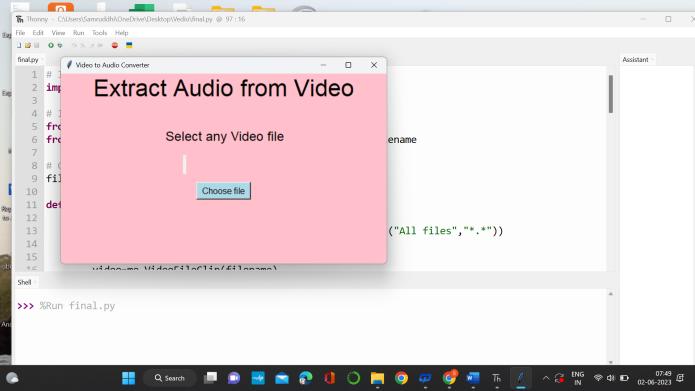
1.Importeachoftherequiredmodulesfirst.
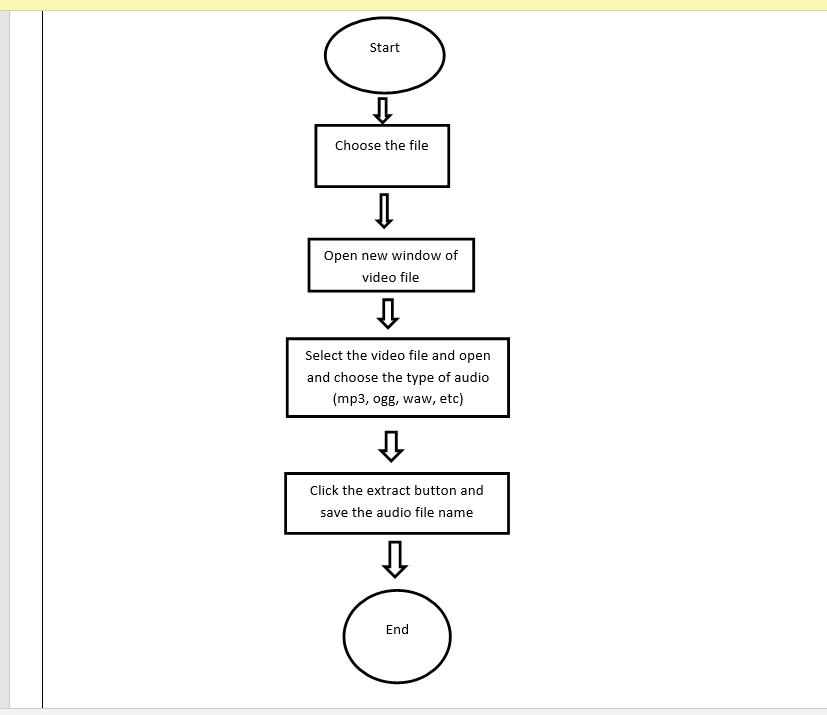
2.Makeawindowforourconverter'suserinterface.
3.Createafunctionthatprocessesthefileandconvertsthe videotoaudioaftertheuserselectsthefile.
4.Thefilewillbesavedautomaticallyinthesamefolder.
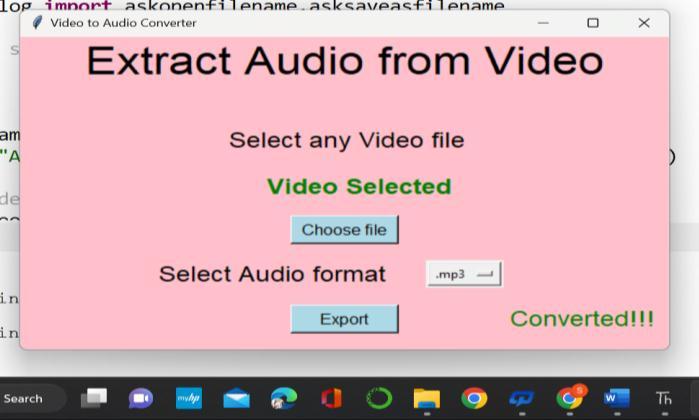
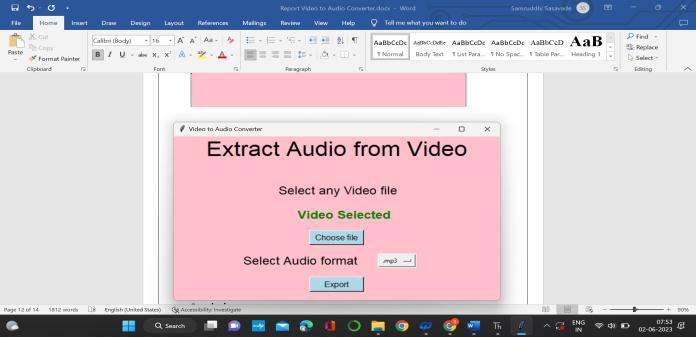
5. Snapshot of the project
6. CONCLUSIONS
Thisprogrammeprovidesanincrediblybasic,hardlyusable sample.Thismightbeenhancedinanumberofways,suchas by allowing users to load either an mp4 or a wav file, by lettingthemchoosefromarangeofspeechrecognizers,and bydisplayingmoreinformationsuchasfilesizeandlength. Graphicaluserinterfacescanimprovetheuserexperienceof straightforward programmes, and they are easy to implementinPythonusingprogrammeslikeMoviePyand TkinterDesigner.Tominimisetheirnegativeeffectsonthe user experience, performance concerns can also be fixed utilising threading and conducting computationally demandingoperationsinthebackground.

7. REFERENCES
[1]. Marcello Federico, Robert Enyedi, Roberto BarraChicote, Ritwik Giri, Umut Isik, Arvindh Krishnaswamy,Hassan Sawaf” From Speech-toSpeech TranslationtoAutomaticDubbing”Proceedingsofthe17th InternationalConferenceonSpokenLanguageTranslation July2020
[2].GOPA-InternationalEnergyConsultantINTEC&HammLippstadtUniversityofAppliedSciences2022
[3].Publishedin:IEEEJournalofSelectedTopicsinSignal Processing(Volume:16,Issue:6,October2022)
[4].Publishedin:IEEETransactionsonSoftwareEngineering (Volume:48,Issue:1,01January2022)
[5].J.Pradeep,E.Srinivasan,S.Himavathi,Neuralnetwork based handwritten character recognition system without feature extraction, in 2011 International Conference on Computer, Communication and Electrical Technology (ICCCET),pp.40–44(2011).
[6]. R. Mittal, A. Garg, Text extraction using OCR: A systematicreview,in2020SecondInternationalConference


onInventiveResearchinComputingApplications(ICIRCA), pp.357–362(2020).
[7]Brantley-Dias,L.,Dias,M.,Frisch,J.K.andRushton,G.,The Role of Digital Video and Critical Incident Analysis In Learning to Teach Science. Proceedings of the American Educational Research Association Annual Meeting, (New YorkCity,NewYork,2008),2008.
[8] Brundell, P., Tennent, P., Greenhalgh, C., Knight, D., Crabtree,A.,O'Malley,C.,Ainsworth,S.,Clarke,D.,Carter,R. and Adolphs, S., Digital Replay System (DRS) - a tool for interactionanalysis.Proceedingsofthe2008International ConferenceonLearningSciences(WorkshoponInteraction Analysis),(Utrecht,2008),2008.
[9]Carroll,J.M.,Koenemann-Belliveau,J.,Rosson,M.B.and Singley, M.K., Critical incidents and critical themes in empirical usability evaluation. Proceedings of the HCI-93 Conference:PeopleandComputersVIII(British Computer Society Conference Series), (1993), Cambridge, U.K.: CambridgeUniversityPress,279-292,1993.
[10] De Liddo, A., Sándor, Á. and Buckingham Shum, S. Contested Collective Intelligence: rationale, technologies, and a human-machine annotation study. Computer SupportedCooperativeWork(CSCW)(inpress),2012.
[11] Erickson, F. Definition and analysis of data from videotape:Someresearchproceduresandtheirrationales.In J.L.Green,G.CamilliandP.B.Elmore,editors,Handbookof complementary methods in education research. Erlbaum, Mahwah,NJ,2006,177-205.
[12] Ferguson, R. and Buckingham Shum, S., Learning analytics to identify exploratory dialogue within synchronoustextchat.Proceedingsofthe1stInternational ConferenceonLearningAnalytics&Knowledge(LAK2011), (Banff,Alberta,2011),2011.
[13] Flannigan, J.C. The critical incident technique. PsychologicalBulletin,51(4),327-358,1954.
[14]Killion,J.P.andTodnem,G.R.Capturingcomplexity:A typology of reflective practice for teacher education. TeachingandTeacherEducation,18,73-85,2002.
[15]Mercer,N.Socioculturaldiscourseanalysis:analysing classroom talk as a social mode of thinking. Journal of AppliedLinguistics,1(2),137-168,2004.