Design and Development of a Dry-Cleaning System for Photovoltaic Panels
Mohammed Abdul Muttalib1, Dina Mourad2, Tamer A.A.Ismail3 , Abdul Latif Syed41 Faculty of Technology and Education, Helwan University, Egypt,
2 Faculty of Technology and Education, Helwan University, Cairo, EGYPT,
3 faculty of technology at El Sahafa. Ministry of higher education,
4Faculty of Engineering, Helwan University, Egypt ***
Abstract - Theamount ofpowergenerated willdecreaseif dustparticlesonthesolarpanelsblocksunlightfromentering thesolarcells.Iftheapplianceisnotfrequentlycleaned,power production can decrease by as much as 42%. An automatic cleaningsystemthateliminatesdustfromthesolarpanelshas been designed to periodically clean the dust. The topic is reviewed and the dust removal technique is discussed in this study. A cleaning robot that travels the whole length of the board has been designed. The robotics control system is implemented using the Arduino Uno microcontroller. By enablingautomaticcleaning,therobotproducedasuccessful outcome and demonstrated the viability of such a system, assistinginthepreservationofthesolarpanels'effectiveness
Key Words: photovoltaic panels; photovoltaic panel maintenance; dry cleaning; the dust; the design; cleaning robot
1. INTRODUCTION
Theperformanceofphotovoltaic(PV)panelswhenexposed todustunderstandardtestcircumstances(STC)isindicated by the photovoltaic soiling index (PVSI) (Menoufi, 2017) Soilingisthetermusedtodescribethe build-upofdirton solarpanelmodules.Itisasignificantlossissue,especiallyin desertregionswherethereislittlerainandevenfrequent dustorsandstorms(A.Abidetal.,2018).Thecharacteristics ofsoilingaccumulationonsolarpanelsareinfluencedbythe local environment and the dust qualities, which include shape,component,weight,andsize
(Maghamietal.,2016)Inarticle(Pradhan&Panda,2017),a real-timeexperimenthasbeencarriedout to examinethe impactofvariousconditions,includingthesoilingeffect,on the operation of the PV system. Other researchers (Mohammedetal.,2020)suggestedamethodtolessenthe amount of energy used by regulating the devices for the home. Additionally, in the article (Slamet et al., 2020).The authors proposed an adaptive PI controller with a robust maximum power point tracking (MPPT) controller that is basedonfuzzylogic.Industyconditions,suchacontroller canbeusefulformaximizingPVpower.

Researchershaveproposedavarietyofdust-accumulation mitigationtechniques,including(Saidetal.,2018)(Ghoshet
al., 2019)(Plessis et al., 2020), although efficiency is still significantlyhamperedbydustaccumulation,particularlyin aridregions.APVmodule'sefficiencyisdrasticallyreduced. Numerousmethodswereputforthbyresearcherstolessen dustbuild-uponPVpanels.Severalcoatingapproaches,such as metallic anti-corrosion, drag-resistant coatings, selfcleaningcoating
(Kawamoto, 2019)The authors of (Chaichan & Kazem, 2020).recommendedwashingthesolarmodulewithasalt solutiontolessentheenergylosscausedwhenthemoduleis contaminatedbysoilanddust,buttheirsuggestiononlyhad a minimal impact. However, in this article we will concentrateonstudiesoftheimpactofdustonsolarcellsin adifferentareaofEgyptdedicatedtoresearchers,designers, andengineersdealingwithAdditionally,(Chaichan&Kazem, 2018)hasasectionspecificallyforbooks.
Dedicated to several articles describing the physical properties of dust in Egypt and how they affect solar systems. There is a discrepancy between the amount of availableenergyandtheincreasingdemandforenergyina developing country, as is the case in the Arab region (AlHamadani,2020).Severalstrategieshavebeenproposedto bridgethisgapbyresearcherssuchas(A.J.Abid&Al-Naima, 2020). However, dust widens this disparity due to less powergeneration.TraditionalcleaningwithHRtakestime, costsmoney,andisbestdoneduringtheday.
Itconflictswiththesystemmanufacturetimer.Especiallyin largesolarfarms,itisdifficulttomonitorthedustypartsof the array, so the researchers (A. J. Abid et al., 2018)presentedtheirresults.
Plan to use a wireless monitoring system to monitor the entiregroup.Theauthorsofthearticle[3]makeageneral proposaltomitigatethe(potential)impactofdustcollection on PV performance. They divide the globe into three categories: low latitudes (humid, humid dry, and tropical dry)makeupthefirstgroup.Thesecondgroupisthemidlatitudeclimate(steppe,Mediterranean,grasslandclimate); Thethirdgroupistheclimateofhighlatitudes(theclimate ofthetaigaandtundra).Thisindicatesthatthereislessdust formation at the high-latitude site due to the higher plate inclinationangle,asshownin
(Hashim et al., 2019). While the cleaning robot (Cai et al., 2019)is equipped with sticky feet, a rotating brush, and a dustsuctionmodel,costandeaseofusemustbeconsidered. In(Riawanetal.,2018),aprototypeisshown
However,itdoesn'tappearfeasiblebecauseittakesalong time to clean and isn't appropriate for the oblique angle wherethemajorityofPVarraysaresituated.Anovelbrush isdescribedin(Parrottetal.,2018)thathasanaluminium core with a silicone rubber top put on it. However, this device needs a guide rail and is not self-powered. in (Hammoud et al., 2019). a robotic cleaner was presented withthreemotorsforthepowergenerationofacoastalPVpowerplantatZahraniLebanon.The dry-cleaning results, publishedin(AlShehrietal.,2017),showedaveryeffective, non-abrasive cleaning. While the motor speed is proportional to the amount of dust, the use of a sensor to detectitisdescribedin(AlBaloushietal.,2018).Although thismodellookspremium,itisnotverycost-effective.Five motorswereusedinanintelligentcleaningrobotpresented in (Antonelli et al., 2020), which increased the cost and complexityofthedevice.Anothersmallrobotwaspresented in(Sorndachetal.,2018),butitsmaindrawbacksincluded cleaningtimeinalargesolarfarmandtiltangle.
Inthisarticle,anewphotovoltaicarraycleaningsystemthat is cost-effective, self-powered, reliable, easy to use, and durable is introduced. After completing all mechanical, electrical, and electronic works We started building a prototype. We want to state that most of the system componentsarerefurbishedorrecycled.
1.1 Automatic cleaner for photovoltaic panels
Even the accumulation of small dust on a single plate reduces the efficiency of producing electricity. For this reason, the surface of the plate should be kept as clean as possible. Current human-based solar panel cleaning techniquesareawasteoftime,water,andenergy.Solarpanel cleaninghasnotbeenrunautomatically,soitisnecessaryto build automatic cleaning devices that can easily clean and move the glass surface of photovoltaic panels. Finally, complete content and organizational editing before formatting. Please take note of the following items when proofreadingspellingandgrammar:
1.2 The aim of the research
The purpose of this study is to develop an effective photovoltaicpanelcleaningrobotinagroupandmonitorthe status of photovoltaic panels using dust sensor and light sensor techniques. The measurable objectives for this projectareasfollows:
A. To design and produce an efficient automatic cleaningsystemforphotovoltaicpanelarrays;
B. todevelopafasterandmorereliablerobotcleaning mechanism;
C. todevelopafullyfunctionaldustcontroldevice.
Scope of the search
Thescopeofthestudyistoproduceandimproveasolar panelcleaningrobotsystemusingArduinoUNOwhichcan monitor the surface condition and output parameters of solarpanels.So,theprojectscopesare:
UseArduinoUNOasthemainsystem.
Usingtwosteppermotorsasthemovement ofthecleaningrobotandcleaningbrushes.
The automatic cleaning system can clean morethanonephotovoltaicpanel.
Use the dust sensor to monitor the status of the photovoltaicpanelsandtaketheappropriatedecision.
1.3 PV energy efficiency
The efficiency of a solar PV panel is measured by the panel'sabilitytoconvertsunlightintousableenergyforthe benefitofhumans.Maximumefficiency={(maximumpower output)/(incidenceradiationflux*collectorarea)}*100.
2. Methodology
Topreventtheperformanceandefficiencyofthemodules fromdecliningasdust,grime,anddebrisbuildupontheir surface,cleaningmechanismsaredesignedandinstalledin solararrays.Therefore,thedevicemustbesufficientlycosteffectiveto enable quick recovery oftheinitial investment throughincreasesinpaneloutputpower.Theprimarydesign principles, aside from the financial implications, include minimal human involvement in the operation, optimum cleaning,anddurabilityinaridenvironmentslikedust,strong winds,andhightemperatures. tofunctionasaself-cleaning componentthatlowerstheeffectsofpollutantswithoutusing water. To assess the system's performance in the actual world,aprototypewasmade.
2.1 system block diagram
Figure1showstheblockdiagramoftheproposeddesign.A microcontroller at the Centre of the system reads and processesdatafromnumeroussensorstokeeptrackofhow the thing is working. Here, a single-board microcontroller calledArduinoUNOisemployed.Opensourceprototyping platform Arduino offers its users a variety of services, including simple-to-use hardware and software. It enables users to control different outputs and components and is simplyattachedtoavarietyofsensors.Arduinoisthebest option for this application because of its ease of use and
affordable,accessibleplatform.Onthemechanism,lightand dustdetectionsensorsareinstalledinstrategiclocationsto tracktheamountofdustbuilduponthePVpanelsurface.The microprocessortriggersvariousmotorsbasedonthevalues readbythesensors.

2.2 Discussion and Calculation
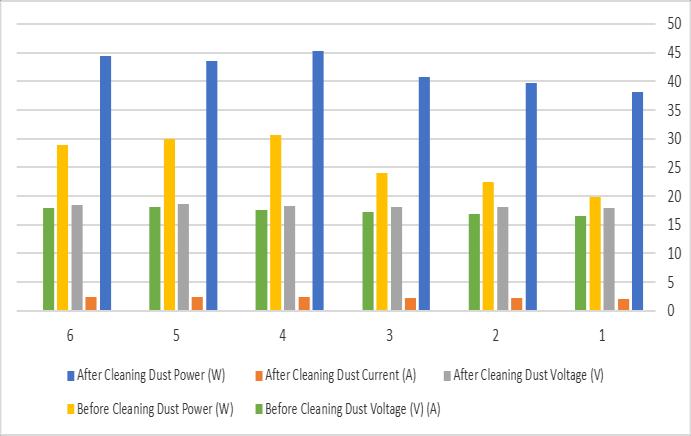
The projected outcomesof energy production withand without the usage of a solar panel cleaning system are displayedinthefollowingtable:
Table -1 Thefollowingtableshowstheexpectedresultsof powergenerationwithoutusingthePVpanelcleaning system:

AfterCleaningDust BeforeCleaningDust
Characteristicsofsolarpanels
Severalexperimentshavebeencarriedoutoncleaningdusty PVpanelstoevaluatetheeffectivenessoftheproposedPV panel cleaning robot. In these tests, the flour was used to simulate the dusting of the photovoltaic panels. The PV panelsundertestweretestedbymeasuringtheirvoltageand currentunderdifferentconditions:initiallybeforecleaning (inadustycondition),andafterthedustcleaningprocess.
Thereisa10%energydropwhenthePVpanelsaretilted. Additionally, the loss increases to roughly 40% when the platecannotbeaddressed.Wecancompletelycomprehend thateverydaycleaningisverysignificantbylookingatthe schedule
Figure 2 shows the complete setup of the robot for dry cleaning of PV panels. The robot moves forward at 250 revolutionsperminutewhenthelightsensorisactivated.In addition,thedustsensoristriggeredandstartsreadingthe dustdensity.Therobotstartsmovingandcontinuestomove forwardifthedustdensityisgreaterthan40micrograms. The microcontroller receives a signal fromLimit Switch1, which causes the robot to reverse the rotation so that it movesbackward.AfterreachingtheotherendofLimitSwitch 2, the robot stops its reverse motion and resumes moving forward.Untiltherobotisturnedoff,thisprocessisrepeated 3.
CONCLUSIONS
In this paper, a robot for cleaning solar panels has been constructed in its entirety. It emphasizes how the effectiveness of the PV systems is impacted by dust, filth, pollen, sea salt,and bird droppings. The performanceand efficiencyofsolarpanelsaresignificantlyimpactedbydust. Peak power generation may be reduced by up to 20% to
40%.Powerlosswasnoticedasaresultofdustbuildupon the panels, and robotic cleaning techniques can help. The solar panels' ability to generate electricity has grown asa result. A few benefits of this method include simplicity of maintenance,affordability,andreducedpowerconsumption.
Finally, this cleaning robot can help to overcome the decreaseinpeakpowergeneration.
ACKNOWLEDGEMENT
We are pleased to acknowledge that a diverse group of peoplehascontributedtothesuccessofourstudy“Design andDevelopmentofaDry-CleaningSystemforPhotovoltaic Panels”.
We are pleased to express our gratitude to all of my professors at the Faculty of Technology and Education, Helwan University for their instructions, support, suggestions, cooperation, and continuous encouragement throughoutthestudyperiod.Ineachcase,hemetourneeds.
REFERENCES
Abid, A. J., & Al-Naima, F. M. (2020). A Photovoltaic MeasurementSystemforPerformanceEvaluationand FaultsDetectionattheField. International Journal of Automation and Smart Technology, 10(1), 409–420. https://doi.org/10.5875/ausmt.v10i1.2144
Abid,A.J.,Obed,A.A.,&Al-Naima,F.M.(2018).Web-Based SystemDesigntoMonitorandControltheMismatching Effects in a Vast Solar Farm. International Energy Journal, 18(4).
Abid, A., Obed, A., & Al-Naima, F. (2018). Detection and control of power loss due to soiling and faults in photovoltaicsolarfarmsviawirelesssensornetwork. InternationalJournalofEngineering&Technology, 7(2), 718.https://doi.org/10.14419/ijet.v7i2.10987
Al-Hamadani, S. (2020). Solar energy as a potential contributortohelpbridgethegapbetweenelectricity supply and growing demand in Iraq: A review. International Journal of Advances in Applied Sciences, 9(4),302.https://doi.org/10.11591/ijaas.v9.i4.pp302312
Al Baloushi, A., Saeed, M., Marwan, S., AlGghafri, S., & Moumouni, Y. (2018). Portable robot for cleaning photovoltaicsystem:Ensuringconsistentandoptimal year-round photovoltaic panel performance. 2018 Advances in Science and Engineering Technology International Conferences (ASET), 1–4. https://doi.org/10.1109/ICASET.2018.8376781
AlShehri,A.,Parrott,B.,Carrasco,P.,AlSaiari,H.,&Taie,I. (2017). Accelerated testbed for studying the wear,
opticalandelectricalcharacteristicsofdrycleanedPV solar panels. Solar Energy, 146, 8–19.
https://doi.org/10.1016/j.solener.2017.02.014
Antonelli, M. G., Beomonte Zobel, P., De Marcellis, A., & Palange, E. (2020). Autonomous robot for cleaning photovoltaicpanelsindesertzones. Mechatronics, 68, 102372.
https://doi.org/10.1016/j.mechatronics.2020.102372
Cai,S.,Bao,G.,Ma,X.,Wu,W.,Bian,G.-B.,Rodrigues,J.J.P.C., & de Albuquerque, V. H. C. (2019). Parameters optimization of the dust absorbing structure for photovoltaicpanelcleaningrobotbasedonorthogonal experimentmethod. JournalofCleanerProduction, 217, 724–731.
https://doi.org/10.1016/j.jclepro.2019.01.135
Chaichan,M.T.,&Kazem,H.A.(2018). GeneratingElectricity Using Photovoltaic Solar Plants in Iraq. Springer International Publishing. https://doi.org/10.1007/978-3-319-75031-6
Chaichan, M. T., & Kazem, H. A. (2020). Experimental evaluationofdustcompositionimpactonphotovoltaic performanceinIraq. EnergySources,PartA:Recovery, Utilization, and Environmental Effects, 1–22. https://doi.org/10.1080/15567036.2020.1746444
Ghosh, S., Yadav, V. K., & Mukherjee, V. (2019). Impact of environmental factors on photovoltaic performance and their mitigation strategies–A holistic review. Renewable Energy Focus, 28, 153–172. https://doi.org/10.1016/j.ref.2018.12.005
Hammoud, M., Shokr, B., Assi, A., Hallal, J., & Khoury, P. (2019).Effectofdustcleaningontheenhancementof thepowergenerationofa coastal PV-powerplantat Zahrani Lebanon. Solar Energy, 184, 195–201. https://doi.org/10.1016/j.solener.2019.04.005
Hashim,N.,Mohammed,M.N.,ALSelvarajan,R.,Al-Zubaidi, S., & Mohammed, S. (2019). Study on Solar Panel CleaningRobot. 2019IEEEInternationalConferenceon Automatic Control and Intelligent Systems (I2CACIS), 56–61.
https://doi.org/10.1109/I2CACIS.2019.8825028
Kawamoto,H.(2019).Electrostaticcleaningequipmentfor dust removal from soiled solar panels. Journal of Electrostatics, 98, 11–16. https://doi.org/10.1016/j.elstat.2019.02.002
Maghami,M.R.,Hizam,H.,Gomes,C.,Radzi,M.A.,Rezadad, M. I., & Hajighorbani, S. (2016). Power loss due to soiling on solar panel: A review. Renewable and Sustainable Energy Reviews, 59, 1307–1316. https://doi.org/10.1016/j.rser.2016.01.044
Menoufi, K. (2017). Dust Accumulation on the Surface of Photovoltaic Panels: Introducing the Photovoltaic Soiling Index (PVSI). Sustainability, 9(6), 963. https://doi.org/10.3390/su9060963
Mohammed, M. A., Farhood, A. D., & Abid, A. J. (2020). A smartenergyconsumptionmanagerbasedonprotues simulation. InternationalJournalof PowerElectronics and Drive Systems (IJPEDS), 11(1), 143. https://doi.org/10.11591/ijpeds.v11.i1.pp143-150
Parrott, B., Carrasco Zanini, P., Shehri, A., Kotsovos, K., & Gereige,I.(2018).Automated,roboticdry-cleaningof solarpanelsinThuwal,SaudiArabiausingasilicone rubber brush. Solar Energy, 171, 526–533. https://doi.org/10.1016/j.solener.2018.06.104
Plessis,A.A.,Strauss,J.M.,&Rix,A.J.(2020).Applicationof dust mitigation strategies to single‐axis‐tracking photovoltaicmodulesinthesemi‐aridareasofSouth Africa. IETRenewablePowerGeneration, 14(15),2781–2790.https://doi.org/10.1049/iet-rpg.2019.1424
Pradhan, A., & Panda, B. (2017). Experimental Analysis of FactorsAffectingthePowerOutputofthePVModule. International Journal of Electrical and Computer Engineering (IJECE), 7(6), 3190. https://doi.org/10.11591/ijece.v7i6.pp3190-3197
Riawan,I.P.G.,Kumara,I.N.S.,Partha,C.G.I.,Setiawan,I.N., &Santiari,D.A.S.(2018).RobotforCleaningSolarPV Module to Support Rooftop PV Development. 2018 InternationalConferenceonSmartGreenTechnologyin Electrical and Information Systems (ICSGTEIS), 132–137.https://doi.org/10.1109/ICSGTEIS.2018.8709138
Said,S.A.M.,Hassan,G.,Walwil,H.M.,&Al-Aqeeli,N.(2018). The effect of environmental factors and dust accumulation on photovoltaic modules and dustaccumulation mitigation strategies. Renewable and Sustainable Energy Reviews, 82, 743–760. https://doi.org/10.1016/j.rser.2017.09.042
Slamet,S.,Rijanto,E.,Nugroho,A.,&Ghani,R.A.(2020).A robustmaximumpowerpointtrackingcontrolforPV panelusingadaptivePIcontrollerbasedonfuzzylogic. TELKOMNIKA (Telecommunication Computing Electronics and Control), 18(6), 2999. https://doi.org/10.12928/telkomnika.v18i6.17271
Sorndach,T.,Pudchuen,N.,&Srisungsitthisunti,P.(2018). Rooftop Solar Panel Cleaning Robot Using Omni Wheels. 2018 2nd International Conference on Engineering Innovation (ICEI), 7–12. https://doi.org/10.1109/ICEI18.2018.8448530