Optimization and Cavitation Analysis of Centrifugal Pump with Variable Working Parameters Using Ansys CFX
Abstract –
Centrifugal pumps are widely used in a varietyofapplications. However, their performance can be affected by a number of factors, including rotation speed (RPM), mass flow rate, blade number, and blade geometry. This study used computational fluid dynamics (CFD) to investigate the impact ofthesefactors on the internal flow behavior of a centrifugal pump. The results showed that increasing the RPM led to higher output pressure, power output, and head rise, but also decreased efficiency due to heightened turbulence and frictional losses. The mass flow rate was also found to be a critical factor, with excessive flow rates leading to overloading and power losses, while insufficient flow rates resulted in diminished performance and overall efficiency. The blade number and geometry were also found to have a significant impact onflow behavior. Initially, a higher blade number enhanced efficiency by facilitating more efficient power transfer to the fluid. However, beyond a threshold of eight blades, diminishing returns were observed due to complex flow patterns and increased losses. Notably, blade geometry played a pivotal role, with the outlet blade angle exhibiting substantial influence on parameters such as efficiency and output pressure, while the inlet blade angle had limited significance.
Overall, this study provides valuable insights into the internal flow characteristics of centrifugal pumps. The findings of this study have a number of implications for the design and operation of centrifugal pumps and could also be used to improve efficiency and reliabilityinpracticalapplications. The results could be used to design pumps that are more resistant to cavitation and also to develop new methods for optimizing the performance of centrifugal pumps.

Key Words: Centrifugal Pump, Ansys CFX, Vista CPD, CFD Analysis, CFD Post Processor, Stimulation, Component Systems,Cavitation
1. INTRODUCTION
Centrifugal pumps, as fascinating hydraulic machines, can convert mechanical energy into hydraulic energy by harnessingthepowerofcentrifugalforce.Byleveragingthis force upon a fluid, these pumps induce velocity, which is subsequently transformed into a flowing motion. The intricateworkingsofacentrifugalpumparemadepossible through an assembly of mechanical components, each
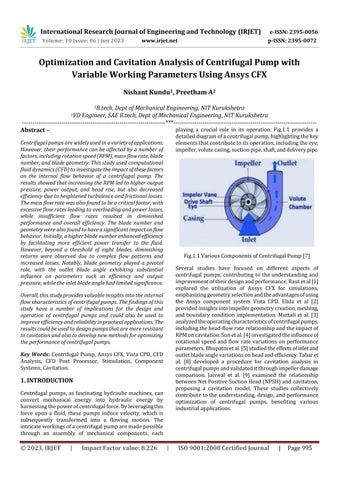
playing a crucial role in its operation. Fig.1.1 provides a detaileddiagramofacentrifugalpump,highlightingthekey elementsthatcontributetoitsoperation,includingtheeye, impeller,volutecasing,suctionpipe,shaft,anddeliverypipe.
Several studies have focused on different aspects of centrifugal pumps, contributing to the understanding and improvementoftheirdesignandperformance.Rautetal[1] explored the utilization of Ansys CFX for simulations, emphasizinggeometryselectionandtheadvantagesofusing the Ansys component system Vista CPD. Elida et al [2] providedinsightsintoimpellergeometrycreation,meshing, and boundary condition implementation. Muttali et al. [3] analyzedtheoperatingcharacteristicsofcentrifugalpumps, includingthehead-flowraterelationshipandtheimpactof RPMoncavitation.Sunetal.[4]investigatedtheinfluenceof rotational speed and flow rate variations on performance parameters.Bhupatnietal.[5]studiedtheeffectsofinletand outletbladeanglevariationsonheadandefficiency.Tabaret al. [8] developed a procedure for cavitation analysis in centrifugalpumpsandvalidateditthroughimpellerdamage comparison. Jaiswal et al. [9] examined the relationship betweenNetPositiveSuctionHead(NPSH)andcavitation, proposing a cavitation model. These studies collectively contributetothe understanding, design, and performance optimization of centrifugal pumps, benefiting various industrialapplications.

1.1 METHODOLOGY
In the study, several steps were followed to analyze a centrifugalpumpusingtheCFXsoftware.First,theVistaCPD componentsystem wasutilizedtocalculatethenecessary parameters and determine the shape of the blades and volute. The design of the impeller blade and volute was created using the Bladegen feature and Create Volute feature. The data obtained from Bladegen was then transferredtoTurbogridtogeneratethemesh,whichwas subsequentlytransferredtotheCFXSetup.Additionally,the mesh of the volute was also transferred to the CFX Setup. Figure1.2depictstheinterconnectionofvariouscomponent systemsofAnsysforthesetupofourstimulation.Figure1.3 showsthefinalgeometrycreatedandwhichisusedforour simulationwork.Toconductthesimulation,theShearStress TransportK-ωmodelwasemployed.

IntheCFXSetup,theTurbomodewasutilizedtoanalyzethe centrifugal pump, with appropriate fluid and boundary conditions specified for both the rotating and stationary domains. The solver controls were set to 500 iterations, achievingtherequiredconvergenceof1e-04.Thesolverwas initiated with double precision, and the results were subsequentlyanalyzedintheCFD post-processor.Various parameterssuchaspressure,velocity,andefficiencywere checked, along with the analysis of cavitation pressure pulsations,throughthe examinationof theircontoursand plots. These steps provided valuable insights into the performance and behavior of the centrifugal pump under differentoperatingconditions

2. MODEL SETUP AND GOVERNING EQUATIONS
A Laminar and Turbulent Flow
Ifflowstreamlinesareparalleltoeachotherthentheflow iscalledlaminaroneandifflowstreamlinescrosscuteach other then the flow is called turbulent flow. Osborne Reynoldsexperimentedandfoundaparameterwhosevalue helpsustounderstandtheflownature.Equation2.1shows Reynolds number(Re)
(2.1)
Where��isthedensityofthefluid,��istheviscosityofthe fluid, D isthediameterofthepipeand v isthevelocityof thefluid.IfReynoldsnumberislessthan2100flowis laminarandifitismorethan4000flowisturbulent.
B. N-S Equations
N-S stands for Navier Stokes Equations represented in equation 2.2. These equations account for Momentum conservation in viscous incompressible fluid flow. These Equations were established by French scientist Navier in 1821andBritishphysicistStokesin1845.Vectorformis:
(2.2)
Here is density, f is an external force on fluid per unit volume,pispressure, isvelocityvectorand��isdynamic viscosity.
C. Continuity Equation

Massconservation equation for incompressiblefluid flow. Where isrelativefluidvelocityvectorinequation2.3.

D. Turbulence Model
To describe turbulence, various models exist, such as the standardk–ε,renormalizationgroupk–ε,standardk–ω,SST k–ω,andReynoldsstressmodel.Insteadysimulations,the SSTk–ωturbulencemodelisusedincombinationwiththe incompressiblecontinuityequationandtheReynoldstime averagedNavier
Stokesequations.Additionally,theSAS-SST turbulence model is utilized in unsteady simulations to captureflowseparationsandvorticesmoreaccurately.
2.1 MESHING AND GRID INDEPENDENCE STUDY
Thegridindependencetestplaysacrucialroleinvalidating theaccuracyandreliabilityofasimulationmodel.Ithelps determinewhethertheresultsobtainedfromthesimulation areinfluencedbythesizeorresolutionofthegridused To conduct a grid independence test, simulations are run at multiple grid sizes or resolutions, and the results are compared.Theobjectiveistoidentifytheminimumgridsize orresolutionneededtoachieveaccurateresults.Inthiscase, after performing the grid independence test, a mesh consisting of 540,046 elements was selected. Figure 2.1 depicts the results of the test, showing that a mesh with approximately500,000elementsfallswithinthesufficiently convergingzone,validatingthecorrectnessofitsresults.Our chosenmesh,consistingof540,046elements,ismarkedbya verticallineandfallswithinthesafezone,ensuringreliable simulations.
andimplementationofboundaryconditionsarecrucialfor accurate and effective simulations, making them indispensableinmodelingandsimulationendeavors.Static Pressure inlet and mass flow outlet is selected here for stimulation purpose. The static pressure within a system typicallyremainsconstantatatmosphericpressure(1atm). However, the mass flow rate at the outlet of the system variesdependingonspecificconditions.Forinstance,ifthe volumeflowratediffers,thecorrespondingmassflowrate willalsodiffer.Here,theVolumeflowrateistakenas280 m3/h so for water mass flow rate comes out to be 77.78 kg/s.Atonceonlyoneparameterisalteredkeepingallother constantanditseffectisobservedonotherparameters.
2.3 VALIDATION STUDY
Validation studies are crucial in Computational Fluid Dynamics (CFD) simulations. They help establish the accuracyandreliabilityofsimulationresultsbycomparing them to experimental data or analytical solutions. To validate our model for a centrifugal pump, we compare operational characteristicslikeefficiencyand headversus flowratecurveswithresultsfromanotherresearcher,Table 2.1showsthesetupdetailsusedbyDr.Ramkrishnaet,al[6] sameinputsareusedheretoo.
Fig.2.1VariationofHeadwithMeshElements

2.2 BOUNDARY CONDITIONS
For designing pump geometry using Vista CPD few parametersareneeded,wehavetakenrotationalspeedas 1450rpm,volumeflowrateas280m3/h,densityas1000 kg/m3, head rise as 20 m and the rest of other settings as default. Boundaryconditionsarevitalinsimulationsacross multipledisciplines,ensuringaccurateandrealisticresults. Theseconditionsencompassfactorslikeinitialconditions, behaviorlimits,andexternalinfluences.Precisedefinition
Operatingcharacteristicsareplotsofpumpparameterssuch ashead,efficiency,etc.concerningflowrate.Thesecurves areprominentinunderstandingthefluidflowbehaviorin any fluid machinery. As visible in Fig.2.2 and 2.3 we get a goodcomparisonbetweentheresultsobtainedbyusandthe results obtained by Dr. Ramakrishna et al. [8] We can see thatsuccessisachievedingettingbothgoodaccuracyaswell asprecisionsowecangoforwardwithourresults.
3. RESULTS AND DISCUSSIONS
Table3.1depictsalistofinitialsetupdataforstimulationsin Ansys CFX. This data is utilized for generating our pump geometry using Vista CPD and then according to the necessaryalterationsaremadetoit.
A. Effect of Variation of RPM


WhentheRPMofapumpisincreasedwhilekeepingother factors constant, several things happen. The head, output pressure, power, and moment of the pump increase significantly. However, this increase in RPM also leads to higherturbulenceandfrictionlosses,resultinginadecrease inoverallefficiency.Figure3.1illustratesthechangesinthe head, output pressure, efficiency,and moment as the RPM increases. Increasing the RPM of a centrifugal pump can enhance flow rates and pressures, but it can also cause cavitation,greaterpowerconsumption,andincreasedwear andtearonthepumpcomponentssameasdepictedinFigure 3.1. The ideal RPM for a centrifugal pump depends on the specificapplicationandpumpdesign.Thefollowingcurves provide insights into how fluid flow is affected by the increaseinRPM.
RPM 1450
Head 32m
MassFlowRate 77.78kg/s

NumberofBlades 6
InletBladeAngle 13.98:
OutletBladeAngle 30:
VariationofdifferentparameterswithRPM
B. Effect of Variation of Blade Number
Anincreaseinthenumberofbladesinacentrifugalpumpcan haveanoticeableeffectonitsperformance.Generally,asthe blade number increases, the pump's efficiency tends to improveinitially.Thisisbecauseagreaternumberofblades caneffectivelycaptureandtransferfluidenergy.However, there is a point where adding more blades can lead to diminishing returns. Beyond a certain blade number, the efficiency may start to decrease due to factors such as increasedfrictionandflowdisturbancesFigure3.2showsa similar pattern. After reaching optimal blade number 8 factorslikeheadrise,outputpressure,andpoweroutputalso showedamilddecrease.Itisimportanttocarefullyconsider the optimal blade number based on specific requirements andoperatingconditionstoachievethedesiredperformance andmaximizethepump'sefficiency.
C. Effect of Variation of Mass flow rate


Theeffectofvaryingmassflowratesincentrifugalpumpsis significant and directly impacts their performance. As the mass flow rate increases, the pump experiences higher demandandneedstoworkhardertomaintainthedesired flow.Thisleadstoanincreaseintheenergyrequiredtodrive thepumpandmayresultinreducedefficiency.Additionally, highermassflowratescancauseincreasedturbulenceand higherfluidvelocitieswithinthepump,whichcanpotentially leadtoissuessuchascavitationandincreasedwearonthe pumpcomponents.Ontheotherhand,decreasingthemass flow rate below the pump's design point may lead to inefficientoperationandreducedperformance.Therefore,it iscrucial tocarefullyconsider andoptimize the massflow rate to ensure optimal pump performance, efficiency, and longevity. As visible in Fig.3.3, for our pump first on increasing mass flow rate a decrease is observed in the momentrequiredtoturntheblades,furtherthedecreasein headriseandoutputpressuresignifiesreducedperformance. As we increase the mass flow rate further, a simultaneous increaseinefficiencyisobserveditsignifiesthattheoptimal massflowrateforourpumpdesignisaround50lps(liters persecond)andweareheadingtowardshigherperformance levels.
Changesinbladeshape,suchascurvature,twist,andblade angle, can influence crucial factors like pump efficiency, pressurerise,andoveralloperatingcharacteristics Careful considerationandanalysisofbladegeometryareessentialto ensure optimal pump performance and maximize its effectiveness in various applications. A similar attempt is madeinfurthertwopartstofindouthowtheperformanceof ourpumpwillbeaffectedbychangingitsbladeorientation. ThebladeNumberisfixedat6foritandthevalueofblade anglesistakenfromtheresearchworkofBhuptaniet.al[5] Initially,theInletbladeangleistakenas13.48degandthe outletbladeangleistakenas28degandthenoneisvaried keepingtheotherconstant.
D.Effect of Variation of Inlet Blade Angle

The angle at which the fluid enters the impeller blades determineshowefficientlyitisguidedintotheimpeller.An optimalinletbladeangleensuressmoothanduniformflow, minimizinglossesduetoturbulenceandrecirculation.Ifthe inletbladeangleistoosteep,itcanleadtoexcessiveblockage andflowseparation,resultinginreducedpumpefficiencyand increased energy consumption On the other hand, if the angleistooshallow,itmaycauseinsufficientguidingofthe fluid,leadingtoinefficientutilizationoftheimpellerblades. HereitcanbeseeninFigure3.4thatastheinletbladeangle changedfrom26degto28degadecreaseisobservedinthe moment required to turn the blades signifies ease in fluid flow.Otherparametersarenotaffectedsignificantlywhich indicates that for our centrifugal pump design inlet blade geometryisnotasignificantfactor.
E.EffectofVariationofOutletBladeAngle


Anincreaseintheoutletbladeangletypicallyleadstohigher pressure output and improved pump efficiency. This is because a larger angle allows for better redirection and controlofthefluidflow,minimizingenergylosses.However, excessive angles can also cause problems such as flow separationand increased turbulence,leading to reducedp erformance.Conversely,adecreaseintheoutletbladeangle mayresultinlowerpressureoutputandreducedefficiency. The fluid may experience more resistance and friction, leadingtoenergylossesanddecreasedpumpperformance. Findingtheoptimaloutletbladeanglethatbalancespressure output,efficiency,andoverallpumpperformanceiscrucial.
Figure 3.5 indicates a mild rise in all parameters as Outlet BladeAngleriseswhichisthesameasexpectedandrequired.
3.1 CAVITATION ANALYSIS Cavitation Model
Cavitationoccurswhenthepressurefallsbelowthevapor pressurewhichcausestheformationofanairbubbleinthe pumpimpellerthatburstsandcauseserosionontheblade surface Investigatingcavitationbehavioraidsinimproving pump reliability and lifespan, ensuring smooth operation andreducingmaintenancecosts.Understandingthefactors thatcontributetocavitationoccurrencehelpsinidentifying and mitigating potential risks of failure and damage. The degree of cavitation is estimated in terms of Net Positive SuctionHead(NPSH)[9]&[10]asgiveninequation3.1:
Where Pi=Absolute Pressure at the inlet, vi = Absolute velocity at the inlet, Pv =Vapor pressure of fluid (3170 Pa, Vaporpressureofwaterat25:C)
Apart from it Rayleigh-Plesset equation as shown in equation3.2isusedforcalculatingtime-varyingcavitation bubbles of radius size 10-6 m (ANSYS CFX-Solver Theory Guide,2016)


Where RB is radius of cavitation bubble, σ is the surface tensioncoefficientbetweenliquidandvapor, isdensityof water. The volume fraction of 100% and 0% are used for waterandwatervaporrespectively.
Thesimulationanalysisincorporatesboundaryconditions thatspecifythemassflowrateattheinlet(35kg/s,initially) andthestaticpressureattheoutlet(250000Pa,Initially).In thisanalysis,theeffectsofvaryingthemassflowrateand staticpressureareinvestigated,byvaryingthemonebyone keeping other variables constant, and the corresponding results are thoroughly examined and discussed. By systematically altering these boundary conditions, a comprehensive understanding of their influence on the simulationresultsisobtained.
Figure3.6showsthecavitationphenomenononourimpeller bladeswherevolumewithVapourVolumeFractionismore than0.8isshowninredandthebladesareshowninGrey.
Figure3.7isofanactualimpellerdamagedduetocavitation andwecanseethat,theareasaffectedintheactualimpeller arethesameaswegotasaresultofourstimulation.
Variation of cavitation with mass flow rate


Highermassflowratesensureagreatersupplyoffluidtothe pump, reducing the chances of localized pressure drops belowthevaporpressureofthefluid.This,inturn,mitigates the risk of cavitation formation. On the other hand, lower mass flow rates can lead to reduced fluid availability, creating conditions conducive to cavitation. In such scenarios,thepumpmayexperiencesignificantdamageand performancedegradationduetocavitationeffects.Asvisible fromfigures3.8and3.9withanincreaseinmassflowrate, cavitation volume where vapour volume fraction is more than0.8decreasesbutthenbeginsincreasingagain.
Variation of Cavitation with Outlet Pressure

Cavitation can be initiated when the local pressure drops belowthefluid'svaporpressure,leadingtovaporbubbles forming Figure 3.11 depicts how a sharp decrease is observedincavitationvolumewithanincreaseinpressure from100000Pato500000Pa
Figure 3.11 depicts a sharp decrease in the percentage of volumeundercavitationasoutletpressureincreaseswhich isthereasonfortheincreaseinpressureatalocallevelthat preventedbubbleformationandultimatelycavitation.
4. CONCLUSIONS
Inthisresearchstudy,weconductednumericalsimulations toprovidea comprehensive understandingoftheinternal flow behavior of a centrifugal pump. Leveraging the powerful computational fluid dynamics (CFD) simulation software,AnsysCFX,weexploredtheimpactofvaryingRPM, massflowrate,bladenumber,andbladegeometryonpump performanceandgotfollowingresults


(1) Raising the RPM produced a higher output pressure, energy output, and head increase. However, this was accompaniedbyadropinefficiencycausedbyheightened turbulenceandfriction-relatedlosses.
(2)Toomuchmassflowratecausedanexcessiveamountof loadonblades,whichleadtopowerlossesanddecreasein efficiency. Conversely, inadequate flow led to poor performanceanddecreasedproductivity.
(3) We observed thatthenumberandgeometryof blades hadamajorimpactontheflowbehavior.Initially,increasing thenumberofbladesallowedforbetterpowertransferto thefluid,leadingtoenhancedefficiency.However,oncethe number of blades surpassed eight, the efficiency of the system decreased due to the complex flow patterns that causedadditionallosses.

(4) Blade geometry played a pivotal role, with the outlet bladeangleexhibitingsubstantialinfluenceonparameters suchasefficiencyandoutputpressure,whiletheinletblade anglehadlimitedsignificance.
(5) Ourresearchexaminedtheeffectsofvaryingmassflow rateandoutletpressureoncavitationwithinthecentrifugal pump.Increasingthemassflowrateinitiallydecreasedthe volumeundercavitation,butitsubsequentlybegantorise again.
(6) As for outlet pressure, a sharp decline in cavitation occurredoncethepressureexceeded100,000Pa,whichcan beattributedtolocalizedpressureincreasesthatimpeded bubbleformation.

Overall, this study provides valuable insights into the internal flow characteristics of centrifugal pumps, elucidatingtheroleofRPM,massflowrate,bladenumber, andbladegeometryintheirperformance.Byenhancingour understandingofpumpdesignandoperation,thesefindings contributetoimprovedefficiencyandreliabilityinpractical applications.
5. ACKNOWLEDGEMENT
IwouldliketoexpressmyheartfeltgratitudetoDr.Rajesh Kumar,mymentor,forhisinvaluableguidanceandsupport throughoutthisresearch.Hisexpertise,encouragementand insightful inputs have been instrumental in shaping this
studyandexpandingmyknowledgeinthefieldofcentrifugal pumps.Iamtrulygratefulforhispatience,dedication,and mentorship. I would also like to sincerely thank my colleague,PreethamA.,forhiscollaborationandassistance during this research endeavor. His contributions, discussions,andsharedexperienceshavebeenimmensely beneficialinenhancingthequalityanddepthofthiswork.
Furthermore, we would like to acknowledge the online resourcesthathaveplayedasignificantroleinthisresearch likeChatGPT,YouTube,GoogleScholar,Edxetc
Lastly,wewouldliketoexpressourgratitudetomycollege, NIT Kurukshetra, for providing us with the necessary resourcesandinfrastructuretocarryoutthisresearch.The academicenvironmentandopportunitiesforlearningand growth have been instrumental in our development as a researcher.
6. REFERENCES
[1] Prathamesh Raut , Rohit Rathod , Rohit Tidke , Niraj Rathod,SanchiteeRokadeand Prof.NishantKulkarni “Design and CFD Analysis of Centrifugal Pump” InternationalJournalforResearchinAppliedScience& EngineeringTechnology,Volume10IssueXIIDec2022
[2] FarahElidaSelamatandWanHarizIskandarWanIzhan “DesignandAnalysisofCentrifugalPumpImpellerfor Performance Enhancement” Journal of Mechanical EngineeringVolSI5(2),36-53,2018
[3] Raghavendra S.Muttalli,Shweta Agrawal and Harshla Warudkar“CFDSimulationofCentrifugalPumpImpeller Using ANSYS-CFX” International Journal of Innovative ResearchinScience,Engineering,andTechnology,Vol. 3,Issue8,August2014
[4] Tianyu Sun, Renkun Wang and Zihao Zeng “Investigations of Rotational Speed and Flow Rate on Centrifugal Pump Performance Using CFD” IEEE 13th InternationalConferenceonMechanicalandIntelligent ManufacturingTechnologies2022
[5] Amith.Bhuptani, Prof.RaviK.Pateland K.M.Bhuptani “DesignandAnalysisofCentrifugalPump”
[6] R. Ramakrishna, S. Hemalatha and D. Srinivasa Rao “Analysis and performance of centrifugal pump impeller” Materials Today: Proceedings 50 (2022) 2467–2473
[7] https://mechanicalnotes.com/wpcontent/uploads/2020/03/Centrifugal_Pump-1.jpg
[8] NavidShervani-Tabar,RezaSedaaghi,RezaMohajerin, Mohammad T. Shervani-Tabar, and Raed I. Bourisli “ExperimentalandComputationalInvestigationonthe
Cavitation Phenomenon in a Centrifugal Pump” ProceedingsoftheEighthInternationalSymposiumon Cavitation(CAV2012)
[9] A. K. Jaiswal, A. U. Rehman, A. R. Paul, and A. Jain “DetectionofCavitationthroughAcousticGenerationin Centrifugal Pump Impeller” Journal of Applied Fluid Mechanics,Vol.12,No.4,pp.1103-1113,2019
[10] Ahmed Ramadhan AL-OBAIDI “Experimental Comparative Investigations to Evaluate Cavitation Conditions within a Centrifugals Pump Based on VibrationandAcousticAnalysesTechniques”Archives ofAcoustics–Volume45,Number3,2020
[11] https://blogs.heattransfersales.com/blog/pumpcavitation
7. BIOGRAPHIES
NishantKundu MechanicalEngineer Researchenthusiast

PreethamA MechanicalEngineer VD&VIengineer@TeamNitrox CEO&Founder@DAMN Codingenthusiast
