Saline Level Indicator for Hospitals using IoT
Kush Manish Sethia1 , Hardik Amit Karnad2, Mayur Gosavi31Member, Young Engineer’s Club, Science Kidz Educare, Mumbai, Maharashtra, India
2Member, Young Engineer’s Club, Science Kidz Educare, Mumbai, Maharashtra, India
3Mentor, Young Engineer’s Club, Science Kidz Educare, Mumbai, Maharashtra, India ***
Abstract - Problem: Mistakes in the ordering of IV fluids and electrolytes are particularly common in emergency departments, acute admission units, and general medical and surgical wards. When the solution's glucose concentration is higher/lower than usual or air pockets form inside the saline, patients experience severe agony
Proof: Infusions of either too much or too little fluid led to the demise of a considerable number of hospitalized patients, according to the 1999 report from the National Confidential Inquiry into Perioperative Mortality. Referencing the paper, fluid prescriptions need to have the same legal standing as prescriptions for medications. It's likely that up to 1 in 5 patients getting IV fluids and electrolytes can experience difficulty or morbidity as a result of inappropriate dose Improper fluid therapy management is identified as one of the main cause of unnecessary patient harm. Patients may feel distress and experience handswelling
Solution: We present a contemporaneous solution for this intravenous therapy (IV) related dilemma which many patients are facing. This project would prevent such pain by immediately alerting the nurses available to replace the saline without the patient going through any uneasiness This would be achieved by the assist of the technology called IoT (Internet of Things) which will allow us to reachour objective.

Key Words: IV fluids, saline, improper fluid therapy management, intravenous therapy (IV), IoT (Internet of Things)

1 INTRODUCTION
In recent years, ensuring optimal patient care and minimizing discomfort have become central objectives within the healthcare system. One crucial aspect of patient care is the administration of intravenous (IV) fluids, which is a common practice in hospitals for maintaining hydration, delivering medications, and providing essential nutrients. However, complications and unnecessary discomfort can arise from unfitting fluid treatment, such as the presence of air bubbles or variations in glucose concentration within the IV fluid. These issues can result in severe distress for patients and potentially compromise their well-being. Therefore, it is essential to explore innovative strategies and
technologies that can mitigate these risks and enhance the safety and efficiency of IV fluid administration. This project aims to address these challenges by taking advantage of the Internet of Things (IoT) technology to develop a saline level indicator that detects bubbles, monitors fluid volume, and ensures appropriate glucose concentration. By integrating IoT (Internet of Things) technology into the healthcare setting, we can improve patient comfort, reduce suffering, and optimize patient care, ultimately leading to better outcomes and a more patient-centricapproachtoIVfluidmanagement
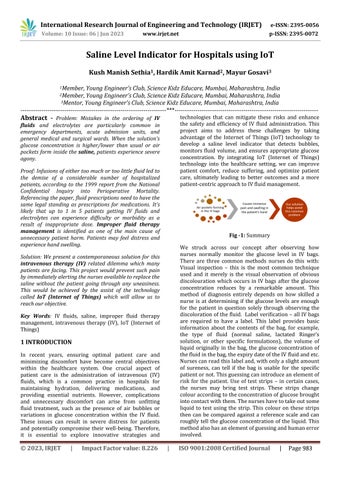
We struck across our concept after observing how nurses normally monitor the glucose level in IV bags. There are three common methods nurses do this with: Visual inspection – this is the most common technique used and it merely is the visual observation of obvious discolouration which occurs in IV bags after the glucose concentration reduces by a remarkable amount This method of diagnosis entirely depends on how skilled a nurse is at determining if the glucose levels are enough for the patient in question solely through observing the discolorationofthefluid. Labelverification–allIVbags are required to have a label. This label provides basic information about the contents of the bag, for example, the type of fluid (normal saline, lactated Ringer’s solution, or other specific formulations), the volume of liquid originally in the bag, the glucose concentration of thefluidinthebag,theexpirydateoftheIVfluidandetc. Nursescanreadthislabeland,withonlyaslightamount of sureness, can tell if the bag is usable for the specific patientornot.Thisguessingcanintroduceanelementof risk for the patient. Use of test strips – in certain cases, the nurses may bring test strips. These strips change colouraccordingtotheconcentrationofglucosebrought intocontactwiththem.Thenurseshavetotakeoutsome liquid to test using the strip. This colour on these strips then can be compared against a reference scale and can roughly tell the glucose concentration of the liquid. This methodalsohasanelementofguessingandhumanerror involved.
1.1 Objective
Comfort and alleviation of pain for individuals, particularly those who are in hospital beds, are the primary concerns in healthcare. Safe intravenous (IV) fluidadministrationisanessentialcomponentofpatient care. Additionally, we aim to create a scalable and straightforward-to-usesolution that can be effortlessly integrated into the infrastructure presently in place at the hospital. Our goal is to make sure that hospitals can quickly deploy our saline level indicator utilizing IoT (internet of things) technology without substantial interruption or additional resource needs by taking into accountvariableslikeprice,easeofimplementation,and compatibility with current systems. By carefully monitoring and controlling the infusion of IV fluids, this approach will enable medical professionals to increase patient comfort and significantly reduce unwantedpain, eventually improving patient outcomes and making the bestuseofhospitalresources.

1.2 Intravenous therapy
A medical procedure that injects nutrition, medicines, andfluidsstraight intoa patient's vein. The intravenous methodofadministrationiswidelyusedtorehydrateor feed persons with nutrients who, for various reasons, suchasimpairedmentalability,cannotordonotwishto consume food or water orally. It may also be used to administer medication or other forms of medical therapy, such as blood products or electrolytes, to correct electrolyte imbalances. One bag of IV may last from 30 minutes or to several hours depending on the particular treatment the patient is going through. Therefore,itplaysavitalroleineachandeverypatient’s treatment and bedrest in the hospital. Disturbances causedwithinIVmayturnouttobefatalinthelongrun.
2.1 Operation
Anoveltechnologyutilizedbynurseson-dutyisasmart device that facilitates the prompt reporting of the need for a saline change, thereby reducing communication errors amongst hospital nurses and minimizing patient discomfort. The device acts as a mechanism for alerting the relevant personnel in a timely fashion, allowing for the swift implementation of necessary measures. This innovation leads to improved patient outcomes and satisfaction,aswellasincreasedefficiency.
2.2 Our idea
A moisture sensor ortwo strips of immaculate andconducting metals can be connected to the inside walls of the saline bag and will be interconnected from the outside. We will be able to identify a number of changesintheIVbagthankstothesesensors/devices

Lowglucoseconcentrations–Whentheconcentrationof glucose in a liquid is low, it causes the liquid to become an electrical insulator, which impedes the flow of electricity between two metal strips and indicates a low glucose concentration. This occurs because glucose is a conductor of electricity, and its absence in the liquid hinderstheconductionofanelectricalcharge.
Bubbles formingin thesaline- Air bubbles tendto form in the inner margins of saline containers. These bubbles can lead to the interruption of the circuit that runs between two metal strips. The moment an air bubble comes into contact with one of the metal strips, the circuit is immediately interrupted, signalling the presenceofairbubblesinthecontainer.
Low level of fluid – Air can be drawn into the patient's vein as the intravenous (IV) fluid level drops, with symptoms that are similar to the effects of air bubbles.
Some points onthe metal strips will come out of touch with the glucose when the liquid level drops by a particular amount (which is usually 70 ml). This canbe easilydetectedsinceachargewillnotpassbetweenboth spotsonthestripasaresult.
2.3 Alerting the nurses
Using a microcontroller, the signals produced by the sensor/device can be effortlessly detected. The signals will be analyzed using an ESP32 microcontroller, and if the microchip senses a potentially injurious signal, a heads-up notification will be delivered to all the attending nurses' smart devices. This will be accomplishedbythemicrocontrollertakingadvantageof IoT (Internet of Things) technology which is inbuilt on the ESP32 board. The same platform willbe utilized for transmitting a message indicating that the problem has been addressed when a nurse has reached out to the patientandchangedtheIVbag.

The conductivity of the saline solution can be measured using a manual moisture sensor. Two exposed conductivemetalplatesonthesensorserveasavariable resistor whose resistance changes in response to the IV level. The conductivity of the liquid improves with IV fluid’s concentration, lowering resistance as a result. Higher resistance results from weaker conductivity, which occurs when there is less saline in the bag. According to this resistance, the sensor generates an output voltage that may be tested to ascertain the moisture level. A microcontroller can read this output voltageandutiliseittosignalotherdevices.
3 COMPONENTS
3.1 Microcontroller

The primary processing and controlling component of a system is a microcontroller. All of the input and output devicesareinterfacedtothemicrocontroller'sinputand output (I/O) pins, and the executable program is stored in the microcontroller's memory. The project's microcontroller is an ESP32 IoT board which is capable to connect to the internet leveraging the integrated IoT (internetofThings)technology.Thecontrollerfeaturesa 32-bit processing unit, 48 connectable on-board pins, andupto4MBofmemoryforstoringcode Withtheaid of this board, we will be able to connect to the internet and communicate throughout the hospital. The internet will be used to connect all of the equipment in the building, including our ESP32 board. The board will be able to contact nurses, even if the nearest nurse is presentonthenextstoreyofthehospital

3.3 Internet enabled smart device
The internet works with the help of clients and servers. Asitisnotdirectlylinkedtotheinternet,a devicelikea tablet is referred to as a client. However, it is indirectly connected to the internet through an Internet Service Provider(ISP)andisidentifiedbyanIPaddress,whichis a string of numbers. The ESP32 board, with the help of IoT (Internet of Things) technology, will be able to contact this device using a platform called Blynk. This online tool will provide a single location to view the statusofIVbagsacrossseveralbedsaroundthehospital.
Allhospitalstaffmemberswithinternet enableddevices willreceivealerts,alongwithnurseswhowillreportany incidentstotherespectivepatient’sbed
[2] https://www.ncbi.nlm.nih.gov/books/NBK554180
[3]
https://n.neurology.org/content/neurology/67/2/203.f ull.pdf
[4]
Intravenoustherapy-Wikipedia
BIOGRAPHIES
Kush Manish Sethia
Young innovator and robotics enthusiast. Exhibits interest in developing projects that will benefit humanity and theenvironment.
Hardik Amit Karnad


A young and aspiring engineer. Specially takes Interest in hardware aspects for complex and handydesigns.
Mayur Gosavi Mentor and specialist in hardwareandelectronics.
4 CONCLUSION
The target of our project is to reduce the number of unnecessary suffering patients in hospitals. This will allow hospitals to work more efficiently and more beds will be free faster. Our device/project aims to be as efficientandeasytoadaptasitcanbe,weareachieving this by: using easily adaptable methods, connecting our microcontrollerwiththemostcommonelectronicdevice everyone owns (a common smartphone with internet capabilities), solving a problem that seems to be irrelevant but has caused more suffering than any other silly-tinyproblem,andmanymore.
4.1 Future enhancements
In the second stage of the initiative, we want to get in touchwithasmanyhospitalsaswecanandintegrateour technologiesintoasmanyofthehospitalsaswecan.Our strategyisnotonlyeasytouseandeffective,butitisalso inexpensive and simple to modify to fit any hospital, no matterhowbigorsmall.
REFERENCES
[1]
https://oa.mg/work/10.7748/ns2014.02.28.23.19.s25?
utm_source=extension